
What Is Source-to-Pay? A Guide for Procurement Teams

Overview
Source-to-pay is procurement, all of it, from finding the right supplier to paying them. This guide breaks down what S2P actually means, why businesses that connect the whole process get better results than those who don't, and how to build something that works.
Nobody Plans to Have a Broken Procurement Process!
It doesn't start that way; it grows.
Sourcing finds a supplier. Legal writes the contract. Procurement raises the orders, and finance handles the invoices. And somehow, none of these teams is talking to each other in any consistent way.
So what happens? Someone negotiates a solid deal with a manufacturer. Three months later, a different team orders the same product from a different supplier at a higher price because no one told them the contract existed.
And at the end of the day, invoices come in that don't match the purchase orders because the POs were raised against different specs. An audit question arrives, and it takes four days to answer something that should take five minutes.
This isn’t unusual. Deloitte reports that 65% of procurement leaders have limited or no visibility beyond their tier-1 suppliers. That’s a lot of decisions being made in the dark.
Source-to-Pay (S2P) is the answer. Not a specific piece of software, not a department, but it's a way of running the whole procurement process as one connected thing, from the first conversation about a supplier to the moment that supplier gets paid.
When it works, your sourcing decisions directly govern what gets purchased. What gets purchased flows directly into the finance department. And the data from every transaction feeds back into better sourcing decisions next time. That's the loop. That's what makes it worth building.
So What Does Source-to-Pay Actually Mean?
Source-to-Pay (S2P) is the full procurement cycle. It starts when you identify a need and ends when the supplier is paid. Everything in between is part of it.
The "source" half is the strategic work that happens before any order is placed: finding suppliers, evaluating them, running RFI, RFP, and RFQ processes to compare options, negotiating contract terms, and agreeing on quality standards and pricing. These are the decisions that determine who you buy from and at what cost. They're made once, at the start of a relationship, and they affect every transaction that follows.
The "pay" half is the operational work. Purchase orders. Goods receipt. Invoice checking. Payment. All of it.
The whole point is that these two halves run together. Most businesses treat them as separate. The sourcing team does their thing. Procurement does theirs. Finance does theirs. And gaps open up between each handoff. S2P closes those gaps by making all of it one connected process.
If you want to go deeper into how the purchasing and payment side works specifically, our procure-to-pay guide covers that in detail.
S2P, P2P, S2C: What's Actually Different?
These three come up together constantly. And they get mixed up constantly. Here's the clear version.
| Term | What It Covers | Starts and Ends Where? |
|---|---|---|
| Source-to-Pay (S2P) | The complete picture: supplier discovery, evaluation, contracts, purchasing, invoicing, and payment, all in one connected process | Starts with a need. Ends when the supplier is paid. |
| Procure-to-Pay (P2P) | The operational execution layer only. Assumes the sourcing and contracting work is already done. | Starts with a purchase requisition. Ends when the invoice is paid. |
| Source-to-Contract (S2C) | The upstream sourcing work only: finding, evaluating, and contracting with suppliers. Stops before any orders are placed. | Starts with spend analysis. Ends when a contract is signed. |
The simplest version: S2P is the whole thing. S2C is the front half. P2P is the back half. Most businesses already have some version of P2P. What they're usually missing is the strategic sourcing layer at the front, the decisions about who to buy from and why, before any order is ever raised. That's what S2P adds.
How the Source-to-Pay Process Actually Works
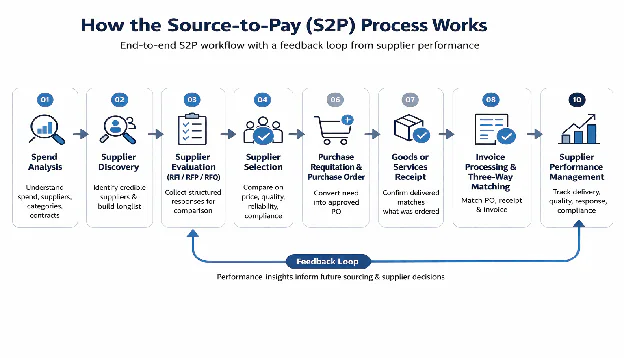
S2P is a sequence of connected stages. Each one feeds into the next. Here's what each stage involves and where things tend to go wrong.
Spend analysis
Before you can improve anything, you need to understand what you're actually spending. Spend analysis tells you who you're buying from, what you're paying, how that spend is distributed across categories, and where your current contracts actually are.
Most businesses that do this for the first time find things they weren't expecting: duplicate suppliers, spending happening outside agreed contracts, and categories where pricing hasn't been tested in years.
This is the intelligence that makes everything else smarter. Skip it, and you're making sourcing decisions without knowing what you're already doing.
Supplier discovery and identification
Once you know what you need and where the gaps are, you start finding the right suppliers. This means market research, supplier discovery, and building a longlist worth evaluating. In global sourcing contexts, buying from manufacturers in Asia, Eastern Europe, or other markets, this stage is where the most groundwork gets done.
Working across international markets adds complexity at this stage. Identifying credible manufacturers, understanding local compliance requirements, and qualifying suppliers across time zones and language barriers takes specific knowledge and capability. Our global sourcing guide covers how this works in practice.
Supplier evaluation, RFI, RFP, RFQ
Now you narrow the field. You send structured documents to potential suppliers: a Request for Information to gather facts, a Request for Proposal to ask how they'd approach your project, or a Request for Quotation to get pricing against a defined specification.
The goal is comparable data. Not presentations. Not feelings. Structured responses that let you evaluate suppliers against the same criteria and make a decision you can defend.
There's a right way to run an RFQ process and a wrong way. The ChinaSource RFQ guide provides practical details on the quotation stage.
Supplier selection
You review the evaluation responses, check references, assess financial health, and choose the supplier that best fits your requirements. Not just on price. On quality, reliability, compliance, and how they'll perform over the life of the relationship.
This is also where vendor scorecards become valuable, structured tools that let you compare suppliers against the same criteria rather than making judgment calls that are hard to explain later.
Our vendor scorecard guide walks through how to build one that actually works for this kind of decision.
Contract negotiation and management
You've chosen your supplier. Now you formalize the terms, pricing, payment schedule, delivery requirements, quality standards, and what happens if something goes wrong. The contract is where all of that becomes binding.
And then the management part begins. Most businesses negotiate a contract, file it, and then forget about it until something breaks. Renewal dates pass unnoticed. Suppliers drift from agreed terms. Volume commitments aren't tracked. This is where a large amount of negotiated savings quietly leaks away over time.
Good S2P treats contract management as a live, ongoing activity. Not a filing exercise.
Purchase requisitions and purchase orders
With a contract in place, purchasing begins. Someone within the business identifies a need, raises an internal purchase requisition, gets it approved, and procurement converts it into a purchase order sent to the supplier. The PO is the legal commitment, quantity, price, and delivery terms, all confirmed in writing.
This is where S2P and P2P overlap. Everything from here is the operational execution of the agreements made upstream in the sourcing stage.
Goods or services receipt
The supplier delivers. Your team checks what arrived against what was ordered, right quantity, right specification, right condition. This gets recorded. And it becomes one of the three documents you need for the matching process that protects you against incorrect invoices.
Invoice processing and three-way matching
The supplier sends an invoice. Finance checks it against the purchase order and the goods receipt note. All three need to agree. If they do, payment goes ahead. If they don't, the discrepancy gets resolved first.
This is three-way matching. It sounds procedural. It is. But it's also one of the most important controls in the whole process, the thing that catches overpayments, duplicate payments, and fraud before money leaves your account.
Payment
Payment is processed in line with the agreed terms. The transaction is recorded. Done well, this step is unremarkable. That's the goal. When payment causes problems, it's almost always because something earlier in the process wasn't handled properly.
Supplier performance management
The cycle doesn't end at payment. You track how the supplier performs against the contract terms, delivery reliability, quality consistency, responsiveness, and compliance with agreed standards. This data feeds back into your next sourcing decision. Do you renew? Renegotiate? Start looking for an alternative?
This loop, from performance data back to sourcing decisions, is what makes S2P a system rather than just a list of things to do.
Why S2P Delivers More Than P2P Alone
This is worth saying directly. A lot of businesses think they're doing S2P when they're really just doing P2P with a sourcing spreadsheet attached.
P2P manages the transaction. You have a supplier. You have a contract. You're buying something, receiving it, and paying for it. P2P handles that, and it handles it well when the process is properly set up.
But P2P starts after the most important decisions have already been made. Who did we choose to buy from? What price did we agree on? What quality standards are in the contract? Those decisions, made once, at the start of a supplier relationship, shape every transaction that follows.
When businesses skip the sourcing layer and jump straight to P2P, they end up managing transactions with suppliers they never properly evaluated, at prices they never benchmarked, under contracts they never properly negotiated. The purchasing process might look clean. The foundation it's sitting on isn't.
That's why the savings from proper S2P consistently outperform P2P alone. It's not just processing efficiency. It's the commercial value of better sourcing decisions flowing through every transaction the system manages.
Companies running integrated S2P report 30% savings on vendor spend through better visibility and data-driven negotiations, according to Gartner. Procurement cycle times typically run 30 to 50% faster when sourcing, purchasing, and payment all connect.
That's a real gap. And it comes from connecting the front half of the process to the back half.
S2P When You're Buying Globally
For businesses that source internationally, working with factories in China, Vietnam, India, Eastern Europe, or other manufacturing markets, S2P matters even more than it does for domestic procurement.
Why? Because the gap between a sourcing decision and a production order is much wider. There's more distance between the agreement and the delivery. More variables that can go wrong between the contract and the container ship. And when things do go wrong, they're harder and slower to resolve.
A supplier relationship in a foreign market needs to be built on solid ground from the start. That means proper qualification before the first order, a real contract that can be enforced, clear quality standards that are documented and monitored, and pricing that's been checked against the market rather than accepted at face value.
Sometimes businesses use a sourcing agent to navigate this, someone with local market knowledge who can identify credible suppliers and handle the initial evaluation before any formal procurement process begins. It's a reasonable starting point for businesses new to a market.
Contract manufacturing is one area where the sourcing decisions upfront are especially consequential. The factory you choose, the terms you agree to, and the quality controls you put in place shape the entire production relationship. Our contract manufacturing guide covers what to get right at this stage.
Where ChinaSource Fits in the S2P Process
ChinaSource works in the sourcing stage, the front half of S2P.
When a business needs to find and evaluate qualified suppliers in global manufacturing markets, the platform handles the initial outreach and data collection.
AI agents contact suppliers across multiple regions simultaneously, gather standardized responses, and compile the comparison data your team needs to make a confident sourcing decision.
No back-and-forth across time zones. No chasing suppliers who don't respond. The information comes back in a format you can actually compare.
That upstream work matters more than it's usually given credit for. The supplier you choose, the price you agree on, and the quality standards you set in the sourcing stage flow through every purchase order and invoice that follows. Better sourcing decisions produce cleaner P2P cycles. The two aren't separate problems.
If you're building an S2P process and want to understand how to approach the sourcing strategy specifically, the ChinaSource procurement strategy guide covers how supplier selection and sourcing fit into the broader procurement picture.
What You Actually Get When S2P Works
Better prices, before the first order
Structured supplier evaluation and real negotiation, both part of the sourcing stage, produce better commercial terms than informal conversations with existing suppliers. When you're comparing five qualified suppliers against the same criteria, you're negotiating from a position of knowledge. That's different from accepting whatever your current supplier proposes at renewal time.
Visibility into what you're actually spending
When sourcing, purchasing, and payments all flow through one connected process, you can see in real time what you're spending, with whom, against which contracts, and against which budgets.
That sounds basic. But nearly 40% of organizations don't have it. When you don't, you're making procurement decisions based on partial information, and the mistakes that are produced compound quietly over time.
Faster decisions and shorter cycles
When sourcing decisions flow directly into purchasing without manual handoffs, and when invoice matching is automated rather than done manually for every transaction, the process moves faster.
Research shows 30 to 50% faster procurement cycle times in organizations running connected S2P processes. For businesses where purchasing speed affects production timelines, that matters commercially.
Better compliance and less fraud
Every step of S2P is documented. Approvals are enforced. Contract terms are visible at the point of purchase. Invoices are matched before payment.
This makes it significantly harder for off-contract spending to happen quietly, for fraudulent invoices to get approved, or for suppliers to charge more than was agreed.
Deloitte found that companies using integrated procurement systems are 2.5 times more likely to maintain continuous compliance across their supplier networks.
Supplier relationships that actually hold
Suppliers who are properly onboarded, who receive accurate purchase orders, and who get paid on time are suppliers who want to keep working with you. That reliability gives you commercial leverage, better pricing, better priority when supply is tight, and more flexibility when you need it.
The Challenges That Come Up Most Often
Sourcing and purchasing still don't talk to each other
This is the most common problem. The sourcing team negotiates a contract. The purchasing team doesn't know it exists and buys elsewhere at a higher price. S2P only works if both halves of the process are actually connected, in the same system, with the same data.
Supplier data is a mess
Wrong bank details, outdated contacts, and missing compliance certificates. When supplier master data is poorly maintained, problems appear all the way through the P2P cycle, including payment failures, invoice disputes, and compliance gaps. Cleaning supplier data is unglamorous. Not cleaning it is expensive.
Contracts get filed and forgotten
Contracts are negotiated and signed, and then nobody monitors them. Renewal dates pass. Suppliers drift from agreed terms. Volume discounts that were supposed to kick in at certain thresholds never do. A significant proportion of the savings companies negotiate on paper never actually materialize because nobody is tracking performance against what was agreed.
Change management is underestimated.
S2P changes how people work in procurement, finance, and operations. If the rollout doesn't include real communication, real training, and genuine buy-in from the teams involved, adoption breaks down. And a half-used S2P process is worse than no process; it gives the appearance of control without the substance.
Trying to change everything at once
The businesses that implement S2P well almost always start small. One or two high-impact categories. A focused sourcing exercise. A pilot with one team. Prove it works. Measure the results. Then expand. The ones that try to overhaul everything simultaneously usually end up overwhelmed and revert to old habits.
How to Get Started
You don't need the perfect system before you begin. You need a clear starting point.
Start with spend analysis
Even a basic look at your purchasing data will surface things worth knowing. Which suppliers are you most dependent on? Which categories haven't been properly sourced in years? Where is spending happening outside approved contracts? This analysis tells you where to focus first.
Pick one category and do it properly
Choose a category where the savings opportunity is obvious and the current process is clearly not working. Run a real sourcing exercise. Evaluate suppliers properly. Negotiate an actual contract. Use that experience to build a repeatable template for the next category.
Clean up your supplier data before anything goes live
Verify bank details. Confirm contact information. Check compliance documents. Remove duplicates. It takes time. Most teams skip it. And then they wonder why payment failures happen and audit queries take days to answer.
Connect sourcing to purchasing
The contract you negotiate needs to be visible to the people placing orders. The supplier you selected needs to be the supplier in the purchasing system. This connection between upstream decisions and downstream transactions is the whole point. Without it, you have two separate processes that share some vocabulary but not much else.
Measure from the start
Set KPIs before you begin. Cycle time from sourcing to contract. Percentage of purchases made against negotiated contracts. Invoice match rate. Cost savings versus your baseline. These numbers tell you whether the process is actually working, and they build the business case for expanding it.
S2P KPIs Worth Tracking
| KPI | What It Measures | Why It Matters |
|---|---|---|
| Sourcing cycle time | Time from need identification to signed contract | Slow sourcing delays purchasing and production downstream |
| Contract compliance rate | Percentage of purchases made against negotiated contracts | Low rates mean negotiated savings aren't being captured |
| Supplier on-time delivery | Percentage of orders delivered on time and in spec | Direct measure of supplier performance against agreed terms |
| Invoice match rate | Percentage of invoices matched first time without exceptions | Low rates point to upstream problems in PO or receipt records |
| Cost savings vs. baseline | Savings achieved through better sourcing compared to previous pricing | The core commercial measure of whether S2P is delivering value |
| Maverick spend rate | Percentage of purchases made outside the approved process | High rates mean the connected process isn't being followed |
Source-to-Pay FAQ
What's the difference between S2P and P2P?
P2P handles the transaction side of procurement: purchase requests, purchase orders, goods receipt, invoices, and payment. It assumes the supplier is already chosen and the contract is already in place.
S2P includes all of that, plus the upstream work of finding suppliers, evaluating them, and negotiating the contracts that govern those transactions. P2P is a part of S2P. S2P is the bigger thing.
Do smaller businesses need S2P?
Not all of it. Not right away. Very small businesses can manage sourcing informally without significant risk. But once you're spending meaningful money with multiple suppliers, and especially if you're buying internationally, the sourcing decisions you make upfront start to have real commercial consequences. Even a basic version of S2P, focused on one or two categories, delivers real value at that point.
How is S2P different from strategic sourcing?
Strategic sourcing is the method you use in the sourcing stage of S2P. It's the approach, how you evaluate suppliers, how you negotiate, how you make better buying decisions. S2P is the end-to-end process that strategic sourcing feeds into.
Strategic sourcing produces the decisions; S2P is the system that connects those decisions to every purchase and payment that follows.
How long does it take to implement?
It depends on the scope. A focused pilot, one or two categories, one or two sourcing exercises, can show results in three to six months. A full S2P transformation across multiple categories and business units takes longer.
Sometimes a year or more. The businesses that make progress fastest start small, prove it works, and expand from there. The ones that try to change everything at once usually struggle.
What does S2P automation actually do?
Automation handles the parts of the process that are repetitive and rule-based, routing purchase requests for approval, matching invoices to purchase orders, flagging when a contract is coming up for renewal, and alerting when supplier performance drops below agreed thresholds.
What it doesn't replace is judgment. Which supplier to trust with a critical component? How to handle a relationship that's under strain. Those still need people.
Is S2P only for large companies?
No. It used to be that the tools were expensive and complex and built for enterprise. That's changed significantly. Mid-market businesses now run effective S2P processes without enterprise budgets or implementation teams.
The principles apply at any scale. Connect your sourcing decisions to your purchasing. Keep your supplier data clean. Use data to make better decisions. That's true whether you're processing 50 orders a month or 5,000.
One Last Thing
Source-to-Pay isn't a complicated idea. Buy from the right suppliers. Agree on the right terms. Execute the transactions cleanly. Pay on time. Track how suppliers perform. Use what you learn to make better decisions next time.
What makes it hard is that most businesses have been doing these things separately for years. Different teams. Different systems. Different data. Bringing them together takes time, takes honest change management, and takes a willingness to question how things have always worked.
But the value is real. Not theoretical. Businesses that run connected S2P processes consistently get better prices, better supplier relationships, better compliance, and better speed than those that don't. That advantage doesn't come from any one stage. It comes from all of them working together.
If you're building an S2P process and need support at the sourcing end, finding qualified suppliers in global manufacturing markets, running structured evaluations, and getting comparable data before any commitment is made, that's where ChinaSource helps. Take a look at how the platform supports procurement teams sourcing globally.