
Supplier Risk Management: What It Is, Why It Matters, and How to Build a Program That Works


In 2021, a single container ship got stuck in the Suez Canal for six days. Six days. And the ripple effects shut down supply chains across three continents, delayed billions in goods, and left procurement teams scrambling for answers they did not have.
Nobody planned for that. But the companies that recovered the fastest were not the lucky ones. They were the prepared ones.
That is what supplier risk management is really about. Not eliminating every possible problem, because you cannot, but building awareness and systems to respond faster when things go wrong. And today, things go wrong more often than any spreadsheet can predict.
This article covers what supplier risk management actually means, the specific types of risk your team needs to watch for, and how to put a real program in place that goes beyond a checklist sitting in a shared folder nobody opens.
What Is Supplier Risk Management?
Supplier risk management is the process of identifying, assessing, and monitoring risks that come from your suppliers and third-party providers. The goal is to catch problems before they reach your operations, your customers, or your finances, and to have a plan ready when they do anyway.
It sounds straightforward. In practice, it is one of the more complex things a procurement team manages, because supplier risk is not a single thing. It is financial, operational, geopolitical, reputational, and legal all at once, often in the same supplier.
The abbreviation SRM is used for supplier risk management, but be careful: the same letters are also used for supplier relationship management, which is a different discipline. Risk management is about protecting the business. Relationship management is about building productive partnerships. Both matter. They are not the same conversation.
Most procurement teams do some version of supplier risk management, even if they have not named it. Running credit checks on new vendors. Asking suppliers to fill out compliance questionnaires. Keeping a backup supplier on file for a critical component.
These are all risk management activities. The shift to a formal program is about making those activities consistent, proactive, and tracked rather than reactive and ad hoc.
Why Supplier Risk Management Is Getting More Attention

Supply chains used to be simpler. More local. More predictable. A factory in the same country, a delivery window measured in days rather than weeks, and a handful of suppliers you had worked with for years.
That world is mostly gone. Today's supply chains are global, multi-tiered, and deeply interconnected. A semiconductor shortage in Taiwan affects car production in Germany. A port strike in California backs up retail inventory for months. A factory fire in a Tier 2 supplier nobody had ever audited shuts down a product line for a brand that had no idea that factory existed.
The risks are bigger, and they are hiding further down the chain than most companies are equipped to see.
A 2022 study by Deloitte found that 44% of private sector companies still lack visibility beyond their Tier 2 suppliers. That means the majority of businesses are managing risk for the suppliers they can see while staying largely blind to everything underneath them.
There is also the cybersecurity dimension, which is growing fast. Suppliers who have access to your systems, your data, or your customer records are a risk vector that did not exist at scale twenty years ago. Procurement is increasingly being asked to evaluate not just delivery performance but also a supplier's digital security posture before any contract is signed.
Put all of this together, and it becomes clear why supplier risk management has moved from a back-office compliance task to something that shows up regularly in C-suite conversations. The stakes are simply too high to treat it as an afterthought.
The 8 Types of Supplier Risk You Need to Understand
Supplier risk is not one thing. It shows up in different forms, and each one requires a different kind of response. Here are the eight dimensions that a well-rounded risk program needs to cover.
| Risk Type | What It Means | Example |
|---|---|---|
| Geopolitical | Political instability or trade tensions disrupting supply | Tariff escalation is blocking imports from a key supplier country |
| Concentration | Over-reliance on a single supplier or region for critical inputs | One factory producing 90% of a component with no backup |
| Strategic | A supplier relationship that no longer serves business objectives | Supplier pivots to serve a larger competitor exclusively |
| Reputational | Supplier conduct that damages your brand by association | Labor violations discovered at a Tier 2 factory you source through |
| Compliance | Supplier fails to meet legal, regulatory, or standards requirements | Import rejection due to supplier non-compliance with product safety rules |
| Operational | The supplier cannot reliably deliver goods or services | Factory fire, equipment failure, or workforce shortage |
| Financial | Supplier becomes insolvent or financially distressed | Key vendor files for bankruptcy mid-contract |
| Contractual | Contract terms that leave the buyer exposed | No force majeure clause, no exit terms, no performance penalties |
The risk types do not operate in isolation. A geopolitical event can trigger a financial crisis at a supplier, which creates an operational disruption, which turns into a reputational problem if customers find out their orders are delayed. Risk cascades. That is why managing them in silos, only checking financial health, for example, while ignoring compliance, leaves real exposure on the table.
How Supplier Risk Management Actually Works
The theory is simple. The execution is where most programs fall apart. A functioning supplier risk management process has four stages, and all four have to work together.
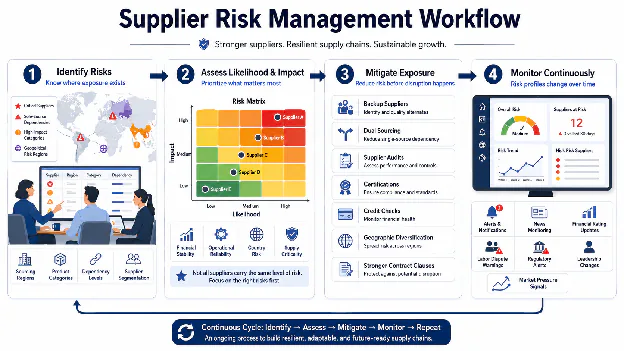
Step 1: Identify the Risks
Before you can manage anything, you need to know what you are dealing with. This means looking at your supplier base and asking honest questions.
Which suppliers are we most dependent on? Which product categories would cause the most damage if the supply were interrupted? Where are we sourcing from regions with geopolitical instability?
Not every supplier carries the same level of risk. A vendor supplying office furniture is not the same risk profile as one supplying a critical component that goes into your core product. The identification stage is about getting that picture clear.
Step 2: Assess the Likelihood and Impact
Once you have identified the risks, you need to triage them. The two questions that matter: how likely is this to happen, and how bad would it be if it did?
A supplier in a politically stable country with solid financials and a strong operational track record is at a different risk level than a sole-source supplier operating in a region with ongoing trade disputes and a balance sheet that makes your finance team nervous. Assessing both likelihood and impact lets you prioritize where to put your attention.
Step 3: Mitigate
This is where the real work happens. Mitigation strategies vary by risk type:
• For concentration risk: qualify backup suppliers and dual-source critical components
• For financial risk: run regular credit checks and monitor news about supplier stability
• For compliance risk: require certifications, conduct audits, and build compliance terms into contracts
• For geopolitical risk: diversify your supplier base geographically so no single region creates a single point of failure
• For contractual risk: work with legal to build proper exit clauses, performance standards, and force majeure provisions into every agreement
No mitigation strategy eliminates risk. The goal is to reduce exposure to a level your business can manage and to have a clear response ready when a risk event does occur.
Step 4: Monitor Continuously
Risk profiles change. A supplier that was financially healthy two years ago may be struggling today. A politically stable region can shift quickly. Monitoring means keeping an eye on your high-priority suppliers on an ongoing basis, not just at contract renewal.
This includes watching for changes in financial ratings, news about labor disputes or regulatory violations, leadership changes at key suppliers, and any signals in the market that a supplier's category is under pressure. The monitoring stage is what separates a risk management program from a risk assessment that sits in a drawer.
Supplier Segmentation: Not Every Vendor Needs the Same Level of Attention
One of the most practical decisions in supplier risk management is also one of the most obvious: you cannot monitor every supplier at the same depth. The resources are not there. The ROI is not there either.
The answer is segmentation. Sort your suppliers by the criticality of what they provide and the risk level they represent. A common approach is a simple matrix:
| Segment | Description | Monitoring Approach |
|---|---|---|
| Critical / High Risk | Sole-source or near-sole-source for essential inputs; high spend; difficult to replace | Active monitoring, quarterly reviews, regular audits, backup supplier required |
| Strategic / Moderate Risk | Important to operations but some alternatives exist; meaningful spend | Annual assessment, periodic check-ins, compliance confirmation |
| Tactical / Low Risk | Easily replaceable; low spend; low operational criticality | Baseline onboarding checks; monitor only if flagged |
This kind of segmentation lets your team focus the most intensive effort where it actually matters, without burning resources on suppliers whose disruption would be a minor inconvenience rather than a business crisis.
The Tier Visibility Problem
Most companies manage their Tier 1 suppliers reasonably well. They have contracts, performance metrics, and at least some visibility into how those suppliers are operating. The problems tend to start at Tier 2 and beyond.
Your Tier 1 supplier buys materials and components from their own set of suppliers. Those are your Tier 2. And Tier 2 suppliers have their own supply chains. A disruption at Tier 3 can cascade upward through the chain and land on your production floor before you even know the original problem existed.
The Suez Canal situation made this painfully visible. Many companies discovered mid-crisis that critical parts of their supply chain ran through regions or carriers they had never thought to map. The lesson was expensive.
Building Tier 2 visibility does not have to mean auditing every sub-supplier in your extended network. It starts with identifying which of your Tier 1 suppliers represent the highest risk and then asking those specific suppliers to disclose who they are buying from, where, and with what backup plans. Technology platforms can help automate parts of this, but the first step is simply knowing which relationships warrant a deeper look.
Where Supplier Risk Management Begins: The Sourcing Stage
Here is something that gets missed in a lot of supplier risk discussions. By the time a supplier is in your ERP system and producing purchase orders, most of the risk decisions have already been made. The real window for reducing risk is before you commit, during the sourcing and qualification stage.
A supplier you vetted properly before signing a contract is a fundamentally different risk profile than one you onboarded quickly because there was pressure to move fast. This is where due diligence on financial health, compliance history, production capacity, and geographic concentration pays the most dividends. After the contract is signed and the relationship is active, your options for managing risk narrow considerably.
This is the stage where a platform like ChinaSource works. Rather than inheriting risk from suppliers who were never properly evaluated, ChinaSource helps businesses identify and qualify manufacturers before any purchase orders are placed, checking capabilities, compliance, capacity, and fit before a commitment is made. That upstream work is what makes the downstream risk management job a lot more manageable.
ERP systems are excellent at managing existing supplier relationships. They track orders, payments, and performance data. But they were never designed to help you find and evaluate new suppliers. Treating your ERP as a sourcing tool is one of the more common mistakes in procurement, and it is the kind of mistake that shows up later as a supplier risk problem nobody saw coming.
Key Risk Indicators to Monitor Across Your Supplier Base
Knowing what to watch for is half the battle. These are the indicators that most often signal a supplier's risk profile is changing:
Financial Indicators
• Late payments to their own suppliers or creditors
• Declining credit ratings from agencies
• Significant changes in leadership, particularly at the CFO level
• Reduction in workforce or facility closures
• News about fundraising struggles or failure to meet financial covenants
Operational Indicators
• Slipping delivery performance or increasing lead times
• Quality reject rates trending upward
• Reduced responsiveness from their account team
• Reports of labor disputes, strikes, or high turnover
• Production capacity issues flagged in their own communications
Compliance and Reputational Indicators
• Regulatory investigations or fines in their industry
• Negative press related to labor practices, environmental violations, or fraud
• Failure to renew or maintain required certifications
• Changes in ownership that could affect compliance posture
You do not need to track all of these for every supplier. For your critical segment, you want ongoing visibility across all three categories. For lower-tier suppliers, a lighter annual review of the most relevant indicators is usually sufficient.
What Good Supplier Risk Management Looks Like in Practice
A mature supplier risk program has a few characteristics that separate it from a compliance checkbox exercise.
First, it is embedded in sourcing, not bolted on after the fact. Risk assessment happens before supplier selection, not after. Questions about financial health, geographic concentration, and compliance posture are part of the RFQ and qualification process, not a separate exercise that happens later.
Second, it is continuous. Risk is not static. A supplier who looked healthy on your last assessment might be in distress six months later. Programs that only review risk at contract renewal leave a lot of time unmonitored.
Third, it covers categories, not just individual suppliers. Some risk is inherent to what is being purchased, regardless of who is providing it.
Software that requires access to sensitive customer data carries a different risk profile than office supplies, regardless of the vendor. Starting with a category risk lens helps you prioritize which supplier relationships deserve the deepest scrutiny.
According to PwC research, cybersecurity is now consistently ranked as one of the top concerns for CEOs globally, and much of that risk enters through the supplier and third-party network. That is not a technology problem. It is a procurement and risk management problem.
Finally, it has a response plan. Identifying a risk without a plan for what to do when it materializes is not risk management. It is risk awareness. The difference matters when something actually goes wrong and decisions need to be made fast.
Frequently Asked Questions
How is supplier risk management different from supplier relationship management?
They share the same three letters but cover different ground. Supplier risk management is focused on protecting your business from negative outcomes, financial loss, operational disruption, reputational damage, or compliance exposure. Supplier relationship management is about building productive, collaborative partnerships that drive mutual value.
A well-run procurement function does both. But they require different conversations, different data, and different outcomes.
Do small businesses need a formal supplier risk management program?
Not necessarily a formal one with dedicated software and a risk committee. But every business that depends on external suppliers needs some version of the core practices:
knowing which suppliers are critical, having a backup plan for high-dependency relationships, and checking the financial and compliance health of suppliers before signing meaningful contracts.
The scale of the program should match the scale of the risk, but the underlying logic applies regardless of company size.
How often should supplier risk assessments be updated?
For critical suppliers, risk assessments should be reviewed at least annually and monitored on an ongoing basis for material changes.
For moderate-risk suppliers, annual reviews are typically sufficient. For low-risk or easily replaceable suppliers, a baseline check at onboarding and a review if something is flagged is usually enough. The cadence should match the risk level, not be applied uniformly across the board.
What is the difference between Tier 1 and Tier 2 supplier risk?
Tier 1 suppliers are the companies you have a direct relationship with. You have contracts with them, you receive invoices from them, and you can call someone when there is a problem.
Tier 2 suppliers are the companies your Tier 1 suppliers buy from. You generally have no direct relationship there, which means you have less visibility and less control.
Tier 2 risk is harder to manage but increasingly important to understand, especially for critical categories where a disruption further down the chain can cascade to your operations without warning.
Can supplier risk management prevent all supply chain disruptions?
No. And any program that claims it can should be looked at carefully. What a good risk management program does is reduce the likelihood of disruptions for risks that are controllable, and significantly reduce the response time and business impact for disruptions that happen anyway. The goal is resilience, not immunity. You cannot predict everything. You can absolutely be more prepared than your competitors.
Final Thoughts
Supplier risk management has moved from a procurement best practice to a business survival skill. The companies that treat it seriously, who build it into their sourcing process, maintain visibility across their supply base, and keep their response plans current, are the ones that recover faster when the next disruption hits.
And there will be another disruption. The question is whether your business sees it coming or finds out about it when a key shipment does not show up.
If your supply chain depends on finding and qualifying the right suppliers before any of this risk management work begins, that is where ChinaSource can help. Getting the sourcing stage right is the foundation on which everything else is built.
A supplier you vetted thoroughly before onboarding is a supplier you manage with confidence. Once you are onboarded, under pressure is a risk you carry for the life of the relationship.
Build the foundation first. The rest of the program follows from there.