
Supplier Relationships: How to Build, Manage, and Improve Them


Many teams often focus on prices, lead times, and negotiations, but real advantage can come from something simpler: building good relationships with suppliers. Many operational issues can be reduced when companies have strong supplier relationships.
You can argue that suppliers who feel valued are more likely to be responsive and proactive, and that building trust can reduce unwanted surprises and risks. As supply chains become more volatile, there is a place for long-term supplier relationships, as they can lead to better value than a regular transactional purchase.
This is where tools like ChinaSource come in. It helps teams structure the early stages of supplier interaction by clarifying requirements, managing supplier outreach, and organizing responses in a consistent format. This creates a clear starting point, so teams can select suppliers based on aligned data and start building stronger relationships from the beginning.
What is a Supplier Relationship?
A supplier relationship is the ongoing working connection that an organization has with its suppliers. It includes all interactions from the first contact through negotiations to ongoing communication for the purpose of delivering goods or solving problems. A good relationship with suppliers can influence pricing, product availability, quality, and delivery times.
Supplier relationships are critical because their benefits trickle down. If you get good prices, better quality, and faster delivery, you are better positioned to meet customer demands, which improves customer satisfaction, your brand’s reputation, and your financial performance. However, these relationships do not just happen; they require effort from both sides to make them work.
Common Types of Supplier Relationships
Supplier relationships can be grouped into five main types based on the intensity of the interaction between an organization and a supplier.
Arms-length
An arms-length relationship is mainly transactional. You find a supplier based on your current need and order from them, often with no guarantee of future orders. Both sides typically share minimal information, and the relationship is usually limited. The same supplier could be working with your competitors, so you will likely not get any competitive advantage from working with them.
Preferred Supplier
A preferred supplier relationship is an ongoing working relationship in which an organization selects a supplier as its primary choice. This typically develops after the supplier has proven reliability in quality, delivery, and communication. While still largely transactional, the relationship builds consistency and trust over time. The buyer prioritizes the supplier for repeat orders, and the supplier becomes more familiar with the buyer’s requirements and processes, making coordination easier.
Partnership
A partnership is a stronger level of supplier relationship between the parties, as the supplier is more committed to your business and may prioritize your requirements, investing more resources to support you.
Partnerships are long-term commitments, often formalized through contracts. Also, there’s greater information sharing, as the supplier needs as much information as possible to meet the organization's exact requirements.
Strategic Alliances
A strategic alliance is a long-term partnership where two or more companies work together to support each other’s goals. They may work together on new products, share resources, combine research efforts, or run joint marketing activities. Companies use strategic alliances when a supplier is critical to production, and switching would be difficult or risky. Both sides work closely to keep quality, timelines, and output consistent.
Supplier Relationship Types, When to Use Them, and Risks
Each relationship is useful for different scenarios and can create dependencies or other risks in supplier intelligence or procurement planning.
| Relationship Type | When to Use It | Risk Level |
|---|---|---|
| Arms-length | When you need flexibility and competitive pricing, and switching suppliers is easy | Low: Many alternative suppliers exist, so switching can be quick, and the impact is limited |
| Preferred Supplier | When a supplier has proven reliable over multiple orders, and you want consistency without strong collaboration | Medium: Some dependencies develop over time, and switching may require some effort. But alternatives are usually available |
| Partnership | When you rely on consistent quality and ongoing coordination with the supplier | Medium: Some dependencies build over time, so replacing the supplier takes effort and may affect quality or timelines |
| Strategic Alliance | When the supplier is critical to your product, growth, or innovation | High: Strong dependency on the supplier’s capabilities, making switching difficult and disruptive |
Can Supplier Relationships Evolve Over Time?
Yes, supplier relationships may not remain static and can become stronger over time as businesses' priorities change. For instance, an organization selects a supplier for a one-time order, which can lead to repeat orders and, over time, develop into a strategic alliance.
| Relationship Stage | Relationship Type | What Changes |
|---|---|---|
| Initial sourcing | Arms-length | You test multiple suppliers, focus on pricing and basic fit, and keep flexibility |
| Early collaboration | Partnership | You start working with selected suppliers, align on quality and processes, and build consistency |
| Critical dependency | Strategic Alliance | The supplier becomes important to your product or operations, with deeper collaboration and long-term commitment |
Many teams lose supplier information between sourcing, onboarding, and execution, leading to misalignment and recurring issues. Details confirmed early on are not always carried through, which makes it harder to manage suppliers consistently over time.
Building Strong Supplier Relationships
Strong supplier relationships are built through day-to-day practices such as clear communication, consistent expectations, and ongoing alignment. These are the behaviors that shape how you work with suppliers over time, regardless of the systems or processes in place.
Effective Communication To Build Trust
Manufacturers and suppliers need to be aligned on requirements from the start and use a single channel or system to record all updates, decisions, and changes. Companies also need to inform suppliers about changes in demand, timelines, or requirements as early as possible. Clear, consistent communication reduces risks and builds trust over time.
Give and Accept Feedback
Feedback remains an effective way to improve supplier relationships, as it enables the sharing of performance information. Engage with your supplier to identify how they can improve their products and services, and be open to receiving their feedback.
Pay Suppliers On Time
Late payments can strain supplier relationships, so it’s best to avoid them if possible. If your suppliers are paid on time, you benefit as they’ll be able to deliver goods or raw materials on time. You’re also more likely to access credit in the future from suppliers if you have a strong history of consistent payments.
Maintain an Open-Door Policy
Many procurement teams only communicate with suppliers when they’re facing problems. While this is acceptable in transactional relationships, communication needs to be more proactive if you want to build a stronger relationship. Ensure that suppliers can easily reach out with updates, issues, or questions, and that you are responsive when they do. Doing this creates a pattern of information sharing that builds trust over time.
Benefits of Building Strong Supplier Relationships
Strong supplier relationships do more than improve day-to-day operations. Good relationships can open the door to long-term value across cost, performance, and reliability in many ways, as follows:
- Offset Price Volatility: Many companies do not like dealing with price fluctuations, especially when many are beyond their control. If you have a good relationship with your supplier, you may be able to agree on stable, fixed pricing in exchange for long-term contracts or minimum-order commitments.
- Reduced Costs: Buying from new suppliers often comes with high initial costs. But if you have a good relationship with a supplier built over time with repeat orders, they may offer you incentives like discounts or reduced delivery costs.
- Risk Management: In strong relationships, buyers and suppliers exchange information often and can identify risks early. Doing this enables you to work together and find solutions to those risks before they become costly.
- Supply Chain Consolidation: When you work closely with a few reliable suppliers, you can align on processes like ordering, production, and delivery, which eases day-to-day operations. Instead of managing many suppliers, you focus on a smaller group, reduce coordination effort, and avoid the time and cost of onboarding new suppliers.
What Weak Supplier Relationships Lead To
While strong supplier relationships bring clear benefits, weak or poorly managed relationships can create serious operational and cost issues. Here are common ones.
- Quality Issues: When there's limited feedback and communication, quality problems are often discovered too late. This leads to defective products, rework, and delays. If there's a change in specifications and this is not clearly confirmed to the supplier, they can proceed with producing items that do not meet the new requirements.
- Higher Total Cost: Weak relationships often lead to short-term, reactive decisions. You may pay higher prices, miss out on volume discounts, and incur extra costs from urgent orders or excess inventory.
- Supply Chain Disruptions: When communication is inconsistent, suppliers don’t flag delays or issues early. This can lead to missed delivery dates, stockouts, or even production stoppages. For example, if a supplier is late with a critical component and doesn’t communicate the delay in advance, it can halt production and delay customer orders.
- Missed Innovation and Improvements: When the relationship is purely transactional, suppliers are less likely to suggest improvements, even if they see inefficiencies in your specs or processes. This limits both sides' opportunities to improve product design, reduce costs, or streamline processes over time.
Managing Supplier Relationships
Supplier Relationship Management (SRM) is a strategic approach to managing an organization’s interactions with vendors that supply goods and services. Beyond placing orders and paying invoices, it also includes evaluating them, measuring their performance, and working with them to identify challenges and solutions. Supplier relationship management comes into play after you have developed supplier relationships and need to maintain their structure.
An effective supplier relationship management strategy should aim to maximize value from each supplier relationship. Supplier management recognizes the role of different suppliers to your business, allowing you to adapt your strategies to suit each one. For instance, you can prioritize suppliers who are critical to your operations, while maintaining a basic cordial relationship with those that are less essential. So, how does supplier relationship management work in practice?
Supplier Relationship Management Flow
Supplier relationship management (SRM) comprises several components that work together to build and sustain effective supplier relationships. This process should consider factors such as:
- Spend.
- Criticality of goods or services.
- Partnership potential.
Here is a 6-step supplier relationship management process:
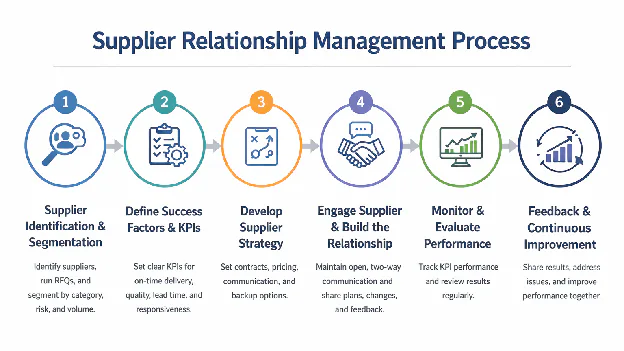
1. Supplier Identification and Segmentation
Start by identifying suppliers based on your business requirements and reach out to them with your request for quotations (RFQ). Once you start getting responses, segment them by category, quantity, risk, and volume. This helps you prioritize resources and determine the right way to manage each supplier or supplier group.
2. Define Success Factors and KPIs
Set clear KPIs based on what you expect from each supplier. For example, track on-time delivery, product quality, lead time consistency, and responsiveness. Make sure these metrics match the supplier’s role and what matters to your operations. This gives you a clear way to measure performance and address issues early.
3. Develop Supplier Strategy
Based on your segmentation and KPIs, decide how you will manage your relationship with each supplier group. This includes setting contract terms, pricing, communication methods, and deciding where to reduce dependency by adding backup suppliers.
4. Engage Supplier and Build The Relationship
This stage focuses on building a closer working relationship with suppliers. It involves open, regular, two-way communication. Suppliers share updates like price changes, delays, or shortages early, while you share information like order plans, changes in requirements, and feedback on their performance. This helps you plan ahead and keeps both sides aligned, so suppliers can better support your operations over time.
5. Monitor and Evaluate Supplier Performance
Track supplier performance against your KPIs regularly. Monitor metrics such as on-time delivery, quality, and lead-time consistency, and review results to identify issues early and areas for improvement. Use tools such as supplier scorecards to track KPIs for lead-time consistency and on-time delivery (OTD). Scorecards also provide performance insights that you can share with suppliers to improve performance.
6. Feedback and Continuous Improvement
Share performance results with suppliers and discuss what needs to improve. Work directly with suppliers to address performance issues and, where possible, improve results.
The SRM process is continuous. Insights from performance tracking feed back into earlier steps, so you can adjust your approach and improve supplier relationships over time.
The Role of Technology in Managing Supplier Relationships
Technology plays a key role in how companies build and maintain supplier relationships. It helps teams stay organized, communicate clearly, and make better decisions based on real data instead of guesswork.
At a basic level, digital tools replace scattered emails, spreadsheets, and manual tracking. Instead of chasing updates, teams can see supplier information, conversations, and performance data in one place. This makes it easier to manage multiple suppliers without losing visibility.
- Centralized Supplier Information: Technology enables you to store supplier details, contracts, pricing, and past interactions in a single system accessible to multiple teams. This ensures that everyone on the team works from the same data and can make decisions based on shared insights.
- Structured Communication: Technology helps standardize communication with suppliers by capturing information in a consistent format. It ensures key details like pricing, lead time, and requirements are clearly recorded, reducing confusion and making communication easier to manage.
- Better Supplier Comparison: Organizations can use digital tools to organize supplier data and quotes in a structured format, so teams can compare them side by side.
- Continuous Performance Tracking: Some SRM tools offer the functionality to track supplier performance over time. These tools enable you to monitor delivery timelines, responsiveness, and consistency.
Software Tools That Support Supplier Relationship Building
Different tools support supplier relationships at different stages, from early supplier interaction and data collection to ongoing performance tracking and collaboration. Here are some of the leading tools to consider.
- ChinaSource: We help teams clarify requirements, manage supplier outreach, and collect responses in a consistent format. This is critical in the early stages of procurement, when teams need to compare and select the right suppliers to onboard and develop relationships over time.
- Coupa: Coupa connects supplier management with spend data. It gives teams visibility into supplier performance, cost, and compliance in one place. Coupa also provides supplier scorecards, risk monitoring, performance tracking, and collaboration tools.
- Ivalua: Ivalua manages the full supplier onboarding, sourcing, contracts, and performance tracking. It allows teams to build custom supplier workflows, track KPIs, manage risk, and monitor compliance. It also supports supplier segmentation and continuous evaluation.
- GEP SMART: GEP SMART combines procurement, sourcing, and supplier management in one platform. It supports SRM through real-time dashboards, supplier performance tracking, and risk monitoring. It includes supplier scorecards, compliance management, and collaboration features that help teams manage supplier relationships.
- SynerTrade: SynerTrade centralizes supplier data, supports structured onboarding, and tracks supplier performance through scorecards and evaluations. It also includes contract management, compliance tracking, and supplier segmentation, which help teams maintain consistent supplier relationships across regions.
These tools help teams bring structure, visibility, and consistency to supplier interactions, making it easier to build and manage relationships.
FAQs
What Is a Supplier Relationship?
A supplier relationship is how you work with a supplier throughout the full sourcing and purchasing process, from initial contact and quoting through ordering, delivery, and ongoing performance management. It includes how clearly you define requirements, how the supplier delivers against them, and how both sides handle updates, issues, and performance over time.
Why Do Supplier Relationships Often Break Down?
Most supplier relationship breakdowns start early, when requirements are not clearly defined or confirmed. Suppliers respond with different assumptions on price, specs, or lead time, but those gaps then go unnoticed. As work progresses, these misalignments show up as delays, quality issues, or unexpected costs. Without a clear baseline, it becomes harder to hold suppliers accountable or address problems quickly.
What Are the Key Stages of a Supplier Relationship?
A supplier relationship begins with supplier discovery and evaluation, where you identify and compare options. Then comes onboarding and contracting, where you discuss and agree on terms. After that, the relationship moves to execution, including ordering, production, and delivery. The final stage is ongoing management, where you track performance, resolve issues, and decide whether to continue or adjust the relationship.
How Do You Improve Supplier Relationships in Practice?
Improvement starts with clarity. Define your requirements in detail before reaching out to suppliers. Keep communication consistent so suppliers are not receiving mixed information from different teams. Track key performance metrics like delivery timelines and quality, and review them regularly. When issues come up, address them with clear data rather than assumptions.
How Does Technology Help Manage Supplier Relationships End to End?
Technology helps connect each stage of the supplier relationship instead of treating them separately. It captures supplier data during sourcing, keeps communication structured, and carries that information into contracts, orders, and performance tracking. This gives teams a clear view of what was agreed, how suppliers are performing, and where issues are coming from, making it easier to manage relationships over time.
Building Supplier Relationships for Long-Term Value
Supplier relationships are critical to the long-term success of procurement teams because they offer benefits such as cost stability, improved pricing over time, priority access to supply, and more reliable delivery. A good relationship with suppliers can also reduce operational risks.
However, most supplier relationship issues start early in sourcing, when requirements are unclear, supplier responses are inconsistent, and expectations are not aligned. These gaps carry through onboarding and execution, leading to delays, quality issues, and conflicts. Procurement teams must address this at that stage to lay the groundwork for developing valuable supplier relationships later on.
This is what ChinaSource addresses. It provides AI guidance to help teams clarify product needs. It then uses that insight for global outreach, contacting suppliers early, confirming details such as pricing and capacity, organizing their responses, and using the data to select the best-fit suppliers.
ChinaSource also organizes supplier quotes and information into a consistent format, making it easy to evaluate and compare suppliers side by side. This ensures you select the right suppliers based on real data that you can leverage later on to build strong relationships. Contact us today to learn more.