
What Is Supplier Diversity? A Practical Guide for Procurement Teams

Overview
Supplier diversity is about deliberately buying from a broader range of businesses, including those owned by women, minorities, veterans, and other underrepresented groups. This guide covers what it means, why the business case is real, how you can build a program that actually works, and where most companies go wrong.
Your Supply Chain Has Probably Stopped Changing

Think about the suppliers your business uses most. The ones you order from every month, the ones you call when something goes wrong, the ones you renew contracts with at the end of the year.
Now ask, how did most of them end up on that list?
For most businesses, the honest answer is: someone already knew them. An existing contact. A referral from a colleague. A supplier that came in through a previous employee and just stayed. Over time, supply chains get comfortable. And comfortable tends to mean the same types of companies, the same networks, the same way of thinking.
That's the problem.
Supplier diversity is a business strategy that deliberately pushes against this. It's about making sure your supplier base includes businesses owned by women, minorities, veterans, people with disabilities, and other groups that have historically been left out of corporate supply chains. Not because it's the kind thing to do, though it is, but because the numbers make the case.
Companies with diverse supplier bases see, on average, a 133% higher return on procurement investment than those without such a base. Nearly half of all businesses now use supplier diversity to actively win new contracts. And 94% of organizations with formal supplier diversity programs report improved customer retention.
That's not charity. That's better sourcing.
What is Supplier Diversity?
Here’s the simple version. A diverse supplier is a business that is owned and actively operated by someone from a group that has historically been underrepresented. . That includes:
-
Women-owned businesses
-
Minority-owned businesses, Black, Hispanic, Asian, Native American, and other ethnic groups
-
Veteran-owned and service-disabled veteran-owned businesses
-
LGBTQ+-owned businesses
-
Disability-owned businesses
-
Small and disadvantaged businesses
The "51% owned and operated" part matters. It's not enough to have someone's name on the company. They have to actually be running it, making decisions, setting direction, managing the business day to day. That's the real test.
Most serious programs require suppliers to be certified by a recognized third-party body. Certification confirms the business genuinely meets the definition. It also makes it easier to track and report your diversity spend in a way that holds up.
Supplier diversity began in the US; the first federal requirements date to the 1950s and 60s. But it's spreading. Companies in the UK, Canada, Australia, and increasingly across Europe and Asia are building their own versions now.
Why This Is a Business Decision, Not Just a Values One
This is the part that gets missed in many supplier diversity conversations. People hear the word "diversity" and assume it's a feel-good exercise, something you do because it looks good on a website, not because it changes anything.
That's not the full picture. Not even close.
It brings real competition back into your buying
When you've been buying from the same five suppliers for years, you've stopped testing the market. You genuinely don't know if you're getting the best price, the best quality, or the best service. You just assume you are.
Supplier diversity changes that. New suppliers enter the process. Existing ones have to work harder. The result is better commercial outcomes, not because diversity is magic, but because competition always works.
It brings in thinking you weren't getting before
Nearly half of businesses running supplier diversity programs say innovation is the biggest benefit they see. Diverse suppliers come from different backgrounds. They've built their businesses in different ways. They approach problems differently. That fresh thinking, a new packaging solution, a more efficient process, a fix for something you'd been putting up with, is genuinely valuable.
Big companies don't have a monopoly on good ideas. They have a monopoly on big contracts. Supplier diversity challenges that.
It makes your supply chain less fragile
A supply chain that's too concentrated, too reliant on one supplier, one country, one network, is brittle. We all saw what happens when that breaks. More suppliers, more options, more flexibility when something goes wrong.
This connects directly to your sourcing strategy. If you're built around one or two dominant suppliers with no real alternatives, you're exposed. Our global sourcing guide covers how to think about geographic and supplier diversity together to manage that risk.
It protects and wins contracts
If you sell to large enterprise companies, government agencies, or international buyers, supplier diversity is often no longer optional. Enterprise customers increasingly ask their suppliers to show what percentage of their own supply chain goes to diverse businesses. Government contracts in the US and UK frequently include mandatory requirements.
Not having a program can cost you deals. Having one and reporting on it clearly can win them. According to Supplier.io's research, nearly 48% of businesses now actively use supplier diversity to win new business. That number has been going up only.
It shows up in how people see you
Customers who are aware of a company’s supplier diversity efforts are 45% more likely to see the brand as valuing diversity and 25% more likely to hold a favorable view of it, according to research cited by Harvard Business Review.
Who Counts as a Diverse Supplier, and How Do You Check?

This is where a lot of programs get sloppy. And sloppy data is a real problem. It makes reporting inaccurate, creates compliance risk, and quietly undermines the whole thing.
Certification is the standard
Certification through a recognized third-party body is how you know for certain. In the US, the main certifying organizations are:
-
NMSDC, National Minority Supplier Development Council, for minority-owned businesses
-
WBENC, Women's Business Enterprise National Council, for women-owned businesses
-
NVBDC, National Veteran Business Development Council, for veteran-owned businesses
-
NGLCC, National LGBT Chamber of Commerce, for LGBTQ+-owned businesses
-
USBLN, US Business Leadership Network, for disability-owned businesses
In the UK, organizations like WEConnect International and MSDUK certify women-owned and ethnic minority-owned businesses. Other regions are building similar certification systems as these programs expand globally.
Certification matters because someone has actually looked at the ownership structure, management control, and financial records and confirmed that it checks out. Self-certification, where a supplier just says they're diverse with no independent verification, is weaker. Some programs allow it, but it introduces risk.
When onboarding diverse suppliers, clean and accurate data is everything. An inaccurate record creates reporting errors that can be embarrassing or legally problematic. Our vendor scorecard guide covers how to track and evaluate suppliers consistently once they're in your system.
How to Build a Program That Doesn't Fade Away
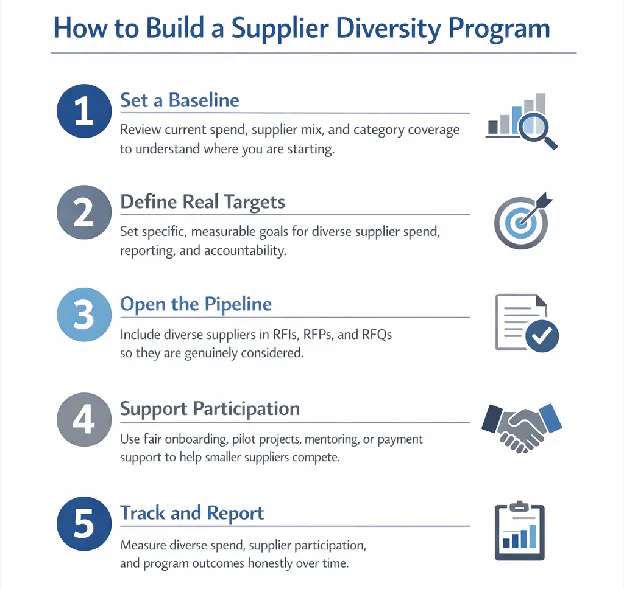
A lot of companies announce supplier diversity goals and then watch them slowly disappear. The energy is there at the start. The press release goes out. And then nothing really changes in the actual buying decisions.
Here's why that happens. And how to avoid it.
Start by understanding where you actually are
Before you can improve anything, you need a baseline. What percentage of your current spend goes to certified diverse suppliers? Which categories have the most options? Where are you most concentrated on non-diverse suppliers?
Most companies that do this for the first time find their diversity spend is much lower than they assumed. That's not unusual. It's the starting point.
Set goals that are real, not aspirational
"Increase diverse spending" is not a goal. A goal sounds like this: by the end of this year, 15% of our indirect spend will go to certified diverse suppliers, measured monthly, reported to the procurement leadership team.
Specific. Measurable. With someone's name on it. Without that structure, supplier diversity stays a good intention rather than an operational reality.
Actually, invite diverse suppliers into your sourcing events
This is the core of the whole thing. Diverse suppliers need to be in the room, in your RFIs, your RFPs, your RFQs. They can't win business if they're not being considered.
If you're not sure how to run a sourcing event that genuinely opens the process to a wider range of suppliers, our RFQ guide covers how to structure a quotation process where suppliers can compete on a like-for-like basis, which is exactly what you need when you're evaluating new suppliers alongside ones you've used for years.
Support them, don't just find them
A lot of diverse businesses are smaller. They may not have the financial history or the production scale that your standard onboarding process was designed for. That doesn't mean they can't do the work. It means your process might need adjusting.
Some companies run mentorship programs, offer early payment terms, or start with small pilot contracts. This isn't lowering the bar. It's making the runway fair.
Report honestly, not just the good parts
Track your diverse spend. Report it. Share it with leadership. And be honest about where you're not making progress, not just where you are.
According to the 2024 State of Supplier Diversity report, 92% of organizations now track spend with small and diverse suppliers.
That's the baseline. The ones getting the most from their programs measure further, innovation outcomes, contract win rates, and community economic impact. The data tells you whether the program is actually working.
The Legal Bits Worth Knowing
Supplier diversity entails legal considerations that vary by where you operate and how your program is structured.
In the US, federal contractors are subject to specific requirements around small business and disadvantaged business participation. The Small Business Act sets out what's required. State-level rules vary significantly on top of that.
For private companies, the picture is more nuanced. Simply expanding the pool of suppliers you consider is generally fine. Setting aside contracts exclusively for diverse suppliers, or giving them automatic price preferences, requires more careful legal structuring to avoid discrimination claims.
The principle to keep in mind: supplier diversity should expand opportunity, not create exclusive entitlements. You're widening the door. Not replacing one unfair system with another.
If you operate across multiple countries, the UK, EU, Canada, and Australia, the frameworks differ. Legal advice specific to your context is sensible, especially if government contracting is part of your business.
How Supplier Diversity Connects to the Rest of Your Procurement Process
Supplier diversity doesn't sit in its own corner. It touches how you source, how you evaluate, how you onboard, and how you manage supplier relationships over time.
The sourcing stage is where it starts. Diverse suppliers need to be in the mix from the beginning, in your supplier discovery, in your RFPs, in your evaluation criteria. If they only ever get considered after the shortlist is already made, the whole thing becomes performative.
How you structure your sourcing approach determines whether diverse suppliers genuinely get access to your business or just get mentioned in a policy document. Our procurement strategy guide covers how to build sourcing processes that bring the right suppliers in at the right stage.
Onboarding is the second gate. A diverse supplier who wins business but can't get through a twelve-week onboarding process designed for major enterprise suppliers has effectively been excluded again. Review your onboarding requirements with smaller businesses in mind.
Once diverse suppliers are active in your supply chain, they need to be managed with the same rigor as anyone else, tracked for performance, paid on time, and given clear feedback. Our procure-to-pay guide covers the operational side of how supplier management works once they're in your system.
Where ChinaSource Comes In
Finding diverse suppliers, especially in global manufacturing markets, is usually the first practical obstacle companies hit when they start building a supplier diversity program.
It's one thing to commit to sourcing from a broader base. It's another to actually identify qualified diverse suppliers in your specific product category, reach out to them, collect comparable quotes, and evaluate them fairly against your existing options. That process takes time. It often requires market knowledge that internal teams don't have.
ChinaSource AI platform handles supplier outreach and quote collection at scale, reaching out to multiple suppliers simultaneously, gathering standardized responses, and compiling the comparison data your team needs to make a fair, informed decision.
For businesses trying to expand into new categories or markets, this kind of structured discovery is what turns the intention of supplier diversity into something that actually happens. See how it works for contract manufacturing sourcing as one example.
If you're new to global sourcing and want to understand how to find and evaluate suppliers across different markets, including smaller and emerging businesses, our sourcing agent guide is a good place to start.
How to Know If Your Program Is Actually Working
Good intentions don't show up in a spreadsheet. Here are the metrics that tell you whether something real is happening.
| Metric | What It Measures | Why It Matters |
|---|---|---|
| Diverse spend percentage | Share of total procurement going to certified diverse suppliers | Without this, you're guessing |
| Number of active diverse suppliers | How many certified diverse suppliers are in your supply base | Shows whether your pipeline is genuinely growing |
| Category coverage | Which categories include diverse suppliers | Reveals where concentration is still a problem |
| Performance vs. non-diverse | Quality, delivery, and cost across supplier types | Confirms diverse suppliers are performing at equivalent levels |
| Contract wins linked to diversity | Deals where your program was a factor | Direct commercial return from the program |
| Community economic impact | Jobs, wages, and economic activity are supported through diverse spending | Increasingly tracked by leading programs for stakeholder reporting |
Supplier Diversity FAQ
What is a diverse supplier?
A business that is at least 51% owned and actively operated by someone from a traditionally underrepresented group, such as women, ethnic minorities, veterans, people with disabilities, or LGBTQ+ individuals. Most formal programs require certification from a recognized third-party body confirming they meet that definition.
Is supplier diversity legally required?
It depends on where you operate and what contracts you hold. US federal contractors are subject to specific requirements. Many state governments have their own rules.
For private companies without government contracts, it's generally voluntary, but large enterprise buyers increasingly require their own suppliers to demonstrate supplier diversity as a condition of doing business. The legal picture varies by country, so specific legal advice is worth getting if government contracting is part of your business.
Does supplier diversity mean working with suppliers that aren't as good?
No. That's the most common misconception. Supplier diversity is about widening the pool of suppliers you consider, not lowering the bar for who you choose.
You still evaluate quality, reliability, price, and capability. What changes is who gets the chance to be evaluated in the first place. More competition generally leads to better outcomes.
How do I find certified diverse suppliers?
Certification bodies like NMSDC, WBENC, and NVBDC in the US maintain searchable databases of certified diverse suppliers. Government procurement portals often have directories. The practical challenge is finding diverse suppliers active in your specific product category, which usually requires active outreach rather than passive searching.
What if diverse suppliers can't meet my order volume?
This is a real challenge, especially for smaller businesses. Some companies split orders, using a diverse supplier for part of a requirement while a larger one handles the rest.
Others use Tier 2 programs, encouraging large prime suppliers to source from diverse businesses within their own chains. Pilot contracts and early payment terms can help diverse suppliers grow to the point where they can handle larger volumes.
How do I report on supplier diversity spend?
Start with clean supplier data and accurate classification of diverse supplier statuses in your system. Track spending against those suppliers consistently. Most mature programs report monthly, with quarterly reviews and an annual impact report. The most sophisticated ones measure beyond spend, innovation outcomes, contract win rates, and community economic impact.
One Last Thing
Supplier diversity isn't a box to tick. It isn't a PR exercise. And it isn't about sacrificing commercial quality for the sake of optics.
It's about recognizing that the way most companies have built their supply chains, through existing networks, comfortable relationships, and familiar names, has quietly left a lot of good suppliers out of the conversation. And left a lot of value on the table.
The businesses doing this well aren't treating supplier diversity as a side project. They're building it into how they source from the start, into the suppliers they invite, the RFPs they send, the criteria they use to evaluate bids, and the relationships they invest in over time.
That shift takes time. It takes honest data. It takes people in leadership who actually own the goal. But the results, better pricing, fresher ideas, stronger supply chains, more resilient operations, and commercial relationships that open doors you didn't know were there.
If you're trying to build a sourcing process that finds the best supplier for the job, whoever owns the business, wherever they are, ChinaSource can help. Explore how the platform supports structured, global supplier discovery at chinasource.com.