
Supply Chain Planning: What It Is, Key Elements, and Strategies


Many organizations deal with issues like inconsistent lead times, frequent stockouts, and delays due to a shortage of raw materials. These, and many other issues, have become even more frequent due to the complex nature of modern markets.
Supply chain planning aims to anticipate these events and help teams decide how to respond. This is essential because without it, businesses risk problems such as cash flow issues, higher operating costs, and lost sales.
To plan effectively, teams need high-quality data inputs from the earliest stages of sourcing. Many organizations use ChinaSource in those early stages, as it helps them collect supplier data on pricing, lead times, and capacity, which they can feed into the planning process. This ensures that the planning builds on a strong foundation.
What is Supply Chain Planning?
Supply chain planning is the process of coordinating and optimizing the flow of goods, services, and information from raw materials to the final customer. It involves anticipating demand and balancing supply to ensure that products are available at the right time and in the right place.
Supply chain planning should not be confused with supply chain management, which covers the end-to-end process of planning, execution, and control.
Supply Chain Planning vs. Supply Chain Management
Organizations use supply chain planning to decide production volumes, timing, and resource allocation, while supply chain management ensures those plans are executed across sourcing, production, and delivery. Here are some other ways they differ.
| Dimension | Supply Chain Planning | Supply Chain Management |
|---|---|---|
| Purpose | Decide what to produce, buy, and stock | Execute and control planning and strategy |
| Focus | Forecasting, capacity, and inventory decisions | Production, order fulfillment, and logistics execution |
| Main Activities | Demand planning, supply planning, setting inventory targets, scenario modeling | Procurement, manufacturing, warehousing, transportation |
| Time Horizon | Usually medium to long term, like weeks to months | Mostly runs on short-term, like daily to weekly |
| Goal | Balance demand, supply, and cost before execution | Meet service levels and execute operations efficiently |
Now that we know the differences, what should an organization have within its supply chain planning workflow?
Elements of Supply Chain Planning
Supply chain planning involves many activities, such as demand forecasting, logistics planning, and inventory, sales, and supply planning. These elements should be in sync to ensure it delivers lower costs, better service levels, and more predictable operations. Here are some of them.
Sales and Operations Planning (S&OP)
Sales and operations planning (S&OP) aligns demand and supply plans into one agreed plan. Teams review forecasts, capacity, and constraints, then decide on volumes, inventory targets, and trade-offs before execution.
Demand Forecasting and Planning
Demand forecasting uses historical sales data, market trends, and known drivers like pricing and seasonality to estimate future demand. Demand planning then builds on that forecast to help teams define required volumes, timing, and priorities for the business.
Supply Planning
Supply planning determines how the business meets demand within real constraints. It balances production, procurement, and capacity to create a feasible plan based on available resources, lead times, and supplier limits.
Production Planning
Production planning converts the supply plan into a production schedule. It determines what will be produce, when, and in what quantities based on available resources, capacity and the delivery requirements.
Inventory Planning and Optimization
Inventory planning sets targets for how much stock to hold, its storage, and replenishment. Businesses use it to define safety stock, reorder points, and where to hold inventory to balance cost and availability.
Logistics and Distribution Planning
Logistics and distribution planning define how a company moves its finished goods from production sites to customers. It involves selecting carriers, designing optimal routes, and sourcing the best warehouse locations. It also includes plans for defective or returned goods, managing their flow to the seller or manufacturer for refunds, repair, or recycling.
The Supply Chain Planning Process
The supply chain process is how an organization maps and optimizes the flow of goods from sourcing to delivery to balance supply and demand while reducing costs. It can be covered in 7 steps, as follows:
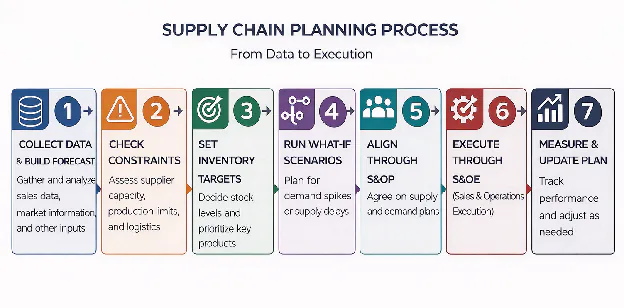
Step 1: Collect Data and Build Forecast
Gather historical sales data from the sales team, CRM, and other business systems. Use this data to develop the forecast, while accounting for external factors such as price increases and seasonality.
Step 2: Check Constraints
Constraints are factors that can limit the supply chain plan. This may include supplier capacity, lead time, production capacity, and logistics limitations. Also, verify that you have adequate labor, machine capacity, and raw materials to meet the projected demand.
Step 3: Set Service-Level and Inventory Targets
Define how much product you want to be available and the inventory needed to support it. Segment products by priority and allocate more resources to the highest-priority products. Ensure that targets and service levels are aligned with business goals, and set inventory policies to balance them with costs.
Step 4: Run What-If Scenarios
What-if scenarios simulate how changes in demand, supply, or constraints affect your plan. They help identify risks early and evaluate options before a final decision. For instance, you can simulate a sudden 20% demand spike to assess its impact on inventory and production capacity.
Step 5: Align Through Sales & Operations Planning
Sales and operations planning ensures that operational teams share the same priorities and assumptions. Review demand, supply, and constraints with the team and align on a single plan. Agree on specific priorities, trade-offs, and targets, such as revenue, capacity, and service levels.
Step 6: Execute Through S&OE
Sales and Operations Execution (S&OE) aligns daily operations with the plan, translating it into actions. It usually lasts up to 12 weeks. An effective S&OE ensures that teams act on the most current demand, inventory, and supply conditions.
Step 7: Measure Performance and Update Plans
Compare actual results against the plan to identify gaps in forecast accuracy, service levels, and execution. Use these to adjust assumptions and improve plans.
Common Trade-Offs in Supply Chain Planning
Supply chain planning is about balancing competing priorities. However, every decision that improves an aspect of the plan creates pressure in other areas. Here are some of those trade-offs:
- Higher Service Levels vs. Higher Inventory Costs: Increasing product availability requires more stock, which in turn increases storage costs. There’s also the risk of damage or expiry, which can lead to waste.
- Faster Delivery vs. Higher Costs: When a company wants to reduce lead time, they usually need to speed up production or use expedited shipping or a faster option like air freight, which costs more.
- Fewer Suppliers vs. Supply Risk: While consolidating suppliers simplifies operations, it also reduces your options. You then have to depend on a few suppliers, which can be risky should they miss a delivery.
- Larger Order Quantities vs. Flexibility: Buying in bulk reduces unit cost, but you may be stuck with that inventory if there’s a drop in demand.
These are some of the trade-offs supply chain planners need to understand and plan for. Understanding these trade-offs helps balance cost, service, and risk rather than optimizing one at the expense of the others.
What Does Good Supply Chain Planning Look Like?
The difference between good and poor planning can be seen in the accuracy of the forecast, inventory levels, execution, and how well teams and suppliers are aligned. The table below highlights these differences.
| Area | Good Planning | Poor Planning |
|---|---|---|
| Forecasting | Teams update the forecast with real inputs and investigate large errors to fix assumptions | Forecasts are built on past or siloed data, leading to inaccuracy |
| Supplier Coordination | Suppliers confirm capacity and lead times before the team finalizes plans; changes are communicated early | Orders are placed without checking constraints; teams only react after delays occur |
| Cross-Functional Alignment | Sales, operations, and finance align on specific numbers and follow them through the cycle | Sales, operations, and finance work with conflicting numbers and priorities |
| Decision-Making | There are clear rules for trade-offs, and teams resolve issues without constant escalation | Inconsistent and unclear decision rules and priorities for decision-making |
| Execution | Most orders and production follow the plan, with only a few controlled changes | Frequent order changes and last-minute schedule changes disrupt operations |
Effective planning happens as a result of deliberate design and execution, and this often comes down to the quality of data and the strategies in place.
Common Planning Models and When to Use Them
Supply chain planning is not a one-size-fits-all activity. Each approach addresses a business challenge, so understanding them helps you pick the best fit for your goals and market conditions. You can categorize them by timeframe and execution model.
By Timeframe
| Planning Level | What It is | Ideal Use Case | Key Trade-Off |
|---|---|---|---|
| Strategic Planning | Long-term decisions on factory and warehouse location, suppliers, and capacity | Market expansion, new facilities, supplier strategy | Shapes long-term cost, capacity, and service level, but changes take months and are costly to reverse. |
| Tactical Planning | Medium-term plan outlining production, inventory, and distribution priorities | Quarterly planning, demand balancing, capacity allocation | Balances near-term production and inventory, but wrong forecasts cause overstock or stockouts |
| Operational Planning | Short-term execution of daily or weekly activities | Order fulfillment, scheduling, and replenishment | Fast response to daily changes vs higher costs and unstable operations |
By Execution Model
| Model | What It Is | Ideal Use Case | Main Trade-Off |
|---|---|---|---|
| Make-To-Stock (MTS) | Manufacture goods based on the forecast, store, and ship after receiving an order | High-volume, stable demand, such as retail and FMCG | Fast delivery vs risk of overstock or stockouts |
| Make-To-Order (MTO) | Start production only after receiving a confirmed order. It is common in contract manufacturing | Customized or low-volume products | Low inventory vs longer lead times |
| Assemble-To-Order (ATO) | Stock standardized components and only assemble after receiving an order | Products with standard parts but some customization, such as PC, electronics | Balance of speed and flexibility vs component inventory complexity |
| Engineer-To-Order (ETO) | Manufacturer designs and produces from scratch after receiving an order, often with customer input | Complex and highly customized, such as industrial equipment | Maximum customization vs long lead times and high cost |
| Just-In-Time (JIT) | Receive materials only when needed for production | Stable, reliable supply environments | Low inventory vs high risk if supply is disrupted |
| Demand-Driven MRP (DDMRP) | Use demand signals and buffers to drive replenishment | Environments with variability and uncertain demand | Better responsiveness vs need for careful buffer management |
While these strategies can be used in different cases, they serve the same purpose of balancing demand, supply, and constraints, which benefits the business in several ways.
Benefits of Supply Chain Planning
Supply chain planning improves how a business controls inventory, meets delivery commitments, and manages working capital. Here are other specific benefits.
- Lower Operating Costs: Effective supply chain planning helps businesses to reduce expenses by avoiding premium freight and last-minute schedule changes.
- Better Service Levels: It enables teams to prioritize inventory for high-value products and customers. That way, they can always fulfil orders consistently even with supply constraints.
- Improved Resilience: Scenario planning prepares teams to identify alternative sources and routes in response to supply chain disruptions.
- Higher Customer Satisfaction: Reliable planning leads to consistent delivery performance and fewer order delays, strengthening customer trust.
- Easier Scaling: A structured planning cadence supports expansion into new products, facilities, customers, or regions without disrupting operations.
- Stronger Sustainability: Aligning production with real demand reduces overproduction, excess inventory, and material waste.
Supply Chain Planning KPIs That Matter
KPIs show whether your supply chain planning is having the desired impact. Here are some important KPIs to track.
Forecast Accuracy
This tracks how close your forecast is to real demand. You want to aim for high numbers, as that shows better planning, which translates to fewer stockouts and less excess inventory. Low accuracy numbers point to forecasts that do not match reality.
OTIF (On-Time, In-Full)
OTIF tracks how often orders are delivered on time and in the correct quantity. It reflects how well your entire supply chain executes orders from production to delivery. Low OTIF points to delays, shortages, or supply chain coordination issues.
Inventory Turnover
Inventory turnover tracks how often inventory is sold and replaced over a period. Low turnover suggests excess or slow-moving stock, while high turnover often points to efficient inventory management or strong sales.
Days of Supply
This tracks how long it will take for your current inventory to run out if recent sales continue at the same rate. It helps you decide when to reorder to avoid excess stock or stockouts. High days indicate excess inventory while low days signal a risk of running out.
Plan Adherence Or Schedule Attainment
This KPI measures how closely actual production follows the approved schedule. Schedule adherence below 85% may indicate production delays, while 85% to 95% is generally considered a realistic target range.
How to Improve Supply Chain Planning
To improve supply chain planning, focus on data quality, clear process ownership, and regular reviews. Here are the steps to improve the process.
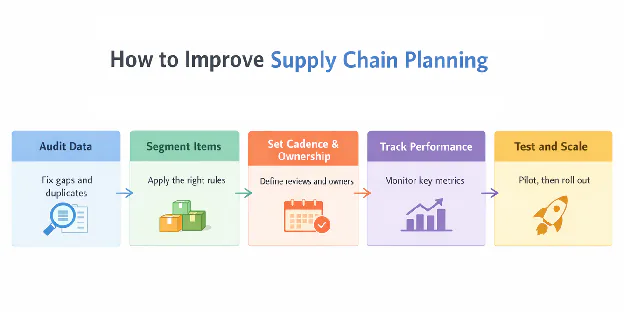
1. Audit Existing Data Sources
Review your current data sources to ensure their output is accurate, complete, and consistent. The audit also helps you identify sources of outdated data, duplicates, and data quality gaps. Ensure you fix any issues before adding new software so that these tools pull from the correct data.
2. Segment SKUs, Customers, and Suppliers
Group customers, suppliers, and SKUs according to importance, demand patterns, or value. Prioritize high-impact segments to ensure you spend time and resources where they matter the most.
3. Set Cadence and Ownership
Develop a realistic calendar for reviewing plans and decide on who is responsible for key decisions, such as inventory policies and forecasts. This ensures you can follow through on decisions or update plans when conditions change.
4. Track Performance
Monitor key metrics, including forecast accuracy, OTIF, and inventory turnover. Metrics help you understand performance. They also offer fresh insights you can use to adjust plans and manage trade-offs between service and cost.
5. Test, Standardize and Scale
Start with a pilot test to validate new processes or strategies on a small scale. You can choose one product line or region. Once validated, you can then roll them out in phases across products, locations, or business units.
Challenges and Common Mistakes in Supply Chain Planning
While the supply chain process looks straightforward, many companies make some common mistakes, as we will see below.
- Overreliance on Software: While software tools can improve speed and efficiency, relying on them without having the right processes and data leads to poor results.
- Forecast Bias: Sometimes teams face pressure from sales targets, rely on assumptions, or even ignore data. This can result in wrong signals that lead to excess inventory or frequent overstock.
- Weak Cross-Functional Communication: When teams don’t share the same information and priorities, it creates a disconnect that shows up as delays, misaligned plans, and constant changes.
- Siloed Data: Data locked away in different systems is one of the reasons for poor cross-functional communication. Using such data to make decisions often leads to poor results.
- Poor Data Quality: Software tools need accurate, fresh, and complete data to support decision-making. Without good data, you get wrong or incomplete insights that limit planning.
Most of these mistakes come from poor data, lack of alignment, or unrealistic planning and can be addressed in the following ways:
- Data cleaning, standardization, integration, and data governance.
- Setting up a regular schedule to align teams on a specific priority.
- Develop a realistic plan that reflects actual demand, constraints, and capacity.
How ChinaSource Supports Supply Chain Planning
Supply chain planning depends on accurate inputs, especially supplier data such as pricing, lead times, and production capacity. Without that, sales and procurement teams can end up with misleading insights. ChinaSource helps teams to collect structured supplier data early, before they make these critical planning decisions.
It collects critical data, such as supplier pricing, capacity, and basic fit, through AI-driven outreach. Then, it collects supplier responses and organizes the data, enabling you to compare inputs such as price, MOQ, and lead time in a consistent format. This improves the quality of demand forecasts, supply plans, and scenario modeling.
Supply Chain Planning Tools
Large organizations operate in complex environments and at a scale that makes it impractical to rely on spreadsheets and disconnected systems. They need tools that can handle large amounts of data and align teams to ease planning. Here are some top supply chain planning tools to consider.
- Blue Yonder: Used by large companies. Its key features include demand forecasting, supply and inventory planning, scenario planning, and AI-driven recommendations. It integrates demand, supply, and inventory, enabling planners to adjust plans quickly based on real data and changing conditions.
- Kinaxis: Kinaxis supports fast, real-time planning and scenario analysis. It offers supply and capacity planning, what-if scenario analysis, and order and inventory management. The platform allows planners to instantly see the impact of changes across the supply chain and respond quickly.
- OMP: OMP's supply chain planning solution is built for complex manufacturing environments. It offers demand and supply planning, production planning and scheduling, and integrated business planning. OMP enables manufacturers to develop feasible plans that account for production constraints and optimize efficiency.
- o9 Solutions: This platform combines forecasting, supply planning, and financial planning. Its key features include real-time demand and supply planning, scenario modeling, and integrated business planning (IBP). Teams using O9 can run multiple scenarios and align decisions across functions with a single shared model.
Other Tools That Support Supply Chain Planning
While dedicated supply chain planning software offers a suite of tools to manage most or the entire workflow, other tools can support the process in different ways, especially via data inputs. These include:
- Sourcing Platforms: Platforms like ChinaSource support early-stage planning by using AI-driven outreach to contact suppliers, confirm pricing, capacity, and fit, and structure the responses into comparable data for planning decisions.
- Enterprise Resource Planning (ERP): ERPs handle core transactions and keep financial records aligned with planning data.
- Advanced Planning and Scheduling (APS): Teams can use APS to model machine capacity and material limits to ensure production schedules are realistic.
- Integrated Business Planning (IBP) Platforms: These tools keep your sales, finance, and operations teams aligned around a single shared plan.
- Control Towers: These systems provide real-time visibility across suppliers, inventory, and shipments. They help teams identify disruptions, such as delays or shortages, so they can take corrective action.
FAQs
Why is Supply Chain Planning Important?
SCP helps you balance supply against demand to reduce waste and service failures. An effective plan helps you protect margins by making purchase and production decisions before committing cash, keeping your operation stable even when material costs change.
How Does AI Improve Supply Chain Planning?
Businesses can use AI to collect and analyze supplier data at scale. AI models are good at recognizing patterns, and using them can help you gain clear insights into demand patterns. These models can also flag stockouts early, giving you enough time to find alternative sources. However, it’s essential to feed these systems with good data to enhance their performance. It’s also a good practice to supervise AI outputs.
How Is Supply Chain Planning Different From Demand Forecasting?
Supply chain planning and demand forecasting serve different roles, but they are related. Demand forecasting estimates future demand based on historical sales data and trends. Supply chain planning then uses that forecast to decide how to meet demand by setting production schedules, inventory levels, and sourcing plans.
What Industries Benefit the Most From Supply Chain Planning?
Industries with complex supply chains, such as manufacturing, retail, e-commerce, and distribution, often benefit the most. These industries deal with high volumes, multiple suppliers, and constant demand changes. Companies in these industries must make effective plans to keep inventory, production, and deliveries in sync.
How Often Should Supply Chain Planning Be Updated?
Many companies follow a monthly planning cycle with weekly or daily updates to adjust for changes in demand, supply, or execution. It can look like this in practice.
- Monthly: set the overall plan (forecast, production, inventory targets).
- Weekly: adjust for changes like order spikes or supplier delays.
- Daily: fix urgent issues like late shipments or stockouts.
The main idea is to ensure that you do not rely on monthly updates, as things can and usually change quickly, and the business needs to be able to adapt when that happens.
Final Thoughts
Supply chain planning helps businesses avoid stockouts and excess inventory, control costs, and ensure reliable deliveries. But it needs accurate data inputs to be effective. That is where an AI-driven sourcing tool like ChinaSource can play an essential role.
By organizing supplier quotes into comparable fields, teams can easily evaluate options and feed accurate inputs into planning decisions. This improves the reliability of demand forecasts, inventory targets, and scenario analysis. Talk to us today to learn more about ChinaSource.