
What Is Contract Manufacturing? Types, Benefits, Use Cases

Many businesses have faced situations in which they create high-quality products that never see the light of day because they lack the capabilities and machinery required for production. From labor costs and raw materials to a functional manufacturing facility, the production process requires significant resources.
A company in this position does not need to abandon its product idea, though. They can still execute production without mass hiring or setting up a large facility. Even large manufacturers sometimes do not make all the pieces they use to build their final products. That’s the point of contract manufacturing.
What Is Contract Manufacturing?
Contract manufacturing is an arrangement in which one company agrees with another to manufacture components or products over an agreed-upon timeframe. It is a form of outsourcing, but on a manufacturing level, enabling companies to compete in areas where they lack capabilities.
In this business agreement, one company pays another to manufacture either a component of a product or the entire product. Contract manufacturers are third-party entities that work mostly as subcontractors or sell their products to other businesses.
Contract Manufacturing as a Strategic Operating Model
Contract manufacturing can act as an operating model that influences how a company scales, prices its products, protects intellectual property, and responds to market changes. It should not be limited to being a production decision.
Once manufacturing is outsourced, decisions around supplier structure, contract length, and production ownership affect everything from cash flow predictability to how quickly a business can iterate on product improvements.
When managed as a long-term operating model, contract manufacturing can improve supply chain resilience, provided supplier incentives, tooling ownership, and capacity commitments are clearly defined.
How Does Contract Manufacturing Work?
The company that needs a contract manufacturing service will typically contact the third-party company with a design or specification. The third-party company will then respond with a quote for the production process, tooling, materials, and labor.
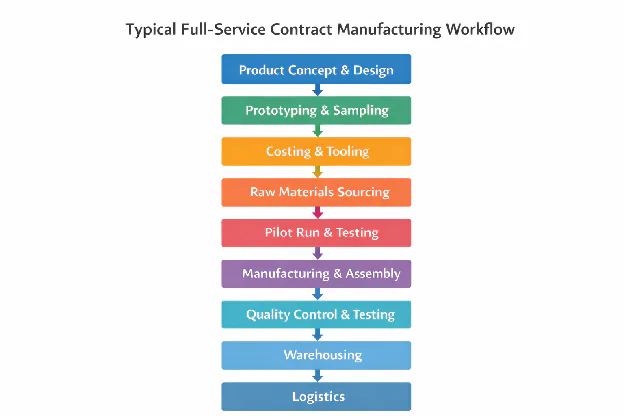
A contract manufacturing company may also collaborate with the company during product design. Manufacturing starts after design, and it can involve various stages, such as tooling, prototyping, component and material sourcing, trial production, and mass production.
Before contacting manufacturers, companies need clear specifications, volumes, timelines, and compliance requirements. ChinaSource supports this early stage by helping teams structure their manufacturing requirements and collect supplier responses in a consistent format. This reduces ambiguity and makes it easier to compare contract-ready manufacturers before entering formal agreements.
Consistent and coherent request documents are critical at this stage. Companies should issue RFPs or RFQs that include detailed specifications, materials, tolerances, expected volumes, quality standards, compliance requirements, lead times, and packaging needs.
Technology Transfer and Pilot Runs
Before full-scale production begins, companies often go through a technology transfer phase to ensure the contract manufacturer fully understands the product and process requirements. This step helps align expectations and reduces the risk of errors once production scales. It usually includes:
- Transfer of product specifications, tooling details, and process documentation.
- Alignment on quality standards, testing methods, and acceptance criteria.
- Pilot or trial production runs to validate consistency and manufacturability.
These pilot runs allow both parties to identify and resolve issues early, confirm production readiness, and fine-tune the details before committing to mass production.
Types of Contract Manufacturing
Contract manufacturing can take various forms, from producing parts to using equipment, labor contracting, and even full-scale production, depending on the agreement between companies. However, most fall under four categories, and here’s how each one works.
The table below summarizes the main types of contract manufacturing and how they differ in scope, involvement, and use cases.
| Types | What Is Produced | Customer Involvement | Use Case |
|---|---|---|---|
| Individual Component Manufacturing | A specific part or component | Low to moderate | Companies with in-house assembly that outsource select components |
| Labor or Service Subcontracting | A specific process or labor service | Moderate | Products that require specialized expertise or affordable labor |
| Private Label Manufacturing | Finished product built to customer specs | Moderate | Brands that want full products without managing production |
| End-to-End Manufacturing | Fully designed and produced products | High | Companies launching new or complex products without in-house manufacturing |
Individual Component Manufacturing
This is where a company contracts with another company to produce a component or part for large-scale production. It is common in the automobile industry, as car manufacturers don’t necessarily produce every piece in-house. They may outsource certain components to third parties and then assemble them with other parts at their facility.
Labor or Service Subcontracting
This type of contract manufacturing is process-focused. The contract manufacturer handles one part of the larger process or supplies the labor needed to handle it. They act more as a subcontractor to a main contractor. This solution is mainly used by a company that owns its facility but needs specialized services.
Private Label Manufacturing
In private label manufacturing, the buyer defines branding and commercial requirements, while the manufacturer often provides an existing base product or formulation customized to meet those requirements, though fully custom arrangements also exist.
These products may include multiple components and are typically delivered directly to the store or an inventory warehouse. It is ideal for businesses with a clear product vision that want to outsource the entire production process.
End-to-End Manufacturing
This is where the product or component is completely outsourced. However, unlike private label manufacturing, the contract manufacturer is more involved in the design of the product and offers feedback to the company that contracts them. This model is ideal for companies that want to bring new or complex products to market without building in-house manufacturing capabilities.
Benefits of Contract Manufacturing
There are many reasons why companies engage in contract manufacturing, as follows:
- Access to Expertise: Contract manufacturing enables companies to access technologies and specialized capabilities that they may lack in-house. This ensures they do not miss out on market or business opportunities.
- Minimise Capital Risk: Contract manufacturing reduces the need for upfront investment in factories and production lines, equipment, and labor. It enables companies to reduce fixed costs and avoid long-term commitments while still scaling output based on demand.
- Scalability: Contract manufacturing enables businesses to be flexible in their production volume. They can scale production without incurring the risks of maintaining excess capacity.
- Reduced Time to Market: Leveraging the production capabilities of contract manufacturers allows companies to accelerate product development and launch, which can create a competitive advantage.
- Shared Capacity and Operational Risk: By using external manufacturing capacity, companies avoid bearing the full risk of underutilized equipment during slow periods or rushed expansion during demand spikes. This makes production planning more flexible and reduces long-term operational risk.
Contract Manufacturing Challenges and Considerations
While contract manufacturing offers numerous benefits, it also presents challenges that outsourcing companies must address to succeed with these strategies. Some of those challenges are as follows:
- Quality Control issues: Businesses that lack direct control over production may struggle to maintain product quality across different manufacturing facilities. It’s essential to commit to regular audits to ensure that partners adhere to compliance standards.
- Communication and Collaboration: When partnering with overseas contract manufacturers, time zone gaps, language differences, and unclear specifications can lead to errors. For instance, a minor design change shared late may cause a full production run to use outdated specifications.
- Supply Chain Risks: If depending on external manufacturers, a company may be vulnerable to delays and disruptions. This can be managed through supplier diversification, dual sourcing, and contingency planning. These strategies can reduce the dependency on a single supplier.
- Intellectual Property Protection: IP issues and concerns can arise when a business shares proprietary information with a contract manufacturer. However, they can mitigate this through confidentiality agreements and security measures to safeguard their intellectual assets.
- Performance Tracking and Governance: Successful contract manufacturing depends on ongoing performance oversight. Companies typically define KPIs such as on-time delivery, defect rates, and production yields. They also support it with regular review meetings and clear escalation paths. This governance structure helps address issues early and aligns performance.
What Types of Businesses Use Contract Manufacturing?
Various types of businesses can use contract manufacturing services, from just-in-time delivery models to companies that specialize in contract filling services.
Any company that aims to streamline its production and enhance efficiency can benefit from the contract manufacturing model. However, it is more common in some industries, such as pharmaceuticals, cosmetics, electronics, and personal, industrial, and household products.
By outsourcing manufacturing tasks to specialized providers, businesses can focus on their core competencies. The shift towards just-in-time and lean manufacturing has also further increased the importance of contract manufacturing in reducing overhead costs and optimizing supply chains.
Some industries, such as pharmaceuticals, food, cosmetics, and medical devices, often require more stringent audits and compliance. These requirements can impact delivery timelines and influence how companies select manufacturing partners.
Services Offered by Contract Manufacturing Companies
There’s a long list of services that a contract manufacturer would typically provide, and here are some common ones:
Packaging Services
Contract manufacturing companies offer a range of packaging services. These packaging services often include compliance with relevant industry regulations, which may vary by product type, such as food-grade, cosmetic, pharmaceutical, or hazardous material requirements.
These compliant packaging solutions ensure that contractors meet the strict standards set by regulatory bodies. Aside from that, it also provides customization options that meet clients’ needs.
Product Development and Design
Like with end-to-end manufacturing agreements, companies with production capabilities can assist with the development and design process. The manufacturers work closely with clients to understand their requirements. This partnership ensures the final product meets the highest quality standards.
For instance, a contract manufacturer working with a skincare brand may review an early formulation and packaging design, then recommend ingredient substitutions to improve shelf stability. That input may help the product meet safety standards and perform consistently in mass production.
Quality Control and Assurance
Quality control is a big issue in contract manufacturing. In some cases, quality control is handled by independent third-party inspection and auditing firms rather than the contract manufacturer itself.
These companies have quality control managers who ensure that production adheres to ISO standards and relevant industry- or region-specific regulatory bodies. These companies oversee the entire production process, from sourcing raw materials to final product packaging.
They implement and monitor quality-control procedures to identify defects or deviations from specifications. They also conduct inspections and audits, helping manufacturers prevent costly errors and maintain consistent product quality across their production lines.
Manufacturers should maintain detailed documentation, including batch records, deviation logs, and formal approval processes for any design or material changes. This ensures that any adjustments are tracked, reviewed, and implemented without risking product consistency or compliance.
Logistics and Distribution
Many contract manufacturers also offer logistics and distribution services, either directly or through integrated partners. These services streamline the supply chain process, allowing contract manufacturers to fulfill orders and meet tight deadlines.
This service builds on advanced technology and automated systems to optimize operations and scale distribution. It reinforces the importance of navigating complex transportation networks, which is vital in meeting customer demands and maintaining a competitive advantage.
Is Contract Manufacturing The Same as Outsourcing?
Contract manufacturing and outsourcing are related but not the same. Contract manufacturing is a type of outsourcing where a company hires a third party to produce goods under agreed specifications. The scope of contract manufacturing is limited to producing physical goods for a company, following its designs and standards.
Outsourcing is broader and involves handing over any business function to an external provider. It can include services such as IT, customer support, logistics, or manufacturing. In short, all contract manufacturing is a form of outsourcing, but not all outsourcing is contract manufacturing.
Is Contract Manufacturing The Same as OEM?
Contract manufacturing means a company hires another firm to produce goods based on its design. OEM (Original Equipment Manufacturer) usually refers to a company that produces components or products that are branded and sold by another company, often as part of a larger system. Here are other ways they compare.
- Product Development Timeline: Development timelines depend on the level of customization and design ownership, not whether the manufacturer is classified as an OEM or a contract manufacturer. Both models can support either standardized or custom development.
- Product Specialization: OEM manufacturers typically offer predefined components designed to integrate into larger systems, allowing buyers to adapt existing solutions to their end product. Contract manufacturers focus on build-to-spec execution, producing goods based on customer-defined designs rather than offering standardized products of their own.
- Customer Involvement: Contract manufacturing requires more customer input. You are responsible for the product design, specifications, and design validation. OEM manufacturers usually have ready-made designs that the customer can build upon. They are more involved in the design phase.
Contract Manufacturing vs Outsourcing vs OEM
| Comparison Area | Contract Manufacturing | Outsourcing | OEM |
|---|---|---|---|
| Definition | A company hires a manufacturer to produce goods on its behalf under a formal contract | A company delegates specific business functions or processes to an external provider. | A manufacturer produces products or components that are sold under another company’s brand. |
| Scope | Focused on manufacturing | May include manufacturing, IT, accounting, customer service, logistics, etc | Focused on producing branded goods or components for other companies |
| Who Owns Product Design | Usually, the buyer owns the design and IP. | Depends on the function outsourced. If manufacturing is outsourced, design ownership may vary | The buyer typically owns branding; Design may be buyer-owned or manufacturer-developed. |
| Strategic Objective | Scale production without vertical integration | Improve efficiency and focus on core competence | Quickly bring products to market using established manufacturing expertise. |
| Best Use Cases | Custom products, proprietary designs, and scaling production without owning a factory. | Cost reduction, focus on core competencies, and operational efficiency. | Private label products, electronics, automotive parts, and branded consumer goods. |
| Example | A U.S. fitness brand designs a smart treadmill and hires a factory in Vietnam to manufacture it under strict specifications | A retail company outsources its customer support to a third-party call center in the Philippines | A laptop brand sources motherboards from an OEM in Taiwan and sells the final product under its own name. |
How ChinaSource Supports Contract Manufacturing
Contract manufacturing depends on clear information, capable suppliers, and aligned expectations. Many delays occur before production begins when details or supplier feedback are incomplete or unclear. ChinaSource helps clean up this early stage so buyers can move forward with confidence.
- Clarifying Manufacturing Requirements: ChinaSource helps buyers define specs, volumes, target pricing, lead times, and compliance needs before reaching out to factories. This creates a clear brief that manufacturers can review and respond to without guesswork.
- Identifying Contract-Ready Manufacturers: ChinaSource focuses outreach on suppliers that handle custom specs, long-term production, and tighter quality controls, based on real responses rather than listings.
- Collecting and Aligning Supplier Quotes: ChinaSource organizes pricing, MOQs, lead times, and payment terms into consistent fields. This ensures you work with the right data quality.
- Creating a Decision-Ready Shortlist: You receive a clear shortlist of manufacturers. Each option shows what was confirmed, differences, and what still needs follow-up, helping buyers move into contracts with lower risk.
When You Should Consider A Contract Manufacturer
There are some instances where a company should start considering contract manufacturing as an ideal strategic decision. Here are some of those instances:
- Limited Internal Capabilities: Sometimes companies lack the bandwidth or resources needed to manage and scale a manufacturing process. In such cases, they can enter into production agreements with other capable companies while they focus on their core competencies.
- Overwhelming Supply Chain: A company dealing with too many moving parts in its supply chain can benefit from engaging a contract manufacturer. These companies can simplify supply chain management and reduce overall process complexity.
- Unstable or Growing Demand: Many companies struggle to predict sales fluctuations, making it difficult to produce the right amount of their product at the right time. Working with contract manufacturers can help ease the pressure and reduce potential waste.
- Limited Resources: A company with other priorities that would rather allocate the time and money required for in-house manufacturing to other aspects of the business can benefit from contract manufacturing, given the associated cost savings.
How to Choose the Right Contract Manufacturing Partner
Selecting the ideal contract manufacturing company starts by understanding whether you need one. Here are the guidelines to do it the right way.
1. Start With Supplier Qualification
Companies should first qualify potential contract manufacturers before evaluating alignment with business goals. This step enables you to firm up the baseline capabilities of a potential partner. It answers the question, “Which manufacturers are even worth talking to?”
Outline what the ideal contract manufacturer looks like, based on production capacity, relevant industry experience, certifications, financial stability, and the ability to meet regulatory and quality requirements. Doing this helps eliminate unsuitable options early and ensures you spend time only on capable manufacturers.
2. Consider Your Needs and Goals
Before choosing a contract manufacturing partner, it’s essential that a company checks for compatibility. Ensure that their capabilities align with your needs and business goals. Also, check that your requirements and their services align. Assessing the partner’s expertise in your industry niche impacts the quality and precision of the products delivered.
3. Research and Compare Companies
This is where you evaluate contract manufacturers whose services align with your needs. Consider factors like the state of their facility, industry reputation, and specialization.
Research their track record, including past projects and client testimonials. This allows you to gauge their reputation and past performance. Look for and prioritize companies with proven expertise in your specific requirements. Also, consider their technological capabilities and infrastructure to ensure they can meet your production demands.
4. Check for Certifications and Quality Standards
Verifying certifications and adherence to quality standards such as ISO is essential when choosing a contract manufacturing company. These checks show a commitment to consistent quality control processes.
Choosing a contract manufacturing partner requires alignment on quality expectations, communication standards, long-term capacity, and commercial terms. It is not only about technical capability. The right partner should not only meet your current production needs but also support your growth without creating operational risk.
FAQs
What Is Contract Manufacturing?
Contract manufacturing is when a company engages a third-party company to produce goods based on detailed specifications or requirements. The agreement usually covers pricing, volumes, quality standards, timelines, and intellectual property ownership.
Is Contract Manufacturing Risky?
Engaging a contract manufacturer has many benefits, but it also comes with some risks that companies should be aware of. For instance, there could be issues with quality, late delivery, or problems with regulatory compliance. There may also be cost overruns, which can lead to losses.
What Are the Main Benefits of Contract Manufacturing?
Engaging a contract manufacturing company can lead to the reduction of capital costs and faster production. It enables businesses to scale their production and leverage the economies of scale built by their partner. These factors can create a competitive advantage over time.
What’s the Difference Between OEM and Contract Manufacturing?
OEM (Original Equipment Manufacturer) typically produces components or products that are incorporated into another company’s branded end product, sometimes based on standardized designs. Contract manufacturing refers to producing goods according to a customer’s specific design and contractual terms. While exclusivity can be negotiated in either model, it is not inherent to either one.
Will AI Take Over Contract Management?
AI tools will help automate and streamline processes such as document review, clause extraction, compliance checks, and performance tracking. Also, AI-driven tools like ChinaSource support the pre-contract stage of the process, helping companies structure manufacturing requirements, identify contract-ready suppliers, and collect comparable quotes before agreements are signed. While AI tools will not take over the entire process, they will reduce manual effort.
Final Thoughts
Contract manufacturing enables companies to bring their product ideas to life without committing to the full cost of tooling, factories, labor, and other fixed costs. It improves flexibility and helps businesses to bring products to the market faster.
However, finding the right manufacturer can be challenging, especially for international partnerships. Factors such as time gaps and communication lags can lead to unclear requirements, and researching and compiling a shortlist of qualified contract manufacturers can also be time-consuming.
ChinaSource addresses these issues. It brings structure to requirements, handles outreach to contract-ready manufacturers, aligns quotes into comparable terms, and delivers a shortlist that you can act on. Talk to us today to see how it works.