
Strategic Sourcing: What It Is and Why It’s Important


As the modern marketplace becomes more globalized, businesses are seeking to adopt more structured and long-term sourcing approaches. Strategic sourcing is one such strategy. This smart approach to sourcing provides a structured framework for businesses to build mutually beneficial relationships.
By integrating strategic sourcing practices, companies can move from transaction-based procurement into something more proactive and value-driven, aimed at delivering measurable cost savings, efficiency, and agility.
What is Strategic Sourcing?
Strategic sourcing is a data-driven approach in which a business analyzes its spending and researches market dynamics to develop efficient supplier relationships. It is a systematic approach to procurement.
It is about making informed decisions that align with and support the business's objectives, such as cost control, supply continuity, and quality consistency. Applying strategic sourcing turns procurement into a structured business function that supports long-term decision-making.
In practice, teams may use analytics platforms or AI-assisted tools, such as ChinaSource, to support early-stage work, like clarifying requirements, comparing supplier options, and organizing supplier data. These tools help teams work with better information and speed up the process, but the strategy still depends on clear goals and sound judgment.
How Does Strategic Sourcing Differ From Traditional Procurement?
Strategic sourcing and traditional procurement differ in several ways, with the primary difference being how decisions are made and what factors are considered. With traditional sourcing, you focus on securing goods at the lowest possible price. In contrast, strategic sourcing is all about value, factoring in the total cost of ownership.
In strategic sourcing, the business typically assesses the costs of its operations and considers factors such as quality, reliability, technical capability, and service levels. The approach tries to get the best quality for the lowest cost, whereas traditional sourcing often focuses on short-term price negotiations.
Both approaches also differ in their strategies. Traditional sourcing focuses on minimizing cost per transaction, while strategic sourcing takes a broader, long-term view. It supports collaboration with selected suppliers and aligns all procurement with the overall business goals.
With strategic sourcing, you analyze the market, focus on the total cost of ownership, and establish performance expectations. It also requires clearly defined contracts and prioritizing quality to ensure consistent performance and reliability.
Pillars of Strategic Sourcing
Strategic sourcing comprises four core pillars: spend analysis, sourcing, contract management, and supplier relationship management.
1. Spend Analysis
This is the process of collecting, cleaning, and analyzing a business's purchasing data. It is the use of software tools and data analytics methods to transform raw data into actionable insights.
This process enables you to understand past spending patterns, supplier performance, and cost-saving opportunities. For instance, a company may review 12 months of ERP data to identify total annual spend on packaging SKUs, grouped by supplier, category, and region, to identify consolidation opportunities.
2. Sourcing Strategy
This is where you identify, evaluate, and select qualified suppliers based on your research and data. To do that, the business must create a sourcing strategy, research the market, and engage potential suppliers before selecting the most suitable ones.
An effective sourcing strategy balances cost optimization with factors like supplier reliability, quality, and alignment with organizational goals. For instance, you may decide to dual-source a critical component, shift volume to a low-cost country, and lock pricing with a 12-month contract tied to forecasted demand.
3. Contract Management
This process ensures compliance with supplier agreements. It also mitigates risks while ensuring that businesses maximize value. Contract management includes activities such as contract negotiations, supplier performance monitoring, and the management of renewals and changes. It also creates an avenue for resolving disputes.
A typical example is a business contract that defines payment terms, compliance, and performance expectations. While the contract remains in effect, the business’s procurement and legal teams usually:
- Monitor supplier performance against defined KPIs.
- Conduct regular reviews.
- Take corrective action when required.
4. Supplier Relationship Management
This is the process that governs how a company collaborates with its suppliers to drive mutual benefits and innovation. A lot of work goes into supplier relationship management as it helps build trust and align goals and objectives.
For instance, a business can establish a preferred supplier program in which top-performing factories receive higher order volume, earlier forecasts, and longer contract terms in exchange for priority capacity, stable pricing, and faster issue resolution.

Why Is Strategic Sourcing Important?
Strategic sourcing delivers value beyond simple cost savings. A good strategic sourcing program reduces risk, improves supplier quality, and ensures the long-term value of every dollar your company spends.
Let’s look at it from a risk management perspective. A company that has conducted proper strategic sourcing will have accurate supplier data, making it difficult to be caught off guard by a supplier that fails to deliver or goes under. They’d have vetted these suppliers and also have backup or dual sources in place.
You vet suppliers, select them using defined criteria, and monitor their performance. Factors such as the supplier’s geopolitical risk, compliance standing, and financial stability often come into play before contract signing. Strategic sourcing ensures you purchase only items that support your company’s objectives. It helps you build a more robust supply chain, leading to continuous improvement in resource usage.
Benefits of Strategic Sourcing
Strategic sourcing helps companies move beyond short-term buying decisions and build a more controlled, cost-effective, and reliable supply base.
- Upgraded Cost Savings: It allows you to choose suppliers that offer the highest value for the products. It considers external factors affecting procurement by factoring in market conditions and cost drivers to improve negotiating leverage.
- It Can Reduce Risk: Strategic sourcing practices enable you to analyze suppliers' products, services, performance, and customer support. This provides insight that ensures a holistic review of a potential partner before reaching an agreement.
- It Supports Transparent Supplier Relationships: Strategic sourcing enables you to engage suppliers earlier and more transparently in sourcing decisions, ensuring both sides benefit from the relationship. This open flow of communication enhances transparency and increases the chances of seamless business operations.
- Improved Compliance: During the vetting process, you can see and prioritize suppliers who meet regulatory and compliance guidelines that concern you. This ensures you protect your organization’s brand equity.
- Enhances the Quality of Acquired Goods and Services: Strategic sourcing enables you to vet a global database of qualified suppliers. You can then use the insight to identify the best suppliers. It ensures companies shift away from viewing costs as the most important factor.
- Improved Operational Efficiency: Strategic sourcing streamlines your entire sourcing process, reducing manual effort. It also enables thorough spend analysis by using automated systems that provide the transparency needed to monitor and control purchasing behavior.
The 7-Stage Strategic Sourcing Process
The strategic sourcing process should be adapted to suit the needs and objectives of each company. However, for structure and practicability, here are the steps they can use.
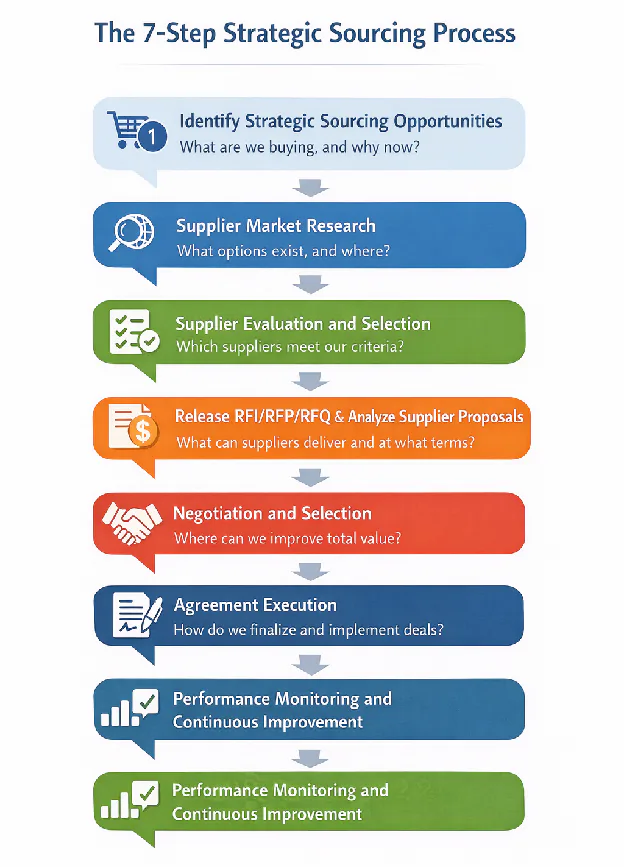
Step 1: Identify Strategic Sourcing Opportunities
The company must know what they want to buy and how much they hope to spend on it. So, the procurement team should collect purchase data and organize it by supplier, category, and other factors. This will show current spending patterns and potential optimization opportunities.
The spend analysis offers insights on where strategic sourcing can improve quality or even save costs.
Step 2: Supplier Market Research
This is the stage of understanding the suppliers, who they are, their location, and other essential details. Consider the category you’re sourcing for, identify one or more suppliers, and study the supplier landscape to understand market structure, major players, and capability ranges. This is also the stage where the procurement team benchmarks pricing and capabilities.
Analyze the top suppliers, trends affecting the market, associated risks, and emerging innovations. For instance, if you’re sourcing consumer electronic devices, this is where you check supplier compliance with FCC, CE, and RoHS requirements, verify test reports from accredited labs, and confirm the factory’s experience with market-specific regulations in the US and EU.
Step 3: Supplier Evaluation and Selection
Here, you evaluate suppliers and narrow down to a few qualified ones. You define the most important criteria, such as price, quality, technical capability, reliability, and more. Use your business needs as the criteria to assess potential suppliers.
During evaluation and selection, you also review supplier information, such as financials, certifications, and business records. You send out RFIs to gather details, meet with suppliers, or even tour facilities, as the case may be. These processes should leave you with a shortlist of qualified suppliers.
Step 4: Release RFI/RFP/RFQ & Analyze Supplier Proposals
At this stage, you invite the selected suppliers to bid for your offer. This is also where you communicate with suppliers, review supplier feedback and submissions, and outline findings. After considering and analyzing supplier proposals, you shortlist those that meet the criteria for the final round of negotiations. You may use scorecards or rating systems to assess each proposal.
Step 5: Negotiation and Selection
In this final negotiation, you consider all requirements of the business. Remember that strategic sourcing goes beyond getting the lowest possible price. Effective negotiations should address delivery schedules, payment terms, quality assurance, compliance, warranty terms, and the flexibility of suppliers to handle emergencies or changes in order.
Typically, many companies negotiate with several suppliers to get the best deal. Given the nature of work here, the legal team will usually work with the procurement team to flesh out the terms of a potential collaboration.
Step 6: Agreement Execution
This is where you start to formalize business relationships. You draft, negotiate, and finalize the contract with the chosen supplier. Beyond signing the contract, it is about executing the agreement. This may include activities such as onboarding the new supplier and updating internal records and related processes, such as how to order from the supplier and implementing changes.
Step 7: Performance Monitoring and Continuous Improvement
This is the final stage where supplier management kicks in. With implementation underway, there’s still work to do, which includes tracking KPIs like responsiveness, on-time delivery, and cost savings targets. It is also normal to review performance with the supplier. If they are performing well, contracts may be extended or expanded. And if the supplier is falling short, the team can work on corrective measures or consider alternatives as the case may be.
Strategic Sourcing vs. Category Management
Category management and strategic sourcing have different scopes and focuses. Category management is more of a broad strategy that can have strategic sourcing within it, while strategic sourcing is narrower and focused on the procurement process.
Strategic sourcing deals with the end-to-end process that a company uses in managing a specific procurement. The goal is to get the best value possible, and this can be achieved based on how the team identifies, evaluates, and selects suppliers to meet company needs.
Category management is broader. It covers how a company plans and manages spending within each category. So, it may include demand management, stakeholder needs, market dynamics, and the long-term objectives of a business.
The Role of Technology in Strategic Sourcing
Strategic sourcing becomes difficult to scale when teams rely on spreadsheets, email threads, and disconnected systems. As spend grows and supplier networks expand, manual processes slow down decisions and introduce errors. This is where technology plays a critical role.
Modern sourcing tools help centralize spend and supplier data, giving teams a clearer view of where money goes and which suppliers drive the most value and risk. Instead of pulling data from multiple systems, procurement teams can work from a single source of truth that supports better analysis and planning.
Technology also improves how suppliers get evaluated and compared. It supports consistency, ensuring you can apply the same standards across categories and regions. And with automation tools, businesses can also reduce manual work and save time.
Where Technology Adds Value in Strategic Sourcing
Here are some of the ways technology can enhance strategic sourcing processes.
| Strategic Sourcing Activity | Common Manual Challenge | How Technology Helps |
|---|---|---|
| Spend analysis | Scattered data | Centralized, structured data |
| Supplier research | Time-consuming | Faster discovery and filtering |
| RFQ comparison | Inconsistent formats | Normalized responses |
| Supplier follow-up | Repetitive emails | Automated outreach |
| Decision-making | Limited visibility | Side-by-side comparison |
How ChinaSource**** Supports Strategic Sourcing
Strategic sourcing works best when you have clear requirements and consistent supplier information. ChinaSource is an AI-powered sourcing platform that helps you find, qualify, and compare suppliers.
It structures the early sourcing stage, where you define specifications, volumes, pricing targets, lead times, and compliance needs. This reduces back-and-forth, limits scope changes, and keeps suppliers aligned from the first outreach.
It also improves how you assess suppliers. You see how suppliers respond, what they confirm, and where they push back. That behavior tells you more than a profile page and helps you decide which suppliers are suitable for long-term partnerships.
ChinaSource also makes supplier comparison easier. Quotes and terms follow the same structure, so you can compare suppliers on equal ground. The platform handles follow-ups and data cleanup while keeping supplier details and conversations visible. This reduces the manual work without limiting your control.
How ChinaSource Works
1. You post your inquiry, and ChinaSource’s AI clarifies the requirements via chat.
2. Next, ChinaSource digs into its database of customs trade records and overseas business contact data to find the best-fit suppliers.
3. ChinaSource can handle outreach in suppliers’ native languages to collect quotes and key terms via multi-round follow-ups.
4. You receive a list of ready suppliers, enabling you to select, initiate the sourcing, formalize agreements, and align proposals.
Challenges Organizations Face While Implementing Strategic Sourcing
Strategic sourcing sounds straightforward on paper, but putting it into practice often comes with real operational and organizational challenges.
Poor Data Quality and Fragmented Spend Data
Many companies do not have a clear view of their spending. They also have data scattered across different systems with a supplier name mismatch. Using this kind of data often leads to poor results. To address it, create one source of truth for spend and supplier information. Clean supplier names and link pricing, terms, and history to the same records.
Resistance to Change
After onboarding new suppliers, there are usually updates to the system and some processes change. Employees may resist these changes due to their comfort in existing routines or fear of job security. Hence, it's essential to involve employees and relevant stakeholders in the process and train them on the benefits of the strategic sourcing initiative.
Weak Strategic Alignment
Poor communication between leadership and procurement, unclear sourcing objectives, and even poor data quality can lead to improper strategic alignment. It shows up as sourcing decisions that focus on short-term savings while ignoring long-term business goals.
Set up integrated planning sessions to create alignment. Using a cross-functional team also helps with cohesion, as the team can be made up of members from all relevant departments. Also, ensure that established goals and KPIs align with the organization's objectives.
Complex Global Supply Chains
Managing a global supply chain offers multiple challenges. You have to deal with sometimes totally different cultural, economic, and geopolitical factors. This adds a layer of complexity to the process.
Dealing with this requires that you train the procurement and legal team on legal requirements and cultural differences. Use risk management tools to monitor risks across multiple regions. Also, diversify your supplier base to reduce dependence on suppliers in specific regions.
Maintaining Compliance
Managing regulatory compliance and ethical standards can be difficult when dealing with suppliers in different parts of the world. There are many environmental regulations, labor standards, and ethical issues to keep up with.
You can manage this by validating suppliers against known standards such as ISO certifications, BSCI audits, or product compliance requirements like RoHS, and only engaging suppliers that can provide verified documentation and audit records.
Strategic Sourcing Best Practices
Strategic sourcing best practices help teams apply a consistent, structured approach to supplier decisions instead of relying on ad-hoc buying. Here are a few to note.
- Plan With a Sourcing Calendar: Organize your sourcing plan around a detailed calendar. The calendar should note important dates, timelines, milestones and events that may affect the sourcing process. This enables you to monitor seasonal trends and plan around budgetary cycles.
- Analyze Total Cost of Ownership (TCO): Assess every cost associated with the goods and service acquisition and management across their lifecycles. Consider everything from price to operating costs, maintenance, licensing, labor, etc. Ensure that your TCO analysis also covers potential costs associated with product quality and supplier issues.
- Use Sourcing Events to Validate Suppliers: Set up sourcing events, whether online or live, to identify a pool of suppliers for your procurement needs. Use such events to understand their offers and terms, and negotiate with different vendors at one time. Using sourcing events can speed up strategic sourcing efforts.
- Leverage Technology: Using modern tools, such as an AI-powered procurement system, can help automate the procurement process, improve data accuracy, and provide more reliable supplier performance insights.
- Understand and Manage Requests: Know when to use the different types of requests. Use a Request for Information (RFI) to gather general information about a potential vendor. Use a Request for Proposal (RFP) to seek proposals from suppliers on how they would approach a specific project you have in mind. Use a Request for Quotation (RFQ) when you clearly know your requirement and need pricing information from a supplier.
FAQS
What is Strategic Sourcing?
Strategic sourcing is a holistic approach to finding suppliers, with a focus on how partnering with those suppliers can support the goals of the business. It is a structured approach to deciding whom you buy from and why. Instead of choosing suppliers based only on price, you consider total cost, supplier capability, risk, and long-term fit. The goal is to build a supplier base that supports your business over time, not just to close the next order.
How is Strategic Sourcing Different From Traditional Sourcing?
Traditional sourcing focuses on filling an immediate need and doing it at the lowest cost possible. In contrast, strategic sourcing is more holistic and forward-looking. It goes beyond pricing and caters to how a business plans demand, evaluates suppliers, and makes decisions based on long-term value rather than short-term convenience.
The table below compares traditional procurement and strategic sourcing across key areas.
| Area | Traditional Procurement | Strategic Sourcing |
|---|---|---|
| Time horizon | short-term | Long-term |
| Primary focus | Unit price | Total cost and value |
| Supplier approach | Transactional | Relationship based |
| Decision drivers | Immediate need | Business goals and risk |
| Data usage | Limited | Spend and market analysis |
When Should a Company Use Strategic Sourcing?
A company may use strategic sourcing when it's expanding its spend, if suppliers are critical to its operations, or when its buying decisions start to impact cost, risk, or long-term business goals. It is especially useful for companies dealing with custom products, global sourcing, and categories with many supplier options.
Why Do Many Strategic Sourcing Initiatives Fail?
Many strategic sourcing initiatives fail because companies treat them as one-time cost-cutting exercises rather than as ongoing, cross-functional processes tied to real business goals. Without clear ownership, clean data, and executive support, the strategy breaks down during execution.
Can Small or Mid-Sized Companies Use Strategic Sourcing?
Yes. Strategic sourcing is not limited to large enterprises. Smaller teams may benefit even more, as they need greater focus and control with limited resources. A clear process helps them avoid reactive buying and choose suppliers that can support growth.
Final Thoughts
A structured strategic sourcing approach helps teams understand where spending is concentrated and why. It brings discipline to how they evaluate, select, and manage suppliers over time. More importantly, it connects procurement activity to broader business goals, rather than treating sourcing as a standalone function.
As organizations grow, supplier choices become more than simple transactions and start to shape product quality, operational risk, and competitive position. This process can become time-consuming for many companies.
This is where an AI-driven platform like ChinaSource proves its value. It automates early-stage sourcing tasks, saving you time and providing a list of best-fit suppliers to work with. If you’re looking to streamline your strategic sourcing initiative, look no further than ChinaSource. Talk to an expert today to learn more.