
Top 10 Global Sourcing Software for 2026


When sourcing internationally, procurement teams face various issues, including international regulations, price changes, exchange rate fluctuations, trade policy differences, and at times, political risks. These issues create uncertainties and increase risk, making it difficult to find reliable suppliers and sources at consistent prices, quantities, and lead times.
Businesses need global sourcing software to gain visibility into markets and suppliers and manage supplier communication and sourcing workflows. For instance, many use tools like ChinaSource to find suppliers, manage outreach, and organize supplier data, thereby easing the tender process. There are also other tools that handle different parts of the sourcing and procurement workflow.
What Is a Global Sourcing Software?
Global sourcing software is a digital platform or tool that businesses use to find, evaluate, and engage suppliers, and, in some cases, to support contracting and ongoing supplier management globally. It helps to manage RFQs and supplier selection, track supplier performance, and supplier communication across countries.
With these functions centralized in one tool, there is less risk of data fragmentation. As such, order tracking, RFQ tracking, supplier communication, and document management become easier to manage.
Functions of Global Sourcing Software
Global procurement software standardizes sourcing processes, enabling teams to compare prices across regions, assess supplier specialization, and partner with the best fit. Here are some specific tasks the software handles.
Supplier Discovery and Verification
Global sourcing software uses data-driven matching, filters, and in some cases, machine learning to search supplier databases and internal records. It provides advanced filters that businesses can use to narrow down options using location, capabilities, and category expertise.
Some tools also display public supplier profiles that include audit reports and certifications, where available or depending on the platform. With layered verification and display of vetted suppliers, the software can reduce the risk of unreliable and unverified suppliers.
Compliance Management
Global sourcing software facilitates data sharing, allowing suppliers to submit export licenses, certifications, audit reports, and regulatory documents. It uses AI, audit trails and rule-based checks to verify some compliance records.
Communication and Collaboration
A standard feature of many global sourcing software solutions is an in-built messaging platform. This feature makes it easier for teams to share updates and requirements as all conversations are centralized. The messaging platform also supports meeting scheduling and file sharing, enabling supply partners to maintain transparent communication during sourcing.
Supplier Risk Tracking and Performance Monitoring
Sourcing software tracks metrics to identify issues like late deliveries, quality problems, or missed commitments. This allows teams to find gaps in supplier performance that can lead to quality issues or delivery failures. They can also flag risk indicators such as inconsistent lead times, enabling businesses to plan their risk management.
Some also feature customizable scorecards, which procurement teams can adapt to reflect product type, industry, and category. These tools help businesses to monitor supplier performance, enabling them to know when to increase volume, renegotiate or turn to other suppliers.
End-to-End Visibility
Digital global sourcing platforms include built-in dashboards that track sourcing processes based on data inputs. They present quantitative and qualitative data from each stage and show sourcing data through dashboards and reports.
From these dashboards, teams can observe the processes, milestones, and setbacks in the sourcing cycle. The dashboard also links sourcing activities with operational data to show how vendor performance and pricing affect sourcing outcomes.
Process Automation
The software uses conditional-logic triggers to automate manual routine tasks throughout the lifecycle. It can send RFQs, organize vendor responses, follow up, send reminders for document submissions, and update sourcing status or workflow stages.
Top 10 Global Sourcing Software
Global sourcing software improves end-to-end coordination of data, documents, suppliers, and sourcing activities. But there are several software options, each offering different features and capabilities. Here are common sourcing tools with an overview of their pros and cons to guide selection.
1. ChinaSource
ChinaSource supports early-stage global sourcing, where procurement teams struggle with unclear requirements and inconsistent supplier responses. It guides buyers through requirement clarification, manages outreach at scale, and standardizes supplier responses into comparable fields like price, MOQ, lead time, and payment terms, making it easier to compare suppliers side-by-side.
Key Features
- AI-guided requirement clarification.
- Multi-round supplier outreach at scale.
- Quote standardization and comparison.
- Transparent supplier shortlist.
Pros
- Reduces back-and-forth with suppliers.
- Works well for unclear or custom requirements.
- Makes supplier comparison faster and clearer.
Cons
- Focused on sourcing, not full source-to-pay.
- Limited contract and invoicing features.
2. Jaggaer
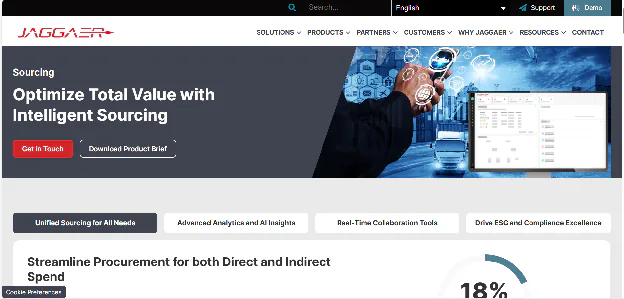
Jaggaer covers the full source-to-pay spectrum. It sources suppliers that manufacture core business products and those that provide support services. The software provides usage insights and guidance to improve adoption. It also helps businesses identify ways to improve sourcing workflows and supplier selection.
Key Features
- AI-powered supplier recommendation.
- Source-to-contract management.
- Audit trail maintenance.
- Scenario-based simulation.
Pros
- It can handle manufacturing-grade sourcing activities.
- It has an internal award navigation system.
- Real-time alerts promote buyer agility.
Cons
- New users need technical training.
- Customers complain of higher renewal prices.
3. Procol
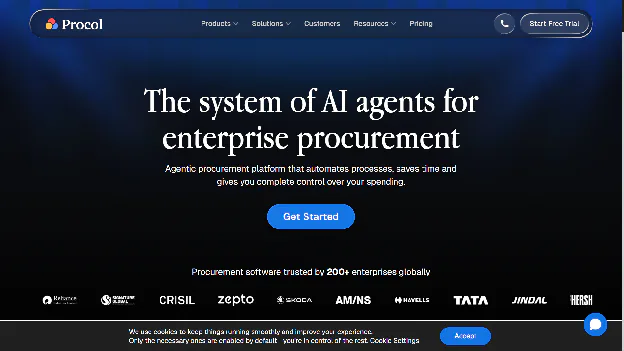
Procol software enables competitive pricing by automatically converting supplier quotes into bids to kickstart auctions. The platform supports over 40 types of forward and reverse auctions and supports AI-assisted negotiation and auction optimization.
Key Features
- Supplier collaboration portal.
- Modular flexibility.
- Anonymous sourcing agents for automated bids, RFQs, and negotiations.
Pros
- Supports integrations and modular configuration; teams can adapt workflows and sourcing events.
- supports supplier discovery through its network and integrations.
- It integrates external data such as market trends or supplier activity.
Cons
- It operates with a smaller network, which limits its benchmarking potential.
- It’s usually unstable during releases.
4. Proactis
Proactis software provides step-by-step sequences to train users on how to use the platform and its features correctly. It explores spending patterns and purchasing trends across locations, giving B2B buyers better visibility into regional pricing differences when planning purchases.
Key Features
- E-catalog for guided buying.
- Hybrid execution model.
- Unified multi-method sourcing.
Pros
- It has a good supplier invitation rate and swift approval workflows.
- Advanced cost intelligence.
- Its interface is easy to use.
Cons
- It’s a bit difficult to set up.
- Limited customization abilities.
5. Ivalua
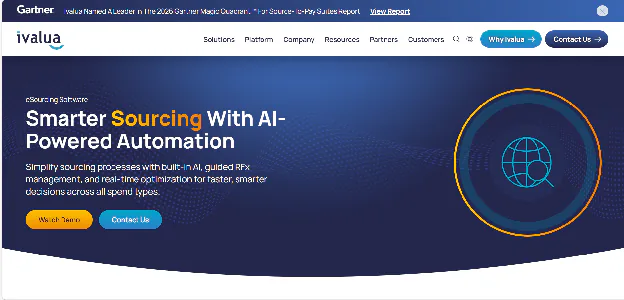
Ivalua is a highly configurable software that delivers adaptable solutions to B2B startups and corporations. Businesses can use this software to gain insights into sub-suppliers and the upstream supply chain. This ability makes it easy to spot risk from sub-suppliers or undisclosed dependencies.
Key Features
- Pre-built external connectors.
- AI agents for category intelligence.
- Proactive compliance guardrails.
Pros
- Businesses can configure it to suit industry specifications.
- Highly configurable but may require IT support.
- Its modules cover several business needs.
Cons
- Performance isn't always optimal during data extraction.
- Users struggle to connect it to legacy systems.
6. SAP Ariba
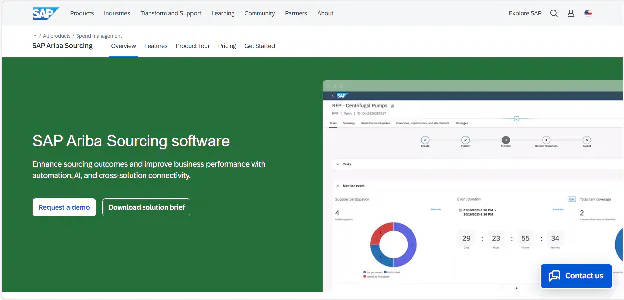
SAP Ariba is a cloud-based platform that supports sourcing, supplier discovery, and procurement workflows. It also supports a range of auction types, including index-based, Japanese, Dutch, and transformation auctions. Users have access to the private SAP business network, which supports the discovery of ESG-compliant vendors.
Key Features
- Intelligent auction and bidding tools.
- Simplified sourcing intake.
- AI‑assisted automation from sourcing request to award.
Pros
- AI-assisted tools help create and manage sourcing events.
- Cross-module visibility.
- It offers smart recommendations.
Cons
- Procurement teams may need expert support to customize workflows.
- It’s best suited to enterprises.
7. Zycus
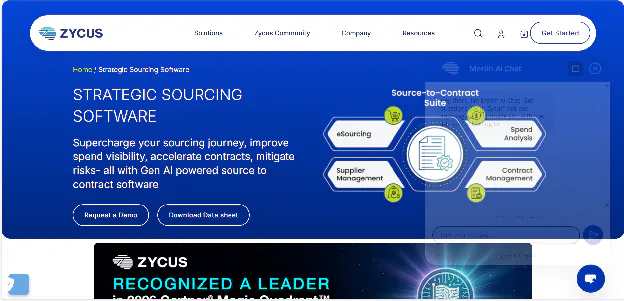
Zycus offers comprehensive capabilities, including its flexi-builder, which allows users to create layered pricing tables. Procurement teams can use MS Excel spreadsheet formulas in these tables to calculate financial information, such as total cost. The software also has a dedicated intake portal and an AI function that summarizes compliance reports and other sourcing-related documents in simple language.
Key Features
- Multi-envelope and proxy bidding.
- Live price checking.
- Cognitive procurement system.
Pros
- Its predictive insights are mostly accurate.
- It has a conversational AI interface for discussing decisions.
- Businesses can customize features and adapt them as their needs evolve.
Cons
- Occasional lagging.
- The user interface is outdated.
8. GEP Smart
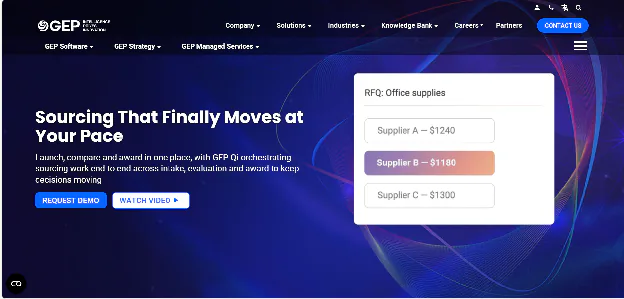
The GEP Smart Sourcing software helps businesses to orchestrate sourcing end-to-end across intake, evaluation, and award. It offers a detailed cost breakdown of products and services. GEP Smart uses cost-decomposition models to assign prices to individual components, so buyers can see the markup and negotiate favorable deals.
Key Features
- Autonomous sourcing by GEP Qi.
- Real-time finance and savings analysis.
- Itemized sourcing with insights from the bill of materials.
Pros
- It provides market and cost intelligence insights
- Businesses can get recommendations for alternative supplier options.
- It provides lasting strategic value.
Cons
- Bugs can hinder connectivity to company systems.
- Additional licensing can be costly.
9. Basware
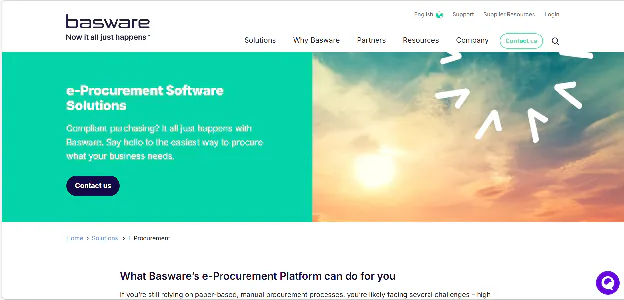
Basware is a source-to-pay software service that allows integrated shopping. This means that sourcing and procurement officers can access free-text forms, catalogs, and punchouts from the homepage. During long, high-value contracts, it records and tracks invoices to ensure that they match purchase order agreements. It flags discrepancies immediately, enabling instant issue resolution.
Key Features
- Automating mass supplier payments.
- Digital purchase requisition management.
- Built-in global VAT and tax compliance engine.
Pros
- Early payments help to avoid late fees.
- Incremental AI improves automation.
- Seamless global supplier connectivity.
Cons
- Sometimes, error messages are unclear.
- Unstable customer support.
10. Coupa
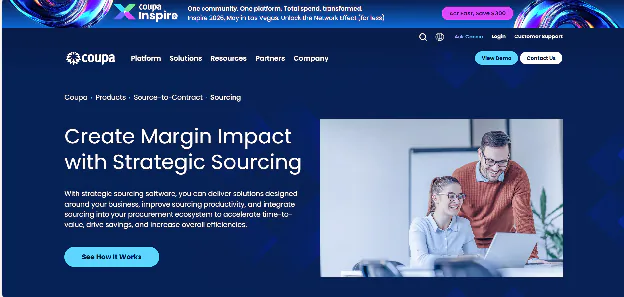
Coupa is a source-to-contract management software that combines sourcing, procurement, and expense management. It supports AI-driven tariff impact planning and demand modeling, enabling organizations to improve their supply chain planning and strategies.
Key Features
- AI-driven data extraction from suppliers’ PDFs.
- Travel expense management.
- Real-time reporting.
Pros
- It uses various internal and external data sources to provide complete supplier overviews.
- Users can access instant answers to sourcing-related questions through Navi, Coupa’s generative AI.
- Availability of peer insights from a large community.
Cons
- It requires training before use.
- It uses seat-based pricing, which is costly for small businesses.
How Global Sourcing Software Works
Here are the steps of how global procurement software turns sourcing into a continuous, transformative lifecycle.
Step 1: Spend Analysis
Without a proper understanding of cash outflows and purchasing patterns, companies may waste resources on unnecessary or high-cost purchases. Sourcing software pulls financial information from the business’s accounting and enterprise platforms, as well as vendor portals. It compares internal and external records to find indicators of wasted spend, such as overbilling. It identifies consolidation opportunities, cost-intensive products, and opportunities to earn discounts from bulk purchases.
Step 2: Supplier Discovery
Sourcing software matches suppliers based on available profile data and filters. In some cases, it can also use available performance data or internal benchmarks to help identify qualified suppliers.
Step 3: Supplier Evaluation
From the list of verified suppliers, the software compares their profiles, past performance, external risk data, and RFQ responses. The software standardizes the data and uses the buyer’s criteria to score and compare suppliers. It displays price, lead time, capacity differences and risks, enabling teams to evaluate each offer side by side.
Step 4: RFx and Bidding
Sourcing software targets selected suppliers to request quotations, information, and proposals. The request documents typically contain clear instructions and requirements. Suppliers submit their bids via the platform, and buyers can then review offers and negotiate.
Some software allows buyers to run reverse auctions, where suppliers compete by lowering their bids in real time. The software helps organize bid data and evaluation results, enabling buyers to compare offers and make decisions.
Step 5: Contract Management
Some tools offer a bid-to-contract conversion feature to create a contract document. During bidding, buyers and suppliers agree on service levels, quality standards, and other contractual terms. The procurement team can then generate a contract using bid data or use the system’s contract templates and clause libraries.
In platforms with contract management capabilities, the system stores the contract and can track key terms, sending notifications for renewals, milestones, and expirations.
Step 6: Supplier Relationship Management
Throughout the contract, the software tracks suppliers' activities, notes any performance issues, and updates scorecards. Procurement teams can then use these insights to detect risks and collaborate with suppliers to improve performance. They can also use these insights to run regular supplier reviews, address issues early, and decide whether to increase, reduce, or reallocate order volumes.
Benefits of Using Global Sourcing Software
B2B companies that use strategic sourcing software for purchase and importation gain the following:
- Improved Process Efficiency: The automation function improves data accuracy by removing manual handling at common error points. This reduces errors and delays in the sourcing cycle.
- Better Supplier Selection and Award Decision-Making: With the software as a unified data source, procurement teams can analyze supplier data and pricing, compare suppliers, and assess supplier risk, enabling faster, more consistent supplier selection and award decisions.
- Improved Negotiation Leverage: The software provides buyers with visibility into historical pricing, enabling them to benchmark supplier quotes and negotiate more effectively. It also highlights price differences across regions, so buyers can choose more cost-effective sourcing options.
- Stronger Supplier Relationships: In-platform communication speeds up responses, facilitates feedback sharing, and supports co-planning. This helps address performance issues and supports accountability and quick issue resolution.
How to Choose the Right Global Sourcing Software
There are many global sourcing software programs, each one offering different features. As such, the benefits of using each one differ. That’s why B2B companies must select software that helps them achieve goals. The following guide outlines how to make the right choice.
Step 1: Assess Your Business Needs
Identify key sourcing requirements and the main inefficiencies in your current process. Measure the average supplier onboarding time. If the review, approval, and activation processes are slow, the team needs a tool that centralizes onboarding workflows.
If you rely on spreadsheets and email threads, check the processes to understand how you track and compare supplier responses. If you experience delays, missing information, or inconsistent data in this process, then it could be worth addressing. You can also check for frequent compliance issues linked to supplier violations.
Step 2: Evaluate the Software’s Features
Review global sourcing software and its features to understand how each option fits your sourcing process. Read online reviews and ask vendors how specific features work in real use.
Request a demo with your requirements, ask for a walkthrough, run a test RFQ, and check how the platform handles your sourcing workflow. Check pricing and free trial options, and review which features are available in each plan. Then compare how well each tool addresses your sourcing challenges.
Step 3: Check Software Integration Capabilities
Ask the software provider to demonstrate how it connects with BI tools, ERPs, and supplier portals through APIs. Ensure that it integrates with the business's existing tool stack to maintain continuity across sourcing workflows. Interoperability is essential for preventing siloed data and extracting and unifying data.
Step 4: Consider Ease of Use and Adoption
Check if the tool has clear dashboards, drag-and-drop features, tooltips, and guided walkthroughs. These features make it easier for teams to adopt the system. Test usability through vendor demos or a pilot.
Step 5: Check for Vendor Support and Scalability
Confirm whether the software company offers support through channels like email, chat, or account managers and responds quickly to inquiries. Use customer reviews to gauge whether the software can support larger and more complex sourcing activities. Check the software roadmap and release notes to confirm that there are regular updates and feature improvements that support changes in your sourcing needs.
Once you’ve assessed your needs and evaluated your options, you can match your requirements with the right sourcing platform.
Type of Platform to Prioritize Based on Sourcing Needs
Here’s a quick guide on platforms you can choose depending on what sourcing problem you want to address.
| Sourcing Need | Type of Platform to Prioritize | Why It Fits |
|---|---|---|
| Unclear product specs or first-time sourcing | Early-stage sourcing platforms (e.g., ChinaSource) | Helps clarify requirements, gather complete supplier data, and structure quotes |
| Running competitive RFQs across multiple suppliers | eSourcing/RFx platforms (e.g., Procol, Zycus) | Supports structured RFQs, bid comparison, and supplier evaluation |
| Driving price competition at scale | Auction-based sourcing platforms (e.g., SAP Ariba, GEP) | Enables reverse auctions and real-time bidding to reduce costs |
| Managing complex, multi-category sourcing | End-to-end source-to-pay suites (e.g., JAGGAER, Ivalua) | Covers sourcing, contracts, suppliers, and procurement in one system |
| Improving supplier performance and long-term relationships | SRM-focused platforms or modules | Tracks performance, scorecards, and supplier collaboration |
| Handling compliance-heavy or regulated sourcing | Platforms with strong compliance and audit features (e.g., Basware) | Supports document tracking, audit trails, and regulatory checks |
| Integrating sourcing with finance and procurement | Full procurement suites (e.g., Coupa) | Connects sourcing with purchasing, invoicing, and spend management |
Best Practices for Implementing Global Sourcing Software
Companies that invest in global sourcing software need to use it properly to get value. Here are some best practices to follow:
- Define clear sourcing goals and address data and process issues before deployment.
- Train procurement and sourcing teams to use the software effectively.
- Localize internal workflows to reflect regional differences.
- Monitor performance, adapt, and restrategize when necessary.
FAQ Section
Can Global Sourcing Software Replace Sourcing Agents?
Global sourcing software can reduce reliance on sourcing agents by automating supplier discovery, outreach, and comparison. However, agents may still be useful for on-the-ground verification, factory audits, or managing complex supplier relationships in specific regions.
How Long Does It Take to Implement Global Sourcing Software?
The implementation timeline depends on factors such as your business size, sourcing process structure, and the software's technical requirements. Processes such as system integration and data migration also take time. These factors determine whether it can take days or weeks to fully implement.
How Does Global Sourcing Software Ensure Supplier Reliability?
Most global sourcing software includes built-in tools, such as performance trackers and vendor scorecards, that support supplier evaluation. These tools assess the quality of a supplier’s products, shipping frequency, lead-time accuracy, and other metrics that provide insight into the timeliness of a supplier's deliveries.
Can Global Sourcing Software Help With Logistics and Shipping?
Though the primary function of sourcing software is supplier management and procurement, some software products, such as GEP Smart and Oracle Cloud, offer logistics modules that can be integrated. Most modern sourcing software is interoperable. Hence, they integrate with logistics planning and tracking tools, enabling B2B buyers to align procurement activities with shipping timelines.
What Kind of ROI Can Businesses Expect When Using Global Sourcing Software?
Businesses achieve faster sourcing cycles, better price benchmarking, and fewer sourcing errors. By standardizing quotes and reducing back-and-forth with suppliers, teams save time on data collection and cleaning and speed up supplier selection. Teams can also expect to reduce costs through clearer supplier comparisons, which help them identify more competitive pricing.
Final Thoughts
Expanding sourcing across global markets is no longer optional for B2B companies looking to stay competitive. But without structured processes and clear supplier data, international sourcing can quickly lead to delays, inconsistent quotes, and poor supplier decisions.
Global sourcing software helps teams structure this process by centralizing supplier discovery, standardizing RFQs, and improving supplier comparisons. ChinaSource focuses on the early stages of sourcing, where most inefficiencies occur. By helping buyers clarify requirements, collect complete supplier responses, and compare quotes in a structured way, it makes it easier for teams to move from initial inquiry to a confident sourcing decision. Talk to us today to learn more.