
What is a Vendor Scorecard: A Guide for Procurement Teams


Without tracking supplier performance data, businesses cannot detect delays, defects, or cost changes early. This can lead to missed deadlines and higher operating costs. As a result, procurement teams need to monitor suppliers and track their performance using structured tools and data-driven systems.
Many organizations also use sourcing platforms such as ChinaSource to discover, qualify, and shortlist suppliers before entering long-term procurement relationships. Once suppliers begin delivering goods or services, tools such as vendor scorecards help companies monitor their ongoing performance.
While individual observations are subject to bias, a vendor scorecard compiles performance data, often sourced from operations, logistics, and finance systems. These data insights enable brands to identify high-performing suppliers and reduce reliance on underperforming ones. But what is a vendor scorecard, what is its content, and how does it work?
What Is a Vendor Scorecard?
A vendor scorecard is an assessment tool businesses use to monitor supplier performance and determine whether suppliers deliver as expected. Other names for this tool include supplier scorecard and supplier performance scorecard.
It uses defined KPIs and scoring rules to assign grades to criteria that reveal how well suppliers fulfill their responsibilities. Scorecards take many forms, including documents, spreadsheet tables, radar charts, and graphical templates that aid visualization.
Vendor Scorecard vs. Vendor Evaluation
Business users may confuse vendor scorecards with vendor evaluation. Although vendor evaluation and scorecards belong in a single workflow, they differ in focus, purpose, and timing.
| Vendor Scorecard | Vendor Evaluation |
|---|---|
| It is a tool used to measure and monitor supplier performance. | It is the process companies use to assess vendors. |
| It serves as a consistent framework for continuously monitoring supplier performance. | It helps companies select qualified suppliers and confirm that they meet expectations. |
| Companies primarily use it to monitor supplier performance during ongoing vendor management. | The process takes place during supplier sourcing and selection. |
| It relies on operational performance data such as delivery rates, defect levels, and cost consistency. | It relies on capability assessments such as certifications, capacity, experience, and compliance. |
| It is used after suppliers begin delivering goods or services. | It occurs before and during supplier approval and selection. |
During vendor evaluation, companies identify suppliers that align with their operational standards, quality expectations, and business values. Many procurement teams use sourcing platforms such as ChinaSource to discover and qualify suppliers before moving forward with formal evaluation and selection.
Why Vendor Scorecards Matter in Procurement
Scorecards are useful because they turn supplier management into a repeatable review system tied to thresholds, trends, and actions. It ensures that teams can track supplier performance against clear metrics and enables them to act based on defined thresholds. They ensure that supplier decisions are based on the same criteria across the organization.
Key Components of a Vendor Scorecard
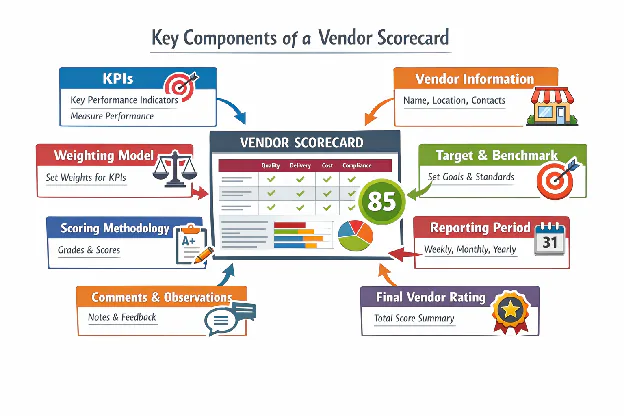
Ideally, supplier scorecards should have some similar components across the board, though they can be adjusted based on needs or industry. Here are the major elements that should be present in a supplier scorecard.
- Key Performance Indicators (KPIs): These are measurable criteria for assessing performance. KPIs help you to objectively identify specific areas where suppliers excel or underperform.
- Vendor Information: This includes the company's name, location, contact details, and its goods or services. It provides the structured data needed to accurately measure, compare, and manage supplier performance.
- Weighting Model: A weighting model defines how much each KPI contributes to the final score. Many companies set weights based on their priorities, with higher weights given to factors that affect cost, production, and compliance.
- Target and Benchmark: The target and benchmark are the expected level of performance that each vendor should meet or exceed.
- Scoring Methodology: The scoring methodology defines how you rate vendor performance using numbers, grades, percentages, and color codes.
- Reporting Period: The reporting period specifies the timeframe for the evaluation, which can be weekly, monthly, or yearly.
- Comments and Observations: These are the general notes on supplier performance. It captures key issues and recommendations that add context to the scores.
- Final Vendor Rating: The final rating shows the total score of a supplier and serves as a reference for comparison.
Common Vendor Scorecard Metrics
Vendor scorecard metrics are measurable criteria used to evaluate supplier performance across areas like quality, delivery, cost, and compliance. Organizations must choose the metrics that are most valuable in their industry and reflect the nature of suppliers’ products. Regardless, some metrics, such as the following, are widely used:
Product Quality
Quality can affect a company's reputation, either positively or negatively. The product quality metric measures how well a supplier meets quality expectations and specifications. Common indicators used to measure product quality include:
- Defect Rate: The percentage of units that fail quality checks.
- Specification Compliance: The percentage of products that meet the agreed specification.
- Return Rate: The percentage of products returned due to quality issues.
On-Time Delivery (OTD)
On-time delivery measures how consistently a supplier delivers orders on the agreed date. It’s important to track this as vendors may commit to specific delivery dates and fail to meet them. Here are the sub-metrics to track OTD.
- On-time Delivery Rate: The percentage of orders delivered on schedule
- Delay Frequency: The percentage of shipments delivered late.
- Lead Time Accuracy: The difference between promised and actual lead time.
Cost and Pricing
This measures the consistency, transparency, and competitiveness of a supplier’s pricing. When prices fluctuate without a justifiable explanation or when extra charges and hidden fees rise, businesses struggle to control costs. Here are common cost and pricing metrics to follow:
- Invoice Accuracy: The total percentage of invoices that match agreed pricing and terms
- Total Cost of Ownership: The unit price plus shipping, duties, and other costs.
- Price Stability: The consistency of pricing over time vs agreed terms.
Responsiveness and Communication
This measures how quickly a supplier communicates as well as how they respond to and resolve issues. Vendors should be accessible via different platforms and ready to provide support on time. Here are some indicators of communication and responsiveness:
- Response Time: The average time to reply to inquiries
- Issue Resolution Time: The time taken to resolve problems.
- Support Availability/Coverage: This is the availability of support across channels and time zones.
Compliance and Risk Management
This measures how well a supplier follows agreed terms, regulations, and required standards. Failure to comply with rules and standards can pose safety hazards that result in legal disputes and penalties for businesses. Here are sub-metrics to track compliance and risk management.
- Contract Compliance: This is the percentage of orders that meet agreed terms and conditions.
- Documentation Accuracy: This is the percentage of complete and error-free documents.
- Safety and Regulatory Compliance: This refers to proof of adherence to required safety and industry standards.
How to Interpret Vendor Scorecard Results
The grades and numbers on scorecards provide clear signals on whether to continue, improve, or replace a supplier. When analyzing scorecard results, consider different factors and use the following approaches to interpret them.
- Weighted Metrics: Most companies use priority-based weighting. So, a high score in a low-weighted area has less impact on the overall rating, while a low score in a high-weighted area requires immediate corrective action.
- Performance Thresholds: Companies decide on the minimum acceptable scores. If the minimum is 6, they may replace a supplier whose grade is lower. Companies usually monitor suppliers scoring slightly above the threshold.
- Trend Analysis: Rather than focusing solely on current scores, procurement teams compare them against previous scores. This way, the business gets the full picture of consistent performance growth or decline.
- Benchmarking: Businesses use industry standards, internal targets, or reports from similar vendors to assess a supplier's competitiveness.
- Action Triggers: Organizations use the overall score to determine their next steps. Depending on supplier performance, they may decide to organize targeted training, renegotiate, or end contracts.
- Visual Indicators: For companies that use color-coded charts, green represents strong performance. Yellow indicates a need for attention, and red highlights underperformance.
Types of Vendor Scorecards
Vendor scorecards are not one-size-fits-all. Their design often depends on the complexity of your sourcing and what you need to control. Vendor scorecards are commonly classified by the structure and the systems used to manage them.
They are commonly classified by structure and the systems used to manage them, and each class has several types, as shown in the table below.
| Category | Type of Scorecard | Ideal Use Case |
|---|---|---|
| Structure Type | Basic Vendor Scorecard | Small teams, low supplier count, early-stage procurement |
| Advanced Vendor Scorecard | Mid to large teams managing multiple supplier categories | |
| Industry-Specific Vendor Scorecard | Specialized or regulated industries, such as the Pharmaceutical Industry | |
| System Type | Manual Vendor Scorecard | One-off evaluation or low-volume sourcing |
| Automated Vendor Scorecard | Organizations with an ERP or logistics system with recurring supplier evaluation | |
| Collaborative Vendor Scorecard | Building long-term relationships with key suppliers |
| Category | Type of Scorecard | Ideal Use Case |
|---|---|---|
| Structure Type | Basic Vendor Scorecard | Small teams, low supplier count, early-stage procurement |
| Advanced Vendor Scorecard | Mid to large teams managing multiple supplier categories | |
| Industry-Specific Vendor Scorecard | Specialized or regulated industries, such as the Pharmaceutical Industry | |
| System Type | Manual Vendor Scorecard | One-off evaluation or low-volume sourcing |
| Automated Vendor Scorecard | Organizations with an ERP or logistics system with recurring supplier evaluation | |
| Collaborative Vendor Scorecard | Building long-term relationships with key suppliers |
Structure Types
The structural classification emphasizes the layout, format, level of detail, and presentation of the scorecard. Examples are:
Basic Vendor Scorecard
A basic vendor scorecard is straightforward, containing a few essential pieces of information that businesses can tweak. It's usually a spreadsheet document. Businesses can choose between an offline solution, such as Excel, or a cloud-based solution, such as Google Sheets.
Advanced Vendor Scorecard
As businesses grow, their demands increase, making it necessary for them to switch to a more detailed tool. Advanced scorecards feature multiple data points from various sources. It combines data from quality, delivery, cost, and compliance into one report.
Industry-Specific Vendor Scorecards
Different sectors attach varying levels of importance to performance metrics, which, in turn, influence rankings. For a better fit, businesses in specialized industries use scorecards that reflect their regulatory standards, priorities, and operational requirements.
System Types
The systemic classification emphasizes the data collection and management approach. Under this category, there are:
Manual Vendor Scorecard
Manual scorecards are usually simple spreadsheets that require data entry and updates by hand. The data entry process is usually slow and error-prone. Therefore, it does not scale well for large organizations with broad supply chains.
Automated Vendor Scorecard
Automated scorecards are often designed to be interoperable, allowing them to integrate with other business systems to extract performance data. These systems can update scorecard data from integrated systems, helping teams keep performance data up to date. However, human supervision is necessary at certain stages, including verification and interpretation.
Collaborative Vendor Scorecard
A collaborative scorecard is one that isn't restricted to internal use. The company obtains consent before monitoring suppliers and grants them access. Thus, vendors observe the assessment and adapt their services as needed.
Benefits of Using Vendor Scorecards
Vendor scorecards help reduce supplier risk by tracking defects, delivery delays, and compliance issues over time. They provide data insights, enabling buyers to identify suppliers with consistently high performance who can handle more volume. Here are some specific benefits.
- Cost Management and Reduction: Scorecards support cost control by linking supplier performance to spending decisions. They highlight where a business can renegotiate terms, shift volume to better-performing suppliers, or replace underperforming ones.
- Better Negotiation Leverage: Scorecards give you a clear view of performance history, providing facts and insights to support pricing discussions, service terms, and accountability.
- Early Risk Detection: Scorecards enable ongoing tracking of defects, delays, and compliance issues, helping you spot problems before they affect operations.
- Continuous Improvement and Alignment: With access to shared performance data, teams can be aligned with the business goals. Also, it helps suppliers understand where to improve and how to meet expectations.
- Increased Transparency: Scorecards improve transparency and communication with suppliers. Through regular feedback, both sides can address issues early, align expectations, and build trust over time.
Steps for Creating a Vendor Scorecard
Businesses can get scorecards by downloading templates, using vendor management software, or building their own. Here are 5 steps businesses can use to create a supplier scorecard.
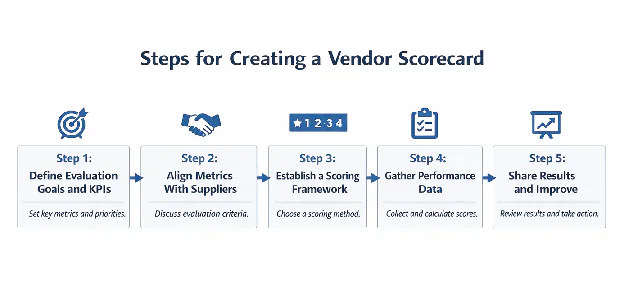
Step 1: Define Evaluation Goals and KPIs
Determine the most important criteria to measure factors that affect operational success. To identify these, seek stakeholder input, analyze business goals, past risks, and contractual agreements.
Then identify the high-risk aspects of vendor performance that most impact your business outcomes and translate them into measurable metrics (KPIs) for tracking. Once you have the KPIs, rank them to reflect the business's supply priorities and allocate percentage weights accordingly. Ensure that the total value of all metric weights is 100%.
Step 2: Align Metrics With Suppliers
Before implementing the scorecard, procurement teams should communicate the evaluation criteria to suppliers. This ensures both parties understand how performance will be measured and prevents disputes later.
Step 3: Establish a Scoring Framework
Choose a method for scoring vendors per metric. A 1 to 5 or 1 to 10 number scale works best with regular weighted scoring. If the selected metrics are based on operational data, percentage-based scoring can be useful because it directly reflects measurable outcomes. Color-coded ratings are best for those who want a simple visual overview.
Step 4: Gather Vendor Performance Data
Many organizations pull supplier performance data from operational systems rather than manually collect it. ERP systems provide data on invoice accuracy, payment terms, and purchase order fulfillment. Logistics systems track shipment status and on-time delivery performance. Quality inspection reports reveal defect rates and compliance with specifications, while finance records show cost consistency and invoice-matching accuracy.
Record the vendor's performance score and multiply it by the decimal value of the metric weight. Repeat this to get the weighted score for each metric, then sum them to get the vendor’s final rating.
Step 5: Share Results and Implement Performance Improvements
After collecting the performance data, you can review scorecards with suppliers during quarterly or semi-annual performance meetings. These discussions help both parties understand the results, address recurring issues, and agree on corrective actions when needed.
If performance problems persist, procurement teams may require suppliers to provide corrective action plans. These plans outline specific improvements and timelines for resolving quality, delivery, or compliance issues.
How ChinaSource Supports Early Supplier Evaluation
ChinaSource helps procurement teams discover, qualify, and shortlist suppliers early on. This helps you build a shortlist of potential suppliers before moving into formal vendor evaluation and ongoing performance monitoring through vendor scorecards.
How ChinaSource Works
1. Define Sourcing Requirements: Buyers submit product specifications, target pricing, MOQ, lead time, and compliance requirements.
2. Automated Supplier Matching and Outreach: The platform matches requirements against supplier data, reaches out to suppliers at scale, and follows up to confirm pricing, capacity, and production capabilities.
3. Supplier Qualification: Supplier responses are organized and compared to help procurement teams identify the most suitable vendors.
4. Decision-Ready Shortlist: You receive a shortlist with normalized data such as price, MOQ, lead time, and terms, with missing information clearly flagged.
Best Practices for Effective Vendor Scorecards
Having a scorecard doesn't equate to mastery of the supplier management process. Businesses must learn to use it properly. It's necessary to develop an approach that gives the right insights that can be applied to the business.
The following are practices that businesses can use to support fair, objective supplier evaluation:
- Select performance indicators that reflect the company's goals and objectives.
- Communicate your evaluation metrics to suppliers so they can put in more effort.
- Consider both performance and risk when evaluating suppliers.
- Use industry standards for vendor comparison.
- Confirm the importance of each criterion to your business before assigning weights.
- Use reports to refine award decisions.
- Work with suppliers to develop implementation roadmaps for corrective strategies.
Common Challenges in Vendor Scorecard Implementation
After businesses create vendor scorecards, they sometimes experience difficulties that prevent them from using the tool. Understanding these challenges makes it easier for procurement teams to formulate strategies to overcome them.
Below are some of the most common implementation issues businesses face:
- Lack of Reliable Data: Human error can lead to missing data fields. Such errors lead to misinterpretations that can alter ratings and strain relationships.
- Data Fragmentation: Without integrated digital tools, supplier information is usually scattered across departments. That makes it difficult to get a complete, accurate view of supplier data.
- Too Many Metrics: Excessive criteria in a scorecard increase its complexity. If many of the indicators are unnecessary, analysis may be more difficult and time-consuming.
- Vendor Resistance: Vendors may resist collaborative scorecards or limit the information they share, especially if they believe the evaluation criteria are too strict or unfair.
- Inconsistent Scorecard Updates: Without a clear workflow, vendor scorecards become less effective as procurement teams may forget to update them.
Businesses can address these challenges by improving data quality, focusing on priority metrics, aligning suppliers on expectations, and setting clear workflows with defined ownership. These issues can be addressed using specific technologies.
Tools and Software for Vendor Scorecards
Managing vendor scorecards at scale often requires dedicated tools that track performance, automate scoring, and organize supplier data. Below are examples of platforms that support vendor scorecards.
- Graphite Connect: Graphite Connect offers supplier scorecard software focused on risk and performance management. It allows teams to build dynamic scorecards that track supplier metrics over time. The platform collects and organizes supplier data, helping businesses monitor performance trends and identify risks early.
- GEP SMART: GEP SMART is a procurement and supplier management platform that supports supplier performance management. It enables teams to track supplier KPIs, automate evaluations, and analyze performance. The system integrates data from sourcing and procurement activities to keep scorecards up to date.
- Kodiak Hub: Kodiak Hub is a supplier relationship management platform with built-in scorecard functionality. It helps companies evaluate supplier performance using customizable scorecards and shared insights. Suppliers can also access feedback, which supports collaboration.
- SAP Ariba: SAP Ariba is a procurement and supplier management platform with built-in supplier performance and scorecard modules (SLP). Its scorecard feature allows users to track KPIs, rate suppliers, and manage performance over time.
The above tools simplify the vendor scorecard process and address the data quality problem as they can integrate with and pull data from different systems, such as ERP systems, P2P platforms, and analytics tools.
FAQ Section
Who Is Responsible for Maintaining a Vendor Scorecard?
Several teams in the buying company jointly maintain the vendor scorecard. That's because different departments oversee different aspects of purchase. For example, while the operations team provides delivery reports, finance monitors costs. Despite the shared input, the procurement team is responsible for overall maintenance and for ensuring proper compilation and evaluation.
Why Are Vendor Scorecards Important in the Procurement Process?
Vendor scorecards help procurement teams identify performance trends and issues early, enabling more data-driven supplier selection and better cost control. They also support risk reduction by highlighting reliability, quality, and delivery gaps, while improving accountability and strengthening supplier relationships. For executives, scorecards provide visibility into supplier performance, risk exposure, and whether procurement activities align with overall business goals.
Can Small Businesses Use Vendor Scorecards?
Supplier scorecards are useful for businesses of all sizes, including small businesses and large enterprises. However, startups mostly use basic scorecards, which are sometimes simple spreadsheet pages. They reference these for insight into supplier behavior, which enables them to make informed decisions.
How Many Metrics Should Be Included in a Vendor Scorecard?
There is no rule regarding the ideal number of metrics businesses should add to a scorecard. But to promote clarity and ease of assessment, many organizations typically track between 5 and 10 KPIs, such as price and cost, on-time delivery rate (OTD), lead-time variance, and supplier responsiveness. It's completely okay for one to surpass this range if all the metrics on the document align with the company's procurement objectives.
Can Vendor Scorecards Be Customized for Different Vendors?
Yes, procurement, supply, or operations teams can customize supplier scorecards to reflect the metrics they want to assess in specific vendors. For example, when assessing a manufacturer, the major criteria are the product quality and adherence to specifications. But for a logistics provider, the scorecard will focus on measuring delivery speed and reliability.
Final Thoughts
Beyond performance monitoring, vendor scorecards can help reduce delays, defects, and unnecessary costs in supplier operations. The application of modern technology transforms evaluations into a proactive, data-driven strategy that enables businesses to scale operations and meet demand.
Modern procurement teams increasingly rely on digital sourcing and procurement platforms to compare suppliers using consistent data before awarding contracts. Solutions like ChinaSource help them discover and qualify suppliers more efficiently, while vendor scorecards enable them to monitor performance after procurement relationships begin.