
Sourcing Services: What They Are, How They Work, and When to Use Them


Many procurement teams are now placing more emphasis on strategic value during sourcing. This requires looking beyond unit cost to factors like reliability, compliance, and long-term fit. While this is a positive shift, many of these companies still lack the right processes to make it work.
They start with vague or unclear specifications, omit key details, and suppliers respond with quotes based on different assumptions. They encounter low-quality or mismatched suppliers, many of which are also difficult to verify, especially when sourcing in new markets.
All of these issues lead to a messy process in which it becomes difficult to compare suppliers, so they end up selecting the wrong fit for the sourcing project. This is where sourcing services add value. These services help organizations to find the right supplier partnerships that match technical, commercial, and operational requirements.
What Are Sourcing Services?
Sourcing services are procurement tasks that help organizations to find, evaluate, and select the right suppliers for goods and services. These services are usually delivered by an organization’s internal team or an external procurement service provider. They typically include supplier discovery, outreach, market research, RFQ management, and negotiation support.
In practice, these sourcing tasks can be handled in different ways. Some teams manage them internally, while others use external providers or digital platforms to support execution. One example is ChinaSource, which focuses on the execution side of sourcing, such as supplier outreach, quote collection, and organizing supplier data into a format that is easy to compare.
What Sourcing Services Typically Include
Sourcing services cover a set of execution tasks that support supplier selection. These tasks focus on managing supplier interactions, collecting data, and preparing it for comparison, and may include:
Supplier Discovery: Sourcing services take your requirements and use them to filter suppliers based on products and services, experience, volume, location, and shipping feasibility. They check trade data, past shipping records, and credibility signals, such as responsiveness, completeness of information, and industry-specific certifications and compliance.
Supplier Outreach and RFQ Management: Sourcing services contact suppliers with clear, consistent requirements and run the RFQ process. They collect key details such as price, MOQ, lead time, and terms, and follow up to fill in any missing or unclear information, ensuring all quotes are complete and comparable.
Quote Normalization: Supplier quotes often come in different formats with missing or inconsistent data. Sourcing services organize and align this information into a consistent format, ensuring all quotes are complete and comparable.
Supplier Comparison and Shortlisting: Sourcing service providers can also help compare suppliers based on key factors such as price, lead time, MOQ, and overall fit with the requirement. Based on this comparison, they narrow down the options to a small group of suppliers that make the most sense to move forward with. The goal is to replace a long, unfiltered list with a focused shortlist that is ready for selecting the right supplier.
Negotiation Support: Some sourcing services also support supplier negotiations, depending on the provider. This may involve negotiating unit costs, clarifying cost structures, requesting better terms, or adjusting conditions like lead time, MOQ, and payment terms. The goal is to secure the best possible terms with the right supplier before placing an order.
Supplier Validation: Sourcing service providers can also assess a supplier's reliability before finalizing the supplier. Some of this happens earlier in the process, such as reviewing company information, verifying past trade activities, and checking certifications if needed. Later, when you're closer to a decision, they can support factory audits, product inspections, or third-party checks to confirm quality and capability.
How Sourcing Services Work (Process)
Sourcing follows a structured process that moves from defining requirements to selecting a supplier. Each step builds on the previous one and helps ensure that decisions are based on clear, comparable information.
1. Requirement Definition
The process usually starts with a requirements definition where you define the services you need, the expectations, quality standards, timelines, and any regulatory compliance requirements.
2. Supplier Outreach and RFQ Stage
Supplier engagement is the stage where you contact identified suppliers, issue an RFQ, and evaluate their responses, capabilities, and commercial terms. This requires sending clear, consistent requirements to all suppliers, actively following up to keep responses moving, and ensuring all quotes are complete and comparable before moving forward.
3. Contract Negotiation
Once you have a shortlist, sourcing services can help with clarifying pricing, scope, deliverables, and performance standards. Pricing can be based on a fixed fee or outcome, and the negotiations also address volumes, change management procedures, and termination rights. Service contracts need to be written more carefully than goods contracts because the way services are delivered can vary.
4. Ongoing Management
This is the final stage of the process, where you monitor the quality of deliverables and track KPIs, milestones, and invoices against the agreed work. It also includes performance reviews and feedback management, and ensuring that any change to the scope is handled through the agreed processes.
In most companies, the internal team defines the requirements, while the sourcing service provider takes over from there to find suppliers, send RFQs, follow up on responses, and compare quotes.
Sourcing Service Models
Sourcing services can be delivered in different ways, depending on the level of support a company needs. Each model varies in scope, level of control, and involvement.
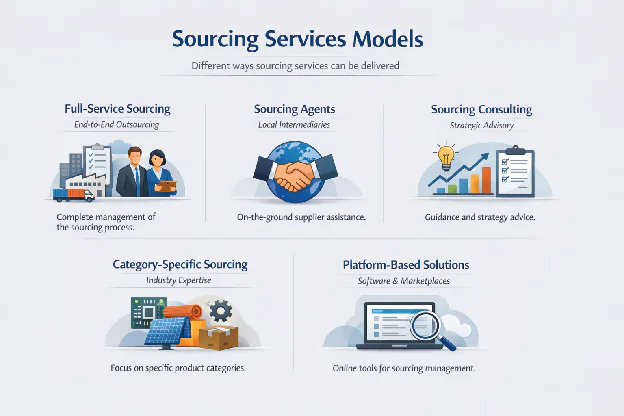
Full-Service Sourcing (End-to-end Outsourcing)
In a full-service sourcing model, you hand over the entire sourcing process to an external provider. The provider takes ownership of the process, managing everything from understanding your requirements to finding suppliers, running RFQs, collecting and structuring quotes, shortlisting options, and supporting negotiations. The internal team defines needs and reviews the final options, while the provider owns the day-to-day execution, including supplier communication.
Sourcing Agents
Sourcing agents act as intermediaries between you and suppliers, usually in a specific country or region. These agents can help you find suppliers, communicate with them, organize product and site inspections, negotiate prices, and coordinate with suppliers during production. Agents are typically more hands-on and locally based, and rely on their network and on-the-ground presence to connect you with suppliers.
Sourcing Consulting (Advisory Services)
Sourcing consultants are more focused on strategy, process changes, and guidance rather than execution. They can help define sourcing strategies, set supplier selection criteria, design RFQ processes, and advise on costs, risks, and supplier structures. In this model, the internal team runs the sourcing process while the consultant provides direction, frameworks, and recommendations.
Category-Specific Sourcing Services
Category-specific sourcing services focus on a specific product category or industry, such as electronics, textiles, packaging, or industrial components. These sourcing service providers bring deep category knowledge, including supplier networks, production processes, cost drivers, and risks. They understand what to look for and can quickly identify suppliers that meet technical and commercial requirements.
Category-specific sourcing services may support supplier selection, technical validation, and, in some cases, product development, depending on the complexity of the category.
Platform-Based Sourcing Solutions
Platform-based sourcing solutions use software to help teams run parts of the sourcing process in a more structured way. These platforms consolidate supplier discovery, communication, and quote comparison into one place. Some, like ChinaSource, focus on early-stage execution, helping to clarify requirements, manage outreach, and organize quotes into a consistent format. Others, like Alibaba, provide marketplaces where buyers can search and contact suppliers directly.
Comparison of Sourcing Services Models
Each sourcing model comes with trade-offs. Comparing them helps clarify which approach best fits your needs, based on your resources, complexity, and required level of control.
| Type | Best for (Use Cases) | Limitations / Trade-offs |
|---|---|---|
| Full-Service Sourcing | Teams with limited bandwidth, entering new markets, or needing end-to-end support | Less direct control; depends on provider quality; lower visibility depending on provider transparency |
| Sourcing Agents / Intermediaries | Sourcing in unfamiliar regions; need local presence and communication support | Quality varies by agent; limited scalability; potential lack of transparency or price visibility |
| Sourcing Consulting (Advisory) | Teams that need strategy, process improvement, or expert guidance | No execution support; results depend on internal team capability |
| Category-Specific Sourcing | Complex or technical products; industries with strict requirements | Limited to specific categories; not flexible across multiple product types |
| Platform-Based Sourcing Solutions | Teams that want structure and speed while keeping control, especially when managing multiple suppliers | Still requires internal effort; results depend on how well the platform is used and the quality of inputs |
How Sourcing Services Compare to In-House Sourcing
Sourcing can be handled internally or supported by external services. Understanding the differences helps you decide which approach fits your current setup.
| Dimension | Sourcing Services | In-House Sourcing |
|---|---|---|
| Control over process | Reduced direct control; depends on provider model and scope | Full control over every step and decision |
| Speed of execution | Can be faster when outreach, follow-ups, and data handling are managed externally | Depends on team capacity and how much time is available |
| Resource allocation | Reduces internal workload on execution tasks | Requires dedicated internal time and coordination |
| Supplier engagement | Managed externally or shared, depending on the setup | Direct relationships managed internally |
| Process structure | Often standardized through provider processes or tools | Can be highly structured or informal, depending on the team |
| Flexibility | Depends on provider scope and responsiveness | Flexible, but may be limited by internal capacity |
| Expertise access | Brings external experience across suppliers and markets | Builds internal expertise over time |
| Scalability | Easier to handle multiple sourcing projects without adding headcount | Limited by team size and available resources |
| Visibility and ownership | Shared visibility depending on provider transparency | Full ownership and internal visibility |
| Best fit | Teams needing execution support, speed, or access to new suppliers | Teams with strong internal capability, capacity, and existing supplier base |
When Should You Use Sourcing Services?
Sourcing services are not always necessary. They become useful when specific challenges make it difficult to run the process effectively in-house.
You Don’t Have Enough Time or Capacity
This usually shows up when you're handling too many sourcing requests or don't have enough people to manage the workload internally. In such cases, teams often rush through RFQs, delaying important sourcing projects. Even strong internal teams can face this when they have to deal with increased volume. Sourcing services support execution, freeing up the internal team's time to focus on decision-making.
You’re Entering a New Supplier Market
Sourcing presents different challenges when you're moving into a new country or supplier market. You don't have an existing supplier base, so it's harder to know which suppliers are reliable, how pricing is structured, and the local standards and compliance requirements.
For instance, if you start sourcing from China for the first time, you may need to rely on sourcing agents to help identify suppliers, communicate locally, and navigate the local operations. Without that kind of support, the process often involves trial and error, which can be time-consuming and costly.
Your Internal Sourcing Process is Not Well-Structured
If the process is not set up, sourcing may work, but it will be inconsistent from one project to another. Organizations need a standard and repeatable system to manage requirements definition, run RFQs, and communicate with suppliers. Sourcing services bring consistency. They apply a defined process, maintain communication organization, and ensure supplier data is collected and structured to support clear decisions.
Your Supplier Communication is Disorganized
Even a good sourcing process can suffer when supplier communication is slow or unstructured. If suppliers respond late, provide incomplete data, or require multiple follow-ups before sharing clear information, teams can find it difficult to manage. Also, with time zone differences and language gaps, simple questions can turn into endless back-and-forth messages. Sourcing services can follow up with suppliers, keep responses on track, and ensure all required information is collected in a complete and consistent way.
Pros and Cons of Sourcing Services
Like any approach, sourcing services offer clear benefits but also come with trade-offs. It’s important to understand both before deciding if they are the right fit.
| Pros | Cons |
|---|---|
| Reduces time spent on outreach, follow-ups, and data handling | Less direct control over day-to-day supplier interaction |
| Helps keep supplier communication active and organized | The quality of results depends on the provider’s process and rigor |
| Produces more structured and comparable supplier data | May require back-and-forth to align on requirements upfront |
| Can speed up early-stage sourcing, including supplier outreach and quote collection | Not always suitable for highly strategic or sensitive categories |
| Provides access to suppliers beyond your existing network | Some loss of direct relationship-building with suppliers |
| Useful when internal bandwidth is limited | Still requires internal review and decision-making |
Sourcing Services Pricing Models
Sourcing services can be priced in different ways depending on the structure of the work, time commitment, and the sourcing model you use. Here are common pricing models.
- Fixed Fee (Per Project): The fixed-fee model charges a set price for a defined sourcing task. The scope is usually agreed upon up front and can include tasks such as identifying a specific number of suppliers, running an RFQ, collecting quotes, and delivering a shortlist. The price stays the same as long as the scope does not change.
- Commission-Based Model: In this model, the provider is only paid when a deal goes through. This model is common when using sourcing agents and intermediaries, especially in international sourcing. The commission is often built into the unit price or charged separately as a service fee.
- Subscription Model: This model is common for platform-based sourcing solutions. You pay a recurring fee, usually monthly or annually, for continued access to the platform or sourcing support. The subscription allows you to run multiple sourcing requests, depending on the plan. The available features also depend on the platform's offering.
- Hybrid Model: The hybrid model combines an upfront fee and a variable component, usually a commission. For instance, you pay a fixed amount to run the sourcing process, and then add an additional percentage if a deal with a supplier goes through. This structure is common when providers want to cover execution costs while also linking part of their compensation to the outcome.
- Hourly/Day Rate: In this model, you pay the provider based on the time they spend on your sourcing project. This is common for consulting arrangements or advisory work, where the scope may not be fully defined from the start.
Pros and Trade-offs of Each Sourcing Service Pricing Model
Each model offers benefits that make it suitable for certain sourcing projects, but it also has disadvantages that procurement teams need to be aware of.
| Pricing Model | Pros | Trade-offs / Cons |
|---|---|---|
| Fixed Fee (Per Project) | Clear cost upfront; easy to budget; well-defined scope keeps process focused | Less flexible if requirements change; extra work may require additional fees |
| Commission-Based Fee | Low or no upfront cost; payment tied to completed order | May create pressure to close deals; less transparency if the fee is built into the pricing |
| Subscription Model | Flexible for ongoing needs; can run multiple sourcing requests; predictable monthly cost | Value depends on usage; it may not be cost-effective if sourcing is infrequent |
| Hybrid Model | Shares risk between both sides; combines upfront clarity with outcome-based incentive | Pricing can be more complex; it requires a clear understanding of both fee components |
| Hourly / Day Rate | Flexible; useful for undefined or evolving scope; good for advisory support | Harder to control total cost; requires close tracking of time and deliverables |
How to Choose the Right Sourcing Service Provider
Choosing the right provider depends on understanding your needs and evaluating how well a provider can meet them. Here are 4 steps to help you find the best-fit sourcing service provider.
1. Define the Sourcing Problem You Need to Solve
Before choosing any provider, be clear on the sourcing tasks you're struggling with. It could be one part of the process, like RFQ management, or you may need help with the entire process, from requirements definition to supplier selection. Clarify the exact sourcing aspect that needs support, as this will help you choose a provider that solves that specific problem.
2. Identify Potential Providers
Once you’ve clearly defined the sourcing need, identify a shortlist of providers through market research, online platforms, or referrals.
3. Evaluate the Provider’s Capability
Research each shortlisted service provider further by checking their online signals, such as website, case studies, reviews, and mentions. You can often find real feedback on platforms like LinkedIn, forums like Reddit, or review sites like G2.
Reach out to these service providers. Ask for examples of past sourcing projects, sample outputs, or client references. If possible, check with peers or industry contacts to see if they have worked with them or know about them. Also, pay attention to how they respond. Are their answers clear or vague? Do they ask relevant questions? How long do they take to reply? These are strong indicators of how they will handle the sourcing process in practice.
4. Align on Scope, Deliverables, and Pricing
Once you’ve evaluated the sourcing service providers, select the one that best fits your needs and make sure there is a clear understanding of how the engagement will work. Clarify the scope of work and deliverables, and review the pricing and fee structure. Make sure everything included in the fee is clearly outlined, and check whether there are additional costs tied to scope changes or successful deals. Ensure there are no gaps or assumptions before signing the engagement contract.
Common Pitfalls of Sourcing Services
Even when using sourcing services, things can go wrong if the process is not managed properly. Being aware of common pitfalls helps you avoid these issues.
- Unclear Scope Leading To Unexpected Costs: A vague or incomplete scope allows service providers to loosely interpret the required work, resulting in additional charges.
- Lacking a Clear Way to Track Performance: Services that are not measured against clear standards tend to lose consistency over time. Procurement teams must define KPIs and the tracking methods before the engagement begins.
- Over-reliance on One Provider Without an Exit Plan: Using a sourcing service over the long term without a defined exit plan can create dependency that prevents competitive retendering and drives costs upward.
To avoid these issues, define the tasks, deliverables, and timelines clearly upfront, and agree on how additional work will be handled. Keep control of the process and data by ensuring the provider shares the full supplier list, complete quote details, and all communication. Start with a small test project before committing long-term, and keep an alternative sourcing option in place so you’re not fully dependent on a single provider.
How ChinaSource Supports Sourcing Execution
ChinaSource handles the early-stage execution work involved in sourcing, including requirement clarification, supplier outreach, and quote organization. Here’s how it works.
1. Requirement Definition: The platform helps clarify product requirements using AI, making sure specifications, quantities, and expectations are clear before reaching out to suppliers.
2. Supplier Discovery and Outreach: It identifies relevant suppliers using global trade data and business contacts, then reaches out to them to confirm basic fit, pricing, and capacity.
3. Response Handling, Follow-ups, and Quote Structuring: It centralizes supplier communication, organizing all quotes into a consistent format that makes them easy to compare.
4. Shortlist Delivery: You receive a focused set of qualified suppliers, based on actual responses and screening, ready for review and selection.
FAQs
What Are Sourcing Services?
Sourcing services are activities that help a business find, evaluate, and choose suppliers for goods or services. They can include sourcing tasks such as identifying suppliers, sending RFQs or tenders, reviewing and comparing quotes, and negotiating commercial terms.
How Do Sourcing Services Work in Practice?
A sourcing service starts with defining requirements, such as specifications, quantity, and timelines, which enables you to identify and contact suppliers with a clear RFQ. The service provider manages supplier communication, follows up on responses, and collects quotes. They then organize all the quotes into a usable format, compare the suppliers, and prepare a shortlist of qualified suppliers for the internal team to review and approve.
When Should a Company Use Sourcing Services Instead of Handling It In-house?
A company can use sourcing services when it lacks adequate time or manpower for sourcing tasks, or when its sourcing processes are unstructured. This could occur when internal teams are overloaded, when the organization is entering a new market, or when the team faces an inconsistent process that slows sourcing.
Do Internal Teams Lose Control When Using Sourcing Services?
The level of control the internal team will have usually depends on how the service is set up. In many cases, internal teams still define the requirements and make the final decision on which supplier to choose. The sourcing service handles execution work, including supplier outreach, follow-ups, and quote collection. The internal team may have a reduced level of control if the provider operates as an intermediary and limits visibility into suppliers or communication.
What Should You Look For in a Sourcing Service Provider?
Start by checking if the provider is credible, based on their track record, relevant experience, and past work. Then understand how they operate, whether they act as intermediaries or offer a transparent process where you can see and interact with suppliers. Review their pricing, scope, and timelines, and ensure they are clear. Finally, look at how they execute the work, especially how they handle supplier communication, follow-ups, and quote organization.
Final Thoughts
Sourcing services are not a replacement for your internal team. Instead, they support the execution part of sourcing, which takes up most of the time and effort. While many teams already know how to choose suppliers, they struggle with the work in between: finding, evaluating, and comparing their responses and quotes.
Sourcing services help structure this part of the process and reduce manual work, enabling faster, better-informed decisions. If your current sourcing process is slow, inconsistent, or hard to manage, it is a sign that execution needs improvement.
ChinaSource relieves your procurement team of the manual, time-consuming work of gathering requirements, chasing suppliers for missing details, and organizing scattered information. It finds, contacts, and verifies suppliers, enabling you to cut down sourcing time from weeks to days. Request a free trial today to see how it works in practice.