
Procurement Consulting Service: Benefits, Risks And Best Practices


Many organizations struggle with procurement challenges, including incomplete quotes, slow RFQ turnaround times, a limited supplier network, and even weak negotiation leverage. These issues often occur due to poor data, inefficient manual processes, lack of standardized workflows and insufficient staffing to own and manage procurement tasks.
While they recognize the need to build internal capabilities, doing so can take significant time and money. That is why many turn to procurement consulting services.
These services, often offered by procurement strategy providers, enable clients to access specialized procurement expertise, cut costs, and scale capacity without adding permanent headcount. In some cases, companies also use tools like ChinaSource to support these efforts by improving how procurement data is collected, structured, and applied in day-to-day workflows.
What Is a Procurement Consulting Service?
Procurement consulting refers to services provided by external experts to improve how procurement works. These services help organizations reduce costs, structure processes, manage suppliers more effectively, and align procurement with business goals.
Procurement consultants can offer various services based on their expertise, industry, and a client’s specific needs. They can help with supplier selection, cost analysis, contract negotiation, and process improvement.
Services Offered By Procurement Consulting Companies
Market Research
Businesses that struggle with limited internal knowledge can contract a procurement consultant to help analyze supplier and market data to improve decision-making. The procurement consultant defines criteria and an approach to identify suppliers across regions, analyzes their capabilities, validates their claims, and tracks pricing trends, cost drivers, and supply conditions.
Compliance And Risk Management
Procurement consulting services help ensure that your purchasing activities meet legal, regulatory, and internal policy requirements, while also reducing supplier-related risks. They verify supplier licenses, assess risk, and flag potential issues.
Supplier Relationship Management
Procurement consultants help evaluate suppliers and define supplier management frameworks. They categorize suppliers based on risk, define performance metrics, and establish structured approaches to monitor and improve supplier performance.
Procurement Strategy And Operating Model Redesign
Procurement consultants help you decide where to focus your spend, which suppliers to prioritize, and how to measure value. They also review how your procurement team is set up and define clearer roles, processes, and rules to make procurement more efficient and consistent.
End-to-End Procurement Consulting And Digital Acceleration
They define and enable digital procurement workflows, such as structured intake, standardized sourcing processes, and digitized supplier onboarding and invoicing. This helps teams reduce manual work and improve consistency across procurement activities.
Spend Analysis And Strategic Cost Optimization
Consultants standardize how a business categorizes purchases. They review existing data sources and highlight issues, such as duplicate suppliers, missing categories, or fragmented records that lead to unreliable analysis. They also define purchasing policies, break down key cost drivers, and recommend when to consolidate suppliers, renegotiate terms, or rebalance volume.
Specialized Tendering & Project-Based Sourcing
Procurement consultants determine whether you need an RFI, RFQ, or RFP, and how many stages the process should include based on project complexity. They clarify technical specs, commercial terms, and service expectations, and design standardized tender documents. They also define supplier pre-qualification criteria and create structured evaluation frameworks.
Procurement Consulting Engagement Workflow
While services vary, many procurement consulting engagements follow a similar step-by-step process, from defining the problem to applying changes in day-to-day procurement.
| Stage | What Happens | What Data Is Used | What Your Team Does |
|---|---|---|---|
| 1. Problem definition | Scope is defined (costs, processes, suppliers, etc.). | High-level spend data, current workflows, pain points | Defines priorities (cost, speed, risk), shares the current process, and highlights key issues |
| 2. Data assessment | Data review to identify gaps and inconsistencies | Spend data, supplier lists, contracts, PO history | Exports data from ERP/finance systems and explains how data is currently tracked |
| 3. Structuring & analysis | Data is cleaned, categorized, and analyzed | Categorized spend, supplier segmentation, cost breakdowns | Clarifies missing data, validates supplier/category mapping, and confirms assumptions |
| 4. Framework design | Processes, templates, and evaluation criteria are defined | RFQ templates, KPIs, supplier criteria, workflows | Reviews proposed workflows, flags what won’t work, and aligns on realistic changes |
| 5. Validation | Recommendations are tested on real scenarios | Sample RFQs, contracts, supplier comparisons | Applies templates or frameworks to real cases and gives feedback on usability |
| 6. Adoption & rollout | Changes are applied across procurement activities | Ongoing procurement data, reports and KPIs | Uses new processes in daily work, tracks results, and adjusts based on what works |
When Does Procurement Consulting Make Sense?
Here are some situations where seeking a procurement consulting service may be the right choice for your business:
Unclear Sourcing Strategy and Market Entry Approach
Many organizations expanding into new markets often lack a clear sourcing strategy and a defined supplier-selection approach for those regions. Consultants can help define how to approach new markets, set clear supplier selection criteria, and design frameworks to assess compliance and capacity.
Lack of Structured Procurement Processes
Companies that spend too much time managing emails, updating spreadsheets, or comparing supplier quotes often do so because their procurement processes are not well structured. This usually leads to low RFQ response rates or frequent last-minute purchases. In such cases, a procurement consulting service can help redesign workflows, define clear process steps, and improve the management of procurement activities.
Gaps in Data Structure
If you see different numbers across finance, procurement, and ERP systems, or a large share of spend is uncategorized, your data is likely inconsistent and hard to use. Other signs include duplicate supplier names or reliance on manual spreadsheets. It's difficult to build a reliable spend framework or identify cost-saving opportunities when data is in this form.
A procurement consulting service can help define a consistent data structure, standardize how spend is categorized, and clean up supplier records. They also establish reporting frameworks so your team can track spend more accurately and use it to support better procurement decisions.
No Clear Integration Between Tools, Data, and Processes
While many organizations have different procurement tools in place, these tools cannot perform well without good data and processes. For example, if your procurement system isn't properly synced with the accounting tools, the team may resort to manual workarounds, duplicate data, or disconnected reports.
A procurement consultant can assess your current systems, identify gaps, and define how tools, data, and processes should be integrated.
Lack of Structured Supplier Management Frameworks
Constant changes in demand, data, and global trade policies can create bottlenecks in managing supplier relationships. For instance, managing compliance can add complexity because you need ongoing documentation, audits, and supplier updates, which create constant follow-ups and pressure on the relationship.
This can prove to be too much work when managing multiple suppliers across countries. A procurement consulting service can help establish structured supplier management processes and communication frameworks.
What Changes With a Procurement Consulting Service
Here are some ways a procurement consulting service can improve procurement processes.
| Aspect | Without Procurement Consulting | With Procurement Consulting |
|---|---|---|
| Demand & intake | Requests come in incomplete, with unclear specs, budgets, or priorities | Clear intake guidelines with defined requirements, budgets, and approval criteria |
| Process structure | Inconsistent workflows across sourcing, purchasing, and supplier management | Standardized end-to-end procurement process with defined stages and ownership |
| RFx approach | RFQs/RFPs vary by case, often missing key details | Standard templates and clear data requirements for consistent supplier responses |
| Spend visibility | Limited visibility into spend by category, supplier, or business unit | Structured spend categorization and reporting frameworks for clearer insights |
| Supplier selection | Decisions based on incomplete data or urgency | Defined evaluation criteria and scoring models for consistent comparison |
| Contracts & terms | Contracts vary widely, with key terms often overlooked | Standard contract structures and negotiation guidelines to reduce risk |
| Supplier management | No consistent way to track performance or segment suppliers | Supplier segmentation, KPIs, and performance tracking frameworks |
| Decision-making & control | Limited visibility, reactive decisions, frequent rework | Clear governance, defined KPIs, and structured decision frameworks |
What Benefits Can You Get From Procurement Consulting Service?
Procurement consultants act as an extension of your team, bringing specialized negotiation skills and market knowledge to improve your procurement function.
- Stronger Negotiation Outcomes: Consultants define clear negotiation targets, break down supplier cost structures, and prepare fallback positions. They also standardize key terms, such as pricing, lead time and payment terms. This enables you to negotiate from a consistent baseline instead of starting from scratch each time.
- More Competitive Pricing: By comparing your quotes against market benchmarks, similar categories, and known cost drivers, consultants help you find competitive supplier prices.
- Reduced Contract and Supplier Risk: Consultants ensure that clauses and risk checkpoints are included and reviewed before you finalize an agreement. They check liability, warranties, IP, termination clauses, ensuring you catch risks that are often overlooked during negotiations or contract drafting.
- Better Cost Control: Consultants create a clear structure for categorizing and reporting spend data, making it easier to track spend by supplier, category, and business unit. This helps your team spot overspending, identify consolidation opportunities, and reduce costs.
Risks of Using Procurement Consulting Services
While procurement consulting delivers multiple benefits, it also comes with several risks that companies need to be aware of and plan for. Below are some of those common risks:
1. Procurement Consultants Don’t Understand Your Business
While they are usually procurement experts, consultants do not know your business the same way you do. From its culture and internal processes to its brand positioning and specific constraints, they’ll need time to understand these things. Also, given that they work with multiple clients, you may not have enough personalized interactions to quickly bring them up to speed.
Solution: Assign someone from the consultant’s side whose role is to understand your business. Document requirements clearly and share onboarding materials, including the procurement playbook, supplier guidelines, KPI framework, and brand guidelines. This will give them more context about the business beyond numbers.
2. You May Lose Internal Knowledge
Relying too much on procurement consulting firms can lead to a partial loss of process knowledge and market expertise. If the procurement consulting firm underperforms or the contract ends, it can cost a lot or take time to rebuild internal capability.
Solution: Maintain internal records of the firm’s workflows, supplier interactions, and decision criteria. Include a knowledge-sharing arrangement, such as monthly briefings and keep ownership of key decisions, supplier strategy, and category insights in-house.
3. You Can Incur Hidden Costs
While procurement consulting services can help you save costs, hidden costs or fees can cancel out those benefits. This problem usually occurs when the scope is unclear. For instance, you may be charged extra fees if you ask to extend the consulting engagement or request additional analysis. Some may also charge higher rates for urgent requests.
Solution: Understand the consultant’s rates and fee structure before you sign an agreement. Know what you're paying for, whether it’s per project, RFQ, or supplier. Define scope limits upfront, agree on the rules for change requests, and clarify which activities attract extra fees. During the engagement, monitor the cost per sourcing or project to spot any overrun early.
4. Potential Confidentiality and Data Security Issues
Using a procurement consulting service may increase the chances of unauthorized access to internal data. Since you’ll need to share some internal information, spend data and contracts, you have to find ways to maintain data security and integrity.
Solution: Only provide the information needed for the specific procurement task. Use centralized, secure systems and only grant access to assigned team members on the consultant side. In the contract, specify what can and cannot be shared and set clear consequences for breach.
How to Choose the Right Procurement Consulting Service
Given that consulting introduces external expertise to improve procurement processes, organizations must be thorough in choosing a partner.
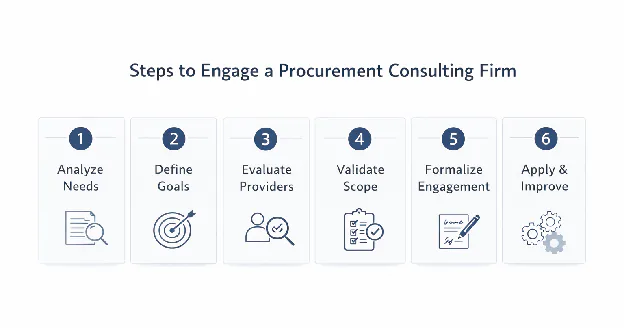
1. Analyze Your Procurement Needs
Evaluate your current procurement processes to identify functions, spend categories, or process stages that need to improve. This may include how you select suppliers and manage contracts and supplier relationships.
2. Define Your Goals
Define measurable goals after establishing your procurement needs. For instance, you may want to reduce RFQ cycle time from 10–14 days to under 5 days or expand the qualified supplier pool from 3–5 to 8–10 suppliers per sourcing event. If you have clear goals, the consultant can easily understand your needs, which enables them to design the right solutions.
3. Research, Shortlist, and Evaluate Consulting Firms
Choosing a procurement consulting service requires extensive research and due diligence. Define the volume, category, and region, then search for procurement consulting services in that niche. Review their case studies, sample outputs, and client types, and filter out consultants that do not meet your requirements. Shortlist 3-5 firms and consider their methodology, problem-solving approach, fees, and experience before making a final decision.
4. Validate and Align on Scope
Start with a small, focused engagement, such as contract structure, spend analysis, or procurement workflows. Use this phase to assess whether the consultant’s recommendations are practical, clear, and easy to apply. This helps confirm that their approach works in your day-to-day environment. Once the engagement begins, focus on how effectively your team adopts and applies the recommended changes.
5. Formalize The Engagement
After validating the consultant’s capability, you can start working on a contract. Ensure the contract terms reflect what has already been tested and agreed upon. It should include the tasks required, deliverables, timelines, KPIs, pricing structure, data access and confidentiality, roles and decision rights, and exit terms.
6. Apply Changes and Improve The Procurement Process
Align the internal team on new processes, clarify who does what, and ensure that your team knows how to use the templates, KPIs, and evaluation frameworks developed by the consultant. Teams apply these changes in real scenarios, refine them as needed, and build more consistent procurement practices over time.
Why Procurement Consulting May Not Deliver Results (and Common Mistakes to Avoid)
Procurement consulting can improve processes and decision-making, but results may also depend on how well your team applies those recommendations in day-to-day work. If your data is inconsistent or requirements are unclear, even well-designed processes will not deliver results.
Procurement teams already work within tight timelines, existing systems, and internal dependencies. If new processes don’t fit how they operate or require too much effort to adopt, they may be ignored or only used partially. Common reasons why consulting engagements fail to deliver results include:
- Unclear or constantly changing requirements during the engagement.
- Limited internal ownership of new processes.
- Lack of alignment across stakeholders on roles and responsibilities.
- Poor data quality that prevents effective implementation.
- Treating consulting as a one-time fix instead of an ongoing improvement effort.
In reality, the impact of procurement consulting depends on how well your team applies the changes in day-to-day work.
How ChinaSource Supports Procurement Consulting Outcomes
Procurement consulting defines better processes, but teams still need a way to apply them consistently. ChinaSource supports this by structuring early-stage sourcing activities where teams define requirements and collect supplier data.
It identifies verified suppliers, manages the outreach, collects supplier insights, and organizes them into a clear format, while your team retains control over decisions and supplier selection. Here is how it works.
1. Clarify Your Requirements: Describe your product needs, such as quantity, specifications, and MOQ, with AI guidance.
2. AI-driven Outreach and Assessment: ChinaSource uses structured data and automation for large-scale outreach to confirm pricing, capacity, and supplier fit. Then, it selects the suppliers who provide relevant responses.
3. Assessment: It uses the insights from the outreach and qualification checks to evaluate the suppliers, ensuring that only the best fit makes the list.
4. Structured Shortlist: It then organizes the supplier data and quotes in a structured format that is easy to compare side-by-side. This eases the supplier selection process and enables you to formalize requirements.
ChinaSource also lets you track progress and step in at any time. It also offers access to a dedicated 1-on-1 sourcing expert and human-led vetting, pricing, and negotiation, enabling you to make realistic decisions.
FAQs
What Should You Expect as Deliverables From a Procurement Consulting Service?
You should expect clear, usable outputs rather than high-level advice. These may include standardized procurement processes, RFQ templates, supplier evaluation frameworks, spend analysis reports, KPI definitions, and contract guidelines. The key is that these deliverables should be practical and easy for your team to apply in day-to-day procurement activities.
How Do Procurement Consulting Services Help Reduce Costs?
Procurement consulting services help structure, organize, and standardize your data. They define clearer sourcing and negotiation approaches and introduce standardized procurement processes. This helps teams identify where money is being spent and compare supplier pricing more effectively. They also break down cost drivers, set benchmarks, and define negotiation strategies, which allows your team to secure better pricing and terms. Over time, these improvements reduce inefficiencies, prevent overspending, and lead to more controlled and predictable procurement costs.
Is Procurement Consulting Suitable for All Types of Businesses?
No. Procurement consulting services are better suited to companies with growing demand, limited internal resources, or complex procurement needs. It may not be ideal for businesses with stable, simple, or low-volume procurement, where an internal team can handle most of the required tasks.
What Are the Risks Associated With Procurement Consulting Services?
The main risks relate to how well the recommendations fit your business. Consultants may suggest processes that are hard to apply, may not fully understand your internal context at the start, or may create reliance on external expertise. These risks can be managed by keeping decision ownership internal, setting a clear scope, and ensuring your team adopts and understands the changes.
How Is Procurement Consulting Different From Procurement Outsourcing?
Procurement consulting helps you improve how your procurement function operates. Consultants define better processes, frameworks, and decision criteria, but your team still handles most of the execution. Procurement outsourcing means an external provider takes over an agreed procurement activity, such as sourcing, RFQs, and supplier management, for an agreed period.
Final Thoughts
Procurement consulting services help address common operational issues such as fragmented processes, inconsistent data, and limited visibility. They define performance metrics and frameworks to segment suppliers and guide how they are managed. By introducing structure and clearer workflows, they make procurement activities easier to manage and more consistent across the entire process.
However, it is critical to define a clear scope and expected outputs, and ensure the consulting provider is the right fit for your needs. Without this, their efforts may not deliver the desired results.
As procurement becomes more data-driven, teams must also focus on how they capture and use information across sourcing, contracting, and supplier management. ChinaSource supports the early stages of procurement by combining structured workflows with human expertise to help you verify, compare, and select suppliers in a more effective way.