
Lead Time Meaning: Plan a China Sourcing Timeline

In sourcing, lead time means the elapsed time between a defined starting event and an agreed endpoint. Your full buying timeline may include requirement confirmation, materials, production, inspection, corrections, transport, customs release, and final delivery. A supplier's production estimate may cover only part of that journey.
To plan backward, start with the date goods must reach the required location. Work back through the tasks that must finish first. Include realistic waiting time and explicit buffers. Then confirm each milestone with the person responsible, rather than assuming a quoted production duration guarantees arrival.
Lead time meaning: separate the clocks
Define lead time with a start event, an end event, and a calendar. “Three weeks” is incomplete unless everyone knows what releases the work and what counts as finished.
APQC's supplier lead-time definition measures the interval from purchase-order transmission to delivery received by the buying business. A particular supplier quote may instead start after approved drawings and an agreed deposit, then end when goods are ready for collection. Compare those boundaries before comparing the numbers. Use the same start and end points in your request for quotation so suppliers quote comparable lead times.
Record these distinctions:
- Preparation time: from your initial buying requirement to a released order.
- Production time: the agreed manufacturing window, with its stated release conditions.
- Transport time: the specified route and services between named locations.
- Total time to receipt: the complete interval ending at your required receiving point.
Specify working days or calendar days. Also confirm the actual operating calendars of the factory, inspection provider, carriers, and receiving site. A weekend or closure can affect one stage without stopping every other stage.
Map the stages and their release conditions
Ask for a sequence tied to your actual order. The table below identifies planning questions; it does not prescribe one universal factory process.
| Stage | What must be clear before the next step? |
|---|---|
| Requirement and order confirmation | Current product version, unresolved choices, and agreed release conditions |
| Materials and components | Availability, procurement responsibility, and any approval needed before purchase |
| Production | Material readiness, confirmed capacity, and the relevant completion milestone |
| Inspection or testing | Product readiness, appointment, method, reviewer, and required decision |
| Corrections and recheck | Treatment of findings, responsible party, and release evidence |
| Export and transport | Cargo readiness, documents, booking cutoffs, and named handover point |
| Destination receipt | Import requirements, release, final delivery, and receiving arrangements |
Use a controlled supplier specification sheet to identify the version being scheduled. Keep the schedule focused on when that version can move forward. A changed requirement can invalidate a previously discussed completion date.
China sourcing stages and the conditions buyers and suppliers need to confirm before moving to the next stage
Plan backward from the required receiving date
Begin with a precise endpoint: goods at a named warehouse, available for a specified receiving appointment. If unpacking or incoming checks must happen before use, allow for those activities too. Do not quietly replace “ready for use” with “arrived at port.”
Next, ask the logistics provider which services its estimate includes. Main transport may exclude origin handling, destination clearance, or the final delivery leg. Check whether the estimate already includes contingency time before adding another allowance for the same risk.
The U.S. International Trade Administration explains that Incoterms define delivery responsibilities and risk allocation. The relevant delivery point can occur before goods reach your warehouse. Record the trade term and named place separately from the required arrival milestone. Neither label alone gives you a complete schedule.
Work backward along the dependencies. When two tasks genuinely run together, use the branch that finishes last to determine the next release. Do not add both durations as if they happened one after another. Confirm the overlap with the parties doing the work.
A worked backward plan in calendar days
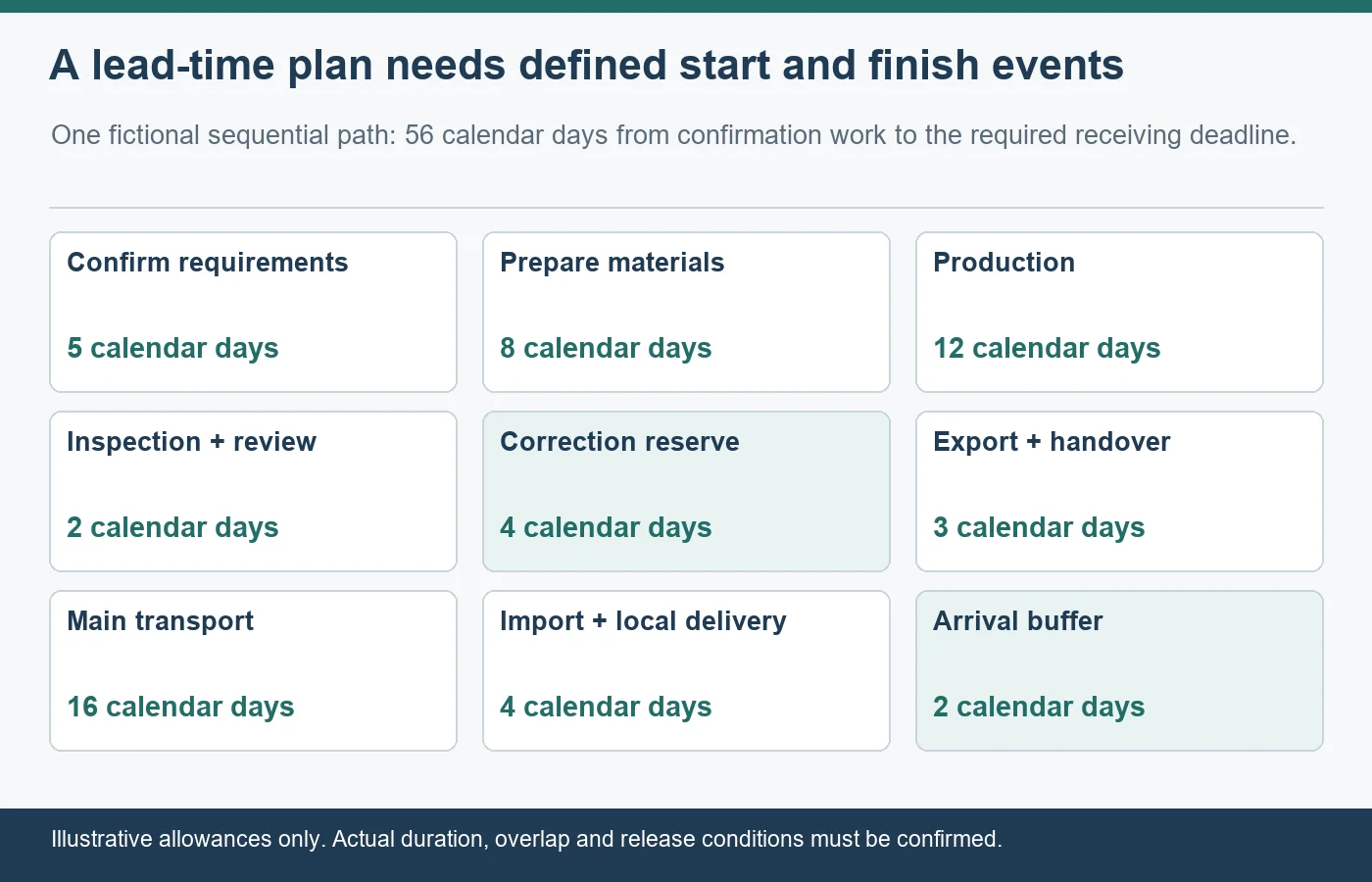
Consider this illustrative example, not a customer result or typical China sourcing duration. A buyer needs simple, unpowered display trays at its receiving warehouse by Day 0. All durations below are invented calendar-day allowances. The sequence assumes each listed block follows the previous one, with no overlap on this particular path.
| Block | Days allowed | Planned interval relative to Day 0 |
|---|---|---|
| Requirement and order confirmation | 5 | Day −56 to Day −51 |
| Material preparation | 8 | Day −51 to Day −43 |
| Production | 12 | Day −43 to Day −31 |
| Inspection and buyer review | 2 | Day −31 to Day −29 |
| Correction and recheck reserve | 4 | Day −29 to Day −25 |
| Export release and carrier handover | 3 | Day −25 to Day −22 |
| Main transport | 16 | Day −22 to Day −6 |
| Import release and local delivery | 4 | Day −6 to Day −2 |
| Arrival contingency buffer | 2 | Day −2 to Day 0 |
The calculation is 5 + 8 + 12 + 2 + 4 + 3 + 16 + 4 + 2=56 calendar days. Each interval measures elapsed time between boundaries; it does not count both endpoint dates as extra days. The buyer therefore starts confirmation no later than Day −56 under these assumptions. Planned warehouse receipt is Day −2, leaving two days before the deadline.
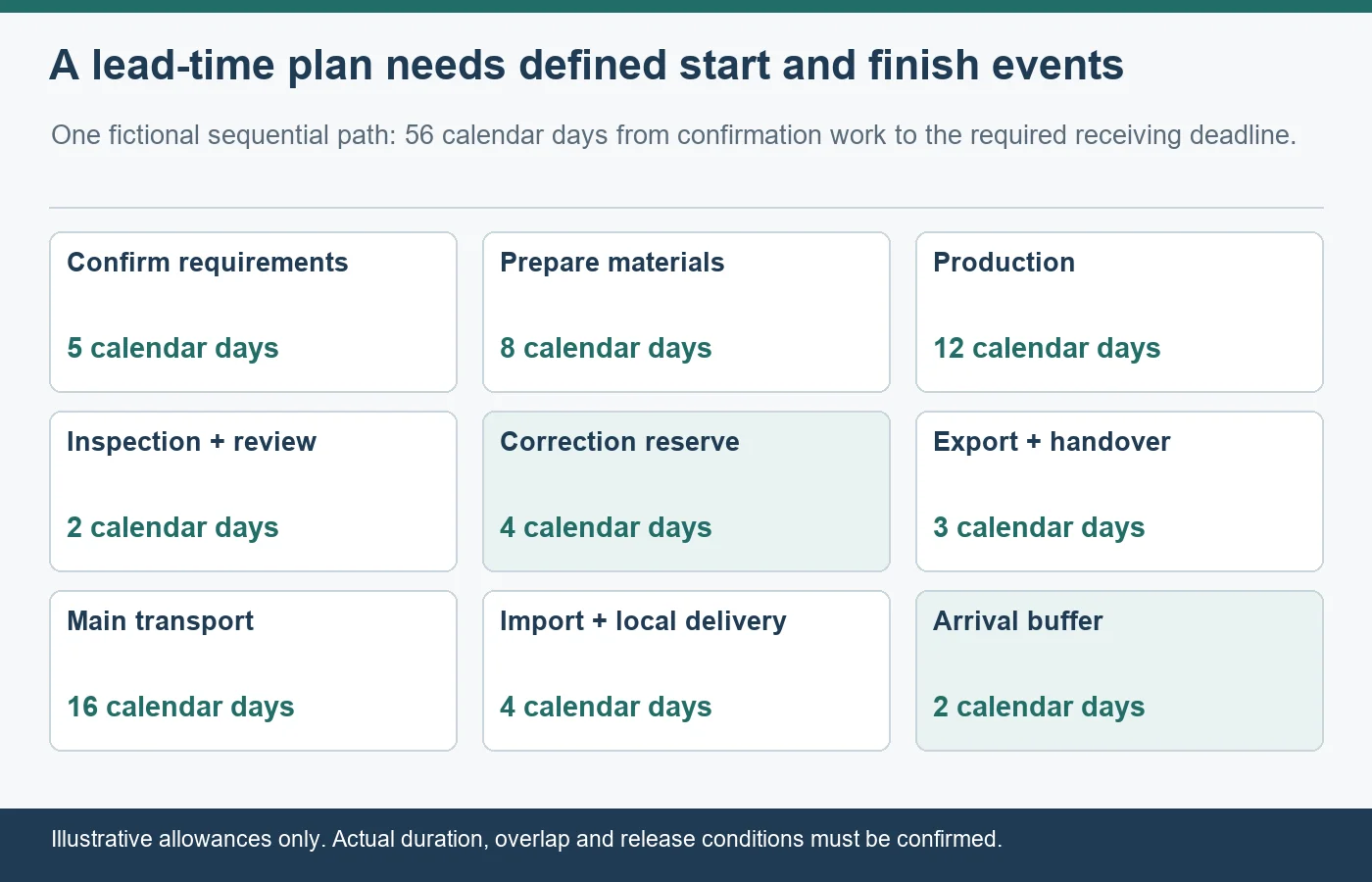
56-day China sourcing timeline planned backward from the required warehouse receiving date, with a two-day arrival buff
The four-day correction reserve is an allowance, not a claim that rework always takes four days. A serious finding could require more time or a different decision. Booking preparation and document review may start earlier in parallel; do not add their full duration again if it is already covered by the agreed plan.
Give buffers a purpose and an owner
Useful sourcing lead time planning separates expected work from uncertainty. Label each buffer with the event it protects against, the person monitoring it, and the point at which it is consumed.
For example, a correction allowance protects the release decision after inspection. An arrival buffer protects the receiving deadline against later uncertainty. They serve different purposes. Neither permits you to release unresolved goods simply to preserve the date.
Avoid applying an unexplained percentage to every stage. Instead, review material availability, approval delays, missed departures, document readiness, and destination requirements with the relevant parties. Record what is confirmed and what remains an estimate. Larger uncertainty may call for another route, an earlier start, or a revised deadline.
Update the plan when a release condition changes
A schedule needs named milestones, not repeated “on track” messages. Ask what has actually finished, what evidence supports that status, and which next task can now start.
If an agreed deposit arrives late, recalculate the stages that depend on receipt. Likewise, a failed check can delay cargo release and miss a planned departure. Resolve the dependency rather than subtracting the delay from transport time. For payment-trigger questions, review the terms to clarify before paying a supplier.
Keep the original baseline alongside the latest forecast. Record the reason for each change, the affected milestone, and who confirmed the revised date. Your supplier lead time is then a measurable interval, not a promise that silently changes whenever the order changes.
Ask for milestones you can check
Before relying on a timeline, ask: What starts production? When will materials be available? What releases the goods after inspection? Which transport services are included? Who confirms destination readiness? What happens if a milestone slips?
Knowing what lead time means starts with explicit boundaries. A useful plan turns those boundaries into dated actions, dependencies, and visible allowances. If you are still identifying candidates, find and contact Chinese suppliers using a product name, image, or link, then ask each candidate to explain the timing for your actual requirements.