
Verify Supplier Certificates for the Right Model

To verify supplier certificates, first identify the document type and the claim you want it to support. Check the issuer, document number, current status where applicable, named holder, site, model, and scope. Follow any references to reports or appendices, then record whether the document addresses your exact product and proposed purchase.
A genuine document can cover a different company, location, or configuration. Keep authenticity and relevance as separate questions. A buyer needs to know which fact has been established before using the record to support the next decision.
Identify which kind of document you received
Ask for the complete original file, including schedules and referenced annexes. A cropped badge may omit the very fields you need. Sort the record before deciding how to check it.
| Document type | What to examine | Question it may address |
|---|---|---|
| Management system certificate | Organization, certified sites, standard, scope, status, and issuer | Which management system activities are certified |
| Product certificate | Scheme, holder, exact models, scope, conditions, and issuer | Which products and conditions the certification covers |
| Test report | Laboratory, applicant, tested sample, method, results, and limitations | What was tested under the stated conditions |
| Declaration of conformity | Responsible entity, product identification, applicable rules, and referenced basis | What the responsible party declares for that product |
IAF CertSearch describes its database as covering accredited management system certification. Use it for that category and follow the appropriate issuer or scheme route for other records.
For EU-bound products, check the applicable conformity route.European Commission guidance explains the roles of technical documentation, declarations, and notified bodies where required. It also warns about voluntary certificates that can mislead buyers about legal requirements.
Verify supplier certificates through the issuer's route
Find the issuing organization independently. Use its official verification service or contact details you establish separately from the submitted document. Check whether the certificate number produces a record and compare the returned details with the file.
Record the status shown, the date of your check, and the reference or response received. Investigate a suspension, withdrawal, expired status, or conflicting number with the issuer. Where the record should have a current status, a historical screenshot needs updating.
A test report may describe work performed on a particular date rather than carry a renewable certificate status. Ask the technical reviewer whether its methods, product configuration, and regulatory basis remain relevant. Avoid inventing an expiry period for every document.
If a record is absent from one search, keep the result unresolved and ask the issuer for clarification. Check spelling, translations, schedules, and database coverage. Preserve the unsuccessful search alongside any later reply so the review remains traceable.
Match the holder and production location
Compare the named legal entity and address with the seller and proposed production arrangement. Ask which organization applied, which one manufactures, and which one holds the certificate. A trading company may supply a product made by another entity, but you need the relationship documented for this transaction.
For routine company identity work, use the Chinese supplier background-check guide. Here, resolve the specific connection between the certificate holder, the factory site, and the offered goods.
Check whether a multi-site certificate includes the proposed location in its schedule. Keep any relevant activity limitation with the record. A similar English trading name or group relationship leaves the legal identity and site question open until you establish the connection.
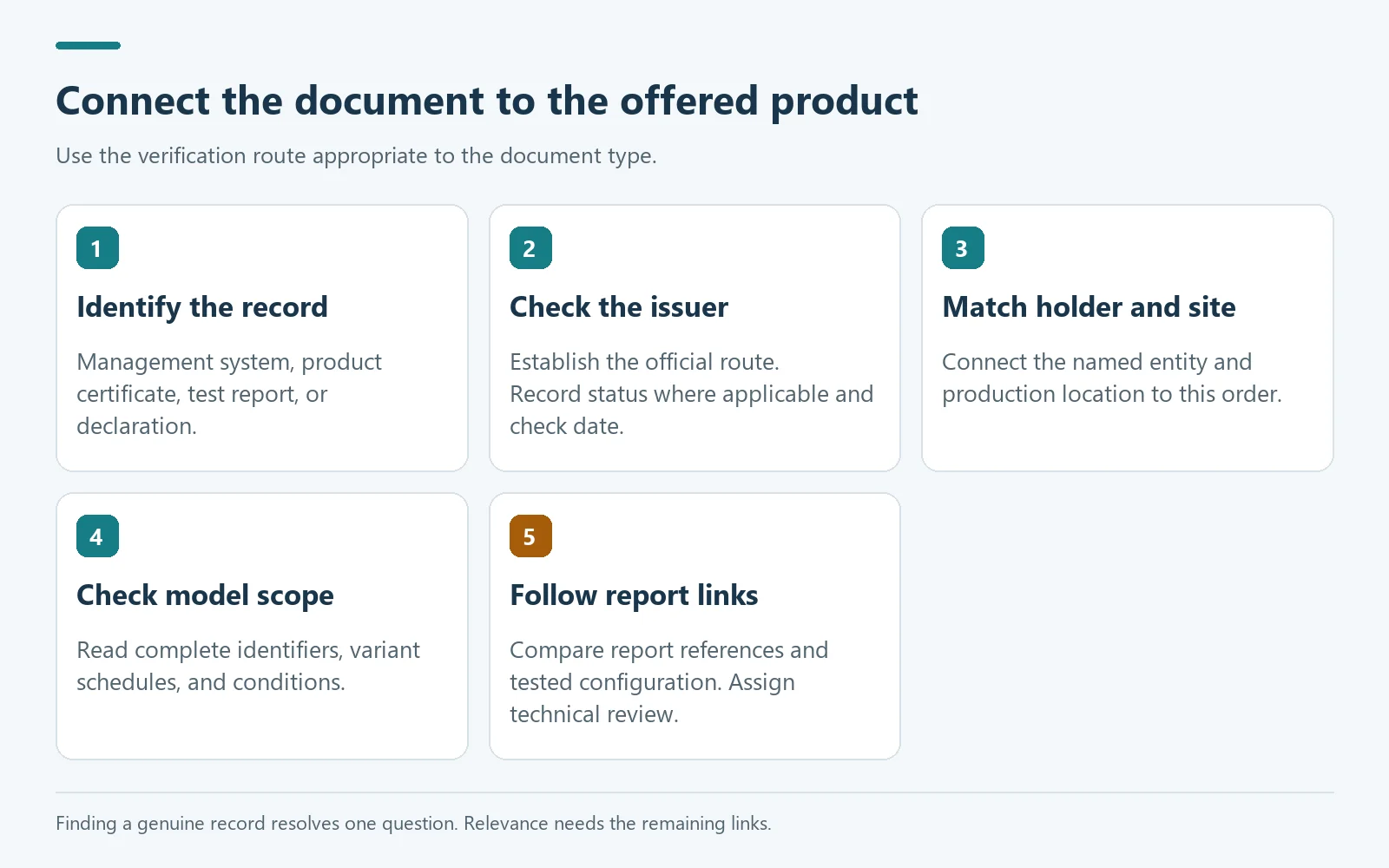
Supplier certificate verification workflow covering document type, issuer, holder, site, model scope, supporting reports and review conclusion
Match the complete model and scope
Read the full identifier, including suffix, size, rating, material option, or other variant marker used in the document. Compare it with the quotation, specification, sample label, and proposed production version.
When a product family is listed, open the schedule that defines the family. Ask the issuer or responsible technical reviewer which variants are covered and on what basis. A buyer's visual judgment that two products look similar cannot establish scope.
For a management system certificate, examine the stated activities and sites. Use a separate appropriate route to assess an exact product model. For a product certificate or report, identify which characteristics and requirements the record actually addresses.
Write each mismatch as a question. For example, ask whether a different material or electrical rating is included in the documented range. Request the schedule or technical basis needed for the reviewer to decide, rather than asking the salesperson for a general reassurance.
Connect reports and appendices to the offered version
Follow the report references printed in the certificate or declaration. Compare report numbers, dates, sample descriptions, model lists, photographs where relevant, and the named entities. Request missing pages that contain conditions or exceptions.
Use a controlled product specification as the buying reference. Record any difference between the tested sample and the planned production version. Ask a competent reviewer whether the difference needs another assessment or further testing.
Retain what the laboratory or issuer actually confirmed. Laboratory testing, scheme certification, and the supplier's own statement each have a defined role. Assign the market-access conclusion to the person responsible for the applicable product requirements.
Work through a fictional model mismatch
Suppose you are buying a fictional electrical display accessory offered as model P-40B. The names and record references below are invented solely to illustrate a document review. They describe no real certification or compliant design.
| Check | Record received | Finding and next action |
|---|---|---|
| Issuer record | Certificate reference C-EX-17 is found | Record the returned details and check date |
| Holder | Example Manufacturer Ltd is named | Establish its relationship to the quoted seller |
| Site | Schedule names Site One | Proposed production is at Site Two, so seek scope clarification |
| Model | Certificate lists P-40A | P-40B remains unresolved pending the complete model schedule |
| Report link | Certificate refers to R-EX-22 | Obtain the report and compare its tested configuration |
| Variant detail | Salesperson says only the housing changed | Ask the technical reviewer what evidence the change requires |
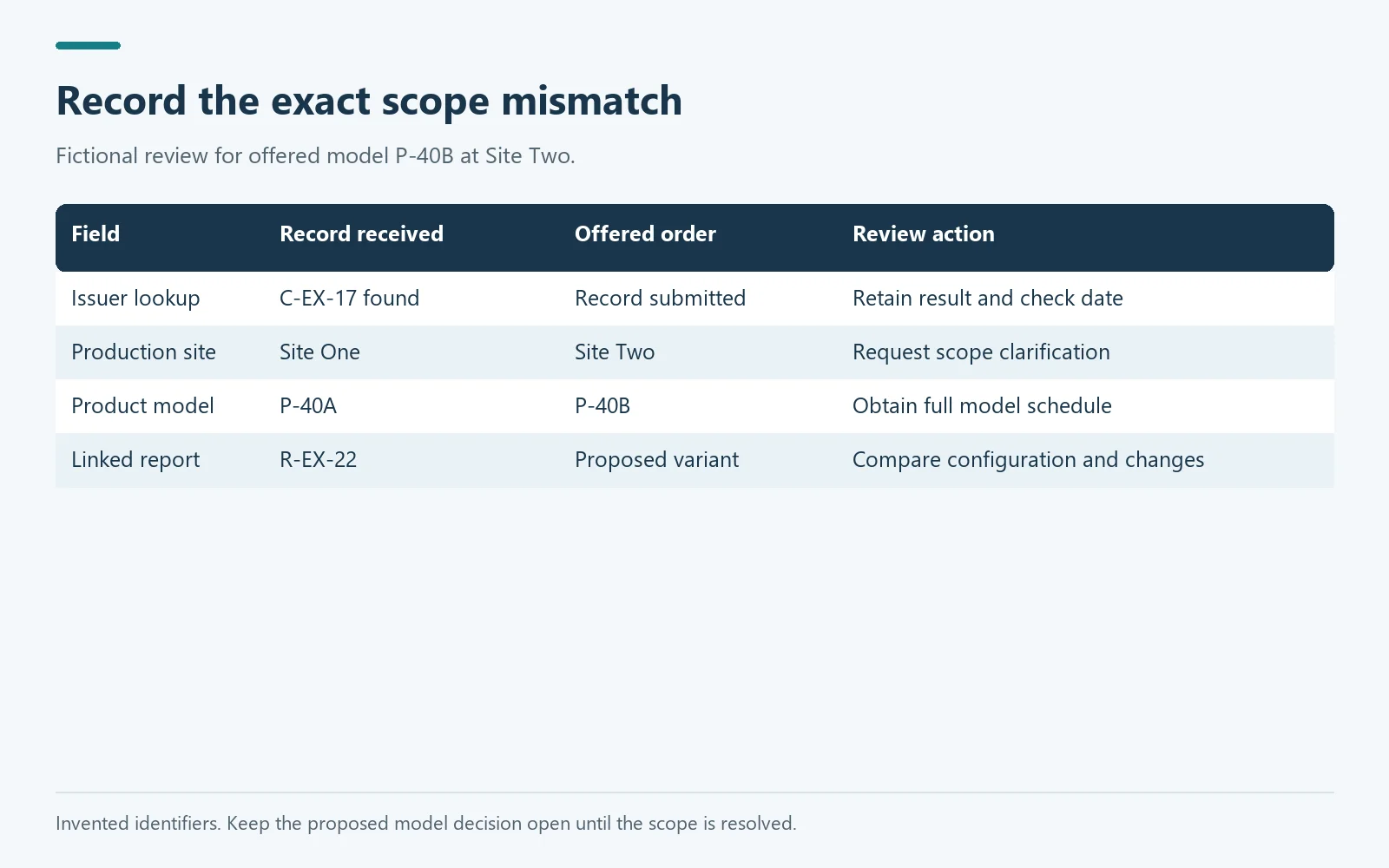
Fictional certificate review showing site and model mismatches between the supplied document and the proposed order.
The practical result is a set of specific requests. The issuer can clarify the schedule, the seller can explain the entity relationship, and the reviewer can assess the variant. Keep the proposed model's relevant approval decision open while those connections remain unresolved.
Record a conclusion that matches the evidence
For each record, retain the source file, verification route, check date, matched fields, mismatches, reviewer, and next action. Useful conclusions include verified as a management system record for the named site, product model covered by the confirmed schedule, or scope unresolved for the offered variant.
Revisit affected records when the model, site, material, or responsible entity changes. You can find and contact Chinese suppliers from a product name, image, or link, then request the particular documents your review requires. Use the resulting evidence for the claim it actually supports.