
Supplier Shortlist Handover: What Buyers Should Receive

A supplier shortlist handover should give the buyer a usable package: the current brief, supplier contacts, original replies, comparison files, outstanding work, and named next actions. Include an index that connects the summary to those records. The buyer should be able to take over without reconstructing the project from someone else's inbox.
Ask one practical question: can another buyer continue this work tomorrow? A polished presentation may still lack an attachment, use an old specification, or leave every action assigned to a departing contractor. This checklist helps you define the deliverables and decide whether the package is ready for handover.
Agree the supplier shortlist handover deliverables
Set the expected contents before the research or outreach assignment ends. Ask the team to deliver the working records alongside the summary. Your sourcing report deliverables should show what was requested, what came back, what remains open, and who takes over.
| Deliverable | What the buyer should receive |
|---|---|
| Buying brief | Current product requirements, quantity, destination, open choices, and revision |
| Candidate register | Supplier names, contact routes, role in the transaction, and selection reasons |
| Original replies | Quotations, messages, and attachments in an agreed usable format |
| Comparison file | The same commercial fields for each candidate, linked to the original replies |
| Supporting records | Documents already collected, with their source references and recorded limitations |
| Action register | Outstanding request, owner, due date, and the decision waiting for it |
| Decision note | What the buyer has authorized and what remains on hold |
Record the search scope as well. Note any limits on product category, location, order size, or search channels. Include a short explanation of exclusions. This lets the next buyer understand the work already done and decide where to continue.
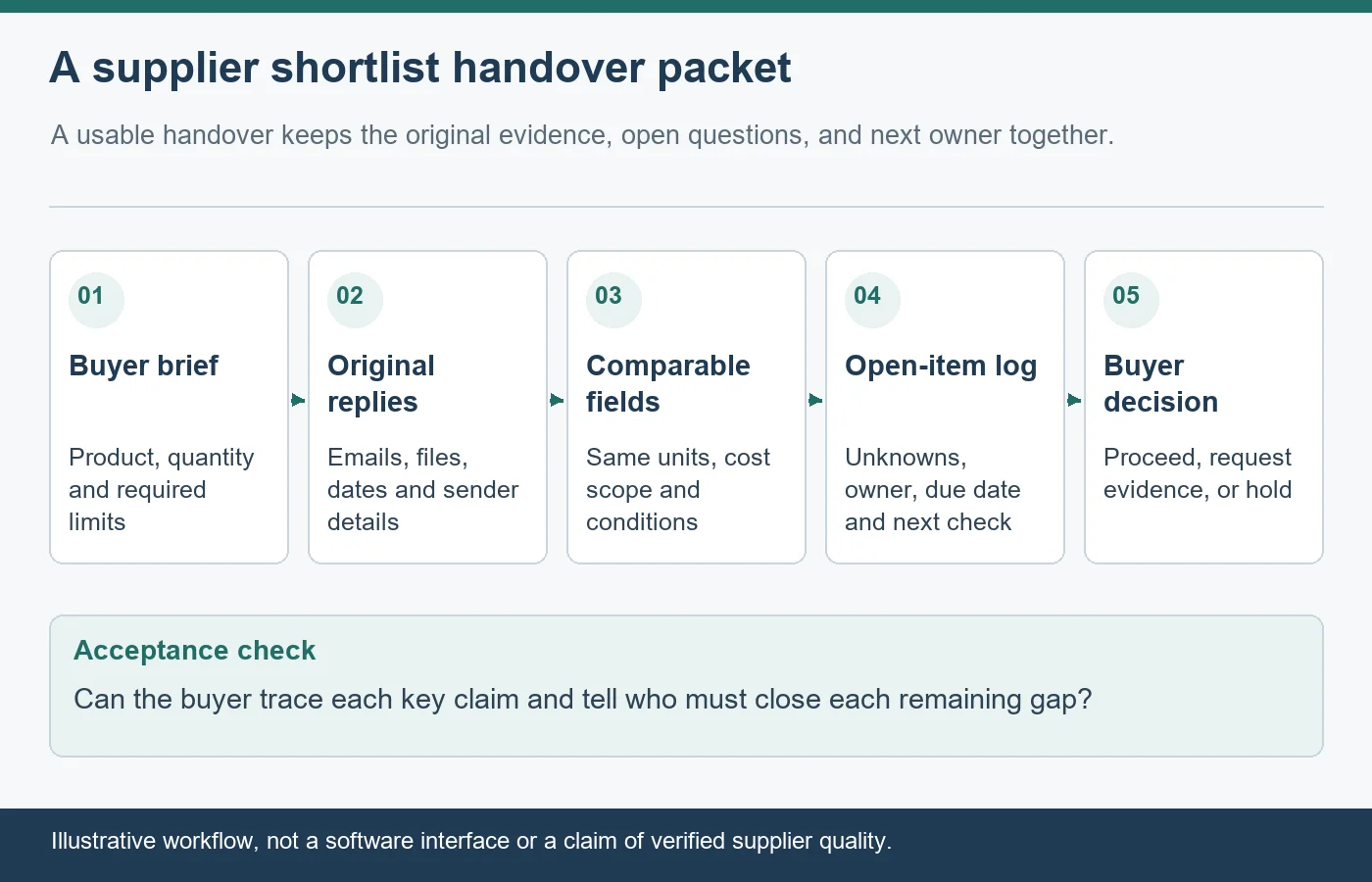
Supplier shortlist handover package showing the buyer brief, original replies, comparison fields, open items and buyer decision
Include an index that someone else can open
An index turns separate documents into a usable supplier shortlist handover. Give each important file a reference, a revision, and a location. Keep original replies separate from summaries or translations. A buyer should be able to move from a comparison cell to the reply behind it.
For example, a simple folder structure could be:
01_Brief/BR-01_Rev-B
02_Original-Replies/Supplier-A/Q-A-01
02_Original-Replies/Supplier-B/Q-B-01
03_Comparison/COMP-01_Rev-01
04_Open-Items/ACT-01
05_Decision-Notes/HOLD-01
Use the folder names or record IDs that suit your team. Agree a format the receiving buyer can open. If a conversation cannot be exported, agree another permitted way to retain the relevant replies and attachments. Preserve dates and sender details with the record.
Test access from the receiving buyer's account. Avoid relying on a contractor's private drive or an expiring invitation. Apply the access permissions your organization requires, and flag missing files openly. For controlled product requirements, reference the current specification sheet guide rather than copying fragments into unrelated files.
Make the supplier comparison report usable
The supplier comparison report should help the receiving buyer navigate the offers. Include the quoted product version, quantity, MOQ, currency, unit price, additional charges, sample terms, lead time, delivery basis, and quote validity. Show the reference for each original quotation.
Keep the supplier's actual answer visible. If an offer covers 600 units, do not silently present its unit price as a confirmed 500-unit offer. Where a reply omits packaging or another cost, mark the field as awaiting an answer. Link the field to the corresponding open item.
Keep the handover comparison concise, and retain the assumptions behind any detailed costing file. Use our guide to comparing supplier quotes on equal terms when a deeper comparison is needed. The receiving buyer should see where offers differ and where to find the supporting reply.
Turn outstanding work into an action register
An unresolved issue can be handed over if its status and next action are clear. “Follow up with supplier” is too loose. Identify the missing answer, the person requesting it, the expected record, and the decision that must wait.
| Open item | Next owner | Required response | Decision waiting |
|---|---|---|---|
| Supplier B quoted a 600-unit MOQ | Sourcing coordinator | Written response to a 500-unit request | Whether B remains suitable for this order size |
| Supplier A's packing details are incomplete | Buyer | Packing specification and included cost | Whether the quote scope is complete |
| A material document has not arrived | Named technical reviewer | Requested document and review result | Whether to approve the sample specification |
Use agreed due dates rather than “urgent” labels. If somebody outside the team must supply information, name the internal person who owns the request. Separate receiving a document from deciding whether it supports a supplier claim; any remaining factual check stays on the action register.
An illustrative package for a 500-unit order
Suppose you are handing over a search for 500 unpowered desk display stands. This is a fictional example, not a ChinaSource customer result. Supplier A quoted 500 units; Supplier B quoted a 600-unit minimum. Both remain candidates while the buyer considers the open conditions.
The brief is BR-01 Rev B. The package includes original replies Q-A-01 and Q-B-01. The comparison file, COMP-01 Rev 01, links to those replies. ACT-01 lists the MOQ question and missing packing information, with owners and due dates. HOLD-01 records which next steps the buyer has authorized.
If a new buyer receives only COMP-01, the delivery is incomplete: they cannot see the original qualifications or retrieve the attachments. If all files arrive but ACT-01 names nobody, the work can still stall. Acceptance depends on both accessible records and a workable transfer of responsibility.
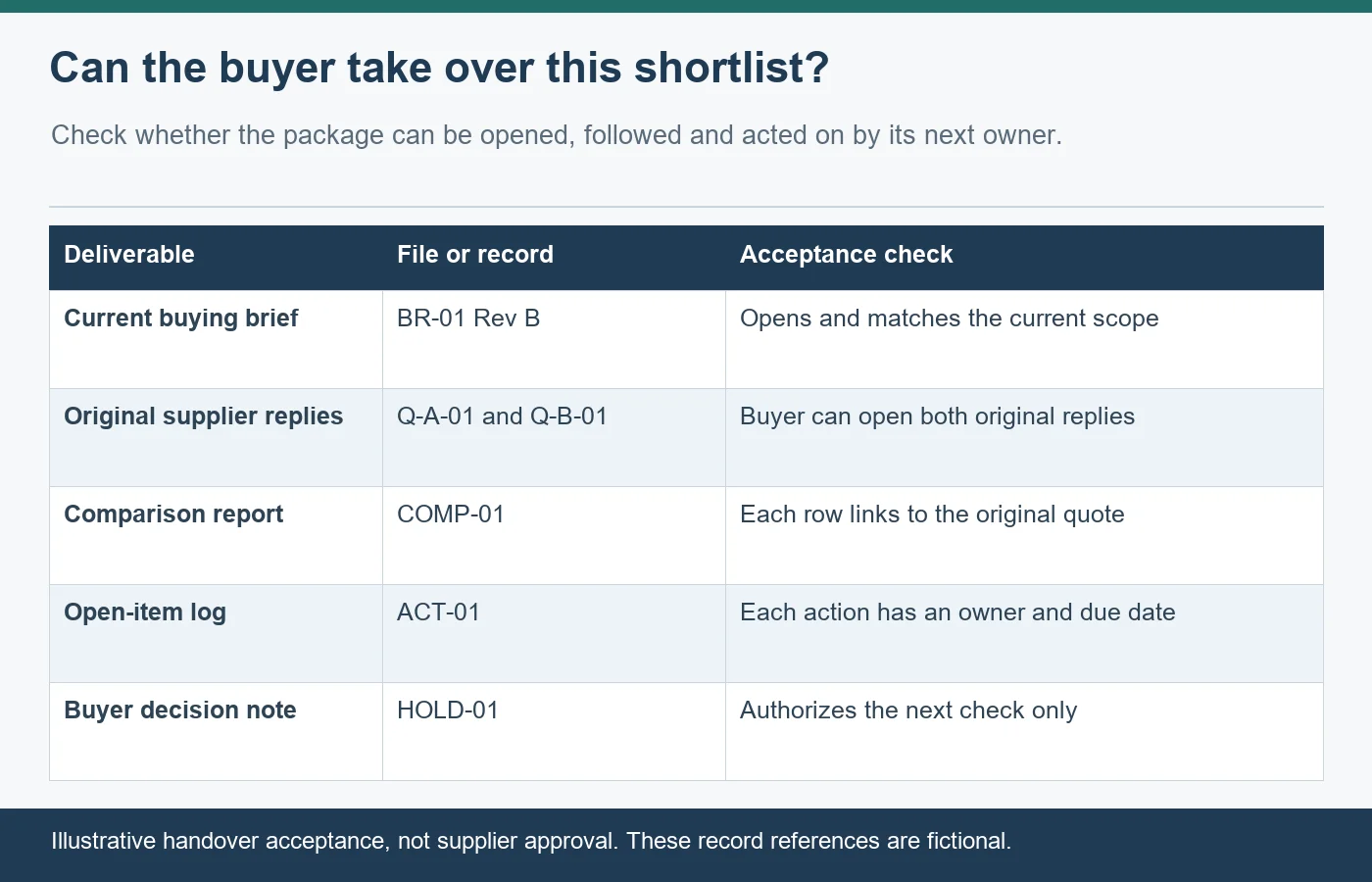
Supplier shortlist handover acceptance checklist with file references and checks for each deliverable
Accept or return the supplier shortlist handover
Use a short receiving check before closing the assignment. Someone who did not prepare the package should be able to:
- Identify the current brief and distinguish it from older versions.
- Open the original reply behind one comparison row.
- Retrieve the attachments referenced in that reply.
- Locate the conditions that remain unresolved.
- Name the next owner and the decision awaiting each answer.
- Find the buyer's latest instruction without guessing from message history.
Return the package with a specific correction when a check fails. For example: “Q-B-01 is inaccessible; provide the agreed copy and retain its attachments.” Record acceptance or the remaining conditions so both teams know what is still due.
If AI helped prepare the work, retain named human responsibilities. NIST's AI Risk Management Framework supports clear roles and oversight in human–AI arrangements. Here, that means identifying who prepared the package, who receives it, and who can approve the next step.
Close the transfer with a buyer decision note
Acceptance of the package does not approve the supplier or authorize an order. A decision note might allow a further inquiry while holding sample approval or payment. State the authorized action, date, owner, and remaining conditions. Keep earlier versions when the brief or supplier replies change.
A useful supplier shortlist handover leaves the next buyer with records they can open and actions they can own. If you are starting with a product name, image, or link, explore supplier options to begin finding and contacting Chinese suppliers. Define the work you need returned, and keep purchasing decisions with your team.