
What Is Supplier Intelligence? A Practical Guide


Often, procurement teams end up paying more due to poor supplier choices or face delays when unreliable suppliers push back on production, launches, or delivery commitments. At times, they are forced to switch suppliers mid-process, which can lead to higher costs and an increased risk of underperformance by the new supplier.
Some of these issues can happen due to factors they can't control, but in many cases, it's because they're making decisions based on low-quality data. When supplier details are scattered across emails, spreadsheets, and replies with missing or inconsistent fields, it can be difficult to build a reliable decision framework.
This is why supplier intelligence is important. It enables teams to notice small changes, patterns, and early signals that are usually easy to miss. It gives them a better context of how a supplier operates. But it all starts early, when the requirements should be clear. This is where ChinaSource helps with structuring requests, collecting complete supplier responses, and making the data usable from the start.
What Is Supplier Intelligence?
Supplier intelligence is the process of collecting and analyzing data to understand a supplier's performance, risk factors, financial health, and capabilities. It is a structured, ongoing process that enables procurement teams to organize supplier data and use it to understand how suppliers operate.
Supplier intelligence reveals a supplier’s information beyond prices, including delivery habits, compliance records, financial stability, and how they respond to changes, like seasonality or supply chain pressures. It enables teams to question what’s changing and what small patterns can reveal. By doing so, they can anticipate future issues, like missed shipments, and make alternative plans.
What Many Teams Get Wrong
Some organizations develop supplier intelligence systems that fail to deliver the expected results. Most times, it’s usually due to one or some of these issues:
- Relying on Supplier Profiles Instead of Real Responses: Supplier profiles often contain claims of what they can do, and some of those profiles may be outdated or biased. Responses show how they respond to real requests, which is where you can see issues like unclear terms or how quickly they respond.
- Comparing Incomplete Quotes: Sometimes, procurement teams rush to compare suppliers even when key details such as MOQ, lead time, or payment terms are missing. This usually leads to choosing a supplier that cannot meet their requirements.
- Treating Supplier Data as Static: Supplier conditions like prices and capacity can change, and the way they respond to requests can vary. When teams rely on old data, they make decisions based on a version of the supplier that may no longer exist.
- Optimizing for Lowest Price: Focusing solely on unit price ignores other cost drivers, such as MOQ, lead time, quality issues, and reliability. A cheaper supplier can still be costlier overall if it leads to delays, rework, or supply disruptions.
Components of Supplier Intelligence
Supplier intelligence builds on multiple data points that answer a specific question but, together, tell a clear story about how suppliers perform, adapt, or behave under real-world conditions.
Supplier Data Collection
Supplier intelligence relies on data, which usually starts with basic and internal sources, such as invoices, contracts, and logistics records. It also includes external data, such as import and export records, company filings, and compliance records, including certifications and audit reports.
As organizations continue to collect and analyze these data over time, they may start to see patterns that were not obvious at first. They’ll start to see a supplier’s typical operations and how they handle seasonality, demand spikes, and foreign exchange fluctuations. Those patterns add more context to whatever the team knows about suppliers and help them make better choices.
Supplier Risk Intelligence
Supplier risk intelligence focuses on what can go wrong and when it can happen. It considers factors like unstable dependencies, location risks, financial concerns, and compliance issues. Teams monitor this information and continuously assess supplier risk. This helps them spot risks earlier and gives them more time to plan their response.
Risk builds over time and shows up clearly during disruptions. This is where supplier intelligence makes a real difference.
| Situation | Without Supplier Intelligence | With Supplier Intelligence |
|---|---|---|
| Sudden Demand Spike | Scramble to check who can handle volume | Already know which suppliers have capacity |
| Supplier Delay | React after deadlines | Spot early signal and adjust plans |
| Price Increase | Accept or renegotiate blindly | Compare alternatives and benchmark pricing |
| Supply Disruption (region, logistics) | Rush to find new suppliers | Switch to backup suppliers that have already been evaluated |
| Urgent Change of Order | Multiple back-and-forth emails | Quicker changes since pricing, MOQ, and terms are already known |
Supplier Performance Intelligence
Supplier performance intelligence considers factors like delivery timing, response speed, quality levels, and flexibility. It shows patterns in delivery, quality, and responsiveness over time. Tracking this data enables teams to base their evaluation on facts.
Supplier Sustainability Intelligence
Sustainability intelligence tracks labor practices, sourcing ethics, and governance signals over a period. It shows which suppliers invest in stable and compliant operations over time. Teams use it to reduce compliance risk and choose partners who build stable, reliable operations rather than cutting corners.
Supplier Intelligence Vs. Traditional Sourcing
Traditional sourcing worked better when businesses had limited supplier options. These days, there are more suppliers, more variables and tighter deadlines, which makes things more difficult. Supplier intelligence turns scattered information into a clear, structured view, so teams can compare suppliers and make decisions faster.
| Traditional Sourcing | Supplier Intelligence Approach |
|---|---|
| Supplier profiles and catalogs | Real supplier responses and behavior |
| Manual email back-and-forth | Structured data collection |
| Quotes in different formats | Standardized, comparable data |
| Decisions based on price | Decisions based on total value |
| Reactive problem handling | Early risk detection |
Supplier intelligence makes sourcing more structured and easier to manage. But to make it work, teams need the right data from the right sources.
Sources of Supplier Intelligence Data
Supplier intelligence is continuous and builds on reliable, regularly verified and updated data sources. Building on that routine ensures that insights are up to date with how suppliers currently operate.
Internal Data Sources
Internal supplier intelligence data sources include logistics updates, purchase orders, ERP logs, and shipping documents. This data often reflects actual operations because it comes from daily transactions and may point to patterns that could lead to bigger issues.
External Data Sources
External sources add more context to the internal data. They may include industry news, financial reports, regulatory compliance records, and shipment records. When teams combine this with internal data, they get a more complete picture. They can see both past performance and external factors like market changes or financial signals.
Supplier Engagement
Direct conversations help fill gaps that data alone cannot show. When teams interact with suppliers, they uncover details that may not be shown in numbers, such as constraints or upcoming changes. Regular check-ins and planning keep both sides aligned and make it easier to spot issues early. Listening also builds trust, which leads to clearer communication and better decisions.
What Good Supplier Intelligence Looks Like in Practice
Imagine a buyer needs custom packaging for a new product launch and sends an RFQ to eight suppliers.
Within a few days, replies start to come in, but each one looks different. One supplier gives a unit price but no MOQ; another includes MOQ and lead time, but pricing depends on unclear volume tiers. One sends a PDF with partial details, and two others completely leave out lead time, while payment terms are not clearly stated.
While the buyer now has data, they may not be able to use it at that point. So they have to go back to the suppliers to fill out the missing details. They also need to reformat the quotes into the same structure. This can take days or even weeks, depending on the case.
Supplier intelligence takes a different approach, structuring all inputs into a consistent format from the start, including unit price, MOQ, lead time, and payment or shipping terms. This helps you flag missing fields early and follow up quickly.
With that, the buyer will be able to compare suppliers side by side. One supplier may offer the lowest price but require a high MOQ and longer lead time. Another may be slightly more expensive but provide faster delivery.
Having a clear view of supplier quotes makes the buyer’s decision easier because, beyond pricing, they are also evaluating suppliers on overall cost and on how flexible and reliable they are.
Strategies for Leveraging Supplier Intelligence
Gather Detailed Supplier Data
Collecting comprehensive, relevant data on suppliers is critical to effective supplier intelligence. Track essential KPIs, such as delivery times, quality levels, and cost efficiency. Assess suppliers’ financial status and monitor compliance with regulatory requirements.
Analyze Market Trends and Supplier Capabilities
Study how the market is changing and what suppliers can deliver. Monitor industry trends and economic factors that could impact supplier pricing and performance. This may include the cost of raw materials, regulatory changes, and technology. Also, assess what technologies the suppliers use and their production capacity. Techniques for market analysis include SWOT analysis, benchmarking, and scenario planning.
Leverage Technology for Real-Time Insights
Technology can support supplier intelligence through data integration, analytics, and automation.
Procurement teams can use supply chain software such as Blue Yonder and Oracle SCM Cloud, automated sourcing software such as ChinaSource and GEP Smart, and BI tools such as Power BI. These tools support supplier evaluation and selection, performance tracking, market trend analysis, and supply chain planning.
Build Collaborative Relationships
While data, technology, and market analysis remain essential, building good relationships with suppliers adds value to supplier intelligence. You can get insights, address issues, and collaborate on improvements through regular communication with suppliers. You can also engage suppliers in joint sessions to align on strategies. A good supplier relationship also allows you to give useful feedback that can help improve performance.
When Supplier Intelligence Matters Most
Organizations should implement supplier intelligence whenever possible because of its benefits, but it provides the most value at certain times, such as:
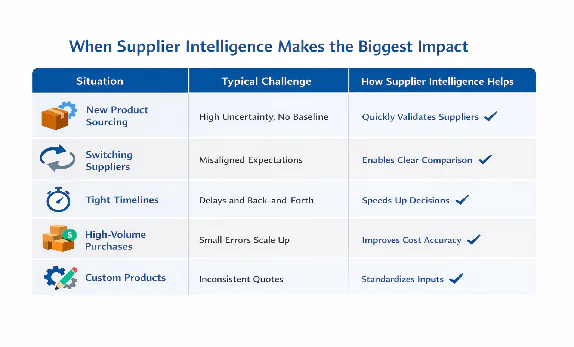
When Sourcing For New Products: When you don’t have historical data, every supplier decision carries more risk. Supplier intelligence helps you validate capabilities, compare options clearly, and avoid early mistakes that are costly to fix later.
Tight Timelines: When you’re working with limited time, delays from back-and-forth communication can prove costly. Supplier intelligence speeds up comparisons and highlights risks early, so you can make faster, more confident decisions.
Switching Suppliers: When replacing an existing supplier, you need to compare new options against a known benchmark. Supplier intelligence helps you assess whether a new supplier can match or improve on price, lead time, and reliability.
High-Volume Purchases: When you’re buying in large volumes, small differences in price, MOQ, or lead time can have big impacts. Supplier intelligence helps you evaluate total cost and avoid decisions that look cheap upfront but become expensive over large orders.
Custom Manufacturing: For non-standard products, supplier quotes are often inconsistent and incomplete. Supplier intelligence provides structured responses and clear requirements, ensuring you compare suppliers on the same basis.
Benefits of Supplier Intelligence
From reduced risk exposure, better supplier onboarding, to more consistent sourcing decisions, supplier intelligence adds value to procurement functions in many ways, as follows:
- Reduced Risk Exposure: Supplier intelligence helps teams spot issues early. Small signals like slow responses, unclear terms, or changes in lead time show up before they become real problems. This gives them time to find backups and avoid last-minute disruptions.
- Stronger Supplier Relationships: Supplier intelligence makes conversations clearer. Both sides work from the same data, align on expectations, and can resolve issues faster. Over time, this builds trust and makes planning and collaboration easier.
- Faster Supplier Comparison: With structured data, teams can compare suppliers side-by-side, enabling faster supplier selection.
- Better Cost Control: Teams can see the full picture and more context beyond unit price. This helps avoid hidden costs associated with high MOQs, long lead times, or unreliable suppliers.
- Less Manual Work: Supplier intelligence reduces time spent chasing missing information and cleaning up data. Teams can focus more on decision-making rather than time-consuming administrative work.
How To Implement Supplier Intelligence
An effective supplier intelligence framework starts with the organization understanding why it needs it. Here are the basic steps to follow.
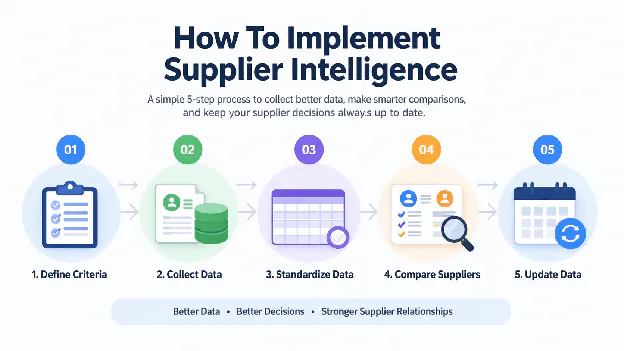
1. Define What You Need to Know
List the criteria you use to evaluate and choose suppliers, such as lead time, price, MOQ, and payment terms. Be clear and specific. For instance, define a target range, like 20 to 30 days for lead time. This ensures you’re focused only on data that supports real decisions.
2. Collect Supplier Data
You can start with supplier profiles, but that’s not enough, as some could be outdated. Reach out to them and also collect information from their responses. Request for structured details like MOQ, unit price, lead time, and certifications. If available, you can also look at past sourcing data for additional context.
3. Standardize the Data
Organize all supplier responses into the same format. Use consistent fields throughout. If suppliers provide incomplete or unclear answers, follow up quickly and get the missing data to fill the gaps.
4. Analyze and Compare Suppliers
Review suppliers side by side. Look at trade-offs, such as lower price vs longer lead time or lower MOQ vs higher cost. Pay attention to missing information or inconsistent answers, as they are usually clear signs of risks. Shortlist suppliers based on overall value, not just one factor.
5. Always Update The Data
Update supplier information during each sourcing project and after every interaction. Track changes in pricing, lead times, and responsiveness. Remove outdated data so it does not affect future decisions. This keeps your supplier intelligence accurate and relevant for continuous use.
Challenges in Implementing Supplier Intelligence
Implementing a supplier intelligence program comes with its own set of challenges. Some common challenges can include:
- Data Availability and Quality: It’s usually not easy to have accurate data at all times, especially when you’re working with many suppliers and different data sources. Procurement teams must address data input issues and standardize data formats.
- Technology Adoption: Although technology can automate some supplier intelligence tasks, many teams still struggle with adopting it. In such cases, organizations must communicate the benefits of these tools, incorporate team feedback and train teams to use the new technology being implemented.
- Data Privacy and Security: There’s always a privacy risk when handling data at scale, as organizations must know what they are permitted to collect and be transparent about its use. They also have to secure sensitive information and establish data-sharing agreements with suppliers.
- Supplier Engagement: Some suppliers may not be engaged as much as required at first. So, organizations must let them understand the benefits to them, such as how it can improve their performance.
Supplier Intelligence Tools for Modern Procurement Teams
Here are some software that can support supplier intelligence at various stages.
ChinaSource: ChinaSource supports the early-stage sourcing process by structuring requirements input, supplier outreach, and supplier selection. It collects real supplier responses like pricing, MOQ, lead time, and terms and organizes them into a consistent format for side-by-side comparison.
Veridion: Veridion provides large-scale supplier data using public web data and AI. It scans millions of companies and builds detailed profiles with information such as capabilities, locations, and business activities. This supports supplier intelligence by helping teams discover and filter suppliers using real, structured data rather than manual research.
Supplier.io: Supplier.io helps companies track supplier diversity and ESG data. It gathers information on ownership, sustainability, and compliance with diversity standards. This supports supplier intelligence by helping businesses evaluate suppliers beyond cost, especially for ESG and reporting goals.
Qualifyze: Qualifyze focuses on supplier qualification, particularly in regulated industries such as pharmaceuticals. It collects audit data, certifications, and compliance records to assess supplier reliability. This supports supplier intelligence by giving clear insights into supplier quality and compliance risks.
GEP SMART: GEP SMART is a procurement platform that includes sourcing, supplier management, and analytics. It collects and organizes supplier data across sourcing activities and contracts. This supports supplier intelligence by giving a centralized view of supplier performance, spend, and risk over time.
FAQs
What Is Supplier Intelligence and How Is It Different From Supplier Data?
Supplier intelligence is a structured view of supplier information that helps you evaluate how a supplier actually performs and whether they are a good fit for your needs. It brings together data like pricing, lead times, responsiveness, and past activity so you can make decisions. Supplier data, on the other hand, refers to basic information like company name, location, and product list.
Why Is Supplier Intelligence Important in Global Sourcing?
In global sourcing, you often deal with many suppliers that look similar at first. The real differences only show up once you start comparing quotes, timelines, and communication. Supplier intelligence helps you filter options faster, spot risks early, and avoid delays caused by missing or unclear information. It structures the sourcing process, enabling you to select the most suitable suppliers based on up-to-date facts.
What Types of Data Are Included in Supplier Intelligence?
Supplier intelligence combines various types of information into a single, clear view. This includes company details, product capabilities, pricing and MOQ, lead times, trade history, certifications, communication quality, and payment or shipping terms. The key is that all this information is aligned, so you can compare suppliers side by side instead of piecing together scattered details.
How Can Supplier Intelligence Improve Supplier Selection Decisions?
Supplier intelligence helps you compare suppliers using consistent criteria like price, lead time, and reliability. It also highlights missing or unclear information early, which is where many sourcing mistakes happen. This gives you a full picture of each supplier's offerings beyond pricing, enabling you to choose the best fit.
How Can a Business Leverage Supplier Intelligence to Reduce Costs?
A business can use supplier intelligence to compare prices more accurately, negotiate better terms, and avoid costly mistakes like choosing unreliable suppliers. It also reduces the time spent chasing suppliers and cleaning up inconsistent data. Over time, this leads to lower sourcing costs, fewer delays, and better overall value from suppliers.
Enhance Procurement With Supplier Intelligence
Supplier intelligence enhances supply chain resilience by enabling proactive risk management, cost optimization, and improved supplier relationships. It enables you to evaluate potential suppliers and select those that align with your company's requirements. With access to structured, up-to-date data, you can monitor supplier performance and potential disruptions.
This is essential for businesses that want to expand their supplier base, increase volume, operate in new markets, or switch suppliers. Supplier intelligence helps you reduce the risk of costly and disruptive surprises.
This is where ChinaSource supports the process. It collects real supplier responses, fills in missing details, and organizes everything into a consistent format so you can compare suppliers side by side. Instead of chasing information and cleaning data, you can focus on selecting a supplier that aligns with your business objectives. If you want a clearer and faster way to evaluate suppliers, ChinaSource helps you turn supplier data into structured, usable information.