
Sourcing Transformation Explained: Process, KPIs, and Implementation Steps


Many sourcing teams still rely on spreadsheets, emails, and long email chains with suppliers. They receive quotes in different formats, with important details missing, which delays supplier comparison and increases the risk of poor decisions. There are also other issues, such as unreliable lead times, rapidly changing prices, and delays in compliance checks.
These issues slow down procurement teams, leading to higher costs and missed opportunities. The current sourcing process lacks the speed, clarity, and agility to deal with the dynamic nature of modern supply chains. This is why sourcing transformation is essential. ChinaSource helps address this by structuring supplier outreach, standardizing responses, and making it easier to compare options.
What is Sourcing Transformation?
Sourcing transformation is the strategic overhaul of an organization's sourcing processes, workflows, and strategies to improve speed, supplier relationships, cost savings, and overall business value. It involves a structured rethinking of how an organization buys goods and services.
Sourcing transformation includes the end-to-end sourcing process from requirement definition through supplier selection and award. It also involves using new technology to improve the sourcing workflow. Sourcing transformation seeks to enhance sourcing processes, reduce risks, and make it easier for buyers and suppliers to collaborate.
However, even when teams understand the need for transformation, many efforts still fail because they invest in new technology before fixing the sourcing process. Without clear inputs and consistent supplier data, these tools only reinforce existing process issues.
Common Problems in Traditional Sourcing
The constant changes in supply chain dynamics can make it difficult for teams still using traditional sourcing processes built on email, spreadsheets, and disconnected systems. The problems with such processes show up in several ways, such as:
- Manual and Fragmented Processes: Relying on spreadsheets, emails, and paper logs slows the cycle and increases the risk of human error.
- Limited Supplier Options: Sticking with known options is a common defense mechanism in traditional sourcing because manually finding and vetting new vendors can be time-consuming. This reduces leverage as you become locked into their prices and lead time.
- Slow RFQ Cycles: Traditional RFQ cycles can take weeks or months because they rely on fragmented, manual steps like individual emails and phone calls. Quotes can get stuck in long email chains or wait for a physical signature, slowing down procurement.
- Lack of Data Visibility: Spend and supplier data are often scattered across different departments. Without a "single source of truth," it is difficult to properly analyze total spending patterns or identify potential savings.
- Lengthy Onboarding Cycles: Adding a new supplier can take months due to corporate bureaucracy and manual verification.
The Real Cost of Poor Sourcing
A poor sourcing function can lead to losses that may not appear on an organization's financial statements. For instance, if a sourcing team receives quotes in different formats with missing information, they can spend days fixing the data before they start comparing suppliers.
They lose time and miss out on opportunities. A business can also suffer a loss of trust when suppliers consistently receive inconsistent or changing requests. These issues have real consequences beyond financial impact, such as reputational damage.
Finally, it’s worth noting the differences between sourcing and procurement, since many teams use the terms interchangeably.
Sourcing Vs. Procurement
The table below breaks down the difference:
| Aspect | Sourcing | Procurement |
|---|---|---|
| Focus | Finding and selecting suppliers | Managing the full purchasing process |
| Scope | Early stage of the process | End-to-end process from sourcing to payment |
| Key Activities | Supplier search, RFQs, quote comparison, negotiation | Purchase orders, contract management, invoicing and payments |
| Goal | Get the best supplier and terms | Facilitate efficient, controlled, and compliant purchasing |
| Timeframe | Before a supplier is chosen | After and including supplier selection |
| Output | Selected supplier and agreed terms | Completed purchase and supplier payment |
What Sourcing Transformation Looks Like in Practice
Sourcing transformation leads to more structure in the handling of sourcing requests from start to finish and typically looks like this:
- A sourcing request starts with clear, structured inputs.
- Suppliers receive the same questions and requirements.
- Quotes come back in a structured and consistent format.
- Missing details are flagged early.
- The team compares options side-by-side without rework.
Sourcing transformation often follows a clear progression:
- Manual: Teams use emails and spreadsheets to manage sourcing. Quotes are inconsistent, and comparisons require manual effort.
- Structured: Teams define clear requirements and standardize supplier inputs, making it easy to compare options.
- Optimized: Teams use structured data to run scenarios, compare trade-offs, and support better sourcing decisions.
Sourcing transformation changes the end-to-end sourcing process, including workflows, data structure, supplier engagement, and tools. This is different from sourcing optimization, which focuses on improving a subset of the sourcing process, like supplier allocation or cost modeling.
How Sourcing Transformation Differs From Sourcing Optimization
Here are some practical differences between sourcing transformation and optimization.
| Aspect | Sourcing Transformation | Sourcing Optimization |
|---|---|---|
| Focus | Improving the end-to-end sourcing workflow | Improving decisions within a sourcing event |
| Scope | Broad changes across the sourcing process, tools, and workflows | Improves specific sourcing activity, such as supplier selection and award decisions |
| Goal | Make sourcing faster, clearer, and more consistent | Get the best possible outcome from a given sourcing scenario, like award allocation |
| When It’s Used | When the process is slow, manual, or inconsistent | When you already have structured data and need better decisions |
| Key Activities | Standardizing RFQs, structuring data and improving supplier communication | Running scenarios, comparing trade-offs, optimizing supplier allocation |
| Data Usage | Makes data usable and comparable across suppliers | Uses structured data to model and test different outcomes |
| Example | Moving from email-based RFQs to a structured and automated process | Deciding how to split volume across suppliers based on cost, risk, and capacity |
Many teams try to optimize sourcing decisions before fixing the process. In practice, optimization is most effective when inputs are already structured and comparable.
Benefits of Sourcing Transformation
When done right, sourcing transformation can unlock many business advantages, such as;
- Agility and Adaptability: By deploying integrated data tools, businesses can overcome silos and establish a single source of truth for decision-making. This enables them to work with unified data, helping them respond effectively to market shifts, regulatory changes, and new opportunities within the supply chain.
- Risk mitigation: A data-driven approach provides better visibility into market trends and potential supply chain disruptions. This enables procurement teams to make contingency plans or update assumptions to manage the supply chain vulnerabilities.
- Cost savings: Sourcing transformation enables businesses to identify cost-effective suppliers, negotiate more favorable contracts, and streamline procurement processes.
- Better Supplier Relationships: Sourcing transformation encourages information sharing, enabling suppliers to receive clear, consistent requirements. This reduces confusion and repeated follow-ups, and ensures conversations are focused on value creation.
- Faster, More Consistent Sourcing Process: The implementation of AI and automation, real-time collaboration tools, and data analytics reduces errors and improves consistency. It also leads to shorter cycle times and streamlined operations.
Sourcing Transformation KPIs
There is a range of KPIs available to organizations to track sourcing transformation. Here are some common ones and how they reflect sourcing transformation.
| KPI | What It Shows |
|---|---|
| Number of Qualified Suppliers per RFQ | Increase in the number of suppliers that meet technical, commercial, and capacity requirements |
| Percentage of Quotes with Missing Data | Clearer RFQs and suppliers responding with complete, usable data. |
| RFQ Cycle Time | Reduced time from RFQ issuance to supplier award due to fewer revision cycles, faster responses, and clearer internal ownership. |
| Cost Savings vs. Baseline | Actual purchase costs decrease compared to historical prices or targets due to improved competition and more effective negotiation |
Number of Qualified Suppliers per RFQ
This KPI tracks the number of relevant suppliers you can engage for each request. The common range is 3 to 5 qualified suppliers, depending on the category. Having up to 5 qualified suppliers gives you better options and pricing leverage, while a low number, below 3, can create dependency risks, such as single-sourcing or vendor lock-in.
Percentage of Quotes with Missing Data
This data quality metric tracks the number of supplier quotes with missing or incomplete data, including pricing or shipping information. High percentages may indicate poorly structured RFQs or delays caused by chasing missing details, while low percentages suggest RFQs are clear, consistent, and understood by suppliers.
RFQ Cycle Time
RFQ cycle time tracks the duration from when a sourcing request is issued to when a supplier is selected and awarded. It can last several days or months, depending on the project's complexity. A shorter cycle often points to fewer delays, while long cycles are usually signs of delays caused by repeated revisions, slow internal handoffs, or unclear ownership.
Cost Savings vs. Baseline
The cost savings vs baseline KPI compares current spending against a historical benchmark. It helps you compare current supplier quotes against past prices or targets to see if your sourcing process is delivering better results over time.
Strategies for Effective Sourcing Transformation
Here are common strategies that transformation leaders should prioritize.
Align Sourcing with Business Strategy
Define the objective of each sourcing request before issuing the RFQ. Set clear priorities, such as lead time, cost, or supply risk, and reflect them in the evaluation criteria. For instance, if the organization aims for faster sourcing, you may prioritize suppliers with shorter lead times even at slightly higher costs than other options.
Invest in Technology After Fixing the Sourcing Process
Fix the sourcing process by using structured intake forms with mandatory fields for product specifications, volume, and lead time, and assign a sourcing owner to review each request.
Use standardized RFQ templates for different categories and add validation rules to the forms and templates, and save the documents for reuse. Once these are in place, use supporting technology to automate supplier outreach, track responses, and compare quotes.
Build Strong Supplier Relationships
Set clear expectations and share key information with suppliers upfront, including specifications, expected volumes, target pricing, and evaluation criteria. Indicate the scope of the RFQ, whether it is short-term or long-term, so suppliers can plan pricing and capacity.
Be transparent about how quotes will be evaluated, including the criteria used to compare suppliers. If requirements change, communicate them early to avoid confusion. After the RFQ, provide feedback to help suppliers improve future responses.
Prioritize Skills Development
Sourcing teams should be trained on how to define clear requirements, create structured RFQs, and assess supplier quotes using structured data. Include practical skills such as documenting decisions and using the new sourcing tool. Use hands-on methods like real sourcing cases, guided workflows, and structured reviews. Prioritizing skills development reduces resistance to change and enhances the adoption of new tools and processes.
How To Implement Sourcing Transformation
An effective sourcing transformation is a well-planned process that improves the overall sourcing function. The steps include:
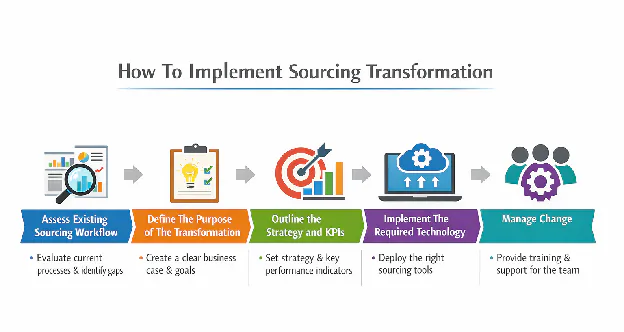
1. Assess Existing Sourcing Workflow
Review how requirements are defined, whether RFQs are complete and consistent, and the format of supplier responses. Look for issues like repeated revisions, slow internal approvals, or unclear ownership. Evaluate the supplier selection decision process and whether they follow consistent criteria or rely on ad hoc judgment.
2. Define The Purpose of the Transformation
Define the problems identified during the sourcing workflow assessment and set clear targets for improvement. Targets may include reducing RFQ cycle time or increasing the number of qualified suppliers per request. Link each target to a measurable outcome that can be tracked. This ensures that the transformation is focused on addressing the real issues.
3. Outline The Strategy and KPIs
Define the actions required to address each problem and the order in which they will be implemented. Standardize requirement intake and RFQ templates, then improve supplier communication and response structure.
Define where tools will be used to automate the process and set KPIs to track improvements in data quality, cycle time, and supplier coverage. This ensures the transformation follows a clear sequence and progress can be tracked.
4. Implement The Required Technology
Select tools based on the problems identified and the processes already defined. Implement solutions that support structured intake and RFQs, such as Coupa or iSource. Then introduce tools to automate supplier outreach, follow-ups, and quote comparison, such as ChinaSource.
Focus on automating repetitive tasks like sending RFQs, collecting responses, and organizing supplier data into a consistent format. Ensure the tool fits into your existing workflow and supports the structured process already in place.
5. Manage Change
Teams often struggle with fear of the unknown, concerns about potential job loss, and, at times, an unwillingness to move on from legacy systems and processes.
To address that, involve the sourcing team in the design of the new process and collect their feedback. Explain the expected changes, rationale, and benefits. Provide hands-on training using real sourcing cases, and assign clear ownership for each sourcing step with expectations.
Track adoption through KPIs such as RFQ cycle time and usage of the new tools. Set up regular reviews to address gaps and provide continuous support.
The Role of Data and AI in Sourcing Transformation
Data provides organizations with the insights they need into spend, risks, supplier performance, and supply chain bottlenecks. This enables them to aggregate internal spending to uncover maverick spend and business opportunities.
With access to structured data, businesses can compare suppliers, analyze demand, and identify potential supply disruptions. Data is also essential for automating sourcing workflows with AI.
AI helps automate sourcing workflows, reducing manual effort and enabling better decision-making. Teams can use it to guide the intake process, ensuring that details like pricing, targets, volume, and lead time are clearly defined. AI can also be set up to manage supplier outreach and follow-ups. This keeps communication consistent and reduces delays caused by time zones or slow replies.
AI can also support supplier screening and help structure quotes. When a procurement team receives information in different formats, they can use AI to organize it into a standard structure. This makes it easier to compare prices, MOQs, lead times, and other terms.
Here are some commonly used tools that support data- and AI-driven sourcing transformation:
- ChinaSource: Automates supplier discovery, outreach, and follow-ups at scale. It structures supplier responses into comparable formats, making it easier to evaluate price, lead time, and fit.
- Coupa: Provides structured intake, spend visibility, and supplier data management. It helps teams standardize RFQs, track sourcing activity, and analyze spending patterns to identify savings opportunities.
- SAP Ariba: Supports end-to-end sourcing with supplier networks, RFQ management, and data-driven supplier evaluation. It helps teams access a broader supplier base and manage sourcing events in a structured way.
- Icertis: Automates contract creation, approval, and tracking. It ensures that agreed terms from sourcing are captured correctly and reduces delays in contract execution after supplier selection.
Common Sourcing Transformation Challenges
While sourcing transformation seems straightforward, teams and decision-makers must be aware of potential implementation roadblocks. Here are some of the common ones to consider and prepare for.
- Poor Data Quality: Most sourcing issues stem from poor input data. Working with unclear specifications, missing details, and inconsistent data formats makes it difficult to transform sourcing processes using technology.
- Fragmented Data: Data silos are a common problem in large organizations. In such cases, AI or any new technology cannot obtain harmonized data. This can lead to wrong forecasting and making award decisions based on incomplete data.
- Resistance to Change: Teams rely on emails and spreadsheets because that’s what they know. Even if the process is slow, they may still struggle to adopt new systems due to a skills gap, lack of confidence, or fears about losing their decision-making authority.
- Lack of Clear Ownership: No one takes full responsibility for the sourcing process from start to finish. Work gets passed between teams, and follow-ups get missed. This leads to delays and makes it hard to keep things moving.
These issues can be managed by standardizing data capture in a shared structure, training and supporting users, communicating the need for change, and having a clear process owner with assigned responsibilities.
Teams should also maintain control over decisions by using manual validation at key points such as supplier selection, final award decisions, and contract approval. They can use external providers for tasks like supplier discovery and pre-screening while retaining ownership of evaluation and final decisions.
Do You Need Sourcing Transformation?
While there are clear benefits to transforming the sourcing process, it may not be ideal for every team. Before considering it, review your processes to identify any real needs or gaps. You may need a sourcing transformation if:
- You spend time chasing suppliers for missing details.
- Quotes come in different formats and are hard to compare.
- RFQs take too long to complete.
- You rely on a small set of familiar suppliers.
- You restart the process from scratch for each sourcing request.
You may not need a full transformation yet if:
- Your sourcing volume is low and manageable.
- Your data is already structured and easy to compare.
- Your current process is consistent and not causing delays.
How ChinaSource Supports Sourcing Transformation
ChinaSource helps identify suppliers with verified activity and relevant experience. It turns verified supplier intelligence into outreach, screening, and a qualified shortlist, enabling you to find the right partners faster. Here is how it works.
1. Clarify Your Requirements: You clarify your product needs with the help of AI, which fine-tunes the details, such as quantity, MOQ, and specifications.
2. AI-driven Outreach and Assessment: ChinaSource uses your requirements as the basis for an AI-powered, large-scale outreach that finds and contacts global suppliers to confirm pricing, capacity, and fit. This ensures that only relevant responses are considered.
3. Assessment: It evaluates the suppliers using the insights from the outreach and qualification checks, ensuring that only the strongest supplier makes it to the shortlist.
4. Structured Shortlist: ChinaSource returns a supplier shortlist with side-by-side quotes and supplier insights that allow you to easily compare suppliers, select your procurement partner, and initiate a structured sourcing process.
ChinaSource also gives you control, as you can track progress and step in anytime you want. It offers access to a dedicated 1-on-1 sourcing expert and human-led vetting, pricing, and negotiation, enabling you to improve your sourcing decision-making process.
FAQs
What Is Sourcing Transformation?
Sourcing transformation is the strategic overhaul of how an organization finds, evaluates, and selects suppliers to improve supplier performance, reduce costs, and deliver better business value. It is a complete overhaul of sourcing workflows, processes, and strategies and typically involves rethinking and restructuring how the company buys goods and services. It transforms everything from how they select suppliers, negotiate and use technology.
How Can Artificial Intelligence Support Sourcing Transformation?
Companies can use AI to analyze large volumes of purchasing, market trends, and supplier performance data to identify patterns that help them save costs and select the best-performing suppliers. AI tools can also be deployed to automate sourcing processes, such as supplier discovery, RFQ generation, and outreach.
For instance, ChinaSource's AI-driven tool handles supplier outreach at scale to help companies confirm pricing, capacity, and fit. It then evaluates suppliers based on those conversations, selects the best-fit one, and collects their data into a clean list, enabling you to compare suppliers and proceed with the tender process.
How Does Sourcing Transformation Impact Supplier Relationships?
Sourcing transformation improves the clarity of communication and expectations between organizations and suppliers. It also shifts the focus from a mainly cost and transactional relationship to a more strategic one. Sourcing transformation encourages businesses to work closely with suppliers and share data to innovate, reduce costs, and improve products. This makes supplier relationships more collaborative, value-driven, and transparent.
When Should a Company Consider Sourcing Transformation?
A company should consider sourcing transformation when its current procurement processes, technology, or supplier relationships can no longer support business growth, efficiency goals, or risk management needs. Key drivers of sourcing transformation include off-contract spending, issues with supplier performance, Inability to see spend data across different business entities, and slow, manual processes, such as reliance on spreadsheets, emails, or legacy systems that do not integrate with modern ERPs.
What Role Does Data Play In Sourcing Transformation?
Data provides the insights into costs, quality, and supplier performance that companies can build on to transform the procurement process. By analyzing the data, they can identify reliable suppliers, spot hidden risk patterns, and negotiate better prices. Data is also essential for technology to perform at its best. Without good data, technologies like AI only deliver incomplete or unclear insights.
Final Thoughts
Sourcing transformation is about rethinking the entire sourcing process to make it more responsive and consistent. Many teams still struggle with issues like unclear requirements, inconsistent supplier responses, and time-consuming email chains. These issues are made even worse by data silos that lead to delayed or incomplete insights.
While technologies like AI are critical to sourcing transformation, organizations must first deal with their data setup. They can do that by standardizing data collection, structuring supplier inputs, and storing data in one central place to enable teams to access and compare it easily.
This is one of the strengths of tools like ChinaSource. It clarifies requirements with AI-assisted guidance, manages supplier outreach and evaluation, and organizes the insights into side-by-side quotes that enable you to easily compare suppliers, choose the best fit, and start the tender process. Talk to us today to see how you can transform your sourcing process.