
Sourcing Optimization: How to Improve Award Decisions With Scenario Planning

Many companies tend to look at “success” in sourcing from the context of cost savings. That isn’t surprising, because in the past, procurement was mainly focused on trimming budgets and on quantifiable results. But when companies focus solely on savings, they miss the bigger picture.
There are risks to this approach, especially in a volatile market. Prioritizing only on cost savings in such contexts can expose a business to more risks and weaken supplier relationships, because they view procurement as tactical and success becomes a race to the bottom.
But before that comes sourcing, and many of the later-stage struggles start here. That is why sourcing optimization is valuable. Yet, most companies struggle to capture their full value because they treat it as a more sophisticated way to compare bids, some kind of supplier ranking tool. That view undermines the potential of sourcing optimization and its real purpose.
Sourcing optimization helps you decide how to split business between suppliers in a way that balances cost, risk, and real-world constraints. However, its true leverage is evident at the award decision stage.
In practice, structured sourcing requires clean supplier data, aligned cost components, and clear visibility into constraints. Many procurement teams struggle because they receive supplier information in inconsistent formats across emails and spreadsheets. Platforms like ChinaSource address this early-stage gap by organizing supplier discovery, quote collection, and comparison in a structured format before award modeling begins.
Once bids are in, the question shifts from “who is cheapest?” to “how should we split the volume?” The award decision becomes a question of how to allocate volume under changing demand, capacity, and cost conditions.
What Is Sourcing Optimization in Practice?
Sourcing optimization is the use of automation and analytics to evaluate cost, capacity, lead time, and risk constraints, allowing businesses to efficiently allocate demand across qualified suppliers. It is widely regarded as best practice when conducting competitive bid processes in settings where a buying organization considers blending two or more suppliers.
Sourcing optimization involves breaking what you are buying into smaller lots, inviting suppliers to bid on these separately or offering package bids. It uses advanced analytics to run comprehensive scenario analytics in sourcing events where:
- A buyer will award the business to more than one supplier.
- Allocation decisions are based on more than just price.
- The spend is significant (so sub-optimal allocations cost more than doing things right).
Imagine you have two qualified suppliers who both produce the same component. One is a large manufacturer with lower unit costs but minimum order quantities that require bulk purchases. The other is a smaller, more flexible supplier with slightly higher prices, no MOQ requirement, and faster lead times.
When a new order comes in, how much volume should each supplier receive? And does that answer change if demand spikes, capacity tightens, or tariffs shift their cost structure?
The answer depends on what you are trying to optimize: cost, delivery speed, reliability, or inventory levels. Sourcing optimization follows the same logic. It helps decide the best option when several goals and limits must be balanced.
Benefits of Sourcing Optimization
Sourcing optimization helps companies make smarter supplier decisions that improve cost, reduce risk, and strengthen overall performance.
- Cost Savings and Budget Control: Strong sourcing optimization is essential for generating cost savings across procurement efforts. By adopting a Total Cost of Ownership (TCO) approach, companies can identify savings beyond just unit prices, such as lower transportation, inventory holding, and overhead costs.
- Strengthened Supplier Relationships: Tools that facilitate tracking of supplier performance help drive ongoing development while securing long-term supplier loyalty. These types of partnerships result in predictable pricing, preferential access to resources, and procurement outcomes that benefit both parties.
- Improved Efficiency and Productivity: Optimized sourcing systems create more efficient workflows, which reduce procurement cycle time. This efficiency has a ripple effect, liberating employees from time-consuming manual processes. Automation is the hallmark of today’s best sourcing platforms. It eliminates duplication of effort by streamlining practices such as bid evaluation and data input.
- Enhanced Decision-Making and Mitigating Risk: Sourcing optimization arms organizations with data-driven insights that guide more informed decision-making. For instance, scenario analysis tools help in evaluating risks such as supply chain disruptions.
Sourcing Optimization as a Structured Decision Framework
A good way to understand sourcing optimization is to consider it a structured decision framework for allocating business across multiple qualified suppliers. It creates value by assigning volume based on supplier limits and business priorities.
There are decision variables that drive this framework. For instance, the most important one is volume allocation, which is how much demand each supplier will receive. After collecting and normalizing bids, the organization must then decide how to distribute total demand across suppliers in a way that serves its broader goals.
Those goals form the objective of the model. In some cases, the objective is to minimize total landed cost. In others, it may be to minimize risk-adjusted cost, limit supplier concentration, or balance cost with service-level performance. The objective defines what “optimal” means.
But objectives alone are not enough. Every allocation must respect hard limits, such as:
- Suppliers have capacity limits.
- Suppliers may require a minimum order size.
- Compliance rules may block certain volume splits.
Your company may also set limits, such as not giving more than a set share of total demand to one supplier.
Sourcing optimization brings these elements together. It structures the award decision as a problem of allocating volume among suppliers to maximize the defined objective while operating within unavoidable constraints.
Defining the Optimization Objective Before Modeling
Before a company starts to model allocations, it must define what it wants to optimize for. That objective is what mainly drives the outcome. If the focus is purely to reduce total landed cost, the model will concentrate volume with the supplier that offers the lowest cost within the capacity limit. The allocation will look different if the objective includes considerations for exposure caps, service levels, or risk-adjusted costs.
Different strategic priorities produce different optimal solutions. For example, a company entering a new market may prioritize service reliability over marginal cost savings. A company operating under margin pressure may prioritize landed cost, and one exposed to geopolitical risk may introduce geographic diversification as a formal constraint.
In more advanced scenarios, optimization can incorporate weighted objectives. For instance, you can have cost accounting for up to 70 percent of the decision, service performance for 20 percent, and supplier concentration risk for 10 percent. Sourcing optimization should reflect strategic intent, rather than mere number crunching.
Defining a clear objective sets the tone before modeling and ensures that the award recommendation aligns with business priorities rather than defaulting to the lowest price.
Award Decision Modeling
Imagine there’s a 10,000-unit demand on the table, and you have the following offers.
- Supplier A offers the lowest price but only has the capacity for 6000 units.
- Supplier B costs more but meets strict compliance rules.
- Supplier C has capacity but longer lead times.
You must decide how to allocate volume without violating any limits. Once you have a shortlist of suppliers, you shift from comparing them to allocating orders. The goal is to determine how you split the total demand across qualified suppliers within defined objectives and constraints. Here are the steps to get it right.
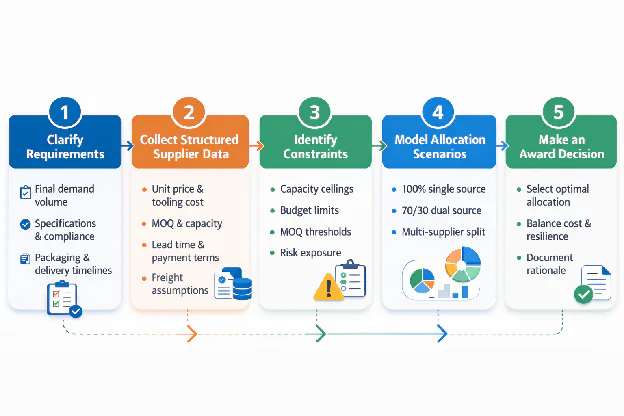
1. Clarify Requirements
Before you model any allocation, ensure you confirm the required inputs. That includes final demand volume, technical specifications, compliance standards, packaging details, and delivery timelines. You risk ending up with flawed cost comparisons and incorrect volume splits if these details are unclear or incorrect.
2. Collect Structured Supplier Data
Gather comparable inputs from each supplier, such as unit price, MOQ, tooling cost, capacity, lead time, and payment terms. Also, collect freight assumptions and collate these details into a consistent format. Ensure every supplier responds to the same data fields.
3. Identify Constraints
Define hard limits that the award must follow, such as capacity ceilings, budget, minimum order quantity threshold, or risk exposure. Identifying constraints ensures that your award decisions are realistic and workable in a real-world context.
4. Model Allocation Scenarios
Test different ways of splitting the demand across qualified suppliers before you make a final decision. You can model at least three options:
- 100% single source.
- 70/30 dual source.
- Multi-supplier split based on capacity.
You can think of this as running a “what if” analysis inside your award model. Compare the total cost, lead-time impact, supply continuity, supplier-concentration risk, and operational feasibility under baseline demand. This ensures that you see the trade-offs before you commit money and volume.
5. Make An Award Decision
Select the allocation that meets total demand, respects constraints, and balances cost with supply resilience. Document the rationale and assumptions behind the final volume split. That way, you can make a cohesive argument if the leadership needs things clarified.
Scenario Stress Testing
While it’s good practice to always consider constraints in award allocation, it's important to know that those assumptions can change. Scenario stress testing evaluates how your allocations hold up under changes in supply availability, demand, or cost structure. You can measure feasibility, cost impact, and service levels by the following stress factors:
Sudden Increases In Cost
Cost shocks can result from changes in freight costs or currency fluctuations, and they can then affect the assumptions made about total landed cost. A supplier that previously offered the lowest cost may lose its advantage when pricing conditions are updated. The allocation model recalculates the full cost of delivery and may shift volume toward suppliers that become more competitive under the new cost structure.
Supplier Disruption
If a supplier cannot deliver or is unavailable for a specific period, say 30 days, that will reduce the available supply. The capacity of other suppliers on your list will then determine if the lost volume can be absorbed. If they cannot, the original allocation is exposed as fragile and must be redesigned to reduce the risk of concentration.
Demand Volatility
Imagine there’s a sudden 20 percent increase in demand, your original allocation may no longer be feasible. Supplier capacity constraints become binding, particularly for the main supplier. You must then redistribute volume to secondary suppliers within their confirmed limits to avoid stockouts and maintain coverage.
Building Robust Sourcing Decisions
An award may look optimal on paper, but even the smallest disruption can expose its fragility. Even a well-structured allocation can fail if it depends too heavily on one supplier or one stable assumption.
Robust decision engineering is about designing sourcing decisions that still perform well even when assumptions change. You may still need to adjust them at the margin, but their structure does not fail under moderate pressure.
This is where risk-adjusted reasoning matters. A slightly higher baseline cost may be justified if it reduces concentration risk, improves recovery flexibility, or lowers expected disruption impact. The goal is to control cost without creating supply exposure.
Clear assumptions make the allocation defensible. If conditions change, leadership can trace the logic behind the original decision. It’s easier to defend allocations when the underlying assumptions are clear. And if conditions change, leadership can understand what was decided and why.
When Does It Make Sense to Split Volume?
You can justify volume splits when the expected cost of disruption exceeds the baseline savings from single sourcing.
For example, if a sole-source supplier is 3 percent cheaper but creates full concentration exposure, that 3 percent savings must be weighed against the financial impact of a disruption. If a temporary shutdown would result in lost sales, expedited freight, or production stoppage costs exceeding the savings, the lower-cost allocation would no longer make financial sense.
Sourcing optimization lets you compare options clearly. You look at the normal cost, then test what happens if things go wrong. If paying a little more per unit lowers your potential losses in a disruption by more than that extra cost, then splitting volume makes business sense.
An allocation strategy, as well as being a sourcing decision, also reflects how the business chooses to manage financial exposure. Different volume structures create different cost levels, recovery flexibility, and disruption impact. The table below is an example to show how allocation choices align with risk posture and financial consequences.
| Scenario | Single Source Savings | Estimated Disruption Cost | Rational Decision |
|---|---|---|---|
| Stable market | 5% | Low | Single source |
| Moderate volatility | 3% | Medium | Evaluate split |
| High disruption risk | 2% | High | Split volume |
| Critical category | 4% | Very High | Diversify |
Enabling Structured Sourcing Optimization in Practice
Structured award modeling depends on disciplined data collection, aligned cost inputs, and transparent visibility into constraints. In practice, managing this manually across emails and spreadsheets introduces risk and inconsistency.
This is why early-stage sourcing workflow matters. When you clearly define your requirements and organize cost details and supplier responses in the same format, you can create better award models.
ChinaSource manages this process inside the sourcing event, so supplier data arrives structured and ready for allocation modeling. This reduces manual reconstruction and enables scenario-based award modeling on a clean foundation.
How ChinaSource Works
1: You start by describing what you need. The system asks follow-up questions to fill gaps around specs, volume, target price, lead time, and compliance.
2: Next, it searches for suppliers that fit the requirement and reaches out to them. It collects quotes, confirms key terms, and follows up when there is missing information.
During this stage, suppliers can ask questions to clarify specifications, quantities, or delivery expectations. The platform keeps all communication in one place. That ensures that requirement clarifications and supplier responses are documented and visible throughout the sourcing process.
3. You see all supplier offers in one view, with quotes aligned to the same structure for clean comparison. It also keeps supplier communication records transparent throughout, so you have everything you need for volume testing and award decisions.
4: You can review the shortlist, adjust assumptions, and test different volume splits without rebuilding everything in spreadsheets.
Turning Optimization Output Into Executive Decisions
Optimization produces recommended allocations, but the final award is usually a business decision. The business leadership must define acceptable exposure levels.
For instance, is it reasonable for one supplier to control 70 percent of the total volume if cost savings justify it? Should splits be required in high-risk categories even when it increases baseline cost?
These choices often determine how a company sets constraints before modeling. Financial stakeholders may also evaluate whether a volume split premium is justified. Executive review should focus on exposure thresholds and acceptable risk levels before approving the final allocation.
At this stage, the allocation goes beyond a sourcing model and becomes a cross-functional decision. Different teams look at the same allocation from different angles, as follows:
| Function | Primary Concern | What They Focus On in the Allocation |
|---|---|---|
| Procurement | Cost performance | Total landed cost and savings vs baseline |
| Supply Chain | Continuity | Capacity limits and recovery options |
| Finance | Margin impact | Cost premium vs disruption exposure |
| Risk Management | Concentration risk | Supplier dependency and scenario outcomes |
| Executive Leadership | Strategic stability | Long-term resilience and governance fit |
When optimization outputs align with governance thresholds and risk tolerance, award decisions shift from analytical recommendations to defensible executive actions.
Data Requirements for Decision-Grade Allocation Modeling
Sourcing optimization depends on clean, aligned data; without it, you risk ending up with a flawed award decision. Here are the required data inputs.
- Clear Lead Time Definitions: Define what lead time means. Is it production only? Production plus transit? Does it start from the deposit or from the PO confirmation? Without a shared definition, you cannot evaluate delivery risk.
- Confirmed Capacity Data: Do not assume a supplier can scale. Ask for confirmed monthly production capacity for your specific product. Allocation decisions must respect real production limits.
- Comparable Cost Components: Break down the total landed cost clearly. Include product cost, tooling, packaging, inland freight, international freight, duties, and inspection fees where relevant. If one supplier includes freight and another does not, the numbers mislead you.
- Standardized Quote Templates: Ask every supplier to respond using the same structure. Request unit price, tooling cost, MOQ, capacity, lead time, payment terms, and shipping terms in fixed fields. When suppliers answer in different formats, comparison turns into guesswork.
FAQ
How Do You Compare Supplier Quotes Before Allocation Modeling?
Compare supplier quotes using the same structure and cost components. Break down the total landed cost to include unit price, tooling, packaging, freight, duties, and any other relevant fees. Make sure every supplier provides the same data fields, such as MOQ, capacity, lead time, and payment terms. By doing that, you can directly compare the numbers before running allocation scenarios.
How Do You Measure the Success of a Sourcing Optimization Initiative?
Success is measured by total landed cost improvement, reduced supplier concentration risk, improved service levels, and how well the allocation performs under stress scenarios. A strong result holds up even when demand or costs change.
What Constraints Should be Included in a Sourcing Optimization Model?
Common constraints include supplier capacity limits, minimum order quantities, budget limits, compliance requirements, and exposure caps that restrict how much volume one supplier can receive. These constraints ensure that the allocation model produces solutions that are realistic and workable in actual operations.
How Do You Decide the Right Volume Split Between Multiple Suppliers?
You decide based on total cost, supplier capacity, risk levels, and business goals. Start with the full demand, apply your limits, and test different split options. Choose the allocation that meets demand, controls risk, and supports your cost targets.
Should Companies Always Use Multiple Suppliers?
Not always. Single sourcing can reduce unit cost and simplify operations when demand is stable and supplier performance is reliable. However, dual or multi-sourcing reduces concentration risk and improves supply continuity in volatile or high-risk categories. The right choice depends on demand variability, capacity limits, and exposure to disruption.
Final Thoughts
Award decisions shape cost structure, risk exposure, and supply stability long after the sourcing event ends. They must respect capacity limits, exposure thresholds, and disruption risk while protecting margins. Baseline modeling sets the starting point. Stress testing confirms whether the allocation holds up
When you treat sourcing optimization as structured decision-making, procurement goes beyond short-term savings. You focus on splitting volume with risk in mind, make trade-offs clear, and document assumptions. This ensures you can defend your decisions if required. This gives you an edge in unstable markets.
Executing this level of award decision engineering requires structured data, aligned cost inputs, and clear visibility into constraints. ChinaSource supports this workflow within the sourcing event by standardizing supplier responses and enabling scenario-based allocation modeling on a clean foundation. Talk to an expert today to learn more about it.