
What Is Procurement Outsourcing? A Practical Guide for Growing Businesses


Overview
Procurement outsourcing is about bringing in an outside supplier to carry out part or all of your purchasing. This guide looks at the actual process, various ways to do it, when it will make sense, and when it won’t.
 When the wheels start coming off, it rarely happens all at once; the signs are gradual. Supplier approvals that could be approved in a day are now taking weeks, and your procurement team is buried in purchase orders and can’t make time to discuss a single contract properly themselves.
Someone in finance flags a duplicate payment, and another category you have been really wanting to review for months keeps getting bumped because there’s always something more urgent.
Sound familiar? This is the procurement strain you see when a company grows much faster than its internal processes can keep up. And it’s really one of the most common reasons that makes a company consider outsourcing.
But procurement outsourcing isn’t merely a matter of capacity; if done properly, it brings to the table expertise, purchasing power, and market knowledge that most internal teams, even the very best ones, will struggle to build all by themselves. That is the real case for it, and it is worth understanding before deciding whether it’s the right move for you.
What Is Procurement Outsourcing?
Procurement outsourcing means bringing in an external provider to take over part or all of your purchasing function. This might mean handing over a single product category to them or delegating everything from finding suppliers to processing payments. Here’s what it’s not, though. It’s not quite the same thing as using a sourcing agent for an occasional product find. A sourcing agent locates a supplier for you, and their job is done when the goods are shipped out. A procurement outsourcing provider takes on continuous operational responsibility; they manage your buying processes, not just help you solve a single problem. That difference really matters more than it might initially appear to. Sourcing agents and outsourcing providers have very different structures, are priced very differently and will require completely different levels of integration within your business. Conflating the two is one of the quickest ways to arrive at an arrangement that won’t deliver the results you’re looking for. If you want a broader view of where sourcing fits into the procurement lifecycle, this blog post on strategic sourcing provides more insight.
The Four Types of Procurement Outsourcing
Not all outsourcing looks the same; there are four models, and which one actually fits your situation depends on where the pain is and how much you’re willing to hand over.
Tactical outsourcing
This is the operational phase; it involves processing purchase orders, going after suppliers for confirmations, and handling the low-value repeat purchases that somehow eat up half your team’s week. None of it requires much strategic thought, but all of it requires consistent time and attention. Outsourcing this layer doesn’t mean giving up control of anything important. It just means your people stop spending Tuesday afternoons on admin they never wanted to do in the first place.
Strategic outsourcing
This one is different. You’re not just outsourcing work; you’re outsourcing judgment. High-value manufacturing inputs, specialist components, categories where pricing shifts fast, and relationships that take years to build—these benefit from someone who has been watching that market for a long time. They know the suppliers, they know what leverage looks like in a negotiation, and they know which moves actually work. That’s genuinely hard to replicate internally if you’re starting from scratch.
Category-specific outsourcing
You don’t have to outsource everything. A lot of businesses hand off one specific area to a specialist while keeping everything else in-house. A consumer goods brand might outsource packaging procurement. A mid-sized manufacturer might hand off indirect spend while keeping direct materials firmly under their own roof. It’s a practical middle ground: get expert help exactly where it adds the most value, and keep control where it matters most to you.
End-to-end outsourcing
The full handover. The provider takes responsibility for the entire function, supplier search, qualification, contracts, purchase orders and payments, all of it. Your internal team sets the direction and holds overall accountability, while the outsourcing partner handles the day-to-day execution. Companies usually end up here for one of three reasons: they’re scaling faster than they can build internal infrastructure, they’re going through a major restructure, or they’re entering a market where they genuinely have no established setup to build from. It’s the highest-commitment model, which means it rewards the most careful selection.
What Does a Procurement Outsourcing Provider Do?
The honest answer is: it depends on the engagement, but most providers cover some combination of the following activities.
| What They Handle | What That Looks Like Day-to-Day |
|---|---|
| Supplier sourcing and selection | Running RFI, RFP, or RFQ processes, vetting suppliers, and building a shortlist based on your requirements |
| Process management | Owning the purchasing workflow, requests, approvals, POs and delivery tracking, so your team doesn’t have to |
| Spend analysis | Going through your purchasing data to find where you’re overspending, duplicating, or missing savings opportunities |
| Contract management | Negotiating supplier terms, managing renewal dates, and keeping commercial agreements on track |
| Technology integration | Connecting procurement tools to your ERP or finance systems and keeping the data accurate |
The best providers don’t just execute tasks; they deliver results. They bring benchmarking data, what other companies in your space are paying for the same categories, and use that information actively in negotiations. That’s the part you genuinely can’t replicate internally without considerable time and investment.
Outsourced vs. In-House Procurement
There’s no universally right answer here. It comes down to your stage of growth, the complexity of your categories, and how central supplier relationships are to what makes your business competitive.
| Factor | Keeping It In-House | Outsourcing It |
|---|---|---|
| Cost structure | Fixed, headcount costs whether you’re busy or not | Variable, scales with activity, lower fixed overhead |
| Speed to scale | Slow hiring and training take months | Fast, the provider has existing people and systems |
| Category expertise | Capped by who you can afford to hire | On-demand access to specialists across categories |
| Visibility and control | Full oversight, direct relationships | Requires strong reporting to maintain clear sight lines |
| Scalability | Hard to ramp up quickly in new markets | Can flex up or down as the business changes |
| Supplier relationships | Owned directly, high continuity | Managed by the provider, quality varies |
Most companies that outsource procurement don’t start big. They pick one category, test the relationship, and expand from there. That incremental approach is almost always lower risk than handing over everything at once.
What You Actually Get From Procurement Outsourcing
When the fit is right, the benefits are real. Here’s what shows up most consistently.
Time your team gets back
Procurement teams in most businesses are stretched thin. When you take the transactional and administrative layer off their plate, purchase orders, routine supplier chasing and invoice processing, you free up time for the decisions that actually require judgment. That’s usually where internal teams add the most value anyway.
Better commercial outcomes
Providers manage spend across multiple clients. That volume gives them negotiating leverage and market benchmarks that individual businesses can’t match. They know what comparable companies are paying for the same categories, and they use that knowledge actively. That’s not a marginal advantage; it often translates into 10 to 20 percent savings on well-managed categories.
Expertise you don’t have to build from scratch
Hiring a specialist for every procurement category you need to manage isn’t realistic for most mid-sized businesses. Outsourcing gives you access to that expertise on a flexible basis: people with years of experience in specific supplier markets, certification requirements, and commercial structures you’d otherwise have to learn on the job.
Stronger compliance and audit readiness
Good outsourcing providers bring documented processes, approval workflows, and audit trails. For businesses in regulated industries, or those selling to customers who audit supply chains, that structure adds real value. It can be the difference between passing a compliance review and failing one.
When Does Outsourcing Procurement Actually Make Sense?

Here are some of the situations that come up repeatedly as the genuine trigger points.
Your team is at capacity, and quality is starting to slip.
When the volume of purchasing decisions grows faster than your team can manage, things start to slide: approvals take too long, supplier negotiations get skipped, and reactive buying costs more than planned buying would have. Outsourcing buys you capacity without the lag time of building a team from scratch.
You’re moving into a new sourcing market.
Expanding into Southeast Asia, Eastern Europe, Latin America- wherever it is—you're entering a market where local knowledge matters. Lead times, compliance requirements, cultural norms around negotiation, payment expectations, these things aren’t obvious from the outside. A provider already operating there can significantly shorten that learning curve.
You don’t have the category expertise internally.
Some categories are genuinely specialized: industrial tooling, pharmaceutical packaging and electronic components. Getting good commercial outcomes in these areas requires people who’ve been working in them for years. Outsourcing to a category specialist often yields better results than having a generalist buyer manage it.
You need to reduce costs without adding headcount.
Outsourcing providers manage spend across multiple clients simultaneously. That scale gives them purchasing power and pricing intelligence that individual businesses simply can’t match. They often know exactly what you should be paying for a category, and they use that knowledge in negotiations on your behalf. For businesses entering new sourcing markets in particular, ChinaSource helps at this early stage, connecting buyers with vetted suppliers globally, handling multi-supplier outreach, and generating standardized quote comparisons that make the supplier selection process faster and less chaotic.
When Outsourcing Is the Wrong Call
Outsourcing is not always the right answer. There are specific situations where keeping procurement in-house is the smarter move, and being honest about this early saves a lot of wasted time.
When the supplier relationship is a competitive asset
If your relationship with a particular supplier involves shared product development, proprietary materials, or years of trust built on direct contact, think carefully before delegating that to a third party. The relationship itself may be part of what makes your product differentiated.
When you’re too early-stage to know what you need.
Procurement outsourcing works when your requirements are reasonably well defined. If you’re still figuring out what you’re buying, at what volumes, and to what specification, an outsourced provider will struggle to add value to your company. That internal clarity has to come first.
When the category is too small to justify the overhead.
Outsourcing introduces coordination costs on both sides, and for very small or simple purchasing categories, those costs often exceed any savings. A direct relationship with one or two suppliers, along with a basic internal process, is usually more efficient.
When you need full, real-time visibility.
In some businesses, particularly those with tight compliance requirements or complex supply chains, the ability to see exactly what’s happening in procurement at any moment is non-negotiable. Outsourcing adds a layer that can slow that visibility unless the reporting infrastructure is set up properly from day one.
How a Procurement Outsourcing Engagement Actually Works
In real life, this usually happens step by step, and not all at once.
Step 1: Decide what you want to hand over
Most companies do not outsource the whole function on day one; They start small. That might mean one spending category, one market, or one part of the work, like supplier research, quote collection, or purchase order admin. This part needs to be clear from the start. What is the provider doing? What is your team still doing? Who makes the final call when there is a price issue, a delay, or a quality problem? If that is fuzzy, the whole thing gets messy fast.
Step 2: Let the provider learn how your process really works
A good provider will not guess; they will speak with the people who do the work now. That includes buyers, approvers, finance, and operations. These are the people who know where requests get stuck, which suppliers are slow, and what usually goes wrong. This matters because the real process is often different from the one written in a policy doc.
Step 3: Set the working rules
Now both sides agree on how the work will run day-to-day. Who sends requests? Who approves spending? Who talks to suppliers? How often will reports be shared? And what happens when something urgent comes up? This is also when the provider gets access to the data, systems, and supplier records they need; If this stage is rushed, problems show up later.
Step 4: Start with live work
Once the setup is done, the provider begins handling the agreed tasks; That may include collecting quotes, following up with suppliers, tracking orders, or managing routine purchasing work. Your team should feel the difference quite quickly, less chasing, less admin, fewer small tasks are eating up the day. But you still stay close to the big decisions. Things like supplier strategy, final approvals, and key relationships should still stay with you.
Step 5: Review what is changing
After the first few weeks, you should be able to see what is getting better. Are approvals moving faster? Are orders more accurate? Is your team getting time back? Are supplier issues being picked up earlier? A good provider does not just do tasks. They also show you what is improving, what is still weak, and where more savings or fixes may be possible. That is what a working engagement looks like: a clear scope → clear roles → a slow handover and then steady review.
How to Choose the Right Procurement Outsourcing Partner
This is a relationship that will become embedded in your operations. Take your time with the selection. Here’s what to look at:
- Market coverage: Do they actually have supplier networks in the regions and categories you need, or are they generalists who’ll be learning on your budget?
- Transparency: Will you have full visibility into supplier identities, pricing discussed, and communications on your behalf?
- Technology: what tools do they use, and how cleanly do they integrate with your ERP or finance systems?
- Track record: Can they point to clients in similar industries or at similar growth stages who’ve seen real results?
- Pricing model: Is it structured in a way that aligns their incentives with yours?
- Supplier communication approach: Do they take over supplier relationships entirely, or keep you involved where it matters strategically?
- Exit terms: What happens to your data and supplier relationships if the arrangement ends?
What Usually Goes Wrong With Procurement Outsourcing
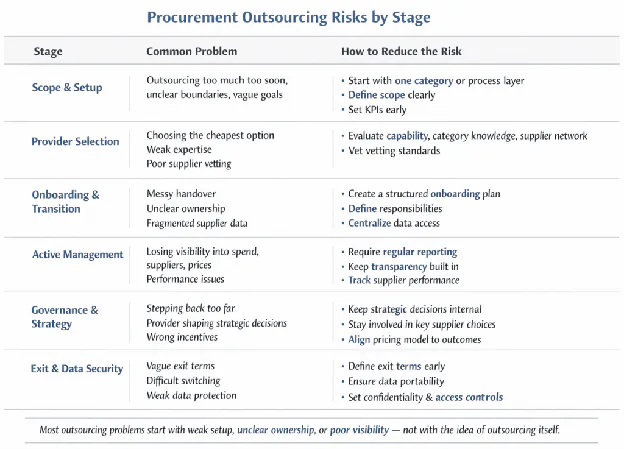
Most problems do not start with one big mistake. They start small. A weak setup at the beginning turns into a bigger problem later.
Starting too big
This is one of the easiest mistakes to make. A company outsources too much too soon. The provider takes on the full process before anyone knows how well the relationship will work. That sounds efficient. It often is not. When the scope is too wide, confusion shows up fast. Roles blur. Small issues pile up. Then the business spends months trying to fix a setup that should have been tested on a smaller scale first.
Losing sight of the work
Once someone else is running day-to-day purchasing, visibility can slip without anyone noticing at first. You stop seeing what is being bought, which suppliers are being used, and what prices are being agreed upon. The same thing can happen with supplier performance. If reporting is weak or the business steps too far back, control fades quietly. By the time the problem is obvious, it is harder to unwind.
Choosing the cheapest option
Low price can look attractive at the start. Still, a cheaper provider can bring weaker supplier networks, less category knowledge, and slower service. That usually shows up in missed savings, poor follow-up, or more work for your own team. So the cheaper option stops looking cheap very quickly.
Setting the wrong incentives
Some providers earn more when spending goes up. That is a problem; if the provider is rewarded for volume instead of savings or stronger buying decisions, their goals are not the same as yours. Over time, that can weaken the whole arrangement.
Stepping back too far
Outsourcing operations is not the same as outsourcing judgment. Yet this is where many businesses drift. They hand over the process and slowly stop owning the important decisions. Supplier strategy, category priorities, and long-term commercial choices start getting shaped by the provider instead of the business. That is rarely a good sign.
Assuming supplier checks are strong
Not every provider vets suppliers to the same standard. Some are careful. Some are not. If your category depends on quality checks, certifications, or compliance documents, weak vetting can create bigger problems later. A lower price means very little if the supplier cannot deliver what you need.
Ignoring the exit until it is too late
Leaving a provider is often harder than people expect. Once systems, records, and supplier communication sit inside the provider’s process, switching can be slow and expensive. If exit terms were vague at the start, the business can get stuck.
Treating data security like a side issue
A procurement provider may see contracts, pricing, spend data, and supplier details. That is sensitive information. If confidentiality, access rules, and data handling are not dealt with early, risk builds in the background. It may not show up right away, but it is still there.
How to Reduce the Risk
The good news is that most of these problems can be reduced. Not with luck. With a better setup. Start small. Test the provider with one category, one market, or one part of the process. That gives you room to see how they work before you hand over more. Set clear targets early. Do not settle for vague goals like “improve procurement.” Agree on simple measures that matter to your business, such as savings, cycle time, invoice accuracy, or supplier delivery performance. Keep visibility built in. You should always be able to see what is being bought, which suppliers are being used, and how performance is tracking. Good outsourcing should reduce workload, not hide information. Stay close to the strategic calls. Let the provider handle execution where it helps, but keep control of supplier strategy, key relationships, and major commercial decisions. Check the pricing model carefully. Make sure it supports better outcomes, not just more spending. Ask how supplier vetting works in practice. Not in a pitch deck. In real work. If quality or compliance matters, ask what checks are done, who does them, and how often they are reviewed. Sort out the exit before the work begins. Make sure data, supplier records, and handover support are covered in the contract. It is much easier to agree on that at the start than at the end. And treat data security as basic, not extra. Access controls, confidentiality terms, and data handling rules should be clear from day one. That is usually the difference between an outsourcing setup that helps and one that slowly turns into another problem.
Procurement Outsourcing FAQ
What's the difference between a sourcing agent and a procurement outsourcing provider?
A sourcing agent helps you find a specific supplier for a specific product. The engagement is transactional; it starts when you have a sourcing need and ends when the supplier is found. A procurement outsourcing provider takes ongoing responsibility for a category or function, managing processes, supplier relationships, and performance over time. The commitment level, commercial structure, and degree of integration with your business are completely different.
Is it possible to outsource only part of the procurement process?
Yes, and it’s actually the most common approach. Plenty of businesses outsource a single product category, packaging, raw materials and indirect spend, while keeping everything else in-house. Others outsource the transactional layer but retain strategic sourcing decisions internally. Starting with a defined, bounded scope is lower risk and easier to manage than a full handover, and it gives you the chance to assess a provider’s performance before committing to a broader arrangement.
How can we maintain strong supplier relationships when outsourcing procurement?
Define upfront which supplier relationships you want to retain direct ownership of. For strategic partners, suppliers tied to product innovation, quality-critical components, or long-term exclusivity arrangements, stay involved regardless of who handles day-to-day communications. For transactional suppliers, provider management is usually fine. Put regular check-ins with your most important suppliers into your own calendar, and make sure the provider gives you full transparency into what’s being discussed on your behalf.
How should we measure the cost and ROI of procurement outsourcing?
Start with a clear baseline before the engagement begins: what you’re currently spending by category, what your internal process costs are, and what your supplier performance looks like. Then measure the delta over time. The metrics that matter most are: cost savings achieved versus baseline, reduction in procurement cycle time, invoice error rates, and internal hours freed up for other work. A good provider should be tracking and reporting all of these as standard. If they’re not, ask why.
How much does procurement outsourcing typically cost?
Pricing models vary. Some providers charge a percentage of managed spend, typically somewhere between one and three per cent. Others use a fixed management fee. Some use a gain-share model tied to savings delivered, which aligns incentives better in most cases. For smaller engagements or category-specific outsourcing, project-based fees are also common. Whatever the model, get absolute clarity on what’s included and what triggers additional charges before signing anything.
How long before you start seeing results?
Tactical and process-level improvements tend to show up within the first few months: faster approvals, fewer errors and less admin overhead. Strategic benefits like improved supplier pricing and better contract terms generally take longer, often six to twelve months, because they depend on the provider building real market knowledge and supplier relationships in your categories. Be realistic about the timeline when setting expectations internally.
One Last Thing
Outsourcing procurement is not a shortcut, but a deliberate decision to gain access to expertise, capacity and the connections with those suppliers that really would require an awful long time to develop yourself internally and then have the possibility of doing so in a much more structured and accountable way, and even turning back if it doesn’t come off as planned. The businesses that really benefit from it usually start off with a super-clear scope, very well-defined KPIs, and a genuine desire to treat the provider as a completely accountable partner instead of merely a contractor. The ones that struggle either hand over too much of their control too early or don’t stay close enough to the strategic decisions themselves to notice whenever things start to drift a bit. If you find yourself at the earlier stages of further developing your sourcing capability, determining which suppliers you should deal with in a new market, obtaining similar quotes from manufacturers, or simply making every effort to bring in some structure to a sourcing process that’s grown almost randomly over time, ChinaSource is really made for that exact situation. The AI-driven platform links buyers with confirmed international suppliers, handles contacting multiple suppliers at once, and builds standardized comparison reports that make evaluation quite effortless. Visit ChinaSource today for a free trial and start outsourcing easily.