
Negotiate with Chinese Suppliers: Keep Key Specs

To negotiate with Chinese suppliers without losing essential requirements, separate the approved product from the commercial choices you can change. Ask what a lower price would alter. Offer specific, conditional concessions on items such as decorative packaging or production timing, then obtain a revised quotation that states the agreed scope.
A discount is difficult to evaluate if the supplier quietly changes the material, omits a required check, or quotes a different delivery basis. Keep those changes visible. Your goal is an acceptable purchase within a defined budget, with the required product and responsibilities still clear.
Set the approved specification as your baseline
Start with the specification revision, quantity, destination, packaging requirements, delivery basis, and required evidence behind the quotation. Identify the features that matter to function, fit, safety, intended use, and applicable market requirements. Your responsible technical reviewer should resolve uncertain requirements.
Then identify preferences that your team may consider changing. The number of decorative print colors might be flexible. A protective insert or required label may serve a necessary purpose. Packaging is not automatically optional simply because it is outside the product itself.
Use our specification sheet guide to document approved requirements and proposed alternatives separately. Assign an approver for each possible change. A supplier's suggestion does not authorize a new material or inspection scope.
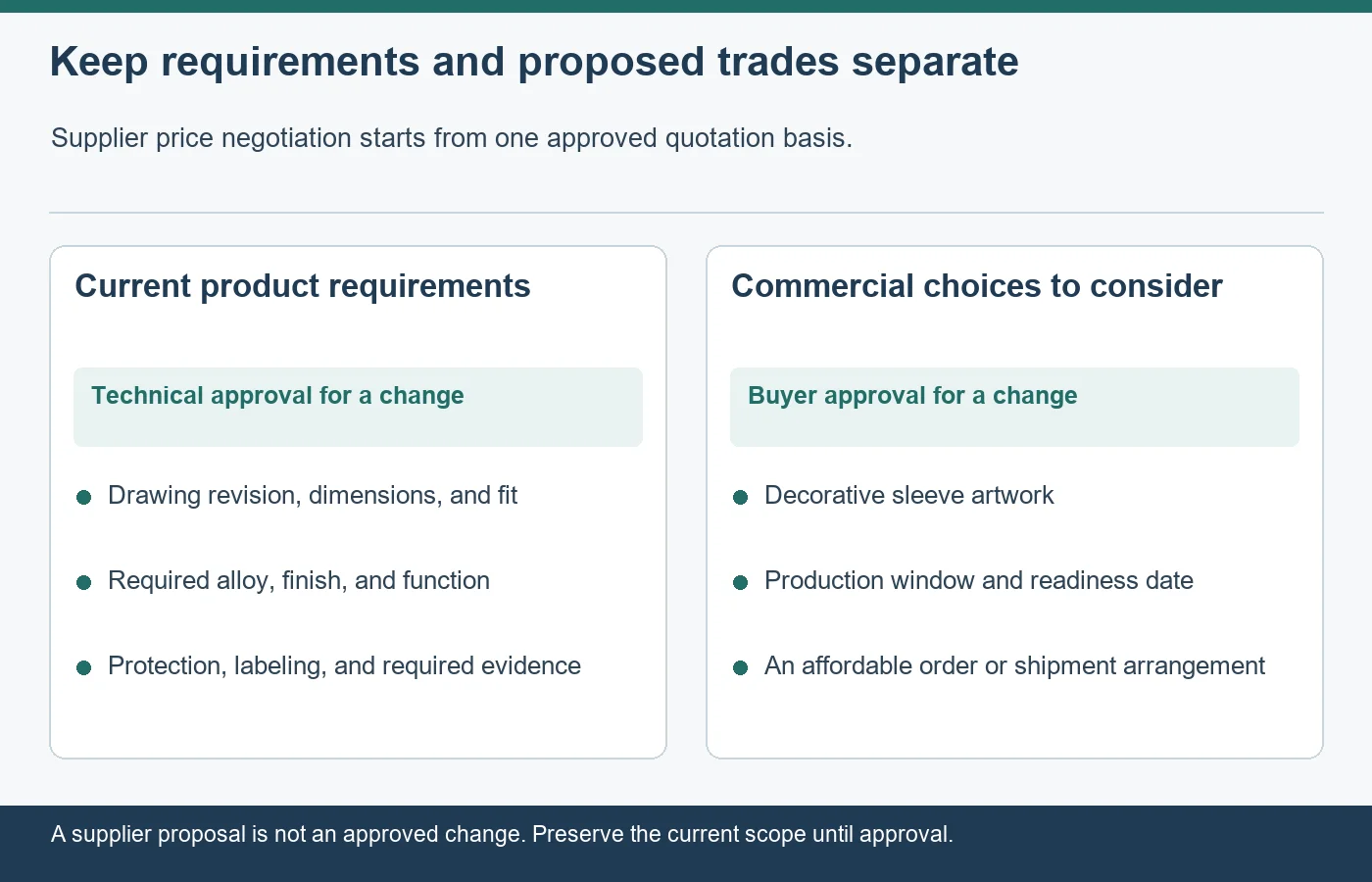
Supplier negotiation checklist separating product requirements that need technical approval from commercial options the buyer can consider
Ask which cost driver the proposal changes
Before asking for another discount, find out what the proposed reduction depends on. Is the supplier offering a different production window, a simpler decorative finish, a larger batch, or a different product? These are separate proposals with different consequences.
Ask for the affected cost or condition without assuming access to the supplier's confidential accounts. A quotation difference does not reveal its profit margin. You can still request an explanation of a setup charge, a packaging alternative, or a date assumption so you understand the offer.
For manufacturing cost negotiation, keep material substitutions and engineering changes outside routine price approval. They may need new technical evidence, testing, or a revised specification. A cheaper alternative belongs in a separate option until your team approves it.
Negotiate with Chinese suppliers through conditional offers
Make a concession specific and connect it to a requested response. For example:
If we approve one-color sleeve artwork while retaining the current material, finish, dimensions, required labeling, and protective insert, can you quote 500 units to the same specification? Please state the revised unit price, setup charge, and readiness period.
This defines what could change and what must remain. Harvard's Program on Negotiation describes contingent concessions as moves tied to a specific concession in return. Here, the practical purpose is to make the trade explicit; it does not guarantee that a supplier will accept it.
Offer alternatives separately. You might consider simpler decorative artwork, a more flexible production slot, or an economically justified quantity. Ask the supplier to price each option against the current baseline. Do not assume separate reductions can be combined into a larger discount.
Keep counterpart-specific information confidential. Discuss what your request requires and what you can authorize. Claims about other suppliers, order volumes, or future purchases should be accurate.
Use a case that keeps specification changes visible
The following illustrative example is fictional. A buyer requests 500 anodized aluminum desk nameplates to drawing ND-02, revision B. The required alloy, finish, dimensions, labeling, and protective insert remain fixed. Decorative sleeve printing and the production window may be reviewed separately.
All figures cover goods and one setup charge only. Freight, duties, taxes, and inspection fees are excluded. These are invented negotiation inputs, not market prices or achieved savings.
| Offer | Quantity | Unit price | Setup charge | Total within this scope | Proposed change |
|---|---|---|---|---|---|
| Baseline | 500 | USD 4.00 | USD 100 | USD 2,100 | Full-color sleeve; 20-day readiness period |
| One-color sleeve | 500 | USD 3.80 | USD 100 | USD 2,000 | Decorative artwork only; 20-day readiness period |
| Flexible production slot | 500 | USD 3.90 | USD 100 | USD 2,050 | Original packaging; 30-day readiness period |
| Different alloy proposed | 500 | USD 3.60 | USD 100 | USD 1,900 | Changes a required material; not comparable on the approved specification |
The baseline is 500 × USD 4.00 + USD 100=USD 2,100. The one-color option totals USD 2,000, a USD 100 reduction within this scope. The scheduling option totals USD 2,050, a USD 50 reduction. Count the setup charge once in each offer.
The material-substitution offer is cheaper but fails the current comparison basis. Do not rank it as the preferred price for revision B. If it merits investigation, request separate technical review before treating it as an approved alternative.
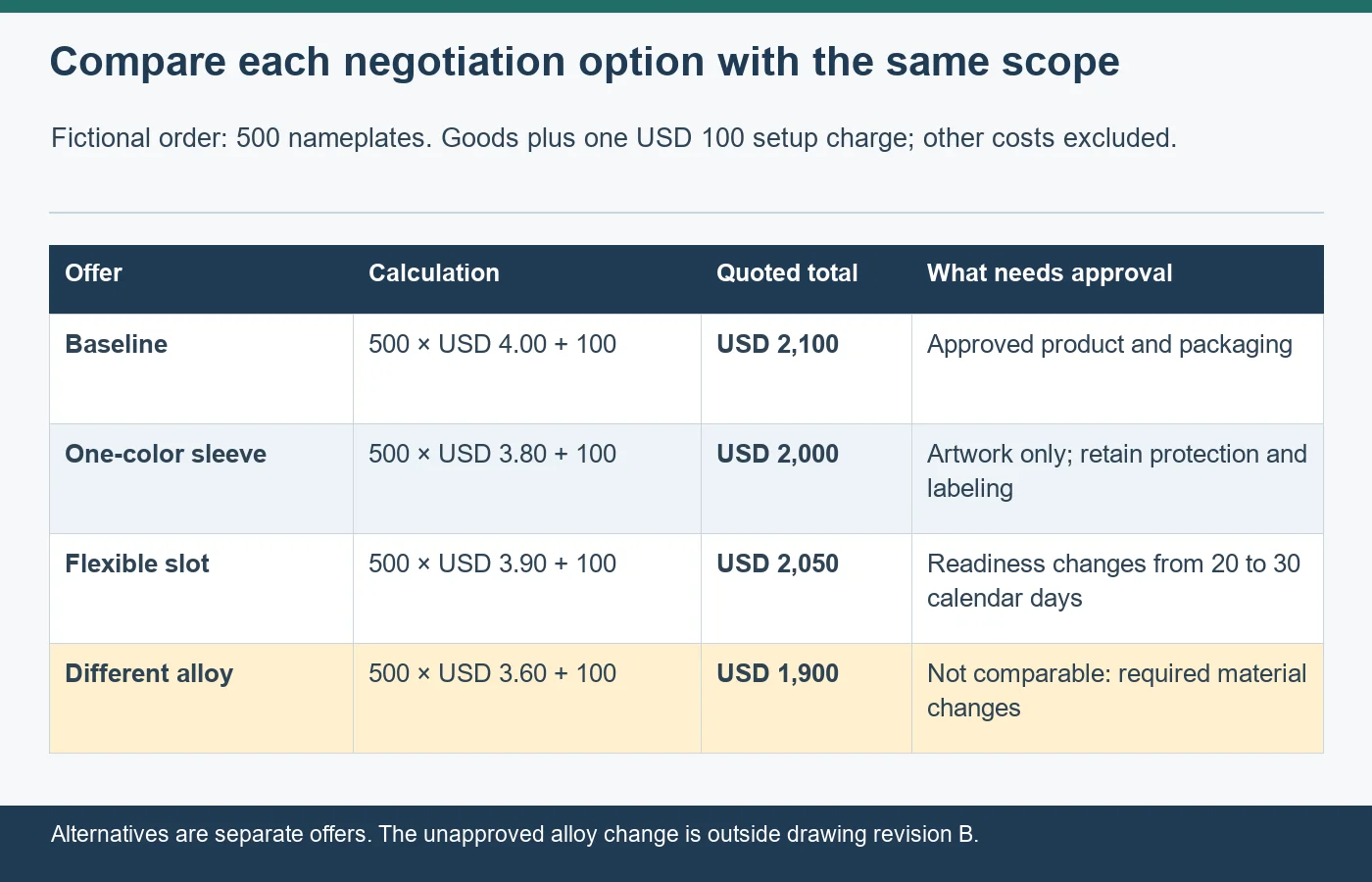
Quote comparison for 500 nameplates showing the baseline, savings from artwork and scheduling changes, and an alloy substitution outside the approved specification
All readiness periods in this example use calendar days. For the eligible options, readiness starts after written order acceptance, artwork approval, and receipt of the agreed payment, whichever occurs last. It means ready for the agreed handover, not arrival at the buyer's warehouse. The buyer must assess whether the longer window still supports the delivery plan.
Approve the change before accepting the revised price
If the buyer chooses the one-color sleeve, obtain the new artwork proof and approval. Confirm that the revised design preserves protection, legibility, and required information. A statement that the product is “the same” is not a substitute for identifying what changed.
Request a revised quote referencing revision B and the approved packaging change. It should identify the quantity, unit price, setup charge, readiness trigger, delivery basis, exclusions, and validity. Check that the supplier retained requirements that were not part of the concession.
Record who approved the change and which earlier quote it replaces. Keep the revised offer connected to the order documents. If another change appears during confirmation, return it for review instead of accepting a different scope through the price discussion.
Keep quantity, payment, and shipment trades separate
A larger quantity may change unit pricing while increasing the buyer's total commitment and inventory. Use realistic demand rather than a hoped-for reorder. This is a separate purchasing decision from simplifying artwork.
Similarly, an earlier payment may change cash exposure, and a shipment consolidation may affect timing or fees. Evaluate those consequences before offering either as a concession. Do not present a payment or logistics change as free value to the buyer.
Use the same cost boundary when comparing revised offers. Our supplier quotation comparison guide covers that wider assessment. Keep this negotiation focused on the specific trade being proposed rather than reopening every requirement at once.
Know when to stop and confirm the outcome
Pause if the only available price requires an unapproved specification change, an unaffordable commitment, or an unusable schedule. A supplier may have no acceptable reduction to offer. Reconsider the budget, purchase scope, or candidate list through your normal approval process.
You can find and contact Chinese suppliers using a product name, image, link, or rough brief. As you negotiate with Chinese suppliers, distinguish proposals from approvals and obtain a coherent final offer. The useful outcome is a price tied to the product and conditions you actually agreed to buy.