
Low-MOQ Manufacturers in China: Trial-Order Terms

To find low-MOQ manufacturers in China, start with the exact trial order you can buy. Search for suppliers whose production route fits that order, then confirm whether their minimum applies per order, model, color, size, design, or packaging choice. Compare the full trial cost and repeat-order conditions before accepting a low headline quantity.
Get a written quote for your exact trial quantities and design mix. If the supplier quotes a one-piece sample, ask for a separate production quote for the trial order.
Define the trial order before searching
Write down the total quantity, the quantity of each variant, and what you can change. Separate essential product requirements from preferences about decoration or packaging. A smaller order may be possible using an existing size or material, but that substitution still needs your approval.
For example, you might need 200 paper card sleeves: one size, two printed designs, and 100 of each design. Stock dimensions and standard bulk packing are acceptable. A different paper grade is not automatically acceptable merely because it reduces the minimum.
Use our specification sheet guide to prepare a consistent trial-order brief.
Find low-MOQ manufacturers in China by process fit
Search with the product and the relevant process, followed by terms such as “small batch” or “trial order.” For the sleeve example, distinguish standard-size printed sleeves from a new custom shape. These are different production requests even when both listings show similar photographs.
Look at manufacturer websites, industry directories, marketplace listings, and relevant referrals. Treat each result as a candidate. Confirm whether the contact represents the manufacturer, a trading company, or another intermediary; a low minimum does not establish that identity.
Alibaba.com's own MOQ guidance describes minimums as supplier-set terms and recommends stating the intended quantity early. That platform guidance does not confirm any particular manufacturer's terms. Ask candidates to respond to your actual variant breakdown.
Separate three routes when reviewing replies:
- Existing stock: Confirm available quantity, condition, and whether the exact product is reserved for you.
- Light customization: Identify which existing product, process, or packaging remains unchanged.
- Full customization: Ask which new materials, tooling, or production setups create minimums.
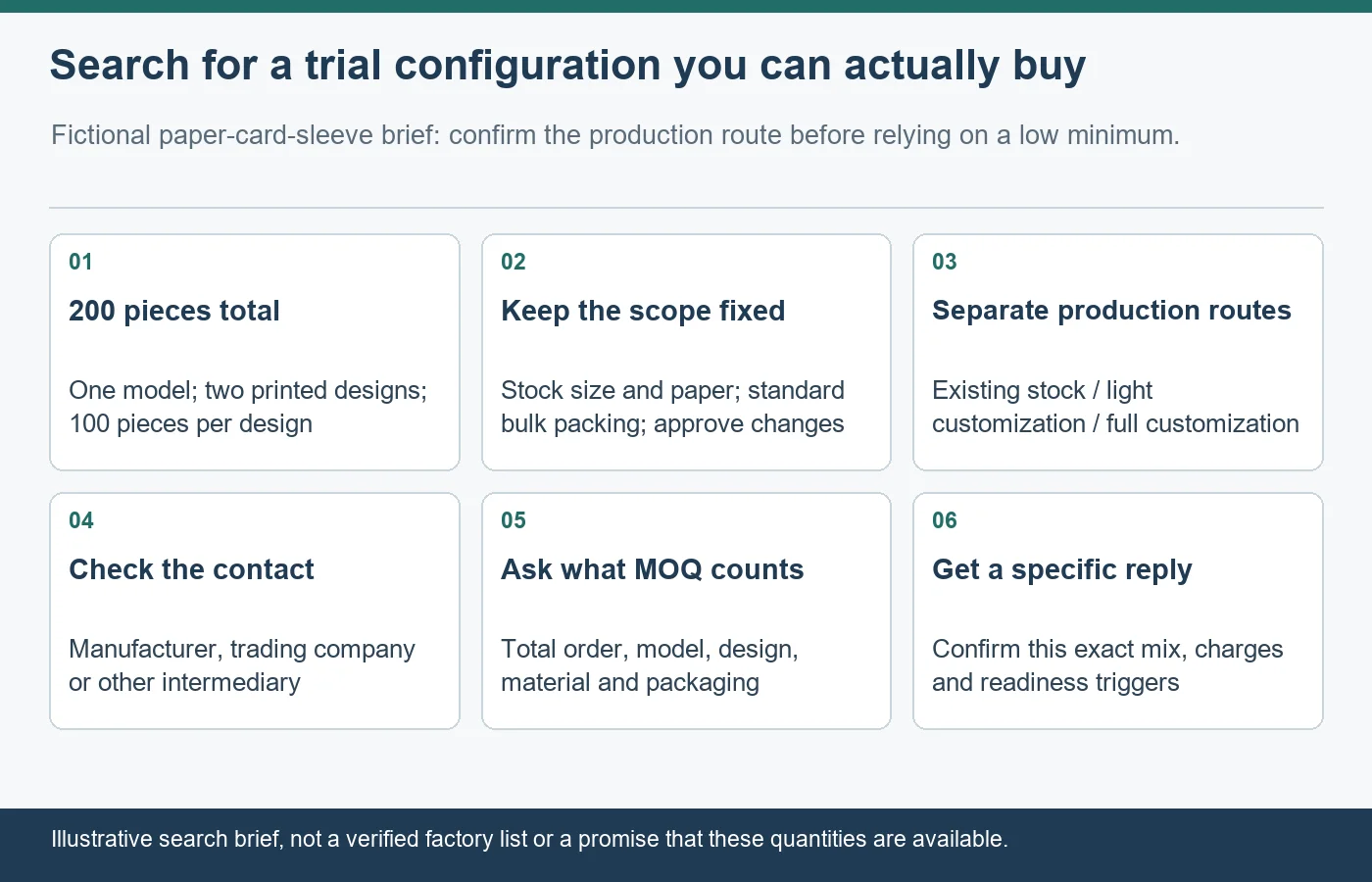
Trial-order brief for finding low-MOQ manufacturers in China, covering quantities, production routes, supplier identity and minimum-order rules
Ask what each minimum actually counts
Send one line for every variant rather than asking only, “What is your lowest MOQ?” Request a written quantity breakdown that covers these boundaries:
| Boundary | Question to confirm |
|---|---|
| Total order | What is the minimum total quantity or order value? |
| Model or style | Can different models count toward that total? |
| Color, size, or print design | What is the minimum for each variant? |
| Separate material or packaging purchase | Does this trial require you to buy material or packaging separately? If so, what quantity must you buy, what carton multiple applies, and what is the extra cost? |
| Sample versus production | Is the offered quantity a sample purchase or a repeatable trial-order term? |
“Mixed designs accepted” is incomplete without the permitted quantities. Ask whether the supplier will accept 100 of Design A and 100 of Design B. Also ask who pays for any unused packaging or material, who owns it, and how long it can be retained. Do not accept an unexplained commitment to additional stock.
Negotiate one constraint at a time
To negotiate MOQ, first ask what creates the minimum. The answer may concern a material purchase, printing setup, machine changeover, or another commercial constraint. Treat that explanation as a starting point for alternatives, not evidence that every quoted charge is unavoidable.
Offer a specific change: fewer variants, an existing material, plain packaging, or a separately priced setup. Ask for a revised quotation showing exactly what changes. Do not quietly reduce a required feature to obtain a lower quantity.
You can request both the intended trial quantity and a larger alternative. Compare the extra cash commitment and unwanted inventory with any unit-price reduction. Avoid promising future volume you cannot commit to. A possible reorder is different from a binding purchase, and the supplier may decline your proposed minimum.
Compare the same trial quantity and cost boundary
The following illustrative example is fictional, not a customer case or a market price benchmark. The target is 200 paper card sleeves, split equally between two designs. All other product requirements match. Standard bulk packing is included; freight, tax, and testing are excluded from this comparison.
| Trial-order field | Candidate A | Candidate B |
|---|---|---|
| Accepted order | 200 total; 100 per design | 200 total; 100 per design |
| Unit price | USD 1.20 | USD 1.35 |
| Goods total | USD 240 | USD 270 |
| Setup charge for both designs | USD 40 once | USD 0 |
| Buyer total within this boundary | USD 280 | USD 270 |
| Illustrative readiness period | 12 calendar days | 15 calendar days |
Candidate A is 200 × USD 1.20 + USD 40=USD 280. Candidate B is 200 × USD 1.35=USD 270. The lower unit price does not produce the lower trial total. Count the setup charge once; do not add it again if it is already included in a quoted total.
A third candidate requires 300 units per design, or 600 in total. That offer is not eligible for this 200-piece trial. Keep it outside the payable-total comparison unless the supplier issues a written exception or you explicitly decide to buy more.
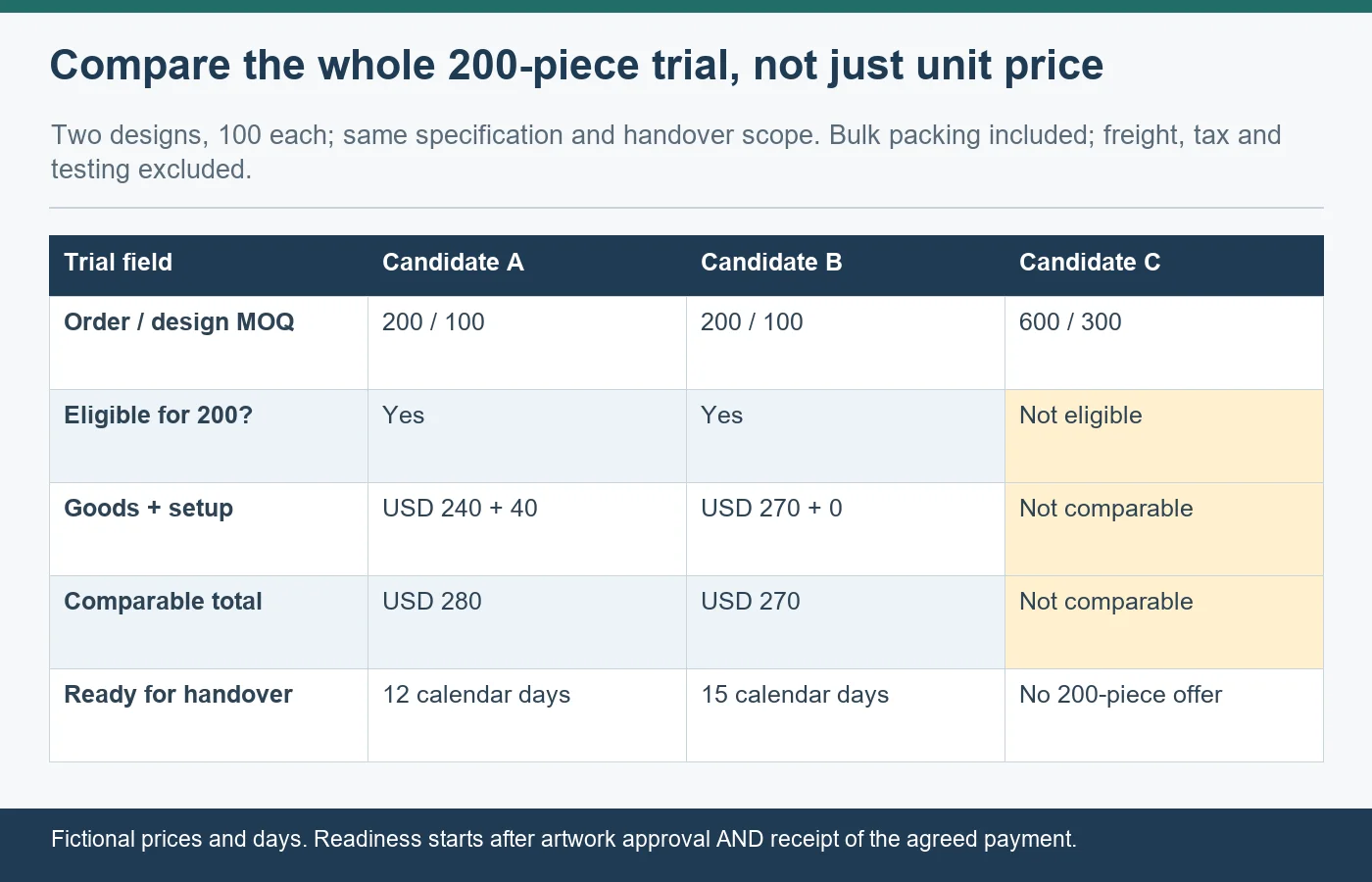
Comparison of a 200-piece trial order showing setup charges, total costs, readiness periods and an ineligible supplier minimum
In this example, both readiness periods start only after artwork approval and receipt of the agreed payment. They mean ready for the agreed handover, not arrival at your warehouse. Confirm those triggers and any outstanding conditions with each candidate. Use a consistent supplier quote comparison for the remaining cost fields.
Confirm reorder terms separately
A first-order concession may not apply again. Ask for the reorder minimum per variant, the price basis, and whether a setup charge returns. Clarify what happens when the artwork, material, or process changes. Do not assume “tooling paid” means every future setup is free.
Request the supplier's conditions for retaining paid tooling or unused packaging, where relevant. Record any storage charge and deadline. If a reorder depends on leftover stock, ask how availability will be confirmed when you return. A low trial minimum should not conceal an obligation to purchase the balance later.
Choose a workable order, not the smallest badge
Keep a candidate in consideration only when the requested quantities, variant mix, product requirements, charges, and timing form one coherent offer. Resolve unclear terms before authorizing the related purchase or payment. A small minimum cannot compensate for an unsuitable product or unsupported commercial promise.
You can find and contact Chinese suppliers starting with a product name, image, or link. When approaching low-MOQ manufacturers in China, use those conversations to confirm a specific trial configuration. The useful outcome is an order you can explain and afford, with clear terms for what happens next.