
Purchase Order Template for Chinese Suppliers

Your purchase order template should identify the buyer, seller, exact product version, quantity, price, and currency. It should also record delivery terms, payment milestones, acceptance checks, and the documents that define the order. Ask the supplier to confirm the same version and identify exceptions before you approve the next step.
A complete form helps you compare what was agreed with what is produced. However, a template cannot resolve an unclear specification or replace legal review. Use the example below as a working record, then adapt it to your product, supplier, and agreed terms.
What should a purchase order template include?
Start with information that someone outside the original email conversation can understand. A purchasing colleague should be able to identify the correct seller, product, and approved documents without guessing.
| Field | What to record |
|---|---|
| PO number and revision | A unique order reference, issue date, and revision number |
| Buyer | Legal name, billing address, and purchasing contact details |
| Seller | Contracting entity, address, and the person confirming the order |
| Ship-to details | Final destination address and receiving contact; record the FCA handover point separately |
| Product identity | Item code, model, drawing number, and specification revision |
| Quantity | Units per item, any permitted variation, and unit of measure |
| Price | Unit price, currency, line total, and separately agreed charges |
| Packaging | Pack quantity, carton requirements, labels, and approved artwork |
| Delivery | Trade term, precise named place, version, and agreed handover date |
| Payment | Agreed amounts, triggers, payment method, and approved payee |
| Acceptance | Approved sample reference, checks, tolerances, and handling of exceptions |
| Attachments | A numbered list of drawings, specifications, and supporting documents |
| Governing documents | Referenced sales agreement or agreed terms, with version and agreed document priority |
| Changes and approval | Who can approve changes and how the supplier confirms the current version |
If the trading company and manufacturer differ, record their roles separately. Similarly, a different payee needs a documented explanation and independent verification. A familiar company logo is not enough to connect three different entities.
Use ourspecification sheet guide to prepare the product requirements, then reference the completed sheet and its exact revision in the PO.
Separate the PO from quotes and invoices
A purchase order, or PO, is the buyer's order document. A supplier quotation proposes a price and scope. An order confirmation records the supplier's response to the order. A pro forma invoice may support negotiation or a payment request, but it does not remove the need to reconcile the documents.
For example, your PO may request individual packaging while the quotation covers bulk packing. A supplier's confirmation may also change the delivery window. Resolve these differences explicitly instead of assuming one document automatically overrides the others.
Contract formation depends on the applicable law and the parties' communications and conduct. UNCITRAL's explanation of the CISG describes offer and acceptance in international sales. Do not assume that every PO has the same legal effect, or that a signature is always the only relevant act. Have appropriate legal advisers review the terms for your transaction.
An illustrative purchase order template and example
The following order is fictional. The companies, item, prices, and timing demonstrate the fields; they are not a real transaction or a market benchmark. Replace every bracketed field and resolve all open terms before use. If a sales agreement already governs the purchase, reference its exact version and agree how conflicting documents will be handled.
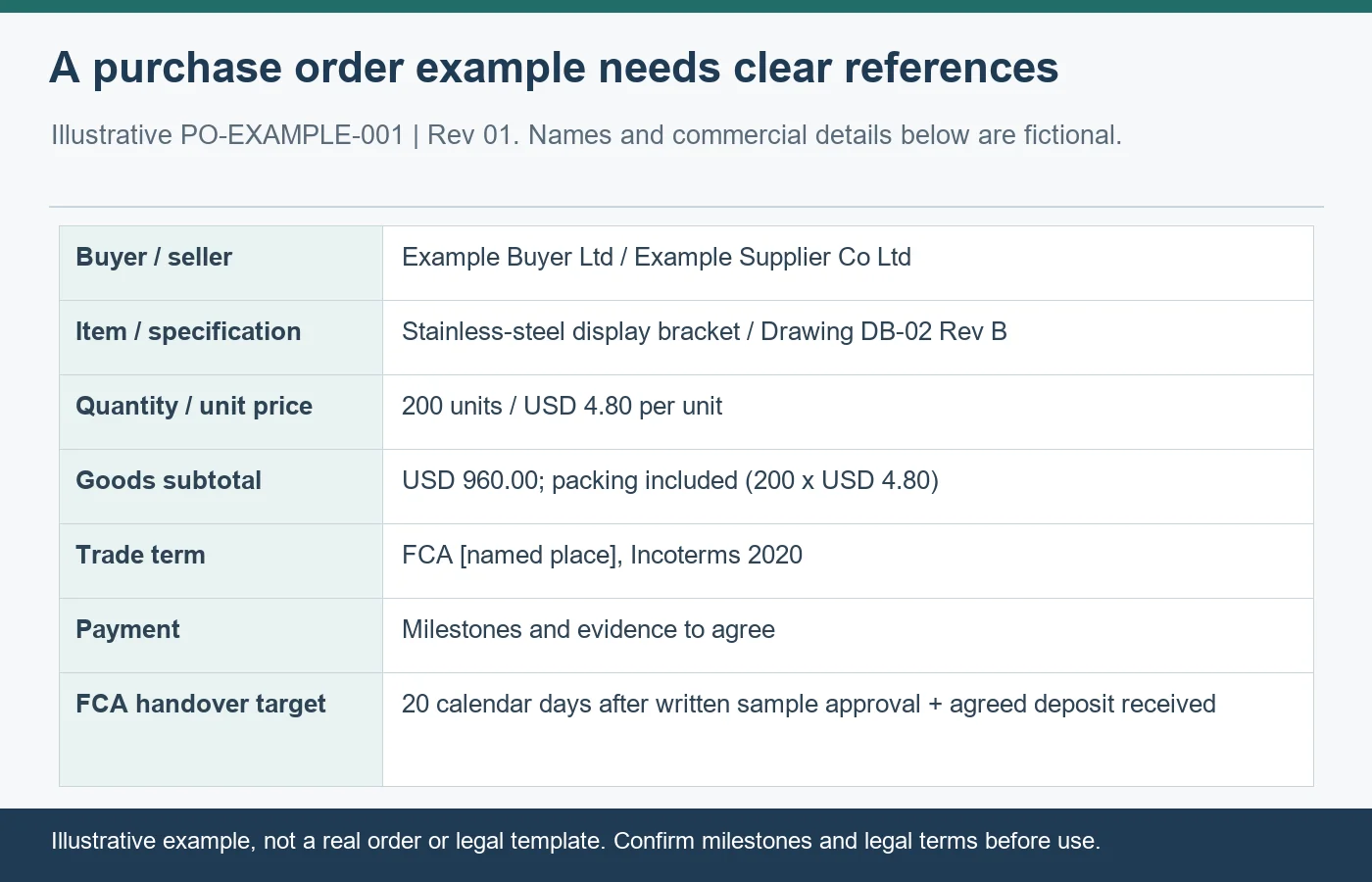
Illustrative purchase order template showing buyer and seller details, product references, quantities, prices, FCA delivery terms and payment milestones
PURCHASE ORDER — ILLUSTRATIVE EXAMPLE
PO number: PO-EXAMPLE-001
Revision: 01
Issue date: [YYYY-MM-DD]

Buyer: Example Buyer Ltd
Buyer address and contact: [complete before issue]
Seller: Example Supplier Co Ltd
Seller legal details and contact: [verify before issue]
Final ship-to address and receiving contact: [complete]

Item: Stainless-steel display bracket
Item code: DB-02
Drawing: DB-02, Rev B
Specification: S-01, Rev B
Approved sample: [reference and written approval date]
Material, finish, dimensions, tolerances: per approved attachments

Quantity: 200 units
Unit price: USD 4.80
Goods total: USD 960.00
Packaging: Included, as defined in specification S-01, Rev B
Freight, insurance, taxes, and other charges: [state allocation]

Delivery term: FCA [precise agreed named place], Incoterms® 2020
FCA handover target: 20 calendar days after written sample approval
and receipt of the agreed deposit; supplier to confirm exact date
Payment amounts, triggers, and method: [agree and complete]
Approved payee: [independently verify and record]

Acceptance checks and exception process: [agree and complete]
Attachments: 1. DB-02 Rev B; 2. S-01 Rev B; 3. approved sample record
Referenced sales agreement or agreed terms: [document ID and revision]
Document priority if requirements conflict: [agree and record]
Changes: Named buyer approval and supplier agreement to affected terms
Supplier response: Confirm this revision and list every exception
Supplier confirming person and confirmation date: [complete]
This purchase order template separates a fixed goods value from terms that still need agreement. The calculation is 200 units multiplied by USD 4.80, giving USD 960. Packaging is included in this example. Other costs must be allocated explicitly rather than silently treated as included.
Notice that the lead-time trigger has two conditions. The clock starts after both written sample approval and receipt of the agreed deposit. Convert that trigger into a confirmed calendar date when both conditions occur. Do not describe this handover target as an arrival date at your warehouse.
Confirm payment, delivery, and acceptance
Trade terms need more than three letters. Record the exact named place and the agreed rules version. For example, “FCA China” leaves the delivery location unclear.
Keep the final ship-to address separate from the FCA handover point. They serve different purposes and may be in different countries.
The U.S. International Trade Administration explains that Incoterms allocate transport responsibilities, costs, and risks. They do not determine every sale condition, including payment timing or when ownership transfers. Keep those matters explicit in the agreed documents.
Likewise, define what releases each payment. “Balance before shipment” leaves questions about who checks readiness and what happens after a failed check. Agree the evidence required, the person reviewing it, and the process for exceptions. See our guide to payment terms when buying from China for questions to raise with a supplier.
Acceptance criteria should be observable. Reference approved dimensions, finish, packaging, and sample records. If inspection or testing is required, identify the responsible party and agreed method. A supplier's confirmation, inspection report, or approved sample should not be described as a guarantee of every future unit.
Control revisions before the factory acts
A changed message should lead to a controlled change record. Record the affected item, old requirement, new requirement, price effect, and timing effect. Then ask the supplier to acknowledge the updated revision.
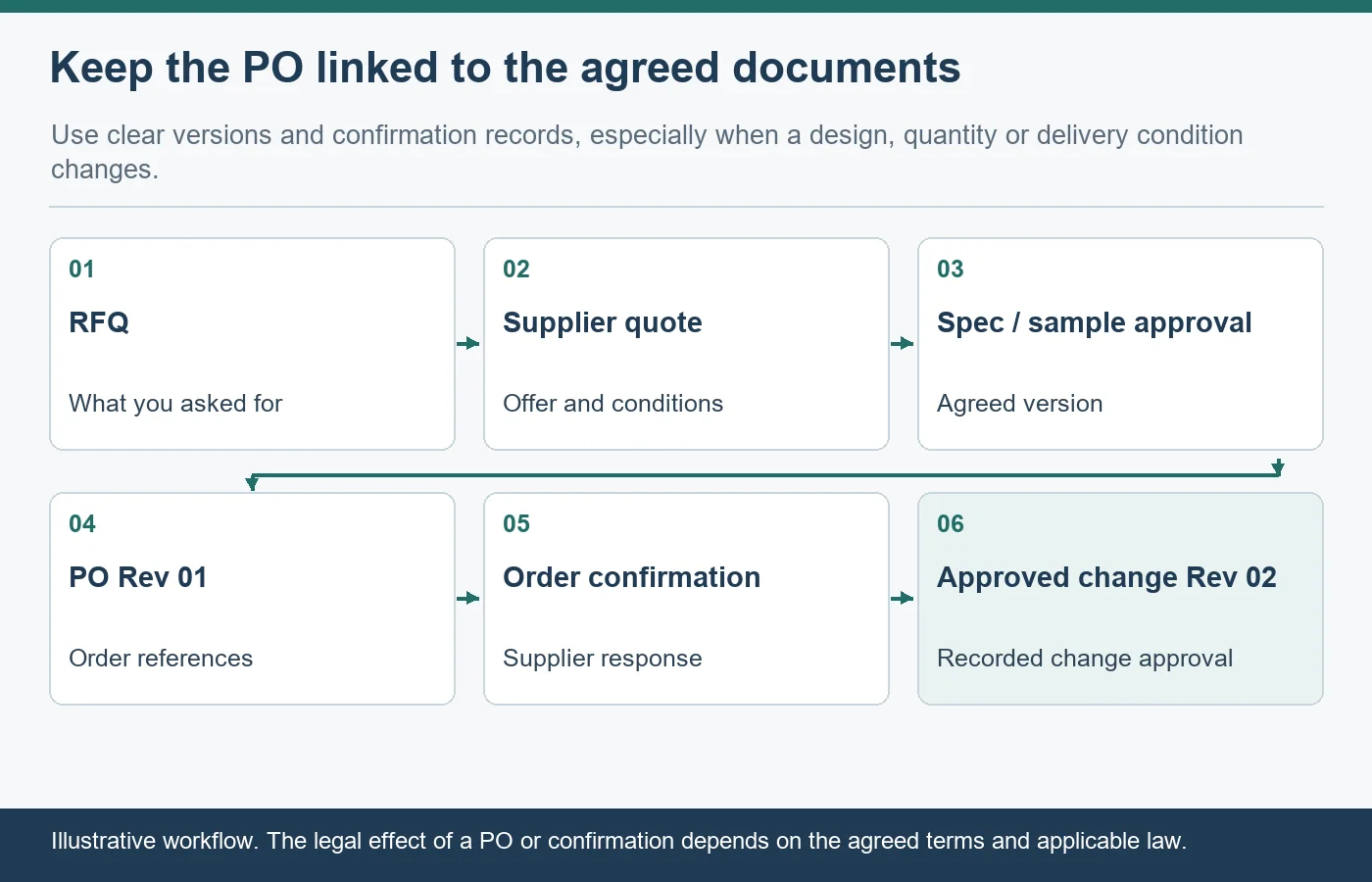
Purchase order document workflow linking the RFQ, supplier quote, specification approval, PO revision, order confirmation and approved changes
Suppose the bracket finish changes after confirmation. Updating only the email subject leaves the drawing and packing instructions unchanged. Instead, identify the new finish in the specification, issue the revised PO reference, and confirm any cost or delivery change. State whether the revision replaces earlier instructions or applies only to particular units.
Keep each completed purchase order template for traceability, and label superseded versions clearly. The factory and your purchasing team should know which revision controls the work. If a correction affects goods already produced, document the agreed treatment separately.
Check the order before you send it
Use a second review where practical. The reviewer should compare the purchase order form with the quotation and approved attachments, not merely check spelling.
- Recalculate quantities, unit prices, currency, and totals.
- Match the seller and payee with the entities you approved.
- Confirm that every attachment opens and shows the correct revision.
- Separate the production trigger, handover target, and expected arrival.
- Check that packaging, labels, and additional charges are clear.
- Identify who accepts exceptions and approves changes.
- Request an order confirmation that references the exact PO revision.
When a supplier replies with an exception, return to the affected field. Do not file the response as “confirmed” while a material difference remains unresolved.
Turn the template into a confirmed order
Use the purchase order template to make decisions visible: what you are buying, from whom, under which version, and on what agreed terms. Keep the supporting records with the supplier's response. Finally, resolve open items before authorizing the related production or payment step.
If you are still finding suppliers, you can start a supplier search using a product name, image, or link. Use early supplier conversations to clarify the missing information before you complete your order documents.