
Custom Manufacturing Checklist for Supplier Quotes

A reference photo can open a conversation with a factory. It rarely explains enough to price a custom part with confidence. Your custom manufacturing checklist should show what the part must do, which details are settled, and where you still need technical input.
You can begin before every drawing is ready. The important distinction is between asking whether a manufacturer can discuss the work and asking it to commit to a price against defined requirements. Moving from one to the other takes more than adding dimensions to a photograph.
Choose the response you need first
Suppose you have photographs of a shaped metal profile and want a similar product made. An initial conversation can establish whether the factory works with that material and process. It can also reveal what files its technical team needs next. Detailed drawings may follow once the discussion has a useful direction.
Tell the supplier whether you want a capability discussion, a preliminary estimate, or a quotation for a defined design. For an estimate, identify which assumptions can change the price. For a firm quotation, those assumptions need an agreed basis.
This distinction matters when the supplier offers an alternative process. A suggestion to machine a prototype rather than invest in production tooling could be worth discussing. It still needs your technical approval, a separate cost basis, and a decision about what the prototype will demonstrate.
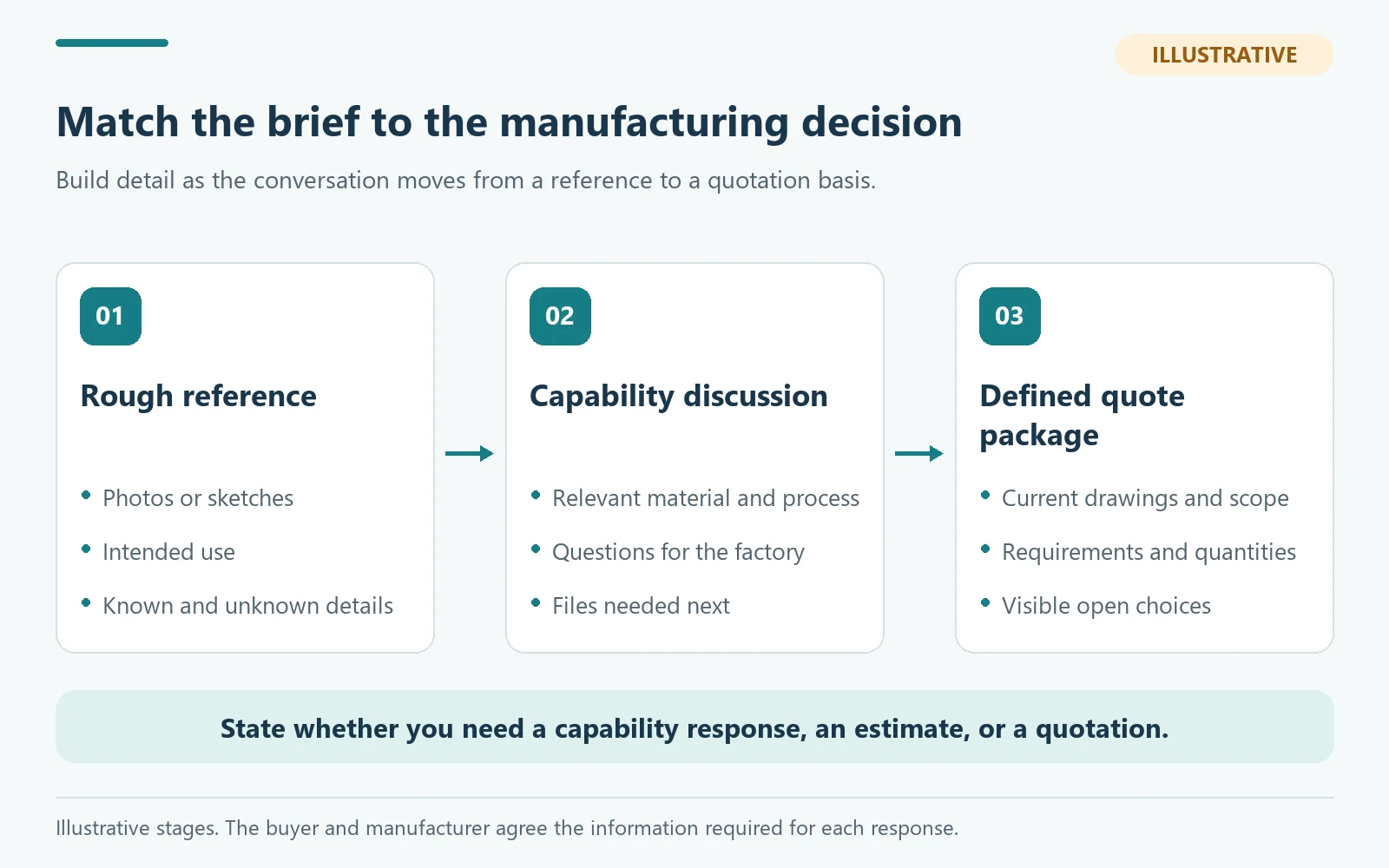
Conceptual workflow. The supplier and buyer agree what information is needed at each stage.
Explain the part in its working setting
A rod pictured on a white background gives little information about its connection to the next component. Does an end slide into a sleeve, accept a threaded fitting, or bond to another piece? Which surfaces touch? Can the supplier change the joint geometry, or must it fit an existing assembly?
A sketch of that connection may answer more than several polished product photos. Add the mating component's relevant drawing or dimensions when available. Explain the operating conditions and performance requirements that your technical reviewer has defined.
Also describe the quoted scope. A bare profile, a cut and drilled profile, and a finished assembly are different purchases. If you will supply inserts or fasteners, say so. If you need the manufacturer to develop the design, request that work explicitly and establish who approves it.
Separate appearance choices from engineering requirements
Words such as black, matte, and smooth answer different questions. A buyer might want a low sheen while leaving the material's pattern visible. Another may want an opaque, uniform appearance. A reference image can suggest either result depending on lighting.
For a composite tube, separate sheen, visible texture, and color. For an aluminum part, distinguish a color preference from the proposed finishing process. Adding anodizing or a coating late in the conversation can change the scope of the quotation.
Describe which faces will be visible in use. Then ask the manufacturer how its proposed finish affects functional surfaces, including threads or mating features. Your technical reviewer should decide whether masking or dimensional allowances are needed.
A photograph is useful for discussing the look. Where appearance drives acceptance, the parties also need an agreed physical reference or another suitable evaluation basis. The supplier should explain what it can reproduce before the price is treated as settled.
Assemble the files that carry the quotation
Organize your custom manufacturing requirements documents so the supplier can understand how the files relate. A short cover sheet can identify the part, revision, requested deliverable, and unresolved issues. Use a supplier specification sheet for recurring fields, with engineering attachments for details that need drawings or models.
| Attachment | Decision it should support |
|---|---|
| Annotated reference images | What the image illustrates and what may differ |
| Current drawing and CAD model, where applicable | Geometry, units, revision, and critical features |
| Material requirement | Required grade or performance basis and permitted alternatives |
| Interface or assembly information | What must fit, what is supplied, and what the factory supplies |
| Finish and verification requirements | Relevant surfaces, required checks, and documentation |
| Quantity and scope statement | Prototype, initial production, and repeat scenarios priced separately |
CAD geometry does not communicate every manufacturing instruction. Technical drawings can carry thread details, special tolerances, and surface requirements that a model alone may leave unclear. Protolabs Network explains these roles in its technical drawing guidance.
State what should happen if a model and drawing disagree. Ask the supplier to raise the discrepancy before quoting or manufacturing. Sending two contradictory files leaves the factory guessing about your intent.
Spend precision where the part needs it
A design for manufacturing checklist should help you discuss the features that drive function and production difficulty. It should not make every dimension equally demanding.
Consider a housing with an internal locating feature and a largely cosmetic outer edge. The locating feature may need careful dimensional control for assembly. Applying the same requirement everywhere could add work without improving the product. The engineering owner must determine appropriate tolerances from the design's actual needs.
Protolabs describes how overly stringent tolerances can add operations, cost, and lead time, while unsuitable loose tolerances can prevent assembly. Its published capabilities belong to its own services. Obtain the proposed manufacturer's assessment of your particular material, geometry, and inspection requirements. See its CNC tolerancing guidance.
The useful supplier response explains which requirement creates difficulty and offers a specific alternative for technical consideration. A lower price after a silent design change is much harder to evaluate.
Give unresolved choices a place in the price request
An unfinished decision does not have to stop the conversation. It does need a visible place in the request. If two materials are still under consideration, ask for separate options and identify the requirements each must meet.
The same applies to a finish, an assembly method, or a tooling approach. Ask what the supplier has assumed, what is excluded, and which decision is needed before the price can become firm. A blank cell should not silently become permission to choose the cheapest option.
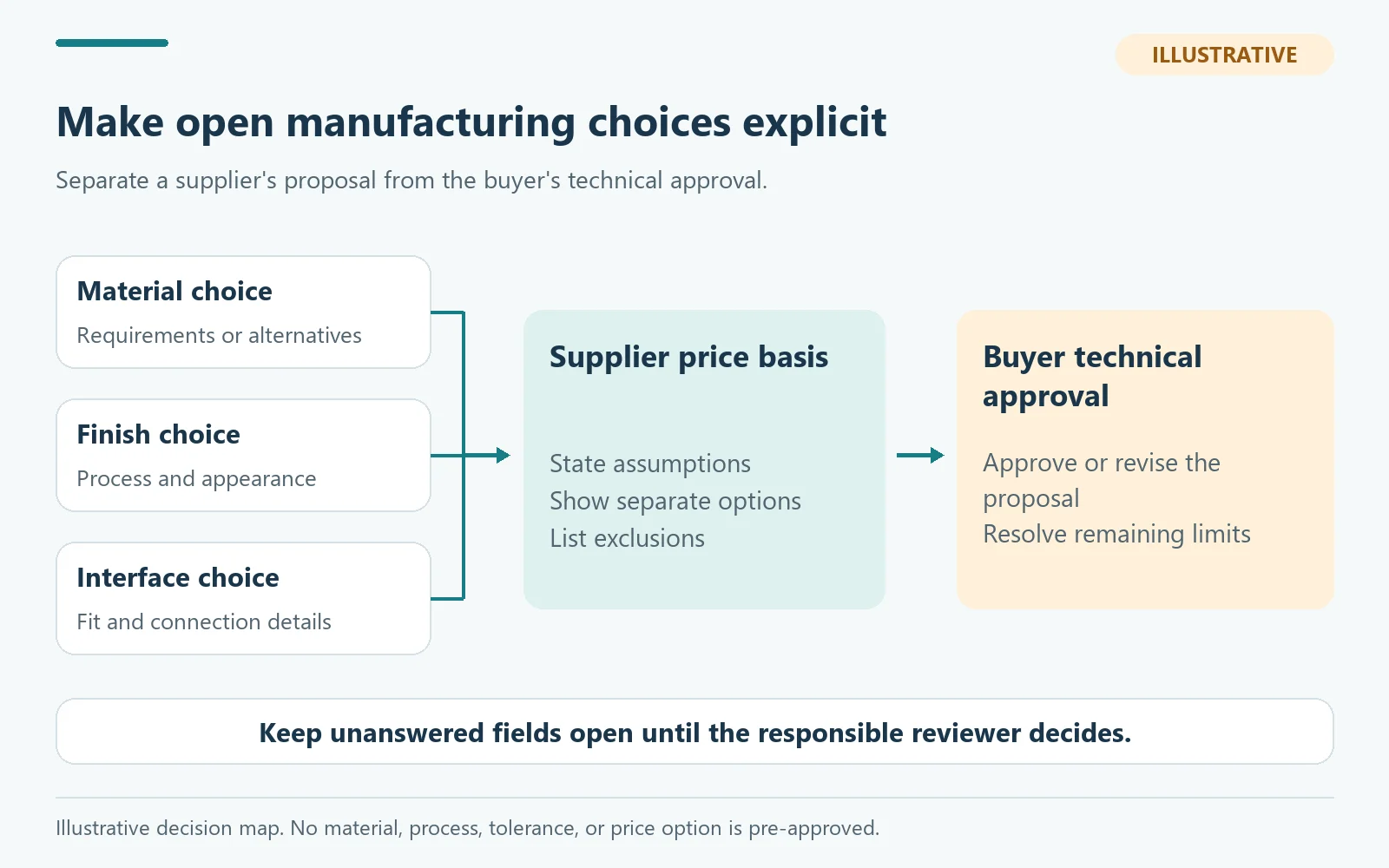
Illustrative decision map. Alternative proposals remain subject to the buyer's technical approval.
Keep forecast quantities separate from a committed order. A possible repeat run may help the manufacturer discuss production methods, but it does not establish your initial purchase. Once offers arrive, compare supplier quotations on the same scope before deciding whether a price difference reflects efficiency or different assumptions.
Release a package the manufacturer can identify
Before accepting an offer, ask the supplier to identify the drawing revisions and attachments it priced. Include its agreed exceptions and any decisions that resolved earlier open items. A later design change should prompt an assessment of price, timing, and manufacturing impact before work proceeds.
Early sourcing tools can help you describe a need and connect with potential Chinese suppliers. ChinaSource's Agent supports requirement matching and buyer–supplier connections. The manufacturer's technical assessment and your own approval process remain separate steps.
Your custom manufacturing checklist is ready for quotation when the supplier can describe the same deliverable you expect to receive, including the remaining limits of its offer.