
Fair Test Supplier Sample Evaluation Checklist

The supplier sample evaluation checklist should include a comparison between samples using the same specification, the same version, the same testing procedures and decision-making criteria. Assign an identifier for each item, note the conditions under which the tests were performed, and relate each observation to images or measurements. Distinguish between a proven defect and a missing test; then determine whether to proceed, correct, or repeat the test.
Comparing supplier samples is helpful because it lets you determine your next investigation. That doesn't mean that all the units going forward are the same as the sample. One good looking sample tells you very little if the materials, tooling or production process are different from the order placed.
Define one comparison specification
Start from requirements agreed before inspecting the samples. Identify the product version, intended use, critical dimensions, appearance requirements, and relevant functional checks. Use our guide to setting production quality standards to establish a common reference, then attach the exact product revision.
Tell each supplier which version to supply. Find out if each sample is from stock, adapted from something else, or produced through the intended process. Note any substitution or deviation. If the sample is from stock, it could provide information on your concept without necessarily being the product you plan to order.
If the suppliers supply different versions of the product, distinguish this factor from the quality of construction. It may be possible to evaluate whether each one fulfills its description, but not as a control of identical items. Make sure you have identical samples before drawing conclusions.
Create a supplier sample evaluation checklist
Use measurable requirements and a written reference for subjective judgments where possible. Need of competent technical input for product specific testing, safety requirements and acceptance limits. Don’t make a universal load test or defect allowance because it fits nicely in a spreadsheet.
| Check area | What the record should contain |
|---|---|
| Sample identity | Supplier, unique sample ID, received date, and stated version |
| Production basis | Prototype or production-intent process, with declared differences |
| Specification match | Requirement reference and observed departures |
| Dimensions | Feature, method, instrument, result, and agreed limit |
| Function | Test procedure, conditions, observations, and result |
| Appearance | Agreed reference, viewing conditions, defect location, and photographs |
| Materials | Supplier's declaration and any separately required verification |
| Packaging | Sample packing condition and whether it represents proposed shipment packing |
| Decision | Continue, correct, retest, or stop; reason and next owner |
Keep raw observations alongside the conclusion. “Poor quality” does not tell the supplier what to change. A photograph labeled with a sample ID and defect location provides a clearer starting point for discussion.
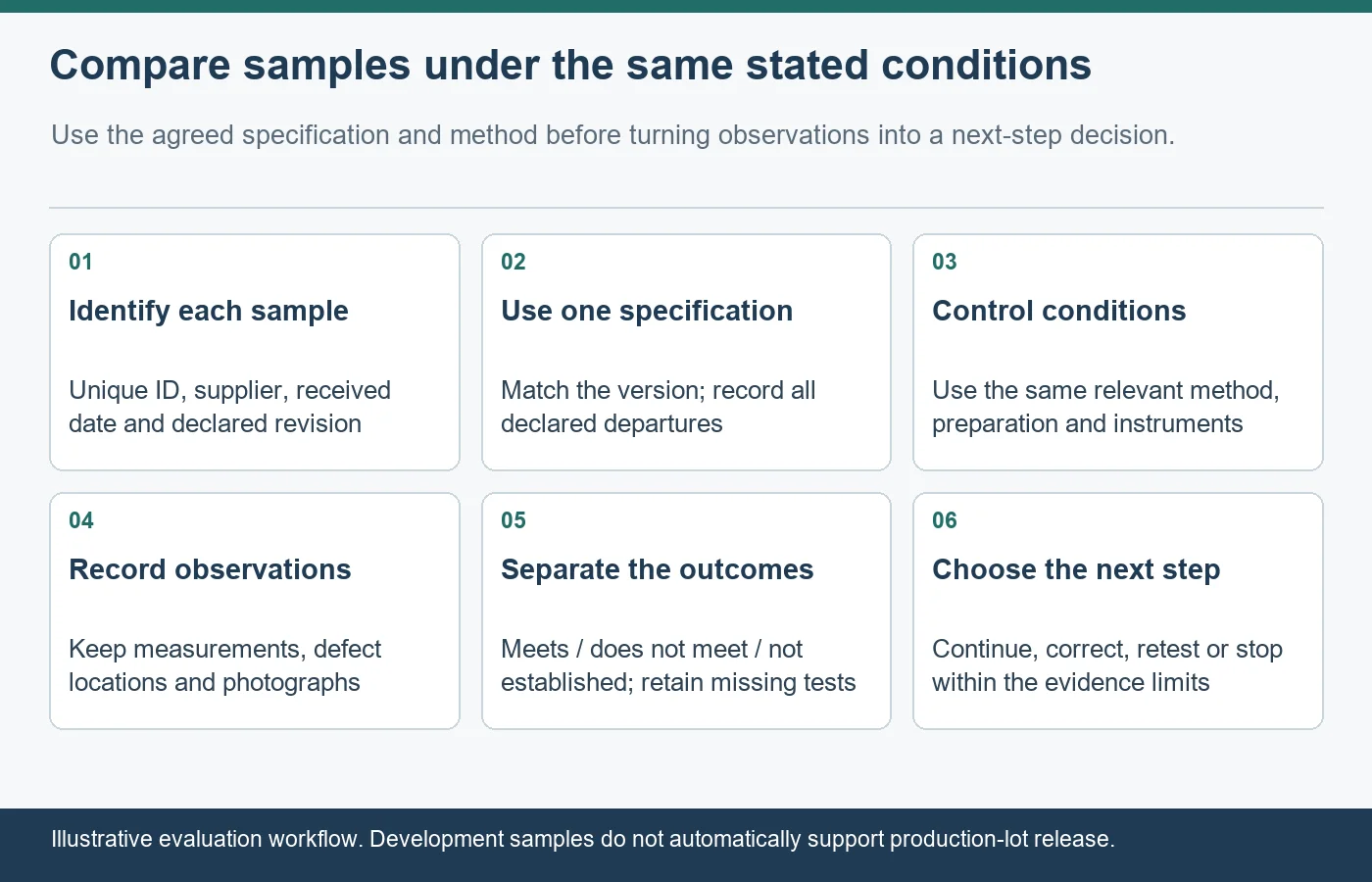
Supplier sample evaluation checklist workflow covering sample identification, matching specifications, controlled tests, recorded observations and next-step decisions
Control the samples and test conditions
Mark the samples as soon as they come in. Retain the supplied version and record any damages incurred during transportation prior to testing. Identify which samples are to be measured, retained, and subjected to destructive testing. Make sure you can distinguish these so that a tested sample does not get mistaken for a reference sample.
Use standardized procedures and calibrated instruments. Control preparation, temperature, light, loading, or conditioning time if needed by the test method. Document actual conditions and any deviations from these conditions. The order of testing and handling should not unconsciously favor one supplier over another.
NIST's measurement terminology explains repeatability in terms of measurements made under the same conditions. The practical point is to state the method and conditions behind a result. When they change, investigate whether that affects the comparison.
If the value sits close to an acceptance limit, ask the technical reviewer to consider measurement uncertainty and method suitability. Repeating an unsuitable measurement does not make its conclusion reliable. For important tests, use an appropriately qualified person or laboratory rather than substituting an informal demonstration.
Separate disqualifying defects from preferences
Discuss what the requirements are absolutely necessary and which ones are desires. The absolute requirement should not get lost in the general rating of color, packaging, and responsiveness. A preference in cosmetics should not turn into an assertion of safety automatically.
Keep things as simple as possible for the checks: meet the requirement, do not meet the requirement, or not determined. Note why the test was not performed. Failure to verify the material would be different from evidence that the material did not meet the requirement.
Record repeated observations across individual samples without turning them into a claimed factory defect rate. ASQ's sampling overview explains that sampling conclusions depend on the population and selection approach. A few supplier-selected development samples are not automatically a statistical acceptance sample from a production lot. Have a qualified practitioner define any later lot-inspection plan.
Make a sample comparison between 3 suppliers
Let’s say there are 3 suppliers that supply plastic desktop drawer trays to spec TR-02 Rev B. This is a sample of a product comparison and is fictitious. For example, the outside length should be 200 mm (buyer's requirement) but acceptable range is 199 mm to 201 mm. These figures are hypothetical only and do not recommend product tolerance.
All three samples undergo the same accepted procedure and under the same conditions. “We only have one sample from each of the three suppliers in the illustration.
| Record | Supplier A | Supplier B | Supplier C |
|---|---|---|---|
| Sample ID | A-01 | B-01 | C-01 |
| Stated version | TR-02 Rev B | TR-02 Rev B | TR-02 Rev A |
| Measured outside length | 200.2 mm | 202.0 mm | 200.0 mm |
| Length conclusion | Within the example limit | Outside the example limit | Not a Rev B comparison |
| Appearance observation | No listed defect observed | Edge mark recorded as photo B-03 | Finish differs from Rev B reference |
| Next step | Continue remaining checks | Request dimensional correction and retest | Request a Rev B sample |
Supplier C's length does not make its older version an overall winner. Supplier A's result covers only the stated checks, not every requirement. Supplier B needs a specific correction rather than a general instruction to “improve quality.”
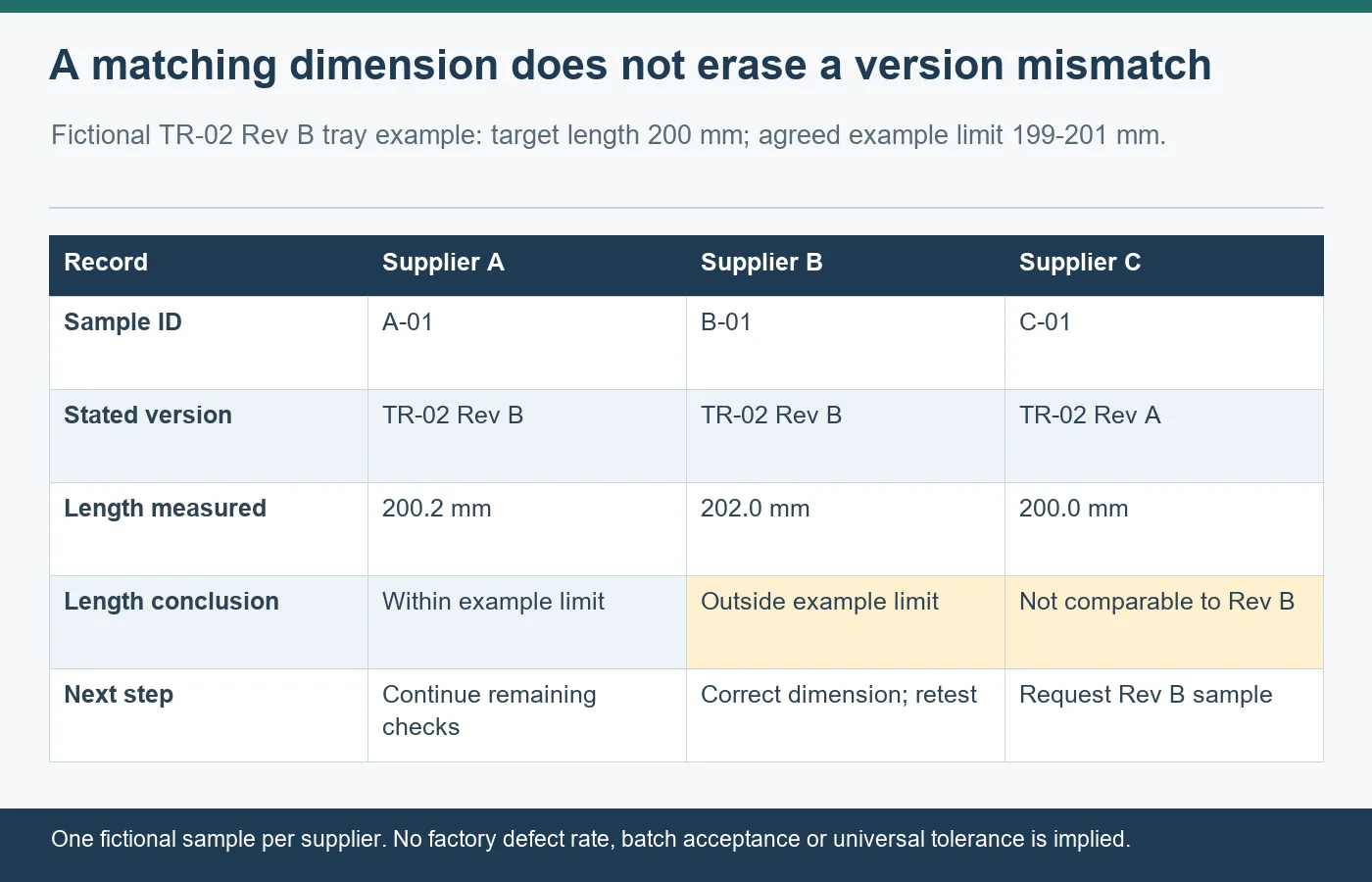
Three-supplier sample comparison showing measured lengths, specification revisions and decisions to continue checks, correct defects or request a matching sample
Ask for a specific retest after a change
Provide the supplier with the failed requirement, the sample ID, the method, the observed result, and any supporting documentation. Find out what changed and which revision or process this is now. Failing to link the new sample back to this means that you cannot justify the difference in the previous result.
Retest and review all impacted features if the change has the potential to impact them. For instance, an improvement to a tooling issue will not just be a verification of the one dimension mentioned in an email. The technical reviewer will decide the appropriate retest scope.
Do not override the results in your assessment of the sample in manufacturing. Instead, link the new sample ID to the original sample and include the reviewer name. Your manufacturing sample assessment should clearly document the flow from observation to resolution and on to the next step.
Convert results into a bound decision
Use the supplier sample evaluation checklist to state what you have learned and what remains open. "Supplier approved" would be a good decision, but "continue to a pilot order after material verification" would be better. Determine the conditions and who is responsible for resolving them.
Keep the sample result separate from the broader supplier verification process. Seeing the product does not confirm the identity of the company, its production capacity or the terms of your future order. Keep an agreed reference sample where useful, with awareness of its limitations.
Want more candidates to compare? Search and contact Chinese suppliers via product name, image or link. Ask for common requirements before you ask for samples, and then the next commitment should be based on documented results, not just presentation.