
How to Set Quality Standards Before Production?

A shipment arrives with loose stitching, a bad print, or a switch that sticks. The buyer has to decide whether to hold the goods, request rework, or reject them. A written acceptance standard and a recorded approval sample give both sides a basis for that decision.
The Problem: Vague Specs, Expensive Surprises
Here's the deal. Most buyers assume "good quality" is obvious. It isn't. A factory's idea of acceptable stitching tension, color match, or drop-test tolerance can be wildly different from yours — and nobody discovers the gap until the goods are already made.
What It Actually Costs
Rework, return freight, expedited shipping, and discounted stock can add costs. If a lot fails the agreed acceptance plan, deciding whether to hold, rework, or reinspect it can also delay shipment.
The Symptoms You'll Recognize
- Inspection reports that say "passed" but customers still complain
- Factories citing "no spec provided" as a defense for defects
- Repeated disputes over what counts as a "defect" versus a "cosmetic variation"
- Samples that looked perfect, but bulk production drifted
Sound familiar? That's not bad luck. That's a process gap.
Why It Happens: Root Causes Behind Failed Quality Standards
Quality failures rarely come from one bad factory. They come from missing groundwork.
No Written Acceptance Criteria
Terms such as “good quality” leave room for different interpretations. Before production, the buyer and supplier need a written basis for judging conformity. Identify unresolved requirements and assign a qualified person to approve the acceptance criteria. In your first quote request to ChinaSource on WhatsApp, separate confirmed acceptance criteria from open items so suppliers can state what their prices assume.
Wrong or Missing Sampling Plan
Decide how to select and check units before the inspection. If you use acceptance sampling by attributes, agree on the standard and edition, inspection level, lot size, sample selection, and acceptance and rejection numbers. ANSI/ASQ Z1.4 and ISO 2859-1 describe plans indexed by acceptance quality limit (AQL).
No Clear Plan for Verification Before Shipment
Review the supplier's quality records and decide whether you need independent verification before shipment. Specify who checks each requirement and what evidence they must record. An inspection documents findings for the items and conditions checked.
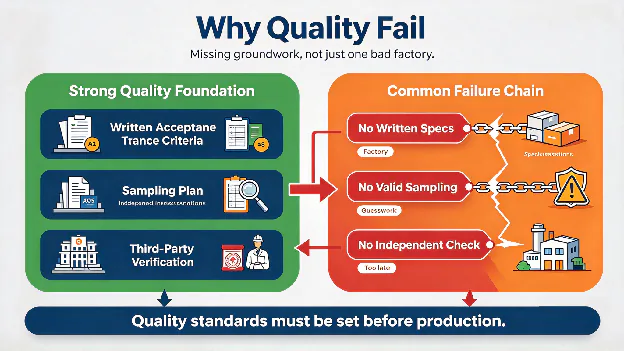
Choose independent verification based on product risk and the evidence needed for the release decision.
The Fix: Building Quality Standards Before Production
Fixing this isn't complicated. It just has to happen early — before the first production run, not after a bad one.
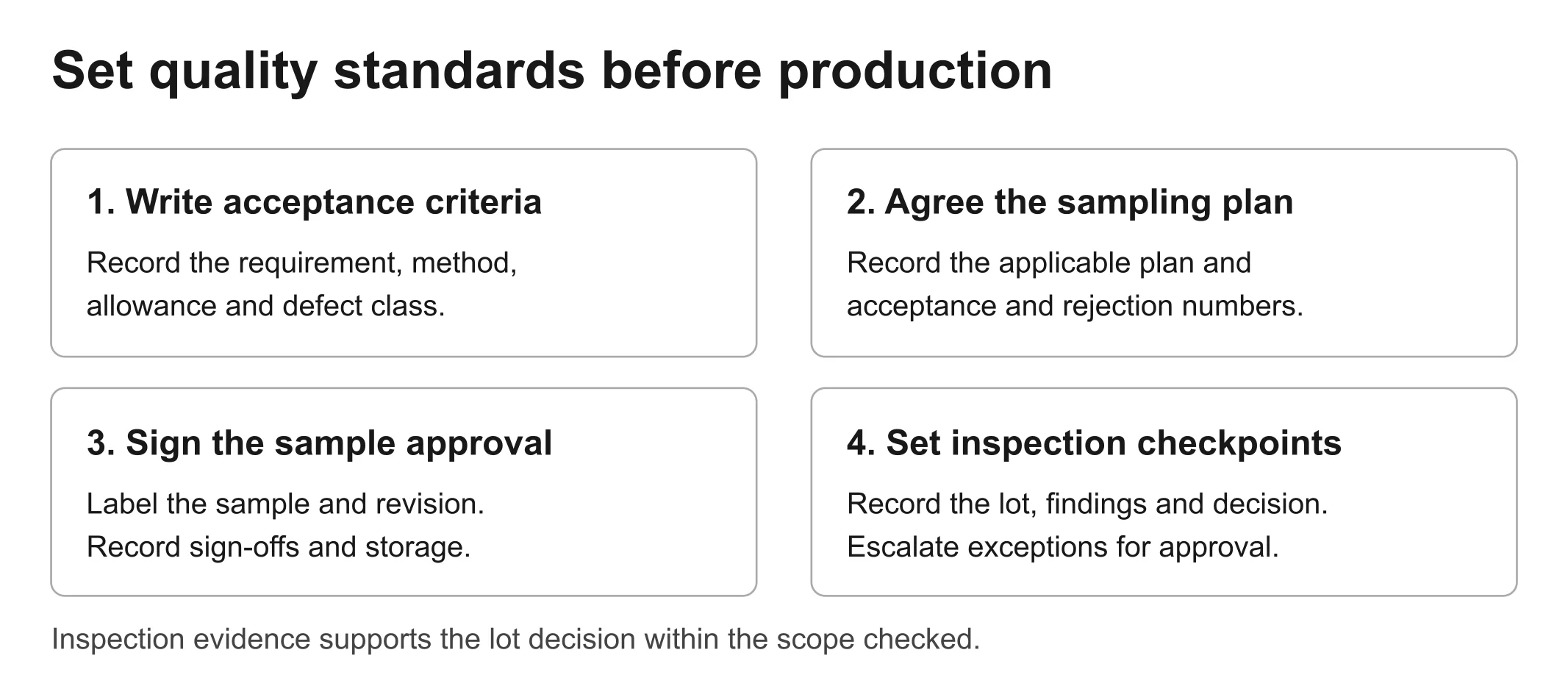
Step 1: Define Measurable Acceptance Criteria
Document measurable requirements such as dimensions, weight, material grade, color reference, function tests, and packaging. For each check, identify the requirement, how to measure it, what variation is allowed, and how to classify a failure. Record who signs the standard and who can approve an exception before production starts.
Acceptance Criteria Example
This fictional cable-pouch example demonstrates how to record requirements, methods, limits, and defect classes. The responsible technical reviewer must define appropriate values and checks for the actual product and intended use.
| Requirement | Measurement or check | Allowed variation or pass condition | Defect if outside the limit |
|---|---|---|---|
| Outer pouch width is 240 mm | Lay the empty pouch flat and unstretched. Measure seam to seam at the midpoint with a millimeter ruler. | 237–243 mm, inclusive | Major |
| Zipper opens and closes fully | Open and close the empty pouch ten times by hand using the pull tab. | All ten cycles complete without jamming or separating. | Major |
| Back panel finish matches the approved sample | Compare against sample P-017-R02 under the agreed light at a viewing distance of 30 cm. Measure any visible mark with a millimeter ruler. | At most one surface mark up to 2 mm in its longest dimension. The mark must not expose fabric fibers. | Minor for a cosmetic mark outside the allowance. Major for exposed or torn fibers. |
On the signed sheet, record the SKU, document version, issue date, buyer approver, and supplier quality lead. Both parties sign the same revision. The inspection report records the version used, who checked it, measured values or observations, and the decision. Any exception needs written approval from the designated buyer approver.
Example check record: P-017, spec v1.2, lot L-018, unit 07. Measured width: 241 mm. Agreed range: 237–243 mm. The unit meets the width requirement. Record the inspector’s name and date. Keep the lot release decision pending until the agreed checks are complete.
Step 2: Agree Defect Classes and Verification Rules
Classify defects by their impact on safety, intended use, and appearance. For example, an exposed sharp component may be critical, a zipper that jams may be major, and a cosmetic mark outside an agreed allowance may be minor. Agree on examples and escalation rules for the specific product. Hold and escalate a lot if a critical defect is found.
Where you use sampling, record the agreed AQLs and acceptance and rejection numbers for each applicable class. The example defect classes do not prescribe AQL values. An AQL is a sampling-plan input. A pass under that plan does not establish the actual defect percentage or show that every unit conforms.
Step 3: Lock a Golden Sample
Before bulk production starts, compare the physical sample with the current written specification. Label it with the SKU, sample ID, revision, and approval date. Record which features it represents, any approved differences and their scope, and who approved it on each side. Use the approved sample alongside the written acceptance criteria. Resolve conflicts in writing before releasing production.
| Approval record | Example |
|---|---|
| Sample identification | Cable pouch P-017, sample P-017-R02, specification v1.2, 12 October. Attach dated photographs of the label, front, back, and zipper. |
| Approved features and allowed differences | Approved for exterior color, finish, and zipper location. Size follows the written 237–243 mm width range. The temporary blank label is approved for this sample only. Bulk units must use the label in v1.2. |
| Buyer and supplier sign-off | Buyer quality lead and supplier quality lead confirm P-017-R02 and v1.2 in writing before bulk production. Record each signer's name, role, date, and approval or exception. |
| Storage and access | Keep matched approved samples in labeled protective packaging. Record which copy the buyer holds and where the factory's QC team stores its copy. Give inspectors access to the current sample and signed record. |
| Change and reapproval | Log changes to materials, construction, or finish. Before using a change, obtain written approval for the revised specification and a replacement sample if it affects approved features. Mark the earlier sample and record superseded and retain them for traceability. |
Step 4: Schedule Inspections at the Right Points
Waiting until goods are boxed and ready to ship is the riskiest — and most common — mistake.
Apply the signed criteria at the checkpoints agreed for this product. Name who checks each requirement, who reviews the findings, and who may release, hold, or request reinspection of the lot. Use a separate pre-shipment inspection checklist to define inspection scope and execution.
Use the approved sample and current specification at the relevant checkpoints. Record the lot, units checked, method, findings, exceptions, and release decision. A passing result records that the lot met the agreed acceptance rule based on the items and conditions checked. It cannot guarantee that every unit conforms or that later handling will leave the product unchanged. When arranging pickup, give your freight forwarder the lot release decision in writing. If you need help finding a freight forwarder, the FIATA homepage links to its Members Directory, where you can look up members by territory.
Avoiding This in Future: Making Quality Standards Stick
Getting one order right is good. Building a repeatable system is better.
Standardize Documentation Across Every SKU
Keep a master spec template that gets adapted per product line rather than rewritten from scratch. Consistency here cuts negotiation time with new factories and reduces the "we didn't know that was required" excuse. The ChinaSource sourcing blog covers how to write product specifications and plan pre-shipment checks, two tasks to revisit when adapting the template for a new SKU.
Reference the Signed Standard in the Order
Reference the current specification, approved sample record, and any agreed inspection plan in the order or quality annex. Record the authorized reviewers and change-approval route. Keep required conformity documents, such as certificates of conformity, as separate evidence matched to the actual product and destination.
Track Defect Trends, Not Just Pass/Fail
Compare recurring defects across lots checked with comparable methods. Record the sample size, defect counts by class, and any change in the inspection plan. Investigate a pattern with the supplier and document the corrective action and follow-up check.
Confirm the Standard Before Production
Before bulk production, obtain written agreement on the acceptance criteria, approved sample record, and authority to approve exceptions. Give the current documents to the people performing the checks. Keep findings, exceptions, and release decisions traceable to the applicable version. If the supplier changes after sign-off, brief the replacement using the current specification revision and approved sample ID. Have those same references ready if you contact ChinaSource about finding a replacement.