
AI Sourcing Agent vs Human Agent: How to Choose

An AI sourcing agent may fit supplier discovery and repeatable early inquiries when it supports those tasks and your team can review the output. A human agent may fit work that needs local coordination, negotiated exceptions, or a named person to follow through. Choose a mixed workflow when preparation can be automated but the next step needs human judgment or physical work.
The right choice depends on the task and its consequences. An AI label does not prove that a service can contact suppliers or inspect goods. Likewise, a human title does not prove competence, independence, or relevant factory experience.
AI sourcing assistant vs human sourcing agent: start with tasks
Write a short buying brief before comparing providers. Include the product, intended use, approximate quantity, target market, and the points still open. You do not need a complete drawing package to ask an initial capability question. However, you must identify which requirements remain assumptions.
Then separate the assignment into three stages: finding candidates, collecting evidence, and making a purchasing decision. These stages need different controls. Our guide to sourcing services and their scope can help you define what you are actually commissioning.
Compare an AI sourcing agent by task, not label
Ask each provider to explain what it will do, what inputs it needs, and what evidence it returns. Treat capabilities as claims to verify. Some AI tools search public information; others support messaging or structured comparisons. Access and authorization depend on the service and your setup.
| Task | AI-assisted approach | Human-led approach | What to check |
|---|---|---|---|
| Find candidate suppliers | Can help search and organize leads | Can add relevant relationships and local knowledge | Source links, entity names, and selection reasons |
| Prepare inquiries | Can draft questions and standardize fields | Can adapt questions to commercial context | Accuracy, permission to send, and original replies |
| Compare quotations | Can organize comparable information | Can challenge assumptions and negotiate exceptions | Missing costs, scope differences, and evidence |
| Visit a factory | Cannot create a physical visit by generating text | May arrange or perform a visit within an agreed scope | Named person, competence, location, and report |
| Approve a supplier | Can support analysis | Can advise within delegated authority | Buyer approval rights and unresolved risks |
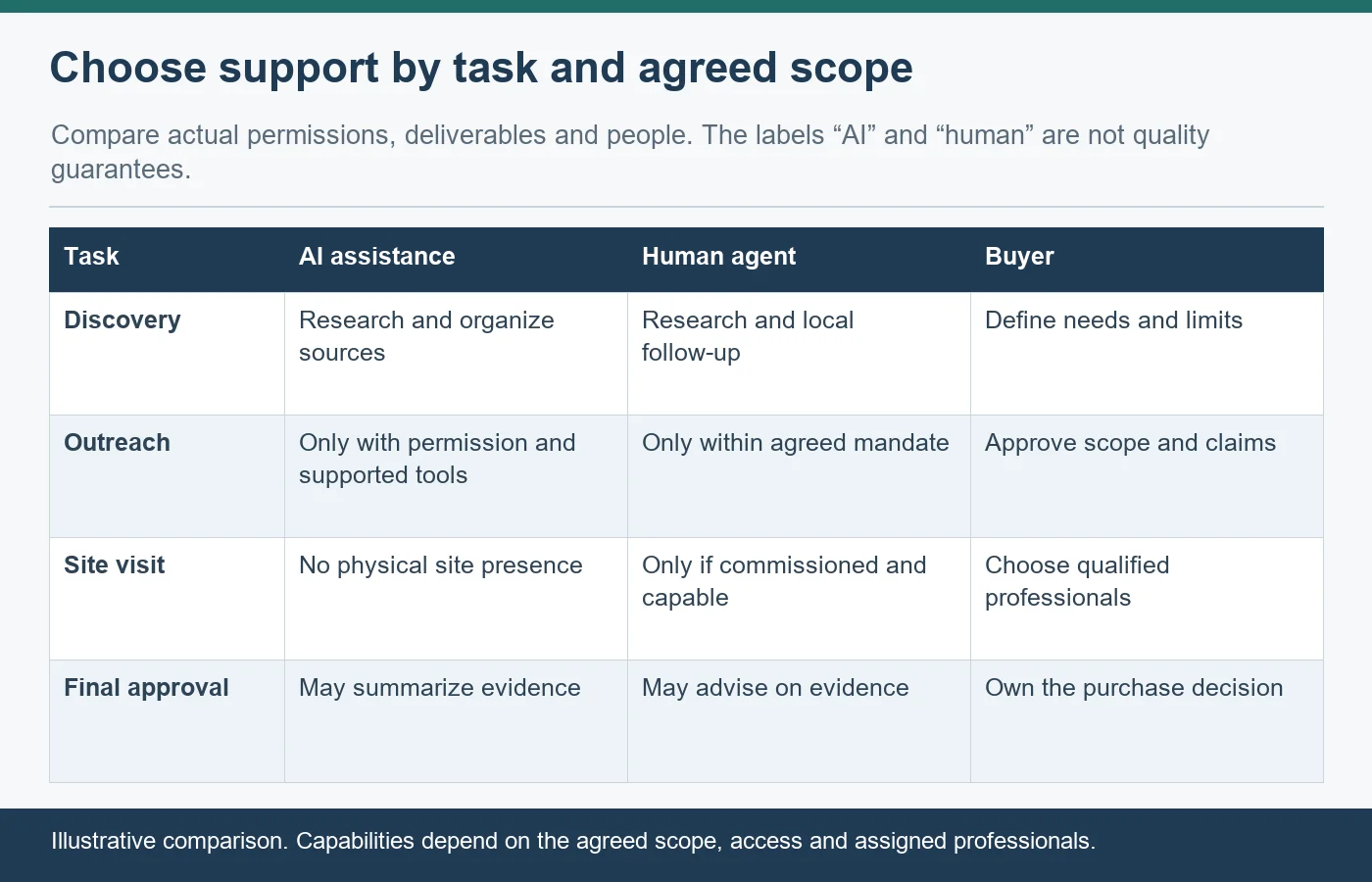
AI sourcing agent and human agent comparison matrix showing sourcing tasks and what buyers should verify
Decide when physical work or specialist judgment is necessary
If your decision depends on a production line, sample performance, or product requirements, define the needed evidence separately. A supplier's online profile cannot show that an on-site activity occurred. A useful report should identify who did the work, when, where, and against what scope.
The NIST AI Risk Management Framework supports clearly defined human and AI roles and oversight. It is voluntary guidance, not a certification for sourcing services. For buyers, the practical lesson is to name the person responsible for reviewing consequential outputs.
Ask a human provider who will perform the assignment and whether specialists or subcontractors are involved. Relevant experience matters more than an impressive role title. Product testing and compliance questions may require qualified independent support. Neither an AI assistant nor a general sourcing agent should be treated as a universal technical authority.
Compare both approaches in a limited trial
Consider this illustrative scenario, not a customer result. You are exploring an order of plain cotton tote bags. Quantity is approximate, and fabric weight and packaging remain open. Your trial covers candidate discovery and an inquiry draft. Samples, factory visits, and orders are outside its scope.
Give each provider the same brief, deadline, spending limit, and permissions. Keep the default trial to drafts. Add supplier outreach only if both agreed scopes include it and you authorize it. Otherwise, compare discovery separately from response handling, rather than penalizing a provider for work you did not commission.
Use a short scorecard:
| Trial measure | What the buyer records |
|---|---|
| Task completion | Which agreed tasks were completed by the deadline |
| Missing requirements | Whether useful questions were raised or gaps were filled with assumptions |
| Review effort | Buyer time needed to understand and correct the work |
| Handling changes | How a revised requirement was incorporated; follow-up performance if outreach was authorized |
| Permission control | Whether messages and commitments stayed within agreed authority |
Check mandatory controls before comparing convenience or speed. Unapproved commitments or invented answers require correction; a strong score elsewhere should not cancel them out. Record actual observations rather than rewarding a polished report.
Then choose the scope that fits your resources. An AI sourcing agent may suit repeatable preparation if review remains manageable. Human support may be more useful when follow-up and exceptions absorb most of your team's time. A mixed arrangement may fit when each approach performs a clearly defined part of the assignment. These are selection criteria, not claimed performance results.
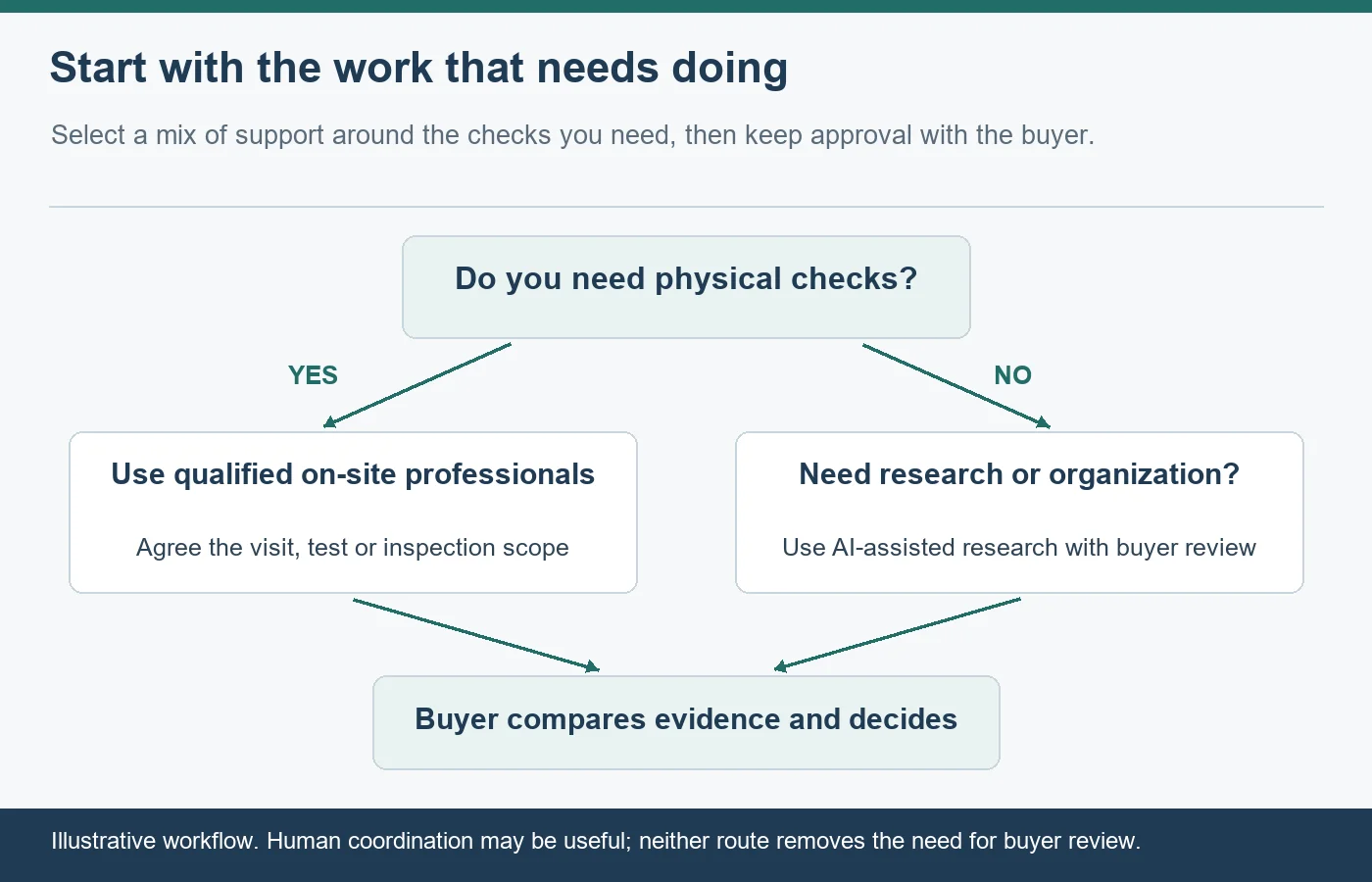
Decision path for choosing AI-assisted, human-led, or mixed sourcing support while keeping approval with the buyer
Compare fees and incentives on a common basis
Compare the complete assignment rather than a monthly subscription against a headline commission. List what each price includes: searches, outreach, translation, follow-up, visits, sample coordination, and document review. Mark any separately quoted service. Do not assume a software plan includes unlimited contact or a human fee includes every follow-up.
Compare service charges and required add-ons for that same scope. Record your team's review and correction time separately, or value it using your organization's own cost method. Keep supplier goods prices separate from this service comparison. A low fee can leave substantial work with the buyer; a higher fee needs a clearly defined service in return.
Ask who pays the provider and whether supplier relationships could affect recommendations. The CIPS Code of Conduct is a professional reference for transparent dealings and fair supplier selection. Its member obligations should not be confused with a blanket legal rule for all agents.
Use the questions in our guide to choosing a China sourcing agent when evaluating human support. Apply the same scrutiny to AI-assisted services. Neither pricing model nor technical architecture proves that a recommendation is independent.
Set data access and approval boundaries
Before starting, establish what the provider may access and share. A tool may not need your full customer list or confidential design files to begin a supplier search. Share only the information needed for the current task, subject to your company's requirements.
Use a written permission checklist:
| Control | Buyer question |
|---|---|
| Data access | Who can view uploaded files, supplier details, and conversation records? |
| Supplier outreach | Can messages be sent automatically, or must I approve them first? |
| Commercial authority | Who may discuss price, change specifications, or accept a quotation? |
| Records | Can I obtain original replies and the underlying evidence in a usable form? |
| Ending the assignment | How do I stop work, revoke access, and handle retained data? |
Request clear answers instead of assuming that every AI sourcing agent has an export function or identical retention rules. For a human provider, confirm the same boundaries with employees and subcontractors. If a necessary control is unavailable, narrow the assignment or choose another approach.
Choose a scope you can supervise
A mixed workflow might use AI assistance to organize the buying brief and candidate information. A human coordinator can then clarify commercial questions. Independent specialists can address defined on-site or technical tasks. Your team reviews the evidence and makes the supplier decision. This is a proposed division of work, not a promise that one service provides every stage.
Start with a limited assignment and assess its output before expanding authority. An AI sourcing agent should make supplier information easier to review, while human support should add identifiable judgment or coordination. In both cases, insist on a clear scope, traceable evidence, and a buyer-controlled next step.
You can start with ChinaSource using a product name, image, or link to explore Chinese supplier options and early conversations. Decide what additional human or independent support your purchase needs before you commit to an order.