
What Is MOQ? A First-Order Guide for Buyers

MOQ means minimum order quantity. It is the smallest quantity a supplier will accept for a specified product and set of order conditions. Before placing a first order, confirm the unit being counted, the configuration it covers, and any separate material or packaging minimums. A number on a listing is only a starting point for that discussion.
For example, “MOQ 300” could mean 300 finished pieces of one model. It does not explain whether custom color, printed packaging, or a later reorder follows the same rule. Your first task is to turn the number into a purchase condition you understand, including what you would pay for and receive.
What is MOQ, and who sets it?
A supplier sets its minimum for a particular offer. Production setup, material purchasing, packaging purchases, and commercial decisions can affect that offer. Ask which constraint applies to your request instead of assuming every minimum has the same cause.
Alibaba.com's MOQ explanation defines the term as a supplier's minimum purchase quantity. It is platform guidance, not confirmation of any individual factory's conditions. Obtain a current written reply for the product you want.
A lower MOQ does not establish product quality, factory identity, or suitability for your intended use. Similarly, a higher minimum does not prove that a supplier is more capable. Evaluate those questions separately. Record the quote date and validity, because an earlier minimum may depend on stock or production conditions that have changed.
Separate product, material, and packaging minimums
Different purchasing layers can create different commitments. The supplier may sell you finished products while buying materials and packaging from other businesses. Those upstream purchases do not automatically become your obligations.
| Layer | What the minimum could describe | What to confirm |
|---|---|---|
| Finished product | Pieces of the specified model or configuration | Exact product, counting unit, quantity, and permitted variants |
| Material | A batch of resin, fabric, metal, or another input | Required purchase, expected use, any excess, and who bears the cost |
| Packaging | Printed retail boxes, labels, or another packaging item | Quantity purchased, quantity used, charges, and treatment of the remainder |
Ask whether the supplier can use existing material or packaging for the requested configuration. If it proposes an alternative, check that the product still meets your requirements. Standard stock is useful only if its specification and condition are acceptable.
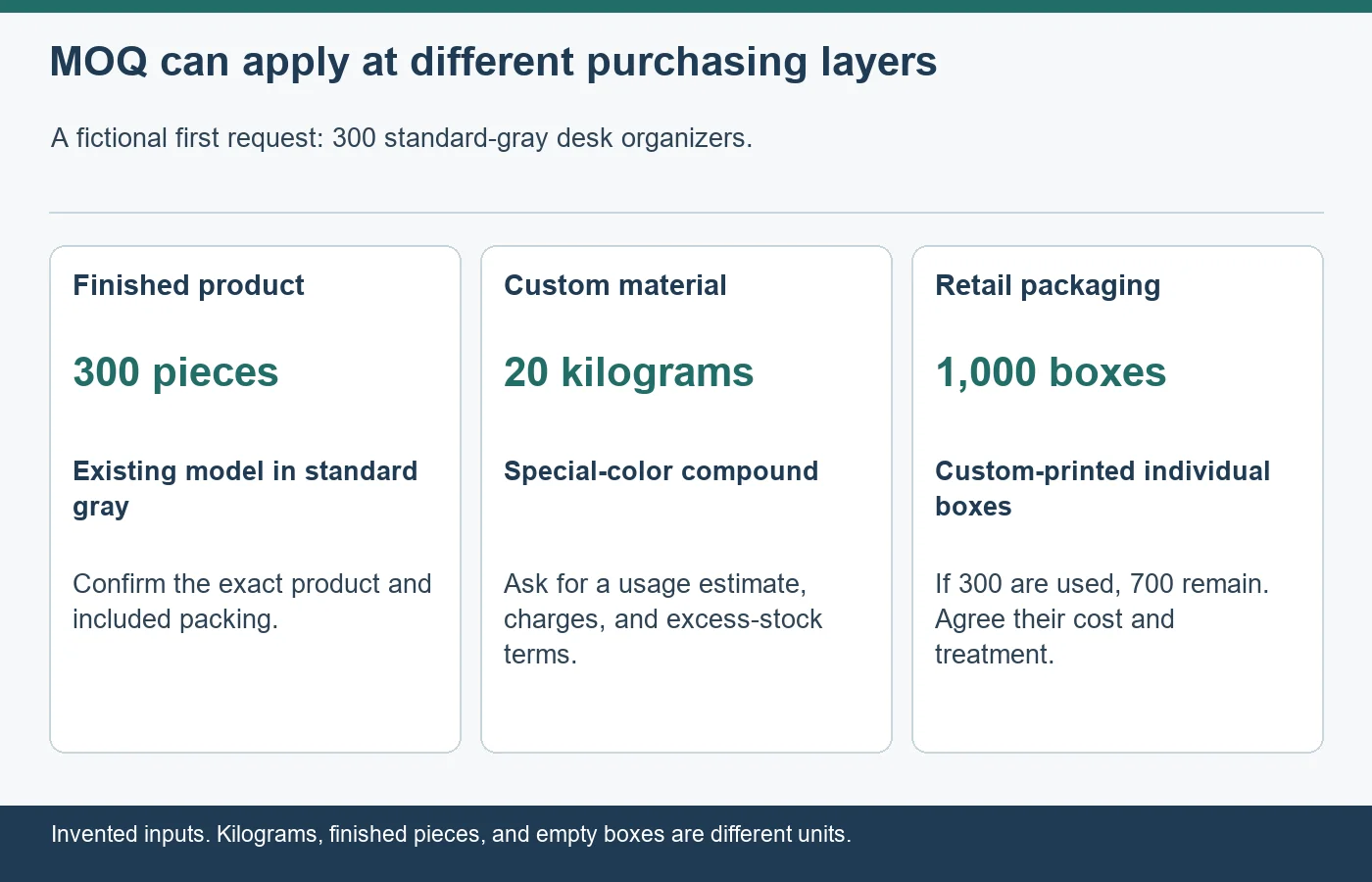
First-order MOQ example showing separate minimums of 300 finished organizers, 20 kilograms of custom-color compound and 1,000 printed retail boxes
Read the unit before planning your order
MOQ is different from a minimum order value, which sets a monetary threshold. It is also different from a carton quantity, which tells you how many units fit in a specified shipping pack. A quotation can contain all three conditions, so ask which ones must be met together.
Suppose a fictional offer has a 300-piece product minimum and packs 25 pieces per shipping carton. An order of 300 pieces occupies 12 cartons: 300 ÷ 25=12. The 25-piece carton quantity does not mean the supplier accepts a 25-piece production order.
For another requested quantity, confirm whether partial cartons are allowed. Do not round up an order without checking the extra purchase. Keep the unit next to every number, particularly when a supplier switches between pieces, sets, kilograms, and cartons in one conversation.
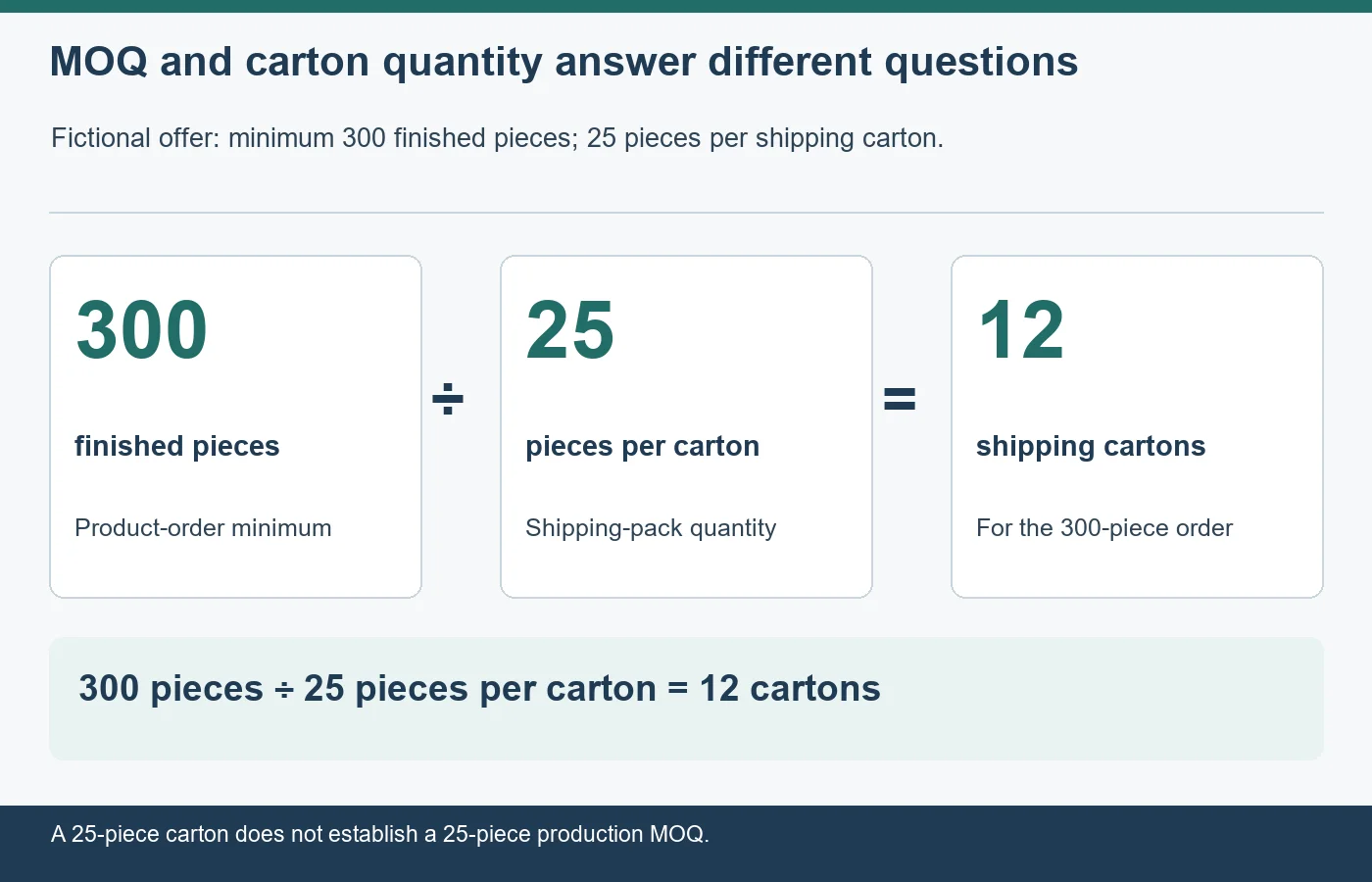
Packing calculation showing that a 300-piece minimum order fills 12 shipping cartons at 25 pieces per carton
Work through a first-order MOQ example
Consider an illustrative, fictional request for 300 desk organizers. The buyer is reviewing an existing model in standard gray, with plain packing. The supplier describes these separate conditions:
| Proposed configuration or input | Supplier's stated minimum | Buyer clarification needed |
|---|---|---|
| Existing organizer in standard gray | 300 finished pieces | Confirm that the requested model and plain packing are included |
| Special custom-color compound | 20 kilograms of compound | Ask for the production-use estimate, cost allocation, and treatment of excess |
| Custom-printed individual retail box | 1,000 retail boxes | Confirm how many boxes are purchased and used, and responsibility for unused boxes |
These numbers cannot be compared by simply choosing the largest. Kilograms of compound, finished pieces, and empty retail boxes are different units. Do not convert the compound minimum into a product quantity without a supported production estimate and its assumptions.
If the buyer authorizes 1,000 retail boxes for 300 individually boxed organizers, 300 boxes are used and 700 remain. That does not itself require ordering 1,000 organizers. The parties still need to agree who pays for, owns, stores, or disposes of those 700 boxes. None of those rights follows from the MOQ label.
The buyer can request one offer for the standard-gray configuration and another for the custom option. Keep each offer's minimum and obligations separate. If the supplier cannot clarify the custom-material commitment, leave that option unresolved rather than treating it as included.
Ask questions that make the minimum usable
When asking “what does MOQ mean” for an actual offer, request answers tied to its configuration. A useful reply should resolve these questions:
- What product, material, color, and packaging does this minimum cover?
- Is the number a finished-product quantity, an input purchase, a pack multiple, or a monetary threshold?
- Which setup or excess-stock charges would I authorize separately?
- Does the same minimum apply to repeat orders, or only to available stock and this quotation?
- What specification, quantity, or packaging change would require a new quotation?
Record the answers in your RFQ or another controlled buying record. Use our RFQ guide to check which fields to include. Ask the supplier to identify assumptions and unanswered fields. A sample purchase is a separate offer; acceptance of a single sample does not confirm the minimum for a production batch.
You do not need to promise a large future order to begin this conversation. Describe the quantity you can actually consider and identify any reorder estimate as a forecast. Detailed arrangements for mixing variants or negotiating a lower minimum need their own confirmation.
Check the first-order commitment, not only quantity
Meeting an MOQ can still create a purchase that does not fit your budget or demand. Review the product payment, setup charges, separately purchased inputs, transport, and other applicable costs. Use a consistent supplier quotation comparison when the offers contain different cost boundaries.
Consider what you can use, inspect, and store. A low unit price on extra inventory does not remove the cash commitment. Equally, an offer above your intended quantity is not automatically unsuitable; it requires an explicit decision based on the full commitment and your actual needs.
Keep packaging and material balances visible. If a supplier offers to retain excess stock, record the quantity, identification, charges, access arrangements, and any storage deadline. Ask how availability will be checked before a reorder. Do not assume that leftover material remains usable indefinitely or belongs to you without agreement.
Use MOQ as a clear starting condition
A useful minimum order quantity identifies what is counted, which configuration qualifies, and what additional purchases the order creates. Confirm those conditions before authorizing payment or excess stock. Leave unclear quantities and charges open until the supplier provides an answer you can review.
You can find and contact Chinese suppliers with a product name, image, link, or rough requirements. Use the initial conversation to establish the offer's scope. For your first sourcing order, the important result is a clear, affordable commitment rather than an unexplained minimum number.