
FOB, CIF or DDP? Which Incoterm Should You Choose?

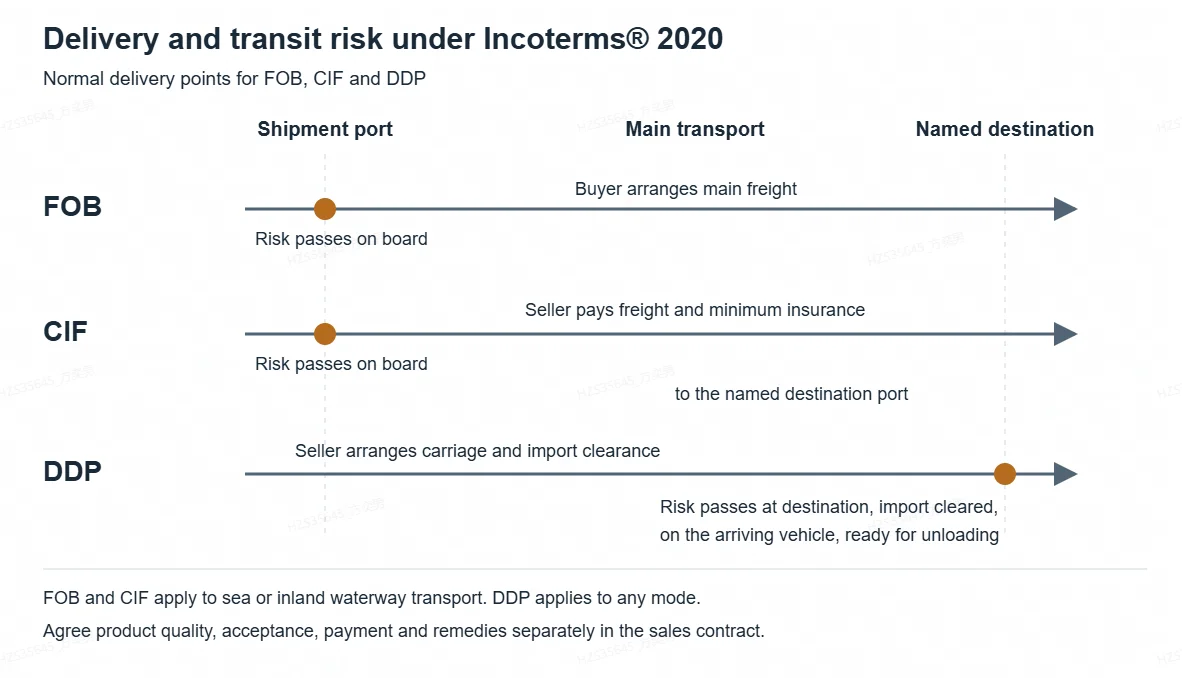
Choose FOB, CIF, or DDP according to the transport mode, handover point, control of carriage, and import-clearance responsibilities. FOB and CIF apply to sea or inland-waterway transport; DDP can apply to any mode. Compare costs to the same receiving point and confirm where transit risk passes.
Specify the Rule, Location, and Edition
Write the chosen rule, named port or place, and edition together in the quotation and order. Use the ICC Incoterms® rules to check who arranges carriage, where transit risk passes, and who handles customs clearance under that edition.
Myth 1: FOB Is Always the Cheapest Option
The claim: The supplier's FOB quote is the lowest number on the table, so FOB must be the cheapest way to buy.
The reality: An FOB price includes delivery on board the vessel at the named port of shipment and export clearance where applicable. The buyer arranges the main carriage and bears transit risk after that delivery. Add freight, any insurance you arrange, destination charges, import clearance, duties and taxes, and onward transport before comparing it with CIF or DDP. The lowest total depends on the actual route, services, and quotations.
What to do instead: Request an itemized breakdown to the same receiving point, including buyer-borne charges and unresolved costs. A comparison beyond unit price also accounts for supplier capability and the cost of inspections or rework. If you use ChinaSource to collect quotes, include the receiving point and the charges to itemize when you send your request on WhatsApp.

Myth 2: DDP Incoterms Mean Zero Risk for the Buyer
The claim: DDP puts everything on the seller, so the buyer is fully covered — no risk, no surprises.
The reality: Under DDP, the seller arranges carriage and export, transit, and import clearance, and pays the relevant duties and taxes. Delivery normally occurs when the import-cleared goods are available to the buyer on the arriving vehicle, ready for unloading at the named destination. The Incoterms rules allocate these obligations between buyer and seller. They do not guarantee that the seller can perform them, or settle product quality, payment, or remedies for delay.
Who Actually Carries the Risk
Under DDP, the seller normally bears transit risk until delivery at the named destination. The buyer still needs to check the proposed customs arrangement and any obligations under local law. Confirm:
- The proposed importer and tax arrangements meet destination-country requirements
- Product labeling and certification meet destination-market rules
- The declared customs value and any required adjustments are supported by transaction records and destination-country valuation rules.
Customs Bonds and Tax Liability
Import-clearance and tax requirements vary by destination. Confirm who may act as importer and whether the seller’s proposed parties hold the required registrations and authorizations.
What to do instead: Identify the legal importer, customs broker, required registrations, declaration basis, and documents you will receive before agreeing to DDP. Ask a destination-country broker or tax adviser to confirm that the arrangement is workable. A factory audit alone does not establish customs or tax eligibility. Where the seller cannot lawfully arrange import clearance, consider DAP with the buyer handling import formalities.
Myth 3: CIF Insurance Covers Every Cargo Loss
The claim: CIF insurance automatically covers every kind of cargo loss, so nothing more needs negotiating.
The reality: CIF requires the seller to arrange minimum cargo cover, normally Institute Cargo Clauses (C) or similar. Under CIF Incoterms® 2020, the insured amount must be at least 110% of the contract price, in the contract currency. That amount does not mean every loss is covered. Check the insured risks, exclusions, deductible, insured journey, and claims procedure. See the ICC Academy explanation of CIF and CIP insurance. The ICC CIF A5 insurance rule specifies the required amount and currency.
What to do instead: Agree any broader cover, such as Institute Cargo Clauses (A), in writing or arrange additional insurance. Check whether war, strikes, and other relevant risks need separate cover. Even an "all risks" policy has exclusions. Ask for the insurance document and confirm who can claim and what evidence is required.
Myth 4: Transit Risk Determines Who Bears Product Defects
The claim: Once transit risk passes under FOB, any defect found later automatically becomes the buyer's responsibility.
The reality: Incoterms allocate delivery obligations, transit risk, and certain costs. The risk-transfer point does not by itself decide responsibility for goods that fail the agreed specification. Quality requirements, inspection and acceptance procedures, notification deadlines, and remedies belong in the sales contract and remain subject to applicable law. Discovering a defect after loading does not automatically release the seller from a pre-existing quality breach. The ICC explanation of Incoterms and commercial contracts sets out this distinction.
What to do instead: Agree measurable acceptance criteria, inspection checkpoints, packing requirements, evidence, and remedies before production. Schedule any pre-shipment inspection while corrective action is still practical, and agree how damage discovered on arrival will be recorded and reported.
Compare FOB, CIF, and DDP on the Same Basis
Put the myths aside, and a clearer picture emerges: no single Incoterm is universally "best." Each one moves cost, risk, and paperwork burden to a different party at a different point in the shipment.
Cost and Risk Comparison Table
| Factor | FOB | CIF | DDP |
|---|---|---|---|
| Transport mode | Sea or inland waterway | Sea or inland waterway | Any mode or combination of modes |
| Named location | Port of shipment, including the loading point where agreed | Port of destination to which seller pays carriage. Also identify the shipment port | Exact destination and delivery point, such as a warehouse receiving bay |
| Main carriage | Buyer arranges and pays | Seller arranges and pays to the named destination port | Seller arranges and pays to the named destination |
| Normal delivery and transit-risk transfer | When goods are on board the vessel at the shipment port | When goods are on board the vessel at the shipment port, although seller pays freight to destination | When import-cleared goods are available on the arriving vehicle, ready for unloading, at the named destination |
| Customs and duties | Seller handles export. Buyer handles transit and import where applicable | Seller handles export. Buyer handles transit and import where applicable | Seller handles export, transit, and import where applicable, including relevant duties and taxes |
| Cargo insurance | No obligation under FOB to buy insurance. Buyer should arrange suitable cover for its exposure | Seller buys at least the required minimum cover. Confirm any broader cover | No obligation under DDP to buy insurance. Confirm how the seller covers transit exposure |
| Charges to clarify | Main freight, insurance, destination fees, import costs, and onward delivery | Destination handling and unloading under the carriage contract, import costs, and onward delivery | Exact destination, customs and tax basis, unloading, delivery access, and any agreed variations |
The delivery and risk points above describe normal performance. Buyer failures to provide required information or take delivery can affect the allocation. Use the ICC Incoterms® 2020 checklist to check the proposed arrangement.
Matching Incoterms to Your Supply Chain Strategy
Choosing between FOB, CIF, and DDP starts with the transport mode and the agreed handover point. Write the rule, exact port or place, and version together, for example "FOB Yantian Port, Shenzhen, China, Incoterms® 2020" or "DDP [full warehouse address and receiving point], Incoterms® 2020". Then ask:
- Who can arrange the route and customs work reliably, and who will be the legal importer?
- Where should transit risk transfer, and what insurance and claims evidence will cover that exposure?
- What is the total cost to the same receiving point, and which fees, taxes, and services remain excluded or unconfirmed?
Use FOB for a suitable sea shipment when you want to arrange the main freight and can manage import clearance. CIF can suit a port-to-port sea shipment when the seller arranges freight and minimum insurance, while you manage destination and import work. Consider DDP when the seller's destination delivery and import arrangement can be substantiated and the price boundary is clear. Experience level alone does not determine the best rule.
For containerized goods handed over at a terminal before vessel loading, discuss FCA instead of FOB. For air, road, rail, or multimodal shipments, use an appropriate any-mode rule, such as FCA, CPT, CIP, DAP, or DDP. If the seller pays carriage and insurance for a multimodal journey, compare CIP. The ICC guidance on FOB and container handover explains why the handover point matters.
Compare Different Quotes at the Same Destination
Whether you ask current suppliers or look for new candidates by product category on ChinaSource Marketplace, keep the product specification, quantity, currency, packing, shipment window, and receiving point the same. Ask for quote validity and an itemized list of included charges. Record the customs classification, valuation, origin, and duty or tax assumptions for confirmation. Keep unknown amounts open instead of treating them as zero. The landed-cost guide on the ChinaSource sourcing blog explains which charges to check beyond the supplier’s price.
Illustration only: a direct-loading sea shipment has the same USD 20,000 goods value and the same final receiving point. Assume identical agreed insurance cover and service scope. These figures are invented comparison inputs, not freight rates or duty advice.
| Quote | Confirmed additions to the same receiving point | Illustrative total before unloading |
|---|---|---|
| FOB Yantian Port, Shenzhen, China, Incoterms® 2020: USD 20,000 | Freight 1,000 + insurance 100 + destination charges 250 + import duties/taxes 800 + onward delivery 400 | USD 22,550 |
| CIF Port of Los Angeles, USA, Incoterms® 2020: USD 21,100 | Destination charges 250 + import duties/taxes 800 + onward delivery 400. Confirm these charges are excluded from the seller's carriage contract | USD 22,550 |
| DDP [same full receiving address and point], Incoterms® 2020: USD 22,700 | None assumed for this illustration. Confirm the lawful import arrangement, tax treatment, quote validity, and access conditions | USD 22,700 |
Check unloading separately in all three offers and flag any quote with unresolved charges, services, or import arrangements as incomplete. The landed-cost guide on the ChinaSource sourcing blog can help you identify costs outside the quoted price. If you add a quote from a supplier you find on ChinaSource Marketplace, use the same product specification, receiving point, and delivery requirements. Compare each offer on total cost, control of carriage, transit risk, access to shipping documents, and available remedies.
Record the agreed rule, named location, edition, and included charges in the order. Set payment milestones separately by specifying what triggers each payment and what evidence is required. Before production, agree on measurable acceptance criteria so the supplier and inspector know what to check and how to judge whether the goods meet the specification.