
Verify AI Supplier Recommendations Before You Buy

To verify AI supplier recommendations, test each important statement against its original source, the correct company, and current transaction details. Then record exactly what the evidence supports. If the source is missing, outdated, or about another entity, keep the claim unconfirmed. A confident explanation, attractive supplier card, or long source list does not establish that the claim is true.
Consider a fictional recommendation for Supplier A, a maker of printed storage boxes. The AI says it owns a factory, holds a current management certificate, accepts 500 units, and can meet your deadline. Those are four separate claims. You can investigate each without accepting or rejecting the whole supplier profile at once.
Turn the recommendation into testable claims
Start by copying the precise statements that could affect your next decision. Replace broad wording such as “reliable manufacturer” with specific questions: Which company? Which production site? Which product? Which certificate? What quantity and delivery condition? A statement that cannot be tested should not earn the supplier a stronger rating.
Give more attention to consequential claims than general descriptions. A useful product category match may justify an initial inquiry. A claim about a payment recipient, production capability, or required certificate needs a different level of scrutiny. Decide what must be established before the next commitment, rather than treating every line of the AI response equally.
The NIST Generative AI Profile identifies confidently incorrect content and invented supporting citations as risks. A linked explanation therefore needs the same scrutiny as the claim itself. Ask the tool for sources if useful, but open and inspect those sources yourself.
Verify AI supplier recommendations against original sources
Locate the exact passage, page, or document behind each statement. A homepage link does not support a detailed factory-capacity claim unless that information actually appears there. Record the full URL or document reference, the capture date, and the words or section you checked. Keep the original statement separate from your interpretation.
Also identify the source type. A supplier catalogue establishes what the supplier says about its products. A registry record addresses particular company details. A certificate record addresses its stated scope. These sources answer different questions; none should silently become proof of everything in the supplier profile.
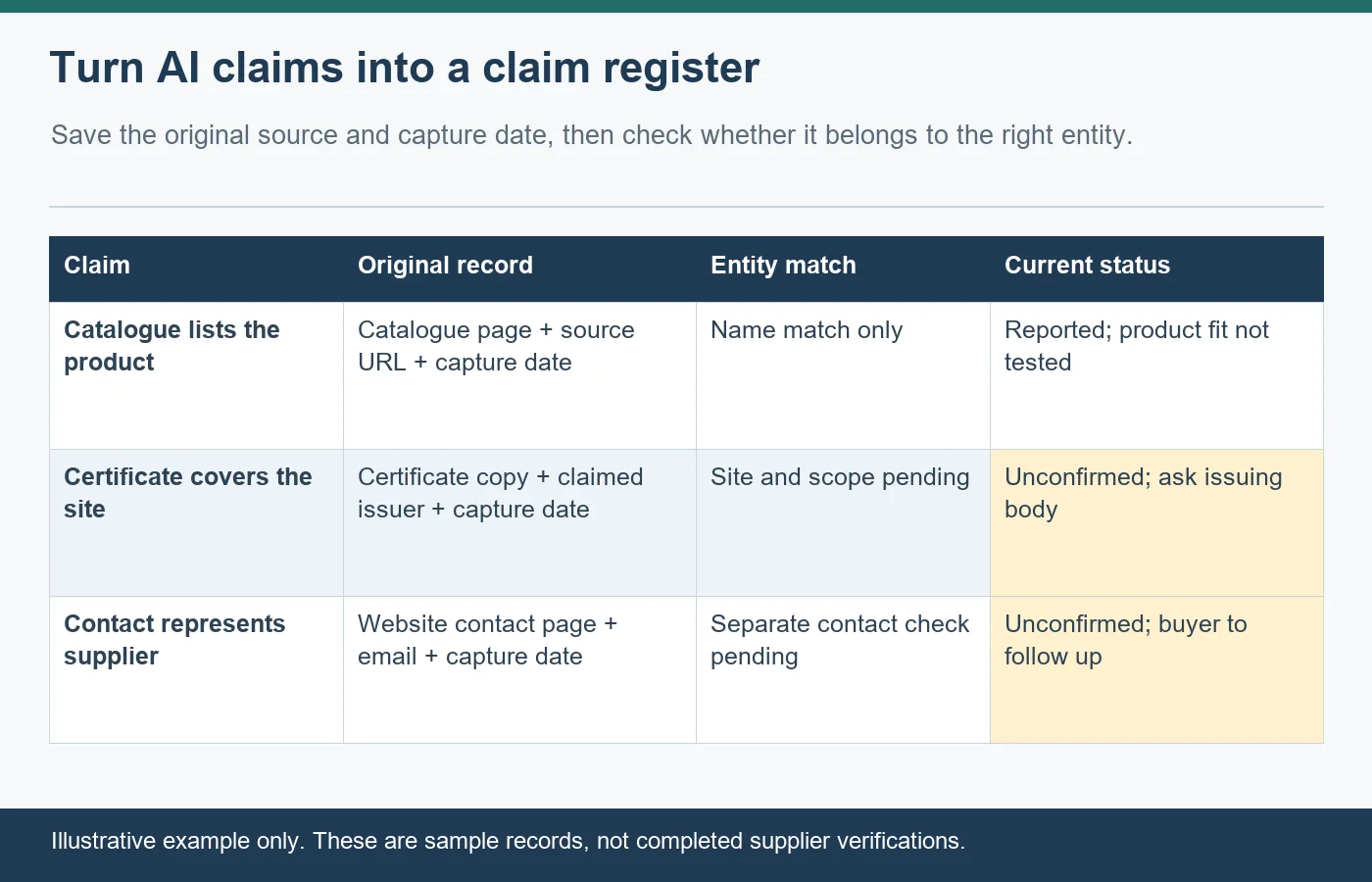
Claim register for verifying AI supplier recommendations using original records, entity matching and verification status
Check whether apparently separate sources are independent. Three directories repeating the same description may trace back to one supplier listing. Repetition increases the number of pages, not the strength of the underlying evidence. Likewise, an old page cached in an AI answer may describe a product or contact that has since changed.
When you verify AI supplier recommendations, keep a missing or inaccessible source visible as a gap. Do not replace it with another generated summary. Request a usable original record, find an appropriate independent source, or leave the claim unconfirmed.
Check that the evidence names the same entity
Compare the legal name and identifiers across the company record, quotation, certificate, website, and proposed payment details. Separate the marketing name from the seller's legal identity. Where several entities appear, ask for records explaining the relationship. A group company, exporter, trading company, and factory may legitimately differ, but their connection needs to be established.
In our fictional example, the factory photograph comes from Supplier A's gallery. That proves the image appears in its marketing material; it does not establish ownership. If the certificate names another group company, do not transfer its status to Supplier A by assumption. Check the named company, production location, and relevant relationship separately.
Our Chinese supplier background-check guide covers the identity-review process. Use the resulting evidence for the claim it addresses. A legal-name match does not establish factory ownership, production capacity, or suitability for your particular order.
Verify the certificate claim, not just its logo
Request the complete certificate, then check its number, named entity, site, standard, scope, issuer, and relevant dates. Use the issuing body's verification route or an appropriate accredited database. Compare the result with the company and location involved in your proposed purchase. A cropped logo cannot establish those connections.
IAF CertSearch's guidance describes checks for accredited management system certificates, including status, scope, certified locations, and issuing bodies. Management system certification is different from product-specific compliance. A valid record does not establish that every listed product meets your destination market's requirements.
Suppose Supplier A's certificate record is current but covers a different site. Record that narrow result and investigate the proposed manufacturing site. If you cannot find the certificate, seek clarification from the issuer. Absence from one search is not proof of a false certificate. Equally, a genuine certificate can be irrelevant to the claim being made. Keep its stated scope and limits attached to the conclusion.
Re-establish current contact and order details
Use a contact route you can independently connect to the company. Ask for a dated reply identifying the person, entity, and product involved. For conflicting contact or payment instructions, confirm through a separately established channel. Do not use only the new contact details included in the instruction you are trying to validate.
Then test time-sensitive statements against a current response. In the example, the AI says Supplier A accepts 500 units. However, the only current quotation states a 1,000-unit minimum. That does not prove the supplier will reject an exception. It means “500 units confirmed” conflicts with the available terms and needs an explicit reply or revised quote.
Similarly, a general lead-time estimate does not establish an available production slot for your specification. Ask what starts the lead-time clock and whether the supplier has confirmed the required quantity and timing. Capture the response date. Commercial details can become stale even when the company identity remains unchanged.
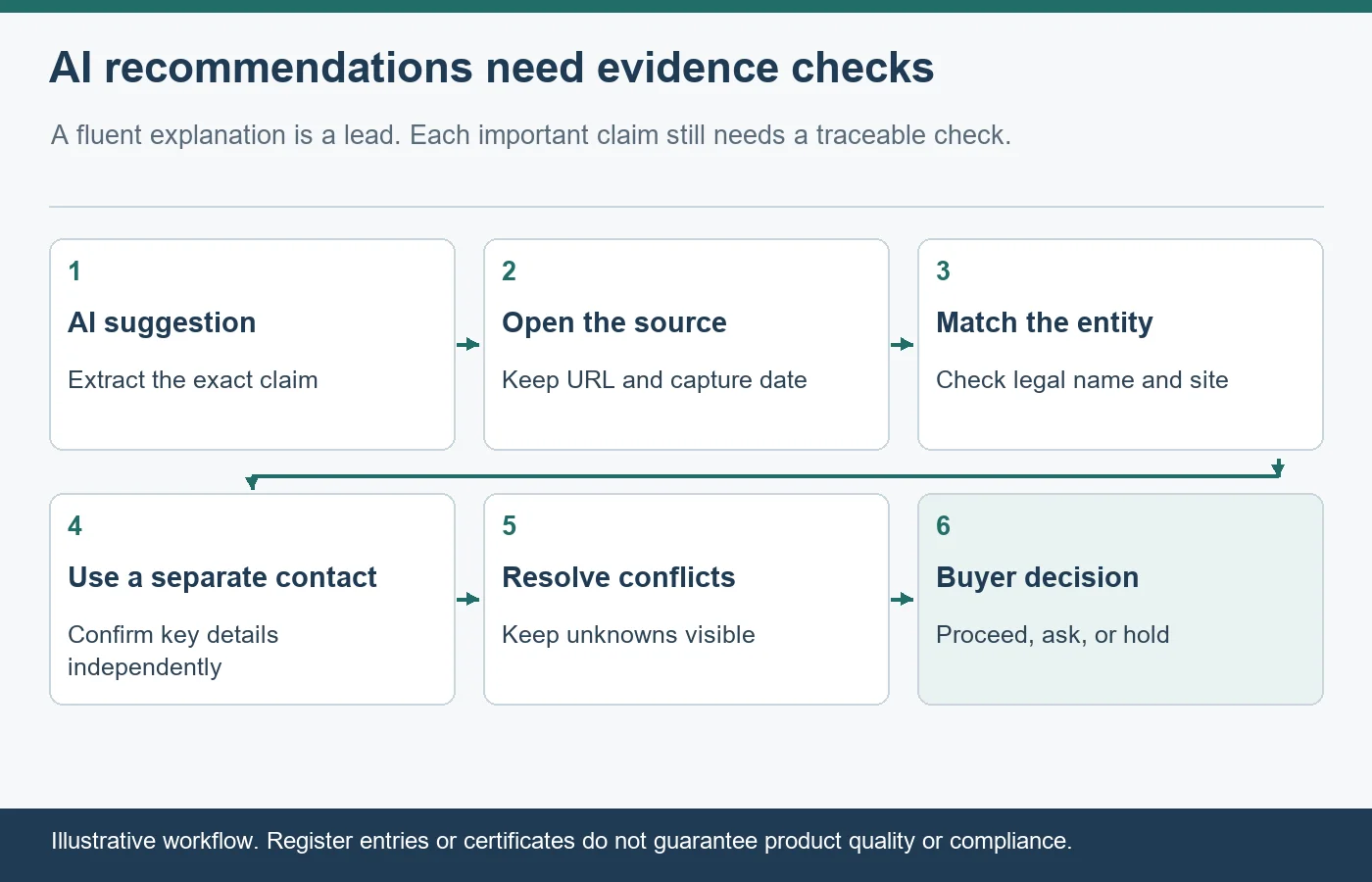
Workflow for verifying AI supplier recommendations through source checks, entity matching, independent contact and buyer review
Mark each claim supported, contradicted, or unconfirmed
When you verify AI supplier recommendations, use a conclusion that describes the evidence, not your confidence in the AI's writing. The following entries continue the fictional storage-box example. They are not assessments of actual suppliers.
| AI-generated claim | What the check reveals | Conclusion to record |
|---|---|---|
| The supplier lists printed storage boxes | Its current catalogue lists that category | Supported as a catalogue statement; capability still needs assessment |
| The supplier confirmed 500 units | The only current quote specifies a 1,000-unit minimum | Contradicted by the available quote; ask about a 500-unit exception |
| The certificate covers the proposed site | The record names another site | Unconfirmed for this site; clarify scope and location |
| The supplier can meet the requested date | No current schedule confirmation exists | Unconfirmed; request a response tied to the final specification |
Correct the recommendation after checking it. Replace “certified factory ready to deliver” with the specific supported facts and remaining gaps. Do not average a serious contradiction into an otherwise high score. A supplier may still be worth investigating, but the unsupported claim should stop influencing the decision as if established.
Decide which gaps stop the next buying step
Tie unresolved claims to the action they affect. An unclear product listing may need clarification before an inquiry. An unresolved contracting entity or payment instruction may justify holding the related commitment. Use our supplier verification guide to combine checks while keeping their limits explicit.
Repeat the affected checks when the product, manufacturing site, certificate, or payment recipient changes. Do not carry an earlier “checked” result onto a new situation. These AI supplier verification limitations keep the conclusion specific to the evidence actually reviewed.
If you are starting with a product name, image, or link, explore supplier options to find and contact Chinese suppliers. Keep purchasing approval with your team. When you verify AI supplier recommendations, the useful result is a corrected set of claims: what the evidence supports, what it contradicts, and what remains unknown.