
Supplier Due Diligence Checklist for Small Orders

A supplier due diligence checklist for a small business should scale with product risk, payment exposure, and the reversibility of the next commitment. Confirm who is selling, what you are buying, who receives payment, and which product requirements apply. Add deeper checks where unresolved facts could affect safety, market access, or a loss you cannot absorb.
A low invoice value limits one part of the exposure. The product may still reach customers, require specific evidence, or create an expensive correction. Start by describing what the trial will actually do, then choose checks that support that decision.
Define the trial before choosing the checks
Write down the item, quantity, intended user, destination, and purpose. Distinguish an internal evaluation from a production pilot or a first shipment for sale. Identify what your team plans to learn and what would authorize a larger order.
Specify which design, material, labeling, and packaging the trial represents. A stock sample can answer a narrow question about an existing item. A custom version may introduce new requirements and commitments. Record which conclusions you will be able to draw from the actual configuration.
Assign the purchasing decision to a named person. Product requirements may need a technical or compliance reviewer, while payment details need finance review. A small team can use outside expertise for a particular uncertainty without buying a broad service it cannot meaningfully use.
Use a small business supplier due diligence checklist
Start with a compact baseline that makes the order understandable. Keep the supporting record and any unresolved answer next to each item.
| Baseline check | Minimum useful record | What it enables |
|---|---|---|
| Seller identity | Contracting name, identifiers where available, and established contact route | Connect the offer to the intended seller |
| Product and intended use | Exact model or revision, destination, users, and planned use | Identify relevant product questions |
| Quoted scope | Quantity, included work, charges, timing, and exclusions | Understand the commitment |
| Payment recipient | Approved beneficiary and explanation of any different entity | Review where the money would go |
| Required evidence | Identified document or check and responsible reviewer | Resolve a requirement before its decision point |
| Decision record | Open items, permitted next action, and approver | Bound what the trial authorizes |
Use the supplier verification guide for the underlying checks when needed. Here, choose their depth and timing around the trial. Preserve a clear distinction between a supplier's answer and a conclusion your team has reviewed.
Review product risk independently of order value
Ask how a failure could affect the user, nearby people, or property. Consider intended use, foreseeable misuse, contact with the body or food, electrical functions, and users who need particular protection. Have the responsible reviewer determine the applicable requirements for the product and destination.
European Commission guidance explains that CE marking follows the EU rules applicable to the product. Use that product-specific route when assessing an EU-bound order. A small budget does not identify which requirements apply.
If the product's intended use is unclear, resolve it before choosing the document list. A certificate covering a different model or an unrelated management system leaves the relevant product question open. Record exactly which requirement the reviewer needs to establish.
Assess payment exposure and reversibility
Consider what becomes difficult to recover at each step. Include deposits, authorized tooling, prepaid inputs, and other committed costs. Separate the amount already paid from an estimate for work you have not authorized. Use a consistent supplier quote comparison for the wider cost assessment.
Ask what happens if the sample fails, the seller changes terms, or your team decides to stop. Record the actual cancellation, correction, or refund provisions in the agreed documents. Check who would handle a dispute and which practical records you would need.
An unexpected change of bank details calls for independent confirmation even on a small order. The FBI recommends verifying changes to account numbers or payment procedures through a separate established contact route. Keep that payment question open until your finance process resolves it.
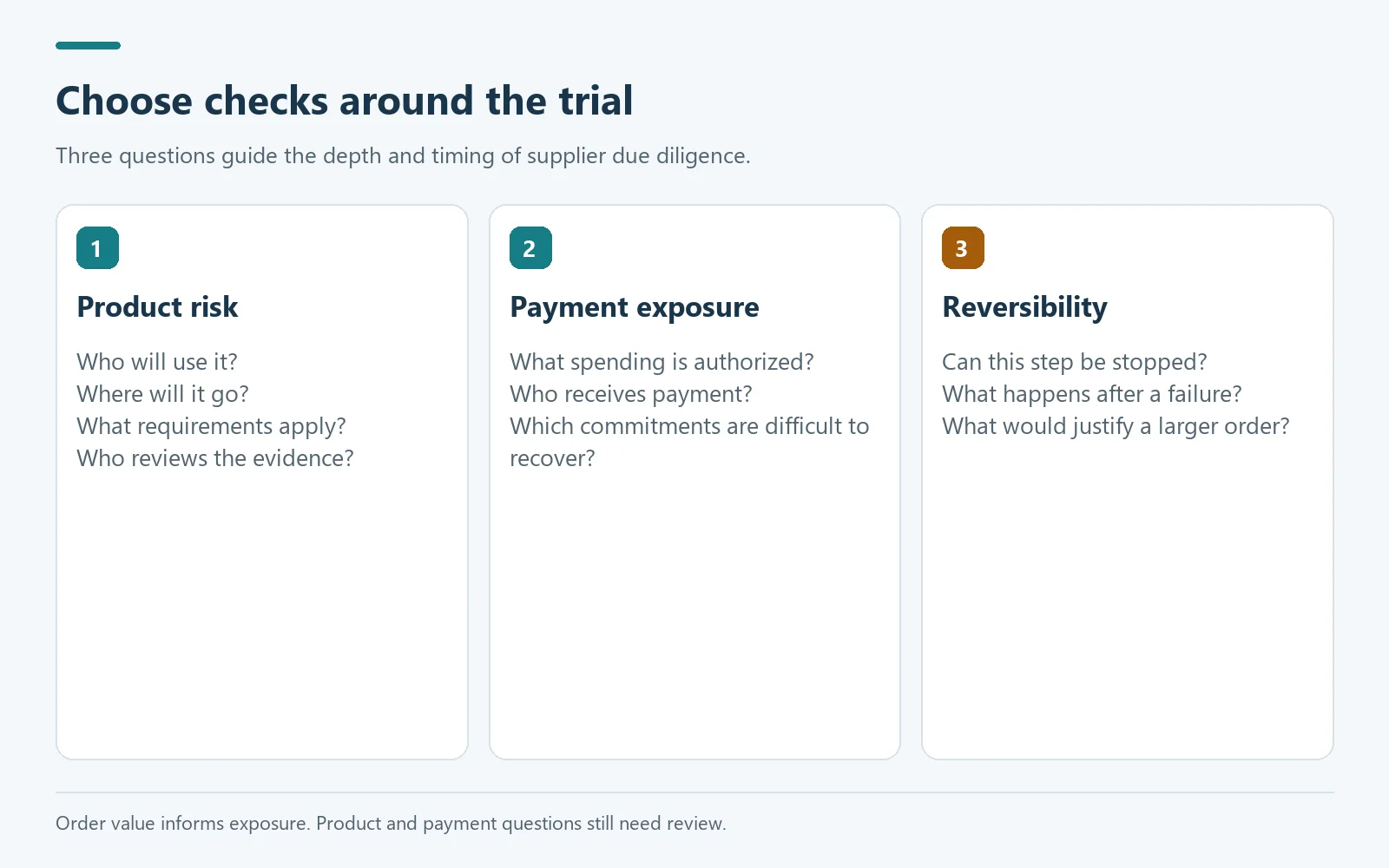
Small-order supplier due diligence framework covering product risk, payment exposure and reversibility
Select deeper checks by the unanswered question
Choose an additional check because its result could change your decision. Ask a provider what it can examine, which site or product it covers, what it will deliver, and what remains outside the assignment.
| Unresolved issue | Proportionate next check | Decision that waits |
|---|---|---|
| Seller and proposed factory differ | Establish their relationship and responsibility for this order | Acceptance of that production arrangement |
| Required product evidence is unclear | Specialist review of the exact model and destination requirements | Relevant import, sale, or use decision |
| Production method materially affects the trial | Targeted capability or process review with defined evidence | Reliance on that process for the pilot |
| Payee changes or lacks a clear relationship | Independent verification and finance approval | Payment to the proposed account |
| Large nonrecoverable inputs precede the trial | Review the commitment and consider staged authorization | Release of the affected spending |
A visit, laboratory test, or document review should have a defined scope. Requesting a generic package because the supplier looks unfamiliar can consume the budget while leaving the actual uncertainty unresolved. Keep the result attached to the question it answers.
Compare two fictional low-value trials
Consider two proposed orders with the same invented goods value of USD 300. The amount is an illustration, not a threshold for reduced checks.
Trial A involves plain, unpowered desk dividers for internal fit evaluation. The buyer has identified the seller, confirmed the exact configuration, and established the payment recipient. The reviewer still checks relevant material and use questions. The team can limit its next authorization to the documented evaluation purchase and require another review before resale or expansion.
Trial B involves an electronic item proposed for use by children. The seller offers only a general company certificate and requests payment to an unexplained third party. That trial has unresolved product and payment questions. A smaller quantity or cheaper price leaves those questions in place, so the relevant commitments stay on hold.
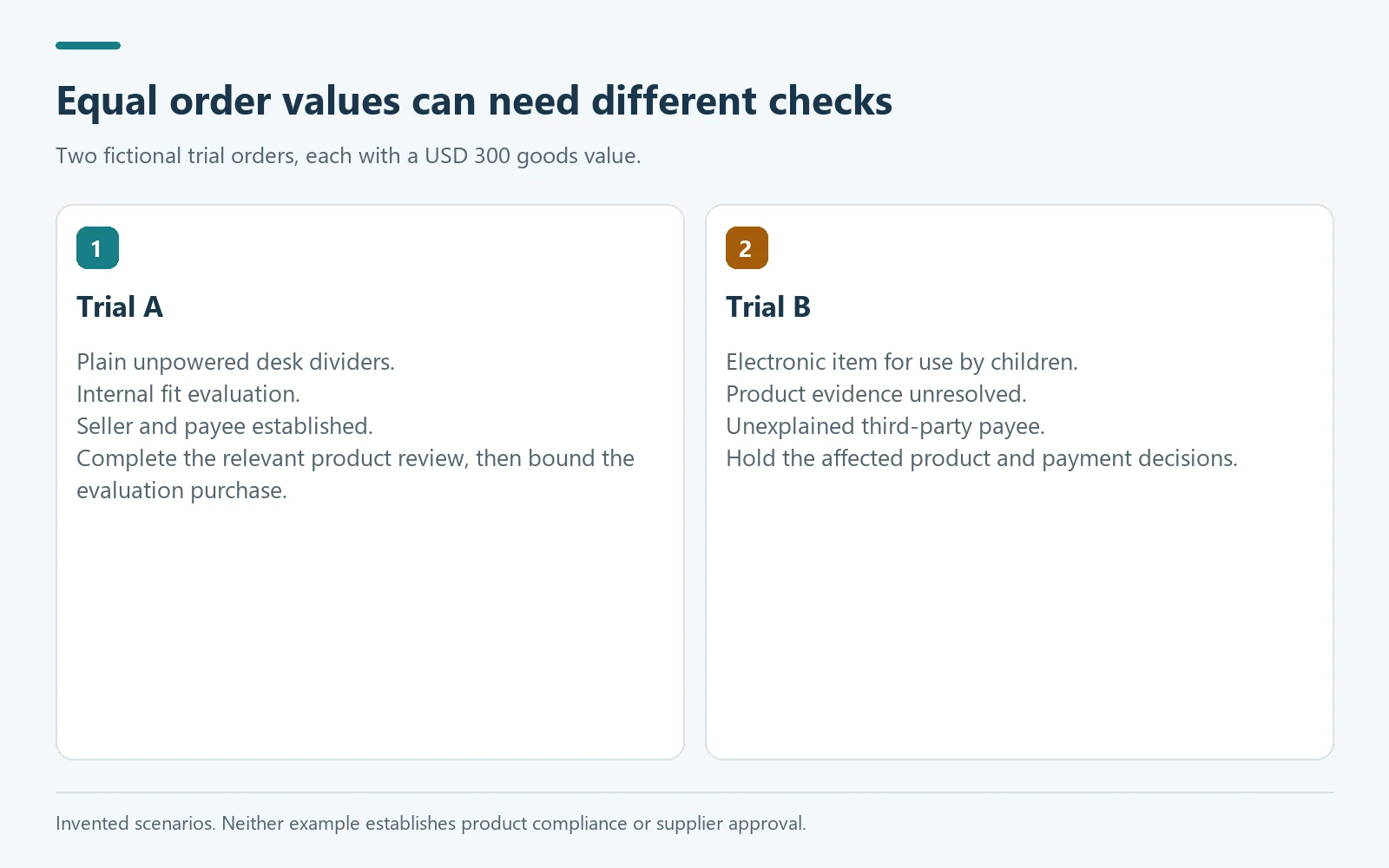
Two fictional USD 300 trial orders showing how product use, evidence gaps and payee identity affect the checks required
Record the next permitted step
Write a short decision with the authorized action, spending boundary, remaining conditions, owner, and review date. For example, permit a defined sample purchase while keeping sale, production tooling, and repeat orders outside that authorization.
Repeat the affected review when the model, site, payee, intended user, or destination changes. Keep the original evidence and state what changed. A successful first delivery can inform the next review, while the larger commitment may call for additional evidence.
You can find and contact Chinese suppliers using a product name, image, or link. Use early conversations to establish the trial's scope, then spend your review effort on the product, payment, and commitment questions that could change the buying decision.