
How to Map the Supplier, Factory and Contracting Company

The company answering your inquiry may not be the same entity that manufactures the goods, signs the contract, or receives payment. That difference is not automatically a problem. It becomes a problem when nobody can explain the relationship or when the documents point to different parties.
To map supplier company factory relationships, start with the names and roles shown in each document. Connect the profile, quotation, factory location, contract party, and payment recipient. Then ask for the proof needed to support each connection. A clear map helps you decide what to investigate before a deposit or production commitment.
Start with roles instead of labels
Words such as supplier, manufacturer, factory, trading company, and agent are often used loosely. Your first task is to give each party a role in the transaction.
| Role | Question to answer |
|---|---|
| Commercial contact | Who sends the quotation and handles communication? |
| Contracting company | Which legal entity would sign the purchase agreement? |
| Manufacturing site | Where would the goods or critical processes be produced? |
| Payment recipient | Which named account holder would receive the funds? |
| Rights or authorization holder | Who owns the design, brand permission, or sales authorization? |
One company may occupy several roles. Several companies may share the work. The map is useful precisely because it prevents you from treating every label as the same identity.
Build the first map from the documents you already have
Create one row for each party and add the name exactly as it appears. Record the Chinese name and registration identifier when available, along with the English rendering used in the quotation. Small differences in translation can be harmless, but they need to be resolved rather than silently normalized.
Add the source and date for every field. A supplier profile may show a location that differs from the address on a quotation. A contract may use a shortened English name. A payment instruction may identify another company entirely. Your map should make those differences visible.
This is where a structured supplier background check can help organize the names, addresses, and evidence dates. The check is a starting point for questions; it is not proof that one company owns the factory or controls every stage of production.
Connect the commercial party to the factory
Ask how the commercial entity relates to the manufacturing site. It may own the site, lease it, use a sister company, subcontract a process, or buy finished goods from another producer. Each arrangement affects what evidence you need.
Useful connection fields include:
- legal name and registration identifier for each entity;
- factory name and complete operating address;
- stated ownership, lease, contract-manufacturing, or sourcing relationship;
- process performed at the named site;
- party responsible for quality records and change notices;
- person authorized to answer questions for the relationship.
Do not ask for a generic statement that the factory is “our own.” Ask for a document or explanation that covers the specific relationship and the product you are considering. A group structure chart can clarify ownership, but it does not prove that the same site makes your product.
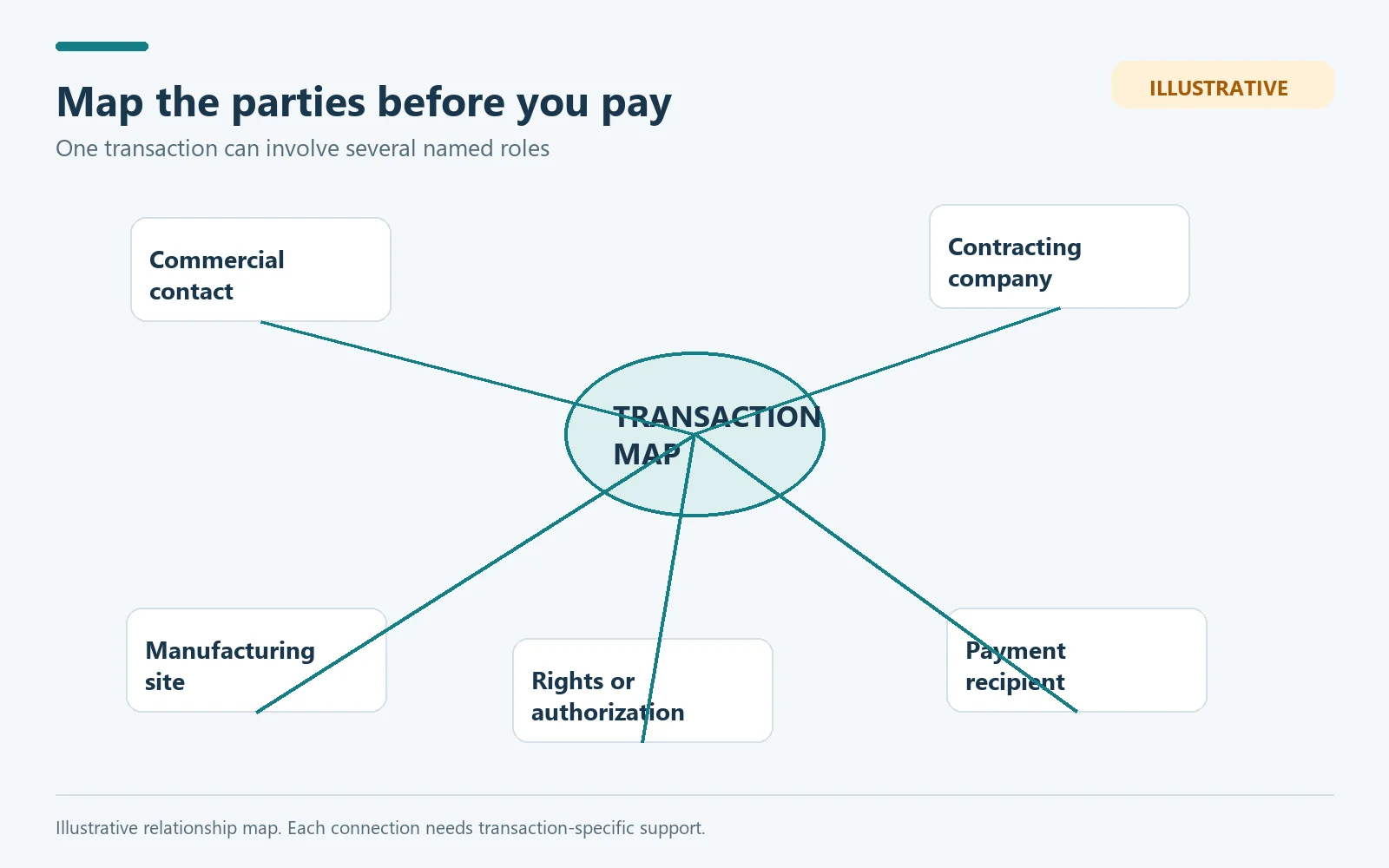
Document chain linking supplier profiles, quotations, factory records, contracts and bank details
Compare the quote, contract, and payment identity
The quotation should tell you who is offering the goods and on what terms. The contract should identify the party taking the obligations. The payment instructions should name the account holder and explain any approved third-party arrangement.
Read the three together. Check the legal name, address, bank beneficiary, currency, product scope, and signatory. A difference is a question to resolve, not an automatic fraud finding. It might reflect a parent company, export entity, authorized sales company, or a mistake in a template.
Request a written explanation before relying on the arrangement. If the seller asks you to pay a different entity, ask why that entity is involved, what document authorizes it, and whether the contract identifies the same payment route. Your finance or legal reviewer should decide what evidence is sufficient for the transaction.
The supplier quotation comparison guide is useful for keeping commercial scope visible while you resolve identity questions. Keep entity identity and price comparison connected, but do not let an attractive price make an unexplained party change disappear.
Check authority for designs, brands, and documents
The product may involve a brand owner, a licensed distributor, a designer, or a separate company that controls the files. Ask who is authorized to sell or manufacture the version you want.
For a private-label product, identify who owns the artwork, tooling, molds, and approved samples. For a branded product, ask what authorization covers the proposed sale. For technical documents, confirm that the issuer, product model, revision, and intended entity line up.
This step is about scope. A document can be genuine and still not cover the supplier, site, model, or transaction in front of you. If you need independent certificate or licensing advice, assign that review to the appropriate specialist rather than treating a platform summary as a final conclusion.
Know which gaps should pause the order
Not every missing field has the same impact. A missing English translation may be easy to correct. An unexplained change in the contracting party or payment recipient can affect who owes you performance and where a dispute must be handled.
Use a simple status for each relationship:
| Status | Meaning | Next action |
|---|---|---|
| Supported | The parties and roles align with documents that cover this transaction | Keep the evidence with the order file |
| Explained, evidence pending | The relationship has a plausible explanation but proof is incomplete | Request the named document before commitment |
| Contradictory | Names, addresses, roles, or payment details conflict | Pause and escalate the mismatch |
| Out of scope | The document does not cover the product, model, site, or date | Obtain a document with the correct scope |
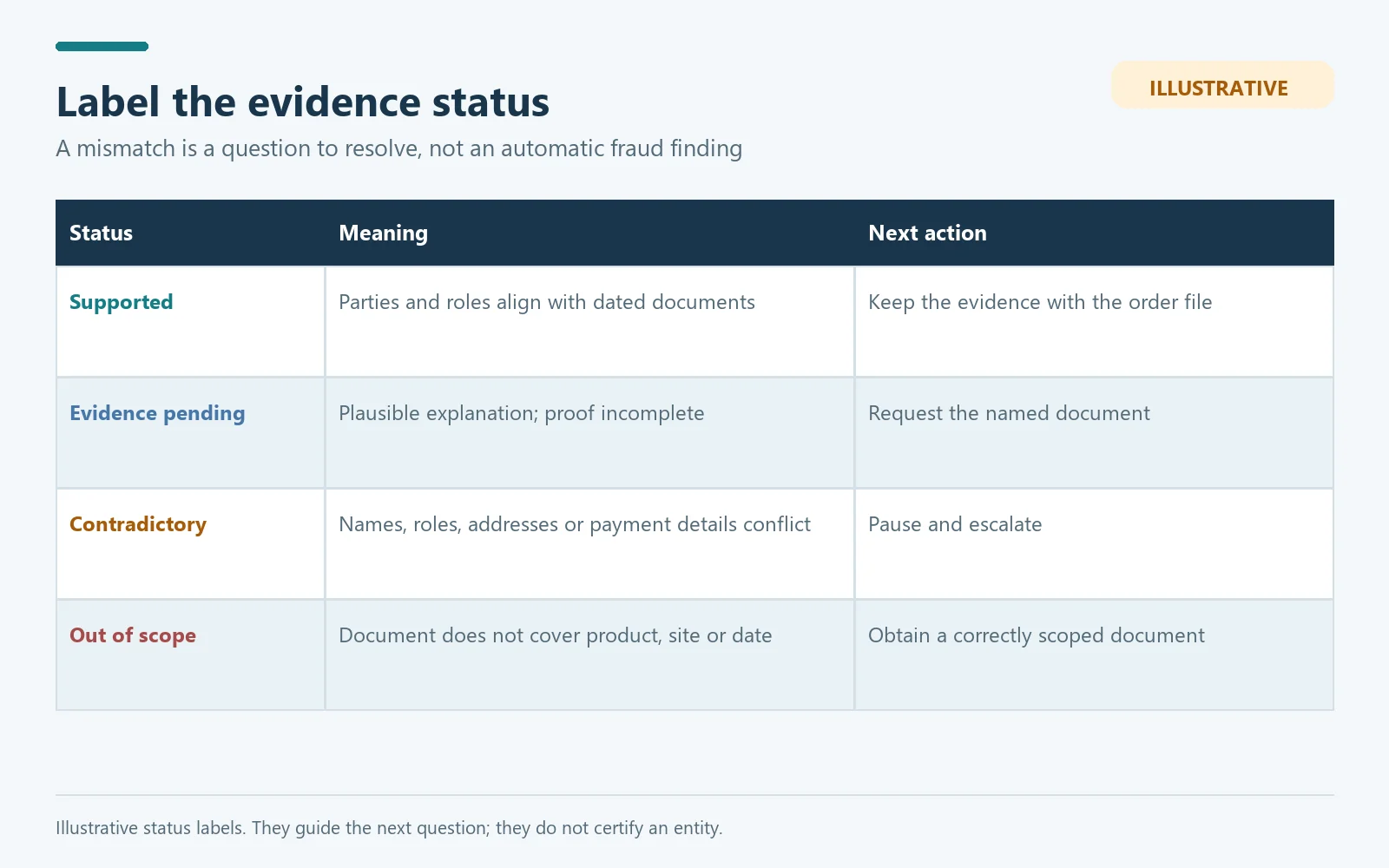
Entity verification checklist for matching company names, addresses, roles and supporting records.
Use a supplier platform as an organizing starting point
When you find potential Chinese suppliers, a platform can help you collect initial profiles and start a focused conversation. The available company background and trade-history context can help you decide which names, roles, and documents to ask about first.
The buyer still decides whether the evidence is sufficient. A company profile is not a factory audit. A trade record is not proof of product quality. Company registration is not proof of factory ownership. The map becomes valuable when it makes those limits visible before money, tooling, or confidential files move.
Before approving the order, finish the map in plain language: who sells, who signs, where the relevant work occurs, who receives payment, and which document supports each connection. If you cannot complete that sentence, the next step is clarification rather than assumption.