
Sourcing Agent Hidden Commission: What to Check

To check for a sourcing agent's hidden commission, establish who pays the agent and what triggers each payment. Then check which suppliers have financial ties to the agent. Compare the supplier's written offer with your agreed service charges. Ask for alternative candidates and keep the final supplier choice with your own team.
A commission, referral payment, or resale margin does not by itself prove wrongdoing. The concern is an undisclosed incentive that can affect recommendations or your total cost. Your review should clarify the business model before you judge the recommendation.
Establish whose interests the agent represents
Start by asking whether you are hiring a buyer's representative, dealing with a reseller, or using a supplier-funded referral service. These arrangements create different expectations. A reseller may sell goods at its own price. That price should not be presented as an unchanged factory quotation if it includes a margin.
The CIPS Code of Conduct provides a useful professional reference for transparent supplier dealings and fair selection criteria. It sets obligations for CIPS members; it is not a universal law governing every sourcing business. For the broader service model, first review our guide to choosing a China sourcing agent.
Build a sourcing agent hidden commission checklist
Ask for a written explanation that covers every potential payer, including related businesses. A low buyer-facing fee tells you little about other incentives. Use this checklist to assess the risk of a sourcing agent's hidden commission when appointing an intermediary or reviewing a changed recommendation.
| Disclosure question | What a useful answer includes |
|---|---|
| Who pays you for this project? | Buyer, supplier, or both, with the receiving legal entity |
| What triggers payment? | Introduction, sample order, purchase order, shipment, or another event |
| How is the amount calculated? | Fixed amount, percentage base, minimum charge, and currency |
| Are there other benefits? | Rebates, volume bonuses, referral payments, or non-cash benefits |
| Do you have supplier ties? | Ownership, shared management, family interests, or exclusive arrangements |
| What happens if we choose another supplier? | Any fee, restriction, or change in service |
Ask separately about freight providers, inspection firms, and other referrals. A supplier commission conflict can sit outside the product quote. Record the answer even when the agent reports no such payments. A dated disclosure gives you something specific to revisit if the arrangement changes.
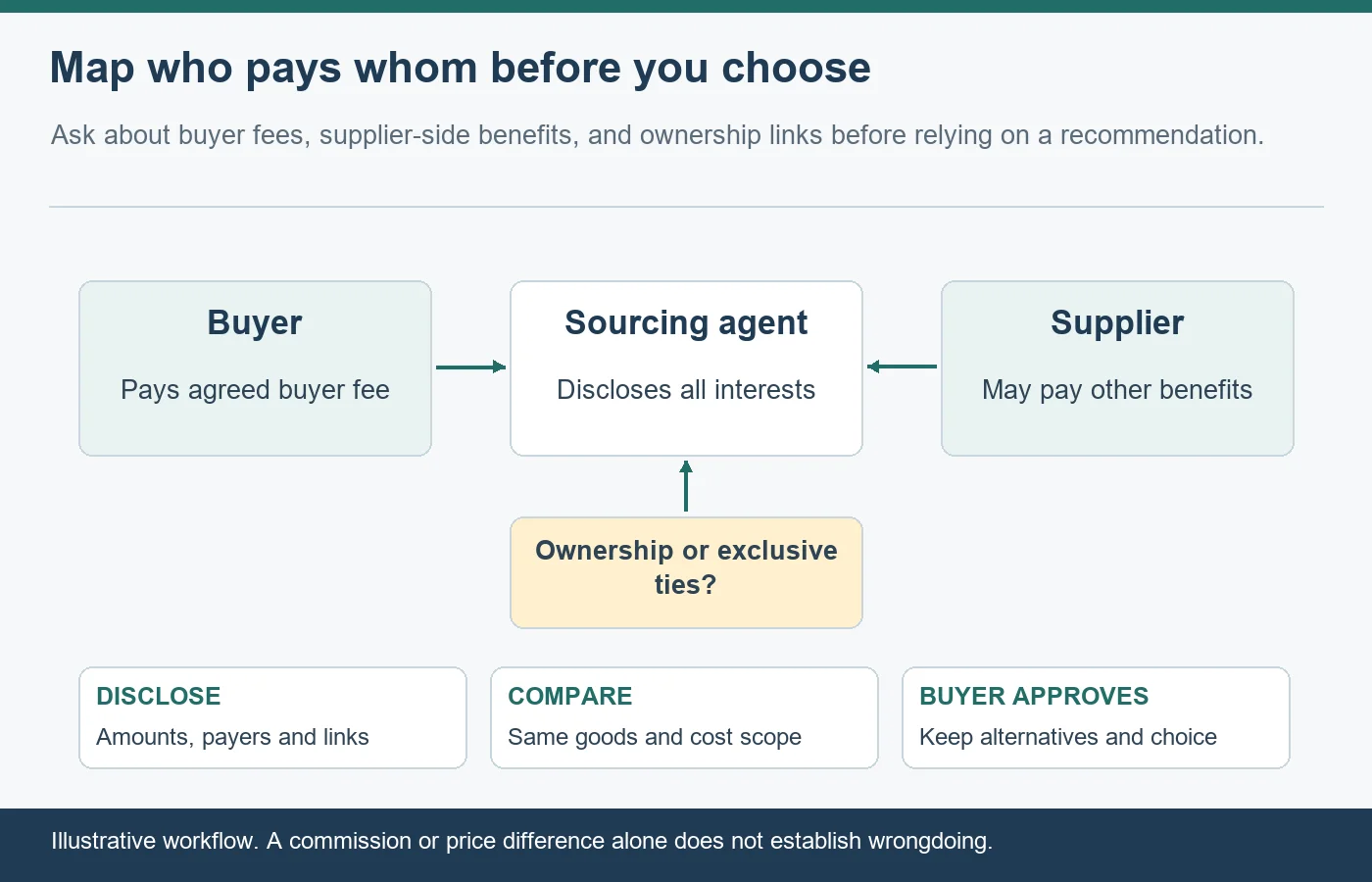
Payment map showing who may pay a sourcing agent, including the buyer, suppliers, and referred service providers
Trace the recommendation to the original offer
Next, request the supplier's dated quotation or a clear explanation of what can be shared. Match its company name, product revision, quantity, currency, delivery boundary, and validity date to the agent's comparison. If documents need redaction, agree which commercial fields must remain visible.
Use these checks to review a sourcing agent's hidden commission risks:
- Ask who issued each quote and whether the agent changed any line.
- Separate supplier charges from the agent's own charges.
- Request an itemized explanation for differences between versions.
- Ask why rejected suppliers failed your stated requirements.
- Retain the option to approach an alternative supplier, subject to your agreed engagement terms.
A refusal to share confidential details is not proof of a hidden payment. However, unexplained markups, unclear quote authorship, or inconsistent fee descriptions need clarification. If the amounts cannot be reconciled, record the fee disclosure as incomplete and request a breakdown before approving the affected charge.
Compare the total price without counting a fee twice
Consider this illustrative example, not a customer case or a market fee benchmark. You are comparing 100 units of the same specification and delivery boundary. Both quotes exclude the same freight, duties, and testing costs. Option B has not disclosed whether the supplier pays the agent.
| Cost item | Option A | Option B |
|---|---|---|
| Supplier's quoted goods total | USD 1,000 | USD 1,100 |
| Buyer-paid agent fee | USD 100 | USD 0 |
| Supplier-side compensation disclosure | None reported | Not disclosed |
| Buyer payable total within this comparison boundary | USD 1,100 | USD 1,100 |
The USD 100 difference in goods prices does not prove a hidden commission. It could reflect a different margin or another cost. Ask for the disclosure before drawing a conclusion. If a supplier-funded commission is later confirmed as already included in the goods price, do not add it again.
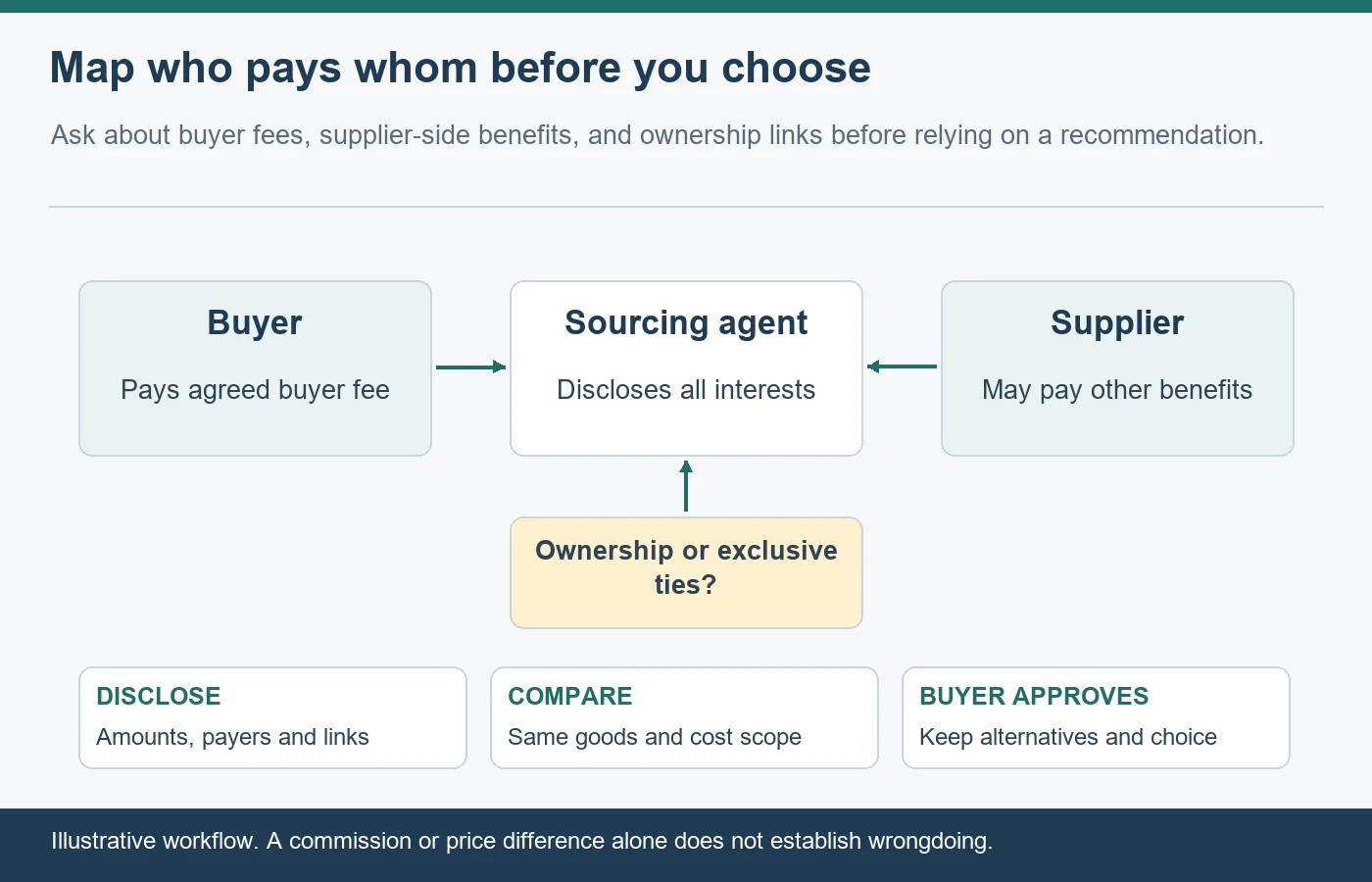
Comparison of two sourcing quotes totaling USD 1,100 each, with a separate agent fee in Option A and unconfirmed supplier-funded compensation in Option B
For a fuller comparison, use the same approach when you compare supplier quotes on equal terms. Keep unconfirmed costs visible instead of entering zero. A missing tooling fee or unclear inspection charge can matter more than the difference in the agent's headline fee.
Request a clear disclosure before you approve
Sourcing agent transparency improves when questions are tied to a specific project, shortlist, and quotation version. You can adapt this request:
Before we appoint you or accept this supplier recommendation, please confirm all payments or benefits your business may receive from us, the recommended suppliers, or referred service providers. Please identify the payer, recipient, calculation basis, and payment trigger. Also disclose ownership or other relationships that could affect these recommendations. Explain which quoted amounts include these payments, what alternatives we may consider, and how you will notify us of changes.
Keep the response alongside the relevant quotes. Where the engagement terms matter, have a qualified adviser review the appropriate disclosure and approval wording. Do not assume a general promise of independence answers the project-specific questions.
Preserve choice and set escalation rules
Compare recommendations against criteria you set before seeing the preferred supplier. These might include order size, material requirements, production capability, sample results, and evidence quality. Ask for the reasons behind each score. A supplier should not gain points merely because its commission structure is more attractive to the intermediary.
Pause the affected decision when an important payment remains unexplained, a stated relationship changes, or the quotation trail cannot be reconciled. Request clarification from the relevant parties and record who will review it. Do not publicly accuse a company based only on a price difference or an unanswered question.
Disclosure alone does not resolve a conflict. Your team must decide whether to accept the arrangement, require additional controls such as an independent quote review, or choose another provider. Record the decision and any conditions in the engagement terms.
Finally, separate supplier selection from payment approval where your team can do so. Record who may recommend, who may approve, and who may change payment details. These controls make the decision reviewable without pretending that any checklist can remove every conflict.
Make the next recommendation easier to review
A useful review of a sourcing agent's hidden commission risks ends with documented payment disclosures, an explained quotation trail, and a recorded decision about any conflict. Keep the disclosure current when suppliers, quantities, or service providers change. The goal is to understand incentives and preserve choice before committing funds.
If you need more supplier options, you can start a supplier search using a product name, image, or link. Use early supplier discovery and conversations to build alternatives. Apply the same disclosure and evidence checks to every recommendation, and keep the purchasing decision with your team.