
Factory Audit Guide: Verify Supplier Quality and Compliance


When you're purchasing goods overseas, there is a lot of risk involved; you could stumble upon an online supplier who fits the bill just right. Their website is professional, their communication is on par, and their product samples are awesome (just what you wanted)
But what if you place a colossal order and the actual goods arrive months late and severely flawed? Or maybe you've gone with another manufacturer that has been performing well over time, but then their quality starts declining. How do you root out the cause of the problem before it ends up ruining the reputation of your brand?
A factory audit is a solution to those very problems; it's the best way to peek into the operations of a manufacturing plant and ensure they meet your very stringent specifications.
So, What is a Factory Audit?
A factory audit (also known as a production audit or supplier audit) is an on-site examination of a manufacturer's facility; it includes an audit of their facilities, systems in place, manufacturing capabilities, work environment, and general competencies.
The purpose of a factory audit is to ensure your supplier has the capacity and ability to produce products that meet the standards you set, whether locally or globally. Companies use factory audits for two main reasons:
-
As a Final Qualification Step
Before signing a contract with a new supplier, a comprehensive factory audit helps you confirm that the factory is legitimate and capable of handling your order. -
For Ongoing Supplier Quality Management
For existing partners, routine audits help you monitor their performance, track their quality approach, and ensure continuous improvement.
Factory Audit vs. Product Inspection
One point of confusion we've found is the difference between an audit and an inspection. While both are important for quality control, they do quite different things.
Product Inspection
This has everything to do with the items themselves; an inspector inspects a certain quantity of goods just before the products are shipped to ensure the order meets your requirements. It is a short-term check.
Factory Audits
This focuses on the bigger picture instead of focusing on a single batch of products; an auditor evaluates the entire quality management system and manufacturing process. A factory audit focuses on the factory's long-term ability to maintain the highest quality standards throughout production.
Audits are about more than just product quality; they look at environmental standards, social compliance, and facility security.
When Should You Conduct a Factory Audit?
Importers generally choose to conduct factory audits during two critical phases of their supply chain journey.
1. When Evaluating a New Supplier
If you're sourcing, you may already have some factories in mind that are capable of producing your product. You'll sort of "judge" their price points, talk to their sales reps and browse through their product samples.
Over time, you will reduce this list to a single key prospect. On paper, this new vendor might be perfect. But you'll want to substantiate their claims before sending a sizable deposit.
See what is really happening on the shop floor before you commit. You can do that by visiting the manufacturer yourself or hiring a third-party inspection team to carry out an on-site audit. Once the audit is done, you will have a clearer picture of the factory's operations, and that makes it easier to make a sound decision before moving forward with the order.
2. As Part of Ongoing Quality Management
Your services with a vendor don't stop when they ship the first order; things wear down in machines, management changes, and quality standards sometimes slip. You can avoid this by auditing your suppliers at set intervals, say, every 12 to 24 months.
On a continual basis, audit cycles help evaluate performance in the long term, so you can monitor supplier performance, and if the audit finds anything involving non-compliance or a decline in quality, this will allow you to work with the factory on corrective action before it ends up reaching your own customer.
The 5 Types of Factory Audits

There is no "one size fits all" approach to auditing. Depending on your industry, your specific concerns, and the type of product you’re manufacturing, you will need to choose the right type of audit that suits you best. Here are the five primary types of factory audits:
1) Capability Audits
This audit is aimed at determining whether or not the production plant has all the necessary equipment, an adequate workforce, and technical know-how it needs to produce your product in a timely manner; For example, when there is urgency for 100,000 units within the next one month, it is assured through such audits that production can cope up with the demand without compromising quality.
2) Quality Audits (System Audit)
Quality auditing, also known as a system audit, is where the auditor examines the factory's quality management system. Assessments are mostly conducted in accordance with the international standard for quality management systems, ISO 9001.
The ultimate goal of this audit is to verify established standard operating procedures for handling raw materials and detect any faults or failures, ensuring consistent, high-quality goods are provided at all times.
3) Social Compliance Audits
Social compliance audits examine the entire work environment and working conditions in the factory. As per established standards like SA8000, these audits ensure that there is no child labour, that appropriate wages are paid, that a secure place is provided, and that they follow some level of ethical employment regulations. This evaluation of the work environment protects your company or business from public relations disasters.
4) Environmental Audits
Industrial production is highly likely to have a pollution effect on the surrounding environment. Therefore, you conduct environmental audits of the factory to check whether it follows set regional or global environmental guidelines, and through these audits, you can inspect its methods of managing waste, the manner in which it stores chemicals, and the manner in which it manages emissions to prevent harm to the surrounding natural habitat.
5) Security Audits (C-TPAT)
Security audits are very important to those companies importing merchandise into America. Conducting such an audit to ascertain compliance with US Customs and Border Protection's C-TPAT (Customs-Trade Partnership Against Terrorism) program is a must.
The audit team examines the physical protection of premises, the method of loading goods onto containers, and IT security to safeguard the supply chain against potential manipulation.
Factory audit types (what you get from each)
| Audit type | What it checks | Best time to use it | Typical deliverables you should expect |
|---|---|---|---|
| Capability audit | Production capacity, equipment, staffing, technical skills, output limits | Before placing a large or time-sensitive order, or when scaling volume | Capacity snapshot (monthly output), equipment list, staffing overview, bottleneck notes, production readiness rating |
| Quality audit (system audit) | Quality management system, SOPs, records, traceability, controls tied to an ISO 9001-style structure | When quality consistency matters across many batches, or when defects keep repeating | QMS review summary, document checklist (SOPs, QC records), non-conformance list, root-cause notes, corrective action plan (CAP) requests |
| Social compliance audit | Working conditions, wages/hours, worker safety, labor practices (aligned to SA8000-type criteria) | Before long-term partnerships, for brand risk control, or for retailer/customer compliance | Compliance report, worker interview notes, payroll/time record checks, safety findings, corrective actions with deadlines |
| Environmental audit | Waste handling, chemical storage, emissions controls, local and global environmental expectations | For regulated products, chemical-heavy production, or high environmental risk categories | Environmental compliance findings, waste and chemical handling review, permits/records check, non-compliance list, remediation actions |
| Security audit (C-TPAT) | Site security, cargo handling, container loading, access control, supply chain security (US-focused) | If you ship into the US and need stronger supply chain security | Security risk assessment, physical security checklist, container/loading controls review, access control gaps, improvement plan aligned to C-TPAT needs |
What Should a Factory Audit Checklist Include?
Before you conduct the audit, you must develop a checklist. An audit checklist acts as a roadmap for the auditor, ensuring no critical details are missed during the on-site visit.
While the contents of a factory audit checklist will vary depending on the specific type of audit, a standard quality and compliance audit will generally include the following key areas:
1. Facility Layout and Maintenance
The auditor will evaluate the physical state of the manufacturing facility. Is the factory floor clean and organized? Is the machinery well-maintained, or is it covered in rust and leaking oil? A clean, well-lit factory is usually a strong indicator of a well-managed quality system.
2. Quality Control System Documentation
The auditor will check the factory's QMS documentation. Do they have written procedures for quality control? Are they following ISO 9001 standards? The auditor will look for evidence that the factory's approach to quality is formalized, not just improvised.
3. Incoming Materials Handling
Quality products start with quality raw materials. The audit checklist must include a review of how the factory inspects incoming materials from its own sub-suppliers. If the factory accepts defective raw materials, your final product will be defective.
4. In-Process Quality Control
During the production processes, does the factory conduct spot checks? The auditor will evaluate how the workers handle non-conforming materials. If a defect is found on the assembly line, is it thrown away, reworked, or accidentally passed down the line?
5. Final Inspection and Packaging
Before goods are shipped, they must undergo a final inspection; the auditor will review the final testing procedures and evaluate the packaging area to ensure the products will survive international transit.
6. Corrective Actions and Continuous Improvement
A good factory admits when it makes a mistake and learns from it. The auditor will check how the factory handles client complaints; do they have a system for tracking issues, conducting root cause analysis, and implementing corrective actions to ensure the mistake does not happen again?
How to Conduct a Factory Audit: Step-by-Step
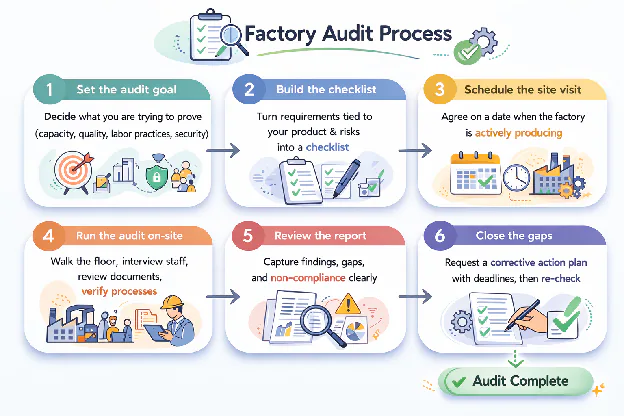
A good audit requires careful planning, and whether you use a person within your company or contract a professional factory audit service, the process largely follows these guidelines.
Step 1: Define Your Goals and the Type of Audit
Clearly determine what you want to accomplish with this audit; do you prioritise product quality above everything else, or do you worry deeply about social conformity and work ethics? Identify and select the audit type that most closely addresses your topmost fears and concerns.
Step 2: Develop a Checklist
Collaborate with your team or an expert third-party auditor in developing a list of things to check out that is relevant to your product and industry. Assume a company produces electronic items; then their checklist would vary greatly from the companies that manufacture clothes.
Step 3: Plan the On-Site Audit
Consult with the supplier so that he can give you the right time to go to the factory personally for an inspection. It is typically advisable to carry out factory inspections when the plant is still actively producing goods like yours. This will give you room to observe the actual production systems in place.
Step 4: Execute the Audit
Your audit team shall arrive at the site and get down to work on the assessment. They will make rounds around the factory floor, talking to workers and managers, and have a thorough look at available documents. They will use the checklist for a systematic grading of the supplier’s performance in all departments.
Step 5: Review the Audit Report
On finishing the audit, the auditor puts together an official audit report; it is a detailed paper describing the results of the audit, containing observations concerning the good points of the manufacturing unit, along with areas for it to improve on, including all cases where there was no compliance with established safety or quality standards.
The Pre-Audit Phase: Sourcing Smarter with ChinaSource

A full factory audit costs money, takes time, and usually involves real coordination on both sides. So it helps to be practical before you book one.
You do not want to send an auditor to a factory, pay for the visit, and then discover almost immediately that the supplier cannot meet your basic specs, timelines, or compliance needs. That is a frustrating mistake, and it happens more often than people admit.
This is why the audit should come near the end of supplier validation, not at the very beginning. In a lot of sourcing projects, the biggest problems show up before anyone steps into the factory. Buyers spend days, sometimes weeks, talking to suppliers they cannot fully verify yet. Answers come back incomplete.
Quotes are formatted differently. Key details are missing. By the time it is time to choose a factory for an audit, the decision can feel more like a guess than a measured call.
That is where pre-qualification tools can be useful. ChinaSource, for example, can help buyers narrow the list before an on-site audit by organizing supplier conversations and exposing missing information early.
Used that way, it supports the audit process, and of course, it does not replace the audit itself.
Here are practical ways it can help before the audit stage.
1. Supplier Screening Before the Visit
Before you schedule an on-site audit, you need basic proof that the supplier is real, active, and operating at the level they claim.
A pre-screening tool like ChinaSource can help you review supplier background details and trade activity before you commit audit time and budget.
2. Clear Requirement Collection
A supplier cannot meet your standards if your requirements are vague; you need your specs, target pricing, lead times, and compliance expectations written clearly before the audit starts, and using a structured sourcing workflow, you can collect those details early, which makes the audit more focused and more useful.
3. Better Communication Early On
A lot of production problems start with simple misunderstandings. If a supplier misunderstands a technical requirement or compliance expectation at the sourcing stage, that confusion often shows up later in production. Tools that support multilingual outreach can help buyers ask clearer questions during early screening.
4. Easier Supplier Comparison
Comparing suppliers gets messy fast when every factory sends information in a different format. One supplier sends a detailed quote. Another sends a short message. A third avoids key questions. Using a structured system helps standardize responses so you can compare factories more fairly and decide which ones are actually worth auditing.
5. Early Red Flags
Sometimes the warning signs appear long before the audit; if a supplier keeps dodging basic questions about quality systems, documentation, or compliance practices, that matters. It may be enough to disqualify them before you spend money on an on-site factory audit.
Maximizing the Value of Your Audit Results
Once you have a shortlist and have completed the audit, the next job is reading the results properly.
A perfect audit report is rare. Most factories will have something that needs attention. What matters is your ability to separate small issues from serious risks.
Critical Failures (Dealbreakers)
These are the issues that should stop the process immediately. Examples include child labor, major structural safety hazards, illegal dumping of hazardous waste, or refusal to allow the auditor to inspect the production line. If you find these, walk away.
Major Non-Compliance
These problems may not be automatic dealbreakers, but they are serious and need action before production starts.
Examples include no incoming material inspection process, broken testing equipment, or severe hygiene problems. In cases like this, we strongly recommend that you require a corrective action plan and schedule a follow-up audit before moving forward.
Minor Non-Compliance
These are common issues and usually fixable.
Think disorganized records, minor housekeeping problems on the factory floor, or outdated training logs. These still matter, but they can often be corrected quickly if the factory is responsive.
After the audit, sit down with factory management and review the findings together.
The report matters, yes. But the factory's response matters too. If they accept the feedback, answer clearly, and fix issues on time, that is usually a strong sign that they can be a reliable long-term supplier.
Final Thoughts
Global sourcing can save you money. It can also create big problems if you trust the wrong factory.
A factory audit allows you to find out what is actually happening at a supplier's location. Going beyond emails, samples and sales talks, a factory audit gives an opportunity to understand how a factory functions, ensures quality control measures and takes care of its employees!
That matters for your business. A good audit can help you spot weak systems early. It can show if the factory can handle your order size. It can also show safety, labor, or process issues before they affect your customers.
In short, audits help you lower risk. They also help you set a clear standard. The factory knows what you expect. You know what needs to improve. And you have a record you can use later if quality starts to slip.
Still, an audit should not be your first move. You need to identify each of the suppliers before conducting audits on the top ones. If you bypass this stage, you could be spending resources conducting factory audits that could have identified suppliers who are not ideal for your needs.
ChinaSource is a useful tool for identifying good suppliers. You can use it to find suppliers, clarify important details, and identify any gaps in information needed prior to booking an on-site audit.
Conducting initial checks on your suppliers, along with conducting a thorough factory audit, will lead to making better decisions. Good quality products can be ensured. The ability to manage our supply chain becomes effective as our business expands.
Frequently Asked Questions (FAQs)
1. How much does a factory audit cost, and is it worth it?
A factory audit can cost between $300 and $1,000 per day. The price depends on the country, the product being manufactured, and the type of audit required.
A simple quality audit will be cheaper compared to a detailed one, which covers labor & environment compliance matters. Yes, it is necessary to undergo an audit.
Conducting a factory audit can help save you from huge financial losses later on. Identifying a suspicious vendor before placing large orders can enable you to avoid issues related to delivery time, defects, claims for refund, and damage to your company's reputation.
2. How long does a factory audit take?
Most factory audits take 1–2 working days. The auditor uses that time to walk the production floor, review key documents, check equipment and maintenance records, and interview managers and workers to confirm how the factory actually runs day to day.
After conducting a site visit, a detailed report summarizing the findings of the auditing team is generally completed within 48-72 hours. Nonetheless, some audits may require more time based on the capacity of the factory and the extent of work required.
3. What should I do if a supplier fails the audit?
The situation depends. If an audit reveals issues such as forced labor, serious safety concerns, or refusal to carry out an audit, we will cease doing business with that supplier.
If the concerns found are minor and can be resolved, supply the factory with a Corrective Action Plan (CAP) outlining what needs to be done and by when.
Conduct a follow-up audit to confirm that the factory completed the corrective actions and that the fix actually holds up on the line.
Also, keep a reasonable buffer stock of your key items. That gives you breathing room if the supplier hits a disruption, fails a re-check, or needs extra time to stabilize quality.