
Best SCM Software in 2026


A company has a supply chain problem. Orders are late. Inventory numbers are wrong. Suppliers send emails to three different people, and no one knows who should respond.
So the business buys supply chain software. The demo looks impressive. They sign a contract, spend six months on setup, and twelve months later, most of the same problems are still there.
The software may not be the issue. The company may have bought the wrong platform for the problem it needed to solve.
When evaluating SCM platforms, the real question is fit. The market has many strong tools, but a platform that works well for one business may not work for yours.
This guide does not name one universal “best” SCM platform. Instead, it explains what each major platform is built for, who gets the most value from it, and who should consider another option.
What is an SCM Software
Supply chain management software connects and coordinates the flow of goods, information, and money across your supply chain. It sounds simple, but it covers a lot.
Depending on the platform, it may handle supplier management, purchase orders, inventory planning, demand forecasting, warehouse operations, logistics, quality inspections, compliance documentation, or a mix of these.
Some platforms go deep in one or two areas. Others try to cover everything. That sounds appealing at first, but doing eight things adequately is not the same as doing two or three things well.
There is also an important distinction early on. SCM software is not the same as an ERP. There is overlap. Some ERP systems include supply chain modules, and they can work. But a module inside an ERP is not the same as a dedicated supply chain platform.
A dedicated SCM platform usually goes deeper. If your supply chain is complex, an ERP module will likely fall short.
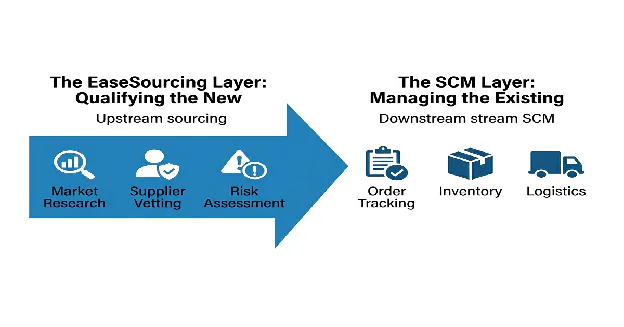
But there is another gap most of these platforms do not address.
SCM tools assume you already have suppliers in place. They help you manage orders, track performance, and coordinate logistics. What they do not do is help you decide whether those suppliers were the right choice to begin with.
You cannot manage your way out of a bad supplier relationship with good SCM software.
This is where ChinaSource fits in. Instead of managing the flow of goods, it focuses on the source itself. It helps businesses identify, verify, and evaluate manufacturers before they enter the supply chain. That means checking production capability, assessing risk, and making sure the supplier can actually deliver what they promise.
It is a different stage of the process. You validate the supplier first. Then you use SCM software to manage everything that follows.
With that in mind, here are the platforms worth knowing about.
The Best SCM Software Platforms in 2026
1. SAP Supply Chain Management

SAP is the biggest name in enterprise software, and its supply chain offering reflects exactly that. It is comprehensive. It connects planning, procurement, manufacturing, logistics, and compliance into one system. And it operates at a scale that very few platforms can match.
The part that has gotten genuinely impressive in the last couple of years is how deeply AI runs underneath the planning tools. Demand forecasting, supply planning, and inventory optimization, the system is not just reporting what happened.
It is predicting what is going to happen and surfacing recommendations before problems arrive. For a company managing a complex, multi-tier, multi-region supply chain, that intelligence is real and it matters.
Now, the honest part. SAP is expensive. Not just the license, the implementation. Getting SAP up and running at an enterprise level is a serious project, typically measured in months, sometimes well over a year.
And getting the most out of it requires either deep internal expertise or a strong implementation partner. It was built for large enterprises. A mid-sized business will likely find it overwhelming and overpriced.
Best fit: Large enterprises with complex global supply chains and the internal resources to match.
2. Oracle SCM Cloud

Oracle SCM Cloud is the closest competitor to SAP at the enterprise level. And depending on your industry, it is sometimes the better fit.
The most important thing to know about it is that it is cloud-native, meaning it was designed for the cloud from the ground up, rather than being an older on-premise system adapted to run in the cloud. That distinction matters for deployment speed and long-term flexibility.
The platform covers the end-to-end supply chain: inventory planning, transportation, warehouse management, global trade compliance, and demand sensing.
Oracle has also embedded AI heavily into its forecasting and logistics tools, and for businesses already operating inside the Oracle ecosystem, the integration with Oracle ERP and HR is clean and natural.
Same caveats as SAP apply here. Enterprise pricing. Complex implementation. A learning curve that takes real investment to climb.
Best fit: Mid-to-large enterprises, particularly those already in the Oracle ecosystem or with significant global trade compliance requirements.
3. Blue Yonder

Blue Yonder is a different kind of platform from the two above. SAP and Oracle are broad enterprise systems; they cover a lot of business functions, and the supply chain is one of them. Blue Yonder was built specifically for the supply chain, and it shows.
The core of what Blue Yonder does is planning. Demand forecasting, supply planning, inventory optimization, transportation, all of it runs on AI that is genuinely sophisticated.
The phrase they use is autonomous supply chain management. The idea is that the system handles routine decisions at machine speed and surfaces the exceptions for human judgment.
In theory, that sounds like marketing language. In practice, for companies dealing with highly variable demand, seasonal retailers, consumer goods companies, and businesses where the forecast is always changing, it is actually how the platform works.
Blue Yonder has been recognized as a Leader in multiple Gartner Magic Quadrant reports. That is independent validation worth noting, not just a vendor claim.
Where it is less strong is in operational execution, warehouse management, and day-to-day supplier coordination. Those are not its primary focus.
If planning is your hardest problem, Blue Yonder deserves serious consideration. If execution is your hardest problem, you might need to look elsewhere or pair it with another tool.
Best fit: Retailers, consumer goods companies, and businesses where demand planning accuracy is the core supply chain challenge.
4. Kinaxis RapidResponse
Kinaxis does one thing that no other platform on this list does quite the same way: concurrent planning.
Most supply chain planning tools work sequentially. You run demand planning, then supply planning, then inventory, then transportation, one after another. The problem is that by the time you finish the sequence, the inputs from step one have already changed. Kinaxis runs all of these simultaneously.
And when something changes in one part of the plan, the impact flows through the entire plan in real time. Not overnight. Not in a batch run at the end of the week. Right now.
For businesses dealing with constant disruption, and if you have been operating a supply chain for the last few years, you know what that looks like; that speed of response is genuinely valuable. A supplier goes offline. A port backs up. A major customer suddenly doubles their order. With traditional planning tools, recalculating the impact takes hours or days. With Kinaxis, it is essentially immediate.
Kinaxis was named a Leader in the 2025 Gartner Magic Quadrant for Supply Chain Planning Solutions. Not a challenger. Not a niche player. A leader.
It is not cheap. But for companies where planning agility is the actual competitive advantage, the math usually works out.
Best fit: Businesses with complex, high-velocity supply chains where scenario modeling and planning speed are critical.
5. NetSuite Supply Chain Management
NetSuite is a different type of entry on this list, and intentionally so. Where most of the platforms above are enterprise-scale, NetSuite is primarily a mid-market solution.
And for growing businesses that have outgrown spreadsheets and basic accounting software but are not yet ready for an enterprise SCM implementation, it often hits exactly the right spot.
The supply chain capabilities in NetSuite sit inside a broader ERP platform. That is both the strength and the limitation, right? The strength: everything connects. Supply chain data, financials, inventory, order management, all in one system, no custom integrations needed between platforms.
The limitation: the supply chain depth is not as specialized as a purpose-built SCM platform. If your supply chain is genuinely complex, NetSuite will eventually show its ceiling.
For businesses that need solid inventory management, demand forecasting, and supplier visibility without the cost and complexity of an enterprise implementation, NetSuite is a practical and honest choice.
Best fit: Mid-market businesses wanting an integrated supply chain and financial management without enterprise-level overhead.
6. Epicor SCM
Epicor has been around for decades and has earned a solid reputation in manufacturing and distribution. Not because of marketing, but because manufacturers actually use it and find that it works for their specific operational reality.
The platform goes deep on warehouse management, production scheduling, inventory control, and supplier coordination. These are not high-level dashboard features. These are the kinds of tools a warehouse manager or a production planner actually uses every day to do their job.
Real-time inventory tracking. Resource allocation. Integration with supplier portals. Work order management. The operational detail is there in a way that some of the more enterprise-scale platforms do not prioritize.
Epicor is also more accessible in terms of implementation scale. A manufacturing company with a few hundred employees can realistically go live without an 18-month project. That approachability is a genuine differentiator in a market where implementation timelines often feel designed for Fortune 500 companies.
Best fit: Manufacturers and distributors that need operationally deep SCM tools without enterprise-level complexity.
7. E2open
E2open's biggest differentiator is not a feature. It is a network. The platform connects over 400,000 trading partners globally. It processes billions of transactions annually across that network.
For businesses where supply chain collaboration, across a wide supplier base, multiple logistics providers, diverse trading partners in multiple countries, is the hardest problem, that network effect is real, and it is hard to replicate.
Beyond the network, E2open covers supply chain planning, transportation management, global trade compliance, and demand sensing. The cloud-native architecture means it scales reasonably and integrates with other enterprise systems.
Where it is less compelling is for businesses with simpler supply chains or smaller supplier bases. The platform is built for complexity. If yours is not that complex, you are paying for a capability you will never actually use.
Best fit: Large enterprises managing multi-tier global supplier networks with significant cross-border trade activity.
8. Coupa Supply Chain Design and Planning
Coupa takes a different approach than most platforms on this list. Rather than optimizing your existing supply chain, it helps you design the right supply chain in the first place.
The core of what Coupa does for supply chain is digital twin modeling, building a virtual replica of your supply chain and letting you run scenarios against it before making real-world decisions.
What does a new distribution center do to our logistics costs? What happens if our primary supplier in Vietnam is unavailable for eight weeks? What does sourcing from a second region do to our lead times and our margin? Coupa lets you answer those questions with data before they become expensive real-world experiments.
Because Coupa also has deep spend management and procurement capabilities, it actually started as a procurement platform; the supply chain design tools connect naturally to sourcing data and supplier performance history. That context makes the modeling more accurate.
Where Coupa is less strong is in day-to-day operational supply chain management. It is a strategic tool. If you need operational execution depth alongside strategic planning, you will probably need to pair it with something else.
Best fit: Companies doing strategic supply chain network design and scenario planning, particularly those already using Coupa for procurement or spend management.
9. Korber Supply Chain

Korber is the most operationally focused platform on this list. Where most SCM platforms emphasize planning, visibility, and strategy, Korber is primarily about what happens inside your warehouses and how your logistics runs day to day.
The warehouse management system at the center of Korber's platform handles things that simpler WMS tools cannot. Complex picking logic. Labor management. Slotting optimization.
Multi-site warehouse coordination. If you are running large fulfillment operations with high SKU counts and real operational complexity, Korber handles that with a depth that few platforms match.
On the planning and strategic visibility side, it is less deep. Korber is an execution platform. That is what it was designed to be. For businesses where getting the execution right is the primary supply chain challenge, not forecasting, not network design, but actually moving the right goods out the door accurately and efficiently every day, that focus is exactly what they need.
Best fit: Businesses with complex warehouse and fulfillment operations where execution efficiency is the core problem to solve.
Side by Side: A Quick Comparison
| Platform | Built For | Industry Focus | Core Strength | Best Fit by Scale | Implementation Timeframe |
|---|---|---|---|---|---|
| SAP SCM | Complex global supply chains | Automotive, electronics, pharmaceuticals, industrial manufacturing | AI-driven planning at enterprise scale | Annual supply chain spend above $100M, 500+ active suppliers | 6–18 months |
| Oracle SCM Cloud | Multi-region operations | Manufacturing, retail, healthcare, logistics, high-compliance industries | Cloud-native SCM with strong global trade compliance | Annual supply chain spend above $50M, 200+ active suppliers | 6–12 months |
| Blue Yonder | Demand-driven industries | Retail, fashion, grocery, consumer goods | AI-first demand planning and inventory optimization | High SKU volume, seasonal demand, 100+ suppliers | 4–9 months |
| Kinaxis | High-velocity supply chains | Electronics, automotive, aerospace, life sciences | Concurrent real-time planning | Complex planning teams, 100+ suppliers, frequent disruption risk | 4–8 months |
| NetSuite SCM | Growing mid-market businesses | Wholesale, light manufacturing, e-commerce, distribution | Integrated ERP and supply chain management | Annual revenue $10M–$250M, 20–150 suppliers | 2–4 months |
| Epicor SCM | Manufacturing and distribution | Industrial manufacturing, fabrication, distribution, building materials | Operational depth with accessible rollout | Mid-market manufacturers, 50–300 suppliers | 3–6 months |
| E2open | Global partner networks | Consumer goods, electronics, logistics, global trade-heavy industries | Large trading partner network and collaboration tools | 500+ suppliers or trading partners across multiple countries | 6–12 months |
| Coupa | Strategic network design | Retail, manufacturing, procurement-led organizations | Digital twin modeling and scenario planning | Annual spend above $50M, complex sourcing and network design needs | 3–6 months |
| Körber | Warehouse-intensive operations | 3PL, retail fulfillment, e-commerce, distribution | Deep warehouse and logistics execution | High SKU count, multi-site warehouses, complex fulfillment teams | 4–9 months |
How to Actually Choose, Without Getting It Wrong
Here is the thing most people do not want to hear. The software decision is not the hard part. Picking the wrong platform because you evaluated the wrong things, that is the hard part.
And most companies do exactly that. They evaluate based on features. They sit through demos that look incredible. They pick the platform with the most impressive slides. And then six months into implementation, they realize that the platform does not fit the way their business actually works. So here is how to approach this differently.
Start With the Broken Thing, Not the Feature List
Before you look at a single platform, write down the one or two things that are costing your business the most right now. Not the things you wish were better. The things that are actually causing pain, lost revenue, wasted time, customer complaints, inventory write-offs, whatever it is.
That list should drive your entire evaluation. A business whose biggest problem is demand forecasting accuracy and a business whose biggest problem is warehouse execution inefficiency should be looking at almost entirely different platforms. Even if both Google searches start with the same keywords.
The platforms that will try to tell you they solve everything, they probably solve some things well and some things adequately. Figure out which category your actual problem falls into before you sign anything.
Industry Fit Is Not Optional
Supply chain software is not generic. The workflows in apparel retail are different from the workflows in discrete manufacturing, which are different again from food and beverage distribution or pharmaceutical supply chains.
A platform built around retailer needs, seasonal demand, markdown management, supplier compliance programs, is going to feel wrong for a manufacturer dealing with production scheduling, bill of materials management, and shop floor execution. The data model is different. The workflows are different. The metrics that matter are different.
Before any demo, ask the vendor to show you customers in your specific industry with your specific business model. If they cannot do that comfortably, that is a signal worth taking seriously.
Integration Is Where Surprises Happen
SCM software does not run in isolation. It needs to connect to your ERP, your WMS if you have one, your transportation management system, your supplier portals, and probably your order management or e-commerce platform.
The cleanest situation is a native integration, built and maintained directly by the vendor. The acceptable situation is a well-documented API that an integration partner can work with reliably.
The expensive situation is discovering six months into implementation that the integration you assumed existed actually requires custom development that was not in the original quote.
Ask about integrations early. And ask specifically, not can you integrate with SAP, but do you have a pre-built connector for SAP S/4HANA, how long does configuration typically take, and who maintains it when something breaks.
Budget Honestly for the Full Cost
SCM software pricing is quoted as an annual license fee. That number is the beginning of the conversation, not the end.
Add implementation costs, which for mid-market projects typically run between one and two times the annual software fee, and higher for enterprise.
Add data migration, training, customization for your specific workflows, and the internal time your team spends on the project instead of their normal work. The total first-year cost of a serious SCM implementation is commonly three to four times the quoted software price.
That is not a reason not to buy. The ROI on well-implemented supply chain software is real. It is just a reason to budget honestly from day one instead of being surprised when the invoices arrive.
Do Not Change the Workflow During Implementation
This one is counterintuitive, and a lot of consultants disagree with it. But the logic is sound.
When you implement SCM software and change your workflows at the same time, you now have two variables. Did results improve because of the software? Or because of the new process? You genuinely cannot know. You cannot separate the two. And if things get worse instead of better, which happens, you do not know which one caused it.
The smarter sequence: implement the software against your existing workflow first. Measure before and after. Now you know exactly what the software contributed.
Then, once that is stable and you have a clean baseline, you can start improving the workflow with confidence that you can measure whether each change actually worked.
That is how you build a supply chain that keeps getting better over time, one measurable change at a time, with real data telling you what is working and what is not.
Where Upstream Sourcing Fits, and Why SCM Software Does Not Cover It
Every platform on this list assumes you already have suppliers. They help you manage those relationships, coordinate orders, track performance, and optimize logistics. That is what they were built for.
What they do not do is help you find the right suppliers before any of that begins. Running an RFQ with factories you have never worked with.
Evaluating a manufacturer's actual production capabilities before committing to them. Vetting compliance before a supplier enters your system. That upstream work happens before SCM software gets involved. It is a different stage entirely.
This is where a platform like ChinaSource operates. We help businesses identify and qualify global manufacturers, particularly across China and Asia, before purchase orders are placed and before suppliers are onboarded into your SCM system. The sourcing stage and the SCM stage are sequential, not competing. You find and qualify the right suppliers first. Then your SCM platform takes it from there.
Businesses that skip the upstream sourcing work and go straight to managing suppliers in their SCM system often end up managing suppliers they should never have worked with in the first place.
Final Thoughts
The supply chain software market is full of genuinely good platforms. That is not the problem. The problem is that most businesses pick based on brand recognition, a good demo, or what a competitor is using, none of which tells you whether the platform actually fits your specific situation.
Figure out the one or two things your supply chain is getting wrong that cost the most. Find the platform that was built to solve exactly that. Budget honestly for the full implementation. And measure everything before and after so you actually know whether it worked.
Nobody has this perfectly figured out. The companies that get it right are not the ones that found a magic platform. They are the ones who were clear about their actual problem before they started shopping.
FAQ
1. What is the best SCM software for a mid-sized business?
It depends on what you need to fix. If you want an all-in-one system that connects inventory, finance, and orders, NetSuite is often a good fit for growing businesses. If you run manufacturing or distribution operations and need stronger day-to-day execution, Epicor tends to go deeper. The right choice comes down to whether your main issue is visibility, planning, or operations.
2. How long does it take to implement SCM software?
Implementation time varies by platform and complexity. Enterprise systems like SAP or Oracle can take 6 to 18 months. Mid-market tools such as NetSuite or Epicor often go live in 2 to 6 months. The timeline depends on data migration, integrations, and how much customization your workflows require.
3. What is the difference between SCM software and ERP systems?
ERP systems manage the full business, including finance, HR, and operations. SCM software focuses specifically on the supply chain. Some ERP platforms include supply chain modules, but they usually do not go as deep as dedicated tools like Blue Yonder or Kinaxis. If your supply chain is complex, a dedicated SCM platform often gives you better control.
4. Does SCM software help you find suppliers?
No. SCM software assumes you already have suppliers. It helps you manage orders, track performance, and coordinate logistics. It does not help you evaluate or select the right suppliers at the start. That step happens earlier. Tools like ChinaSource focus on supplier discovery, vetting, and risk assessment before those suppliers enter your supply chain system.