
Can You Verify EV Charging Certificates Before Buying?

Buyers sourcing an ev charger from China often assume a PDF certificate on a supplier's website settles the compliance question. It doesn't. Certification mix-ups in the EV charging supply chain are common enough that quality teams flag them regularly, and the gap between "looks certified" and "is certified" costs importers real money when shipments get held at customs. This article walks through the specific myths that trip up buyers, what the evidence actually shows, and how to verify certificates before you commit to a purchase order.
Why These Myths Stick
Confusion sticks because certification systems overlap, and buyers rarely see the underlying test report. A CE mark, a CQC mark, and a UL listing look similar on paper — three letters, a logo, a number — but they answer completely different questions. Frankly, most buyers never ask to see the actual report. Just the logo.
Tight sourcing timelines make it worse. When a supplier sounds confident and hands over a clean-looking document, buyers move fast and skip the cross-check. That's how bad paperwork gets waved through, again and again.
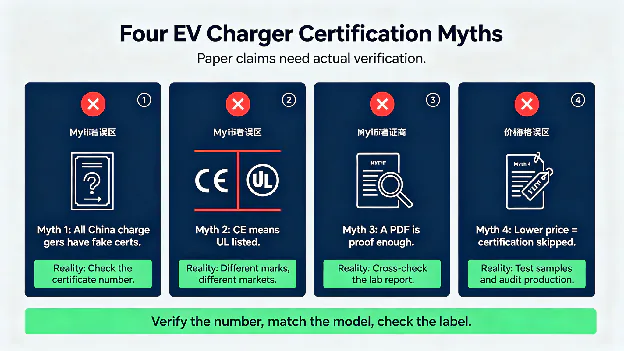
Myth 1: Any EV Charger from China Comes With Fake Certificates
The claim: Every EV charger from China ships with a forged certificate, so verification is a waste of time.
The reality: That's an overcorrection, and it's not backed by how compliance actually works. Plenty of manufacturers hold legitimate CE, RoHS, and CQC certification — verifiable against the issuing lab's own records. A certificate of conformity is a formal declaration tied to a specific test report, not a decorative logo (certificate of conformity requirements). The real risk isn't blanket fraud. It's buyers who never check the certificate number against the lab that issued it.
What to do instead:
- Ask for the full test report, not just the certificate summary page.
- Cross-check the certificate number directly with the issuing lab or notified body.
- Confirm the model number on the certificate matches the exact SKU you're ordering.
- Have a third-party inspector pull the unit's physical label during a pre-shipment inspection and compare it to the paperwork.
Certification Marks That Actually Matter
For EV charging equipment specifically, the marks that carry real weight include CE (EU market access), CQC (China's own compulsory scheme), RoHS (hazardous substance limits), and — for North American buyers — UL 2594, the outline of investigation for electric vehicle supply equipment. None of these substitute for another. Each one covers a different market and a different risk.
Where Fake Certificates Slip Through
Most fraud isn't a completely invented document. It's a digitally altered PDF, a mismatched serial number, or an expired certificate reused on a newer product run. Small details. Easy to miss if nobody's looking.
Myth 2: A CE Mark Means the Charger Is Also UL Listed
The claim: If a supplier shows a CE mark, the product is automatically approved for the US and other non-EU markets too.
The reality: Not even close. CE is a manufacturer self-declaration under EU directives; UL listing requires independent third-party testing against a different standard set entirely. They cover different scopes, different regions, and different testing rigor.
| Mark | Governing Body | What It Confirms | Region Typically Required |
|---|---|---|---|
| CE | EU self-declaration (manufacturer) | Meets applicable EU directives | European Union |
| UL (e.g., UL 2594) | UL, independent lab | Third-party tested to US safety standard | United States |
| CQC | China Quality Certification Centre | Meets Chinese compulsory requirements | China domestic market |
| RoHS | EU directive compliance | Limits on hazardous substances | EU, often referenced globally |
CE vs. UL vs. CQC: What Each Mark Covers
Buyers exporting to the US should never treat a CE mark as sufficient. It wasn't designed for that market. If your ev charger from China is headed to North American retail, you need the UL documentation on its own merits — not as a bonus feature of a European approval.
Reading a Certificate of Conformity Correctly
Check three things every time: the standard referenced (is it the right one for your target market?), the issue date (some standards get revised), and the exact model or SKU listed. A certificate for a "similar" model isn't your certificate.
Myth 3: A Supplier-Issued PDF Certificate Is Proof Enough
The claim: If the supplier emails a certificate, that's proof the product is compliant — no further check needed.
The reality: Self-issued declarations are legal under some schemes (CE allows manufacturer self-declaration), but that's very different from independent lab verification. A PDF from the supplier confirms nothing about the actual unit sitting in the container. Factory audits and quality control inspections exist precisely because paperwork and production floor reality can drift apart.
What to do instead: Pair every certificate review with a physical verification step.
Third-Party Lab Reports vs. Supplier-Issued Documents
A supplier-issued document says "trust us." A third-party lab report says "we tested it, here's the data." Only one of those holds up when a customs officer or a retail buyer asks hard questions.
What a Factory Audit Actually Checks
Factory audits confirm the certified product matches what's actually being produced — same components, same specs, same labeling. It's the difference between a certificate that describes a product and one that describes *this* production run. Big difference.
Myth 4: Lower Price Always Means Certification Was Skipped
The claim: A cheap quote from a Chinese manufacturer must mean corners got cut on certification.
The reality: Price mostly reflects volume, component sourcing, and OEM/ODM manufacturing terms — not certification status on its own. Direct factory pricing exists because there's no middleman markup, not because testing got skipped. That said, unusually low quotes deserve extra scrutiny, and sample development before a full production run is the cheapest insurance available.
What to do instead: Run a sample development and prototyping phase before committing to volume. Test the sample independently. Use quality control inspections at production stages, not just before shipment. For a deeper walkthrough of sourcing red flags and verification steps, the sourcing guides on the ChinaSource blog cover this in more detail.

What the Evidence Actually Shows
Here's the corrected picture. Certificates aren't universally fake, and they aren't universally trustworthy either. The honest middle ground is this: legitimate manufacturers hold real, checkable documentation, and the verification burden sits with the buyer, not the supplier.
That means checking certificate numbers against issuing bodies, understanding which mark covers which market, pairing paperwork with a factory audit, and never assuming price alone tells you anything about compliance. It's a short checklist. Worth doing every time, no exceptions.
- Verify the certificate number with the issuing lab or notified body directly.
- Match the standard referenced to your actual destination market.
- Confirm the certified model number matches your exact SKU.
- Schedule a factory audit or pre-shipment inspection before final payment.
- Treat sample testing as a required step, not an optional one.
Buyers who follow that sequence catch mismatches before they become a customs hold or a recall. Skipping it is how a clean-looking PDF turns into an expensive problem three weeks after the container ships.
Sourcing an ev charger from China doesn't have to be a guessing game. With the right verification steps — and a partner who runs the audits and inspections directly — certificate risk becomes a manageable checklist instead of a leap of faith. Ready to get specific documentation checked before your next order? Reach out for a sourcing quote and get the verification process started.