
Spec Sheet: What It Is, Types, Uses, and How to Create One


Buyers, sourcing managers, and product teams rarely base procurement and manufacturing decisions on marketing materials alone, since those materials are not designed for technical evaluation. They require structured documentation to assess supplier capability, align technical requirements, and reduce production risk.
A specification sheet provides standardized product data, including dimensions, materials, tolerances, performance criteria, and compliance requirements. In global sourcing, a clear spec sheet helps prevent misalignment, reduce rework and change orders, and protect quality before mass production begins.
As products move from design to supplier engagement, specification sheets also become a critical input for supplier communication and evaluation. Well-defined specifications help manufacturers assess feasibility, pricing, timelines, and compliance requirements more accurately.
Platforms like ChinaSource support this early stage by helping teams standardize requirements and collect supplier responses in a consistent format. This makes it easier to compare options and proceed with clearer requirements and more reliable supplier responses.
But what are the exact contents of a spec sheet?
What Is a Specification Sheet?
A specification sheet is a clear, standardized document that outlines a product's physical features and technical characteristics. Components and materials may also have spec sheets that explain their properties, performance characteristics, and intended applications.
People often use terms like technical sheet, product information sheet, or product spec sheet to describe this document. These terms may vary slightly by industry and context. However, they share an essential purpose of documenting product characteristics using measurable, verifiable data. As such, stakeholders like customers, suppliers, quality assurance testers, engineers, and sales teams often reference them.
Differences Between Specification Sheets and Other Product Information Documents
Although similar documents like datasheets, product brochures, and fact sheets exist, you shouldn’t confuse them with specification sheets. A data sheet often focuses on detailed technical performance, especially in engineering and electronics.
On the other hand, a product brochure contains information like key features, benefits, and images. It serves as a marketing tool, using persuasive language to attract buyers. A fact sheet is typically brief and summarizes essential information about a product.
In contrast, a product specification sheet presents structured, measurable product data in a standardized format intended for technical, operational, and sourcing decisions. It is comprehensive, yet structured, compact, and readable. Specification sheets are designed to be usable by both technical and non-technical audiences.
Types of Specification Sheets and When to Use Them
The scope and focus of specification sheets vary depending on the application, purpose, and audience. As a result, they can take on several forms, tailored to reflect industries, lifecycle stages, and users. Here are the types of spec sheets, their roles, and appropriate instances for using them.
- Product specification sheets: They provide factual information on commercial goods for reference and ensure consistency in communication. Companies can use them to support marketing and sales processes or to align internal teams on product details.
- Technical specification sheets: They contain engineering-grade specifications, such as tolerances and measurements, as well as performance metrics. Engineers and technical experts use them to test performance and suitability before implementation.
- Material or component specification sheets: They describe raw production materials. This document is useful for suppliers, who can use it to verify material composition and property data when sourcing components.
- Design or functional specification sheets: They state how the product should look and interact. They outline workflows, user experience, and potential outcomes, enabling developers to design systems aligned with requirements. So, companies can use them when developing apps and software.
Key Elements of a Specification Sheet
A specification sheet acts as a central reference. To promote clarity and understanding, companies organize the content in a standardized format. Here are the main elements in product specification sheets:
| Spec Sheet Element | Primary Users | Decision It Supports |
|---|---|---|
| Header & Identification Data | Buyers, Sales Teams | Confirms product identity and version accuracy |
| Physical Details | Buyers, Logistics Team | Assesses fit, storage, transport, and space requirements |
| Construction Materials | Engineers, Manufacturers | Verifies material suitability and production feasibility |
| Performance Specifications | Buyers, Engineers | Confirms operational capability and performance limits |
| Standards & Compliance | QA, Compliance Officers | Ensures regulatory and safety adherence |
| Compatibility | Engineers, IT Teams | Determines integration with existing systems |
| Warranty & Lifecycle Information | Buyers, Support Teams | Sets expectations for durability and support |
| Notes & Instructions | End Users, Support Teams | Guides correct use and reduces misuse or errors |
Header information: This section contains basic identifiers like name, brand, version, and model. With this, readers can know what a product is, identify its source, and its modification level, preventing them from confusing it with similar products.
Identification data: Here you can find the Stock Keeping Unit (SKU), which serves as an inventory tracking ID. It also includes the manufacturer-assigned product code and the revision date for documentation and update checks.
Physical details: This section comprises the height, depth, width, and other dimensions. It also includes the product’s color, weight, packaging information, and other physical attributes that help transporters and buyers assess space requirements.
Construction materials: A list of the materials in the product with their qualities and standards. For example, if steel is a material, you’ll find its grade, strength, density, and other information alongside the construction method.
Functionality and performance specifications: This section outlines the product’s capacity, power consumption, and speed. Companies use this section to define operational capabilities and limits. This enables users to confirm whether it meets their operational requirements.
Standards, safety, and compliance regulations: Here you’ll find the industry and safety standards to which the product adheres. It includes key certifications, safety ratings, and compliance requirements.
Compatibility: This section outlines what other tools the product can work with. Hence, customers, engineers, and IT personnel can seamlessly integrate the tool and explore other use cases.
Warranty, support, and lifecycle information: This section may outline warranty coverage, support terms, expected product lifespan, and service conditions. It may also cover the claims process and how to access support.
Notes and instructions: In this segment, you’ll find tips on how to use the product correctly. It also includes warnings about what to avoid when using the product, storage instructions, and troubleshooting tips to improve the user experience.
Each section reflects different elements, so users can scan through and easily collect the information they need.
How to Create a Specification Sheet
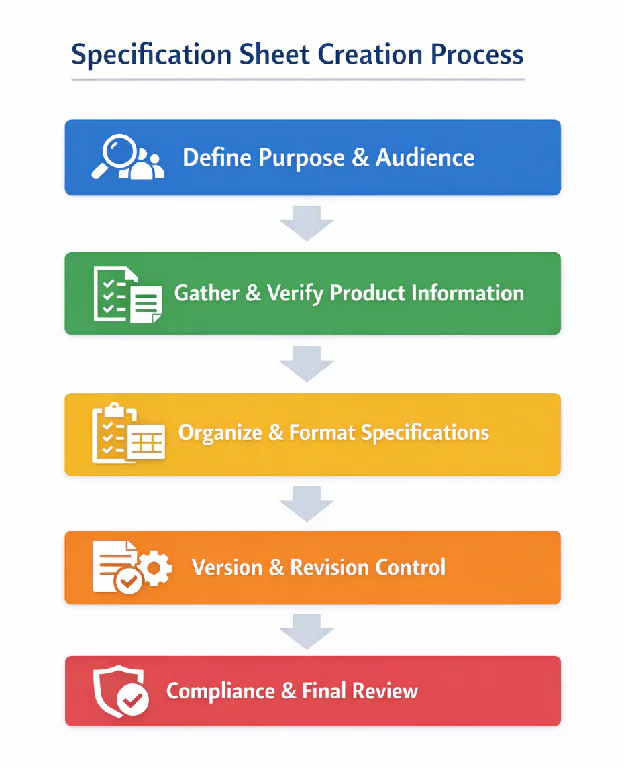
A good specification document provides sufficient information, presents technical details clearly, is concise, and serves as a guide. Here are the steps for creating a professional product sheet.
Step 1: Define the Purpose and Audience
Start by noting the class of stakeholders that’ll use the sheet and what they will use it for. Sales teams may need descriptive data to aid marketing, while buyers look for functionality and benefits.
Understanding this will help you decide on the best layout and format for the document. It’ll also help you determine which information to include and the appropriate language complexity.
Step 2: Gather and Verify Product Information
Contact the necessary professionals, teams, and departments to collect and compile the necessary information. Even minor errors can lead to miscommunication, rework, and production delays. So, you must verify information across sources such as:
- Manufacturing records.
- Engineering documents.
- Supplier datasheets.
- Compliance reports and other sources.
Step 3: Organize Information into Clear Sections Using Simple Language
Use the main specification categories to organize the document. Place related details under a single category and write in a language appropriate for the intended audience. To ensure consistency, maintain the same measurement units and symbols.
Many organizations rely on templates to maintain consistency, so you can adopt one for all your product sheets. Also, for a compact appearance, format text with bullet points, charts, and tables. You can add diagrams to simplify complex information.
Step 4: Indicate Revision and Version Control
Clearly indicate the product version and revision history, including issue dates and documented updates. It’s essential for tracking updates across product documents.
Proper version control prevents miscommunication. It also reduces the risk of confusion for suppliers when sourcing and assembling components. Furthermore, it provides clarity for engineers ascertaining measurements and other users.
Step 5: Review for Compliance and Usability
Review products and list all notable certifications, safety ratings, and applied standards to demonstrate legal compliance. This way, you can protect your company from legal risk and build customer trust.
Get non-technical users to read the spec sheet and test their understanding to determine usability. Ask for feedback to identify unclear areas, then simplify them before distributing the document.
Tools and Software for Creating Spec Sheets
You’ll need organizational, visual, and integrative tools to create a product sheet. But before choosing a solution, consider the product's complexity, the workflow, and the audience. These factors will help you determine the spec's layout and structure, enabling you to choose the best tools.
The following are categories of tools for creating technical product sheets.
Spreadsheet Tools
This category of tools comprises applications with gridded interfaces that support text, numeric, and mathematical functions. Examples include Excel and Google sheets which are efficient for organizing product data in tabular layouts.
When using spreadsheet tools to create technical sheets, you can:
- Sort attributes with filters to simplify search.
- Highlight essential details using formatting functions such as bold, borders, and color coding.
- Automate calculations of performance ranges, tolerances, and totals.
Most companies use spreadsheets as simple tools to draft technical sheets for non-technical users. It also works well when documenting lean workflows for basic products.
Design Software
These tools aid visualization and improve understanding. With such tools, brands can import product documents and design reader-friendly charts, graphs, and visuals. Here are some features of design software that make it ideal for creating technical sheets:
- Customizable templates.
- Seamless logo placement for branding.
- Annotations for adding extra information.
You should integrate design tools into your technical sheet creation process if the expected users are clients and members of the sales team. These tools are also great additions to your stack if you plan to upload the document to marketing channels that require graphics.
Product Lifecycle Management (PLM) and Enterprise Resource Planning (ERP) Systems
PLM tools are business software that store end-to-end product information, including specifications, design cycles, and components. ERPs facilitate the management of procurement, manufacturing, and other major operations.
They support complex, multi-department workflows, so large organizations can use them in the following ways when creating technical sheets:
- Integrate product data from different departments.
- Perform advanced analysis involving multiple product lines, monitor performance, and spot deviations.
- Manage revisions, upgrades, and update records automatically.
As complex data management and storage tools, they’re suitable for managing and governing technical specifications at scale and help to align workflows.
Depending on what you want to achieve, you can work with one tool or use them all progressively. For the latter, you can use spreadsheets for calculations and drafts while design tools handle visual additions. PLMs/ERPs can coordinate maintenance, export, and distribution.

How ChinaSource Helps Operationalize Spec Sheets in Supplier Sourcing
ChinaSource is an AI-driven sourcing platform that uses structured product requirements derived from specification sheets to support supplier discovery, qualification, quote alignment, and evaluation. It helps procurement teams move from documentation to execution by ensuring specification details are consistently reflected in supplier outreach and evaluation. Here's how it works.
- Structure Sourcing Requirements: Specification details such as materials, volumes, target pricing, lead times, and compliance needs are captured in defined fields. The AI identifies missing inputs and prompts for clarification before contacting suppliers.
- Identify Relevant Suppliers: ChinaSource supports supplier discovery, guided by historical trade data and business signals, to help focus outreach on credible, relevant manufacturers.
- Collect Supplier Responses Via Structured Outreach: Suppliers respond through guided conversations that confirm feasibility, pricing assumptions, MOQs, lead times, and compliance requirements.
- Align and Compare Supplier Quotes: ChinaSource normalizes supplier responses into comparable fields, making differences in cost, timelines, and constraints clear and easy to evaluate.
- Review a Transparent Supplier Shortlist: Procurement teams receive a clear view of shortlisted suppliers, confirmed details, and open questions, enabling informed follow-up and negotiation.
Why Specification Sheets Matter
Different categories of stakeholders rely on technical sheets for various reasons. Below are the main users and why specification sheets matter to each of them.
Buyers
Buyers use information about size, functionality, compatibility, and performance to avoid purchasing low-quality or unsuitable products. The given data on durability and lifespan helps them set expectations and plan for replacement in advance.
They also follow the instructions and warnings to use products and tools properly and consult the sheet whenever they encounter issues.
Sales and Marketing Teams
Sales and marketing teams reference product specifications when answering customer questions. They also use it to find information when creating pitches and crafting content.
Since this document is consistent across regions, global businesses can use it to develop unified responses to product capabilities. Hence, it helps them align marketing messages with performance.
Engineers and Manufacturers
When designing prototypes, engineers and manufacturers use specification sheets as a guide. By adhering to established dimensions and standards, they can create products that meet design requirements. As a result, there is a decrease in design and construction errors and greater efficiency.
Quality Assurance and Compliance Officers
Each industry has safety and regulatory standards that products must meet to maintain quality. Specification sheets contain these regulations, enabling testers and inspectors to ensure compliance and spot shortcomings. Through this, quality assurance officers prevent the release of subpar goods into the market.
Applications of Specification Sheets Across Industries
Technical sheets are adaptable, so industries optimize them for their planning, production, and delivery stages. Some companies employ them as operational tools to support workflow coordination, while others use them to inform technical decisions.
Here’s how some major industries apply specification sheets in their daily activities:
Manufacturing and Engineering
By providing clear input, technical sheets reduce ambiguity, leading to a more structured workflow. Besides this, workers in the engineering and manufacturing fields use them to:
- Verify and adhere to established parameters to build stable frameworks and ensure consistent product appearance.
- Test subsequent productions against the baseline standards.
- Track product changes and upgrades to improve configuration management.
- Troubleshoot system issues to locate faults and create solutions.
Technology and Electronics
Comprehensive specification details enable IT teams to align tasks around product capabilities while maintaining interoperability. They can consult technical sheets to:
- Check interfaces, protocols, and software versions, comparing them against other systems to determine compatibility.
- Verify network requirements, processing capacity, and other such information to ensure accuracy when setting up devices.
- Monitor performance to see if it meets expectations, identify maintenance needs, and plan upgrades.
- Support identification of affected product batches during recalls
Retail and E-commerce
Professionals in these environments use the data from technical sheets to organize product listings and customer-facing information. Hence, they can provide accurate information across sales channels. Specifically, marketers use product specs to:
Identify keywords and optimize content for search engines.
Curate accurate descriptions that attract leads and strengthen customer confidence.
Optimize product ads.
Evaluate products and personalize recommendations during upsell or cross-sell interactions.
Construction and Architecture
Technical sheets enable contractors and architects to select effective materials that meet environmental and structural requirements. As an official document, it outlines and records project stages, thereby improving coordination among team members. Experts in this field use tech sheets to:
Determine adherence to building codes.
Conduct pre-installation checks and confirm the load-bearing capacity of materials.
Procure the right components and assemble them with limited errors.
Determine product lifecycles and recommend maintenance routines.
Healthcare and Medical Devices
In the design, manufacture, testing, and selling of medical technologies, specifications help to ensure that products are safe for use and reliable. Manufacturers who develop advanced technological tools use specifications to test equipment before release.
On the other hand, medical professionals study the sheet to understand how devices work and integrate them into patient care. Hence, professionals in these fields use technical sheets to:
Identify faults and improper performance during quality assurance tests.
Guide the use and maintenance of medical devices by learning their temperature, voltage, and pressure ranges, as well as other operating limits.
Evaluate the features, functions, and components of similar equipment to determine which is more suitable.
Learn how to install, calibrate, and handle medical devices according to instructions.
How to Use a Specification Sheet
A specification sheet is only useful when users can extract information and use it to achieve their goals. The following steps explain how stakeholders can use these sheets effectively.
Step 1: Identify the Product
Regardless of your aim, the first thing to do is to confirm that the basic identifiers, such as brand, name, model, and version, match the product you’re working with. With this check, you can confirm that you’re handling accurate information from the correct product sheet.
Step 2: Scan Through the Categories and Key Elements
Before reading the entire document, scan the headers to get an overview of its content. If you’re looking for specific details, this step will help you zero in on them swiftly. You’ll find this helpful, especially if the technical sheet is lengthy.
Step 3: Evaluate Relevant Details
Since the purpose of product sheets varies by role, you should focus on the information most beneficial to you. Customers may prioritize warranty terms, features, and compatibility while logistics personnel note the handling requirements, weight, and packaging. Through contextual evaluation, you can better understand the product’s suitability and notice its shortcomings.
Step 4: Apply the Data to Your Task
You can now apply the insight gotten from the data as a guide or benchmark for decision-making. For instance, engineers can use it as a blueprint to build systems with compatible components. Logistics teams use packaging and weight information to optimize storage and transportation, while customers focus on product comparison.
Best Practices and Common Mistakes to Avoid
Here are proven practices to improve the quality of your specification sheet, and also pitfalls to avoid.
- Assign professionals to look out for errors.
- Use clear headings.
- Keep the information factual.
- Always add the revision date.
- Maintain a consistent format.
- Do not use ambiguous words.
- Include clear ownership or source identification.
These practices contribute to clarity and ease of interpretation while minimizing errors.
FAQ Section
What’s the Difference Between a Spec Sheet and a Datasheet?
A specification sheet typically presents structured product attributes for operational and purchasing decisions, while a datasheet often focuses on detailed technical performance parameters, particularly in engineering or electronics contexts. In practice, the terms are sometimes used interchangeably depending on the industry.
Why are Specification Sheets Important for Quality Control?
Spec sheets contain product compliance standards that quality assurance teams use when testing products for approval. By ensuring that each product matches necessary regulations and specifications, quality controllers maintain consistency and enforce compliance.
How Detailed Should a Specification Sheet Be for Supplier Sourcing and RFQs?
A spec sheet should be detailed enough that different suppliers interpret the requirements the same way. Include material grades, dimensions, tolerances, performance criteria, testing standards, packaging requirements, and compliance needs.
If key details are missing, suppliers will make their own assumptions. One supplier may price a higher-grade material, while another may quote a lower-grade alternative. This leads to large price gaps and makes side-by-side comparison difficult. Detailed and clear specifications help ensure that all suppliers quote against the same requirements, which improves pricing accuracy and lowers production risk.
What Are Common Mistakes in Writing a Specification Sheet?
The most common mistake is missing key details. Buyers sometimes leave out material grade, tolerances, surface finish, or packaging instructions. Without clear numbers and limits, suppliers make their own assumptions. Another issue is skipping compliance requirements such as CE, FDA, or other certifications. Some spec sheets also use vague terms like "high quality" instead of clear numbers and measurable standards. This leads to price gaps and production problems.
Who is Responsible for Creating and Maintaining a Specification Sheet?
The creation and maintenance of specification sheets require the combined effort of various teams. Technical writers collect input from engineers, product managers, and quality assurance officers before drafting the document. After publication, operations teams manage version control, enabling writers to update their content.
Final Thought
Specification sheets are an invaluable resource for product-based businesses in major sectors, as well as professionals, specialists, and consumers. They support the transition from product ideas to reliable, scalable outcomes. They reduce execution risk, support compliance, and help prevent costly downstream errors across sourcing, production, and delivery.
Spec sheets are operational tools that influence quality, speed, and decision-making throughout the product lifecycle. These factors become especially critical when working with external suppliers and manufacturers, where misaligned requirements can lead to cost overruns, delays, or quality issues. You need clear, well-defined specifications that make it easy to communicate requirements, evaluate options, and take deals forward.
ChinaSource supports this process at the front end by helping teams structure requirements, engage the right suppliers, and compare responses on equal terms before commitments are made. If you need a solution to help you improve how you prepare, share, and evaluate specifications during sourcing, ChinaSource provides that structure. Talk to us today to see it in action.