
How to Source from China Without 5 Costly Mistakes?

Sourcing from China moves fast. One wrong turn — a skipped audit, a rushed sample approval — and margins vanish before the first container even ships. This guide walks through the five most expensive mistakes buyers make and the exact steps that prevent each one. Follow the steps below in order. Skip none of them. That's where most of the damage happens.
Before You Start
You need a few things in place before you contact a single factory. Rushing this stage is how buyers end up locked into bad contracts.
- A clear product spec sheet — materials, dimensions, tolerances, target unit price
- A shortlist of verified suppliers, not just names pulled from a search result
- Budget set aside for third-party factory audits and inspections (rule of thumb: 1–3% of total order value)
- Working knowledge of Incoterms — FOB, CPT, and DDP at minimum
- A packaging, labeling, and consolidation plan drafted before production begins
Got all five? Good. Move on.
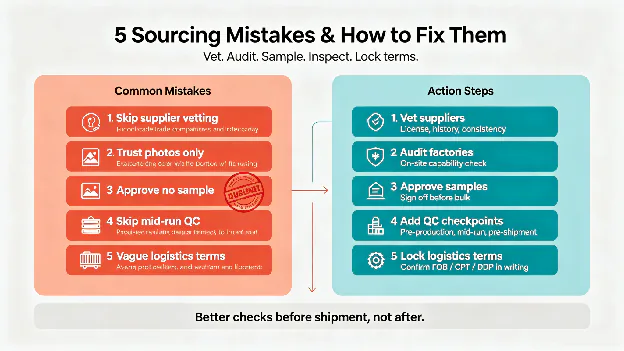
Step 1: How to Source from China Starts With Supplier Vetting
Every costly mistake in this business traces back to weak vetting. Buyers see a slick B2B sourcing platform storefront, assume it's a factory, and wire a deposit. Frequently, it's a trading company with no production floor at all — nothing wrong with that model, but you need to know which one you're dealing with before you negotiate price.
Check Business Licenses and Export History
Pull the supplier's business license number and cross-check it against China's National Enterprise Credit Information Publicity System. Look for export volume history, registered capital, and how long the entity has actually operated — not just how long the storefront has existed. A company registered eight months ago claiming "12 years of manufacturing experience" is a red flag. Not even close to a coincidence.
Cross-Reference Trade Show and Platform Listings
Confirm the same company name, address, and contact appear consistently across trade platforms and trade show exhibitor lists (Canton Fair). Mismatched addresses usually mean you're talking to a broker reselling another factory's output — fine if priced accordingly, disastrous if you're paying factory-direct rates for a middleman markup. Skipping this step is the single most common way buyers overpay by 15–30%, based on typical trading-company margins in the sourcing industry.
Step 2: Verify Suppliers With Factory Audits, Not Just Photos
Photos lie. Video calls get staged. Real supplier verification means an independent audit of the physical facility, either your own team or a third-party inspection firm.
On-Site Audit Checklist Essentials
A proper factory audit covers production capacity, machinery condition, worker headcount versus order volume claims, and existing client references. Here's the deal: a factory claiming 500 workers should have a payroll and dormitory footprint that matches. If it doesn't, someone's exaggerating capacity to win your order — and you'll find out the hard way when your delivery date slips by six weeks.
Reading Audit Reports Correctly
Audit reports aren't pass/fail documents. They're risk maps. A report flagging weak fire-safety compliance or inconsistent QC documentation doesn't automatically disqualify a factory, but it tells you where to add inspection checkpoints later. Ignore these flags and you inherit the risk. ChinaSource provides supplier verification and factory audit services to assist buyers in verification and avoid risks.
Step 3: Approve Samples Before Committing to Mass Production
Skipping sample development is the fastest way to fund a container of unsellable goods. Every new SKU, every material change, every color variant needs a physical sample signed off before tooling or bulk production starts.
Request a pre-production sample and inspect it against your spec sheet line by line — stitching tolerance, wall thickness, hardware finish, whatever applies to your category. A kitchenware buyer sourcing silicone spatulas, for example, should test heat resistance and check for mold-release residue before approving color batches. Skip this step and you'll discover the defect after 5,000 units are already sitting in a warehouse. Sample development and prototyping exists as a formal step precisely because catching a flaw on one unit costs far less than catching it on a full order.
Step 4: Build Quality Control Checkpoints Into Every Production Run
Quality control isn't a single inspection at the end. It's a sequence.
Pre-Production, During-Production, and Pre-Shipment Inspections
Three checkpoints catch most defects before they reach your customer: a pre-production inspection (raw materials and components), a during-production inspection (mid-run, usually at 20–30% completion), and a pre-shipment inspection (final random sampling before the container loads). Skip the middle checkpoint and defects discovered at pre-shipment often mean re-working an entire finished batch — expensive, slow, and sometimes impossible if packaging is already sealed.
Setting AQL Standards for Your Order
Set your Acceptable Quality Limit (AQL) before production starts, not after a shipment fails. AQL 2.5 is common for general consumer goods; tighter categories like electronics or personal care often run AQL 1.5 or lower. Below is a quick comparison of how mistakes at each stage typically play out.
| Mistake | Hidden Cost | Fix |
|---|---|---|
| No factory audit | Overpaying broker margins, capacity fraud | Third-party audit before deposit |
| Skipping sample approval | Bulk defects, unsellable inventory | Sign-off on physical pre-production sample |
| No mid-run inspection | Full-batch rework, shipment delay | During-production QC checkpoint |
| Vague Incoterms | Surprise duties, demurrage fees | Confirm FOB/CPT/DDP terms in writing |
| No packaging plan | Damaged goods, retailer rejection | Custom consolidation and labeling pre-approved |
Step 5: Choose the Right Incoterms and Logistics Partner
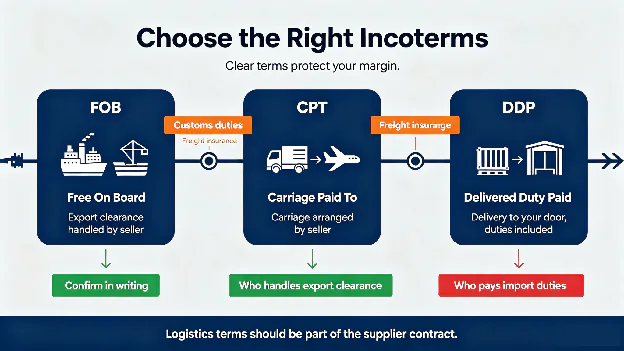
Logistics coordination is where a lot of "cheap" sourcing deals quietly turn expensive. FOB, CPT, and DDP shift risk and cost at different points in the journey, and mixing them up in a contract can leave you paying customs duties you never budgeted for.
Confirm in writing which party handles export clearance, freight insurance, and import duties. Multimodal freight standards published by the International Federation of Freight Forwarders Associations (FIATA) offer a useful baseline for what a compliant freight forwarder contract should cover. Tariff schedules and trade rules referenced in supplier contracts should also align with current World Trade Organization member commitments, especially for buyers importing into markets with fluctuating duty rates. Get this wrong and a shipment that looked 8% cheaper on paper can cost more once duties and demurrage land.
Troubleshooting Common Sourcing Mistakes
Even careful buyers hit snags. Here's how to fix the recurring ones.
- Deposit paid, factory goes silent. Escalate through the platform's trade assurance program immediately, and loop in a third-party inspection firm to confirm whether production actually exists. Silence past 48 hours on a confirmed order is a warning sign, not a coincidence.
- Sample passes, bulk order fails QC. This usually means the factory subcontracted overflow volume to a second facility without telling you. Demand production-line photos with timestamps and add a mid-run inspection to every future order.
- Shipment held at customs. Almost always a documentation mismatch — HS code errors or missing certificates of origin. Confirm Incoterms and paperwork responsibilities in writing before the container leaves the port, not after.
- Packaging arrives damaged or mislabeled. Private labeling and custom consolidation need their own QC pass, separate from product inspection. Treat packaging as its own checkpoint, not an afterthought.
Final Thoughts on Sourcing From China the Right Way
None of these five mistakes are exotic. They're common, predictable, and — frankly — avoidable with the right sequence of checks. Vet the supplier. Audit the factory. Approve the sample. Inspect the production run. Lock down the logistics terms in writing. That's the whole playbook for how to source from China without the expensive surprises that sink first-time importers.
Buyers who want a deeper walkthrough of any single step can find practical guides on the ChinaSource blog. For anyone ready to move past the planning stage, the fastest next move is to get in touch for a sourcing quote and put a verified supplier network to work on the next order.