
How to Set Quality Standards Before Production?


A container lands. Half the units have loose stitching, a bad print, or a switch that sticks. Now the buyer is stuck: reject the whole shipment, eat the return costs, or sell defective goods and hope nobody notices. This happens more than most brands admit, and it almost always traces back to one thing — nobody set quality standards before production started.
The Problem: Vague Specs, Expensive Surprises
Here's the deal. Most buyers assume "good quality" is obvious. It isn't. A factory's idea of acceptable stitching tension, color match, or drop-test tolerance can be wildly different from yours — and nobody discovers the gap until the goods are already made.
What It Actually Costs
Rework, air freight upgrades to hit a deadline, discounted liquidation of bad stock — it adds up fast. Retail buyers routinely report that a single failed shipment can wipe out 15–30% of the margin on that order once return freight, restocking, and chargebacks are counted (a rough estimate common across import/export forums, not a fixed rate). Even a "minor" defect rate above the agreed AQL threshold can trigger a full shipment hold at the port, adding days of demurrage charges.
The Symptoms You'll Recognize
- Inspection reports that say "passed" but customers still complain
- Factories citing "no spec provided" as a defense for defects
- Repeated disputes over what counts as a "defect" versus a "cosmetic variation"
- Samples that looked perfect, but bulk production drifted
Sound familiar? That's not bad luck. That's a process gap.
Why It Happens: Root Causes Behind Failed Quality Standards
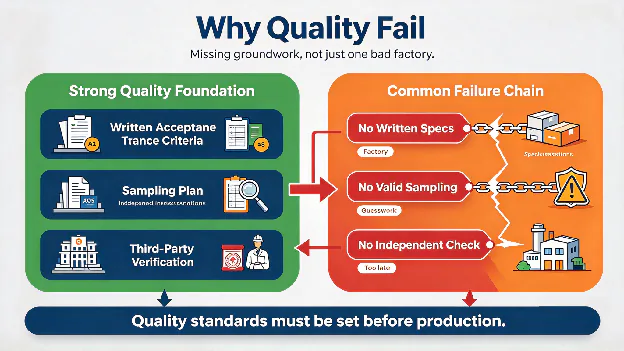
Quality failures rarely come from one bad factory. They come from missing groundwork.
No Written Acceptance Criteria
Verbal agreements or a single reference photo aren't specs. Without a documented standard — tolerances, materials, color codes, function tests — the factory fills gaps with its own assumptions. Those assumptions favor speed and cost, not your brand's expectations. You can tell ChinaSource your standards, and we can help you output written acceptance criteria
Wrong or Missing Sampling Plan
Many importers still eyeball a handful of units and call it inspected. That's not statistically valid. Formal sampling uses Acceptable Quality Limit tables — commonly the ANSI/ASQ Z1.4 or the equivalent ISO 2859-1 standard — to define how many units to check and how many defects trigger rejection. Skip this, and you're guessing.
No Third-Party Verification Before Shipment
Trusting the factory's own QC report is common — and risky. Internal reports have an obvious incentive problem. Without an independent inspection, the first real quality check often happens after the goods clear customs. Too late.
The Fix: Building Quality Standards Before Production
Fixing this isn't complicated. It just has to happen early — before the first production run, not after a bad one.
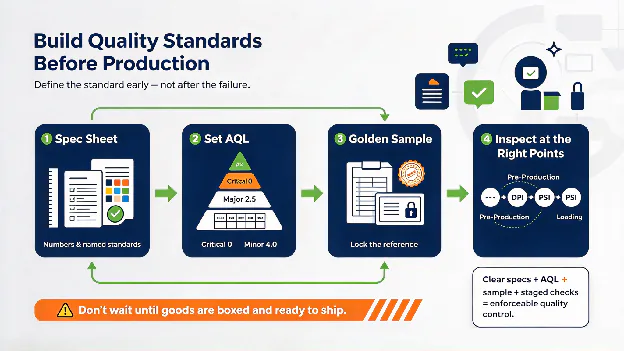
Step 1: Write the Spec Sheet
Document everything measurable: dimensions, weight, material grade, color reference (Pantone or physical swatch), function tests, packaging specs. Vague language like "durable" or "premium feel" means nothing to a production line. Numbers and named standards do.
Step 2: Set the AQL Level Per Defect Class
This is where AQL earns its keep. Split defects into critical, major, and minor categories, then assign different acceptance limits to each.
| Defect Class | Typical AQL | Example |
|---|---|---|
| Critical | 0 | Safety hazard, wrong voltage, choking risk |
| Major | 2.5 | Broken zipper, wrong color, malfunctioning part |
| Minor | 4.0 | Light scuff, small label misalignment |
These figures follow the widely used ANSI/ASQ Z1.4 general inspection levels — not a house rule, an actual referenced standard. Locking these in before production gives both sides a shared, enforceable line.
Step 3: Lock a Golden Sample
Before bulk production starts, approve a physical reference sample and keep a signed copy at both the buyer's office and the factory floor. Every inspection afterward compares against that sample, not memory or a spec sheet alone.
Step 4: Schedule Inspections at the Right Points
Waiting until goods are boxed and ready to ship is the riskiest — and most common — mistake.
- Pre-production check: raw materials and components
- During-production (DPI): early output while defects can still be corrected
- Pre-shipment inspection (PSI): full AQL-based sampling before goods leave the factory
- Loading supervision: confirming quantity and condition as containers are sealed
Each stage catches different failure types. Skipping DPI, for instance, means a die-cutting error discovered on day one of a two-week run repeats for two more weeks before anyone notices.
Avoiding This in Future: Making Quality Standards Stick
Getting one order right is good. Building a repeatable system is better.
Standardize Documentation Across Every SKU
Keep a master spec template that gets adapted per product line rather than rewritten from scratch. Consistency here cuts negotiation time with new factories and reduces the "we didn't know that was required" excuse.
Build AQL Into the Purchase Order
Not as a side agreement — into the actual contract language. Reference the exact AQL levels, sampling standard, and consequence (rework, discount, rejection) directly in the PO. This also supports any later certificate of conformity requirements (Wikipedia: Certificate of conformity) a retailer or customs authority might request.
Track Defect Trends, Not Just Pass/Fail
A factory that barely passes AQL every single time isn't stable — it's coasting on the margin. Trend data over five or six orders tells you more than any single inspection report. Rising minor-defect rates often predict a major failure two or three orders out.
When to Bring in Help: Beyond DIY Quality Checks
Some of this you can manage internally with a good checklist and a spec sheet. Some of it, honestly, needs boots on the ground.
When In-House Teams Can't Cover It
- No local presence near the factory to run in-person inspections
- No trained inspector who understands AQL sampling math
- Multiple factories across different regions, each needing separate audits
- Complex OEM/ODM builds where component-level QC matters as much as final assembly
What Professional QC Partners Add
Third-party inspection teams bring standardized checklists, calibrated tools, and — critically — no financial stake in the factory passing. That independence is worth more than most buyers realize until they've been burned once.
For sourcing teams juggling logistics on top of QC, coordinating inspections with freight timing also matters; multimodal shipping standards from groups like the International Federation of Freight Forwarders Associations (FIATA) shape how inspection windows align with loading schedules.
Need a deeper walkthrough of sampling math and defect classification? The ChinaSource blog covers AQL tables, inspection checklists, and supplier scorecards in more detail. For anyone assembling a first-time QC plan, that's a reasonable next stop before locking in a factory contract.
Bottom Line
Quality standards set after production starts are damage control, not quality control. Define the spec, set the AQL by defect class, lock a golden sample, and inspect at multiple stages — not just at the end. Get the standard right before the first unit is made, and the container that lands at your dock won't be a gamble. Ready to build that into your next order? Reach out to ChinaSource before your next PO goes out, not after the goods arrive.