
What Is Procure-to-Pay? A Complete Guide for Procurement Teams

Overview
Procure-to-Pay (P2P) is the process that takes a purchasing need from initial identification through payment to the supplier. This guide will outline exactly what that really looks like in each phase, where the most frequent breakdowns occur, and what you can do to build a process that really works.
When Buying Something Simple Takes Three Weeks
Someone needs an item of equipment. Nothing very complicated. Not very expensive. It is just something that will have to be ordered.
So they sent an email to their manager. The manager then forwards it to procurement. Procurement asks for three quotations. A purchase order needs to be created first.
The supplier will need a vendor registration form before they confirm anything. Three weeks later - maybe more - the original request stays stuck in someone's inbox.
Does this situation sound familiar?
This isn't a people problem; no one is doing anything wrong, but it's a process problem. And it costs a whole lot more than most businesses actually know, not just in lost time but also in duplicate orders, missed payment terms, irate suppliers, and the spending itself when individuals bypass procurement entirely, because the right route is simply moving too slowly.
According to a study by the Hackett Group, companies with orderly P2P procedures process invoices at less than a quarter of the cost of those employing almost all manual methods themselves. That difference is quite real and continues to get bigger with the growth of the company itself.
The procure-to-pay process forms the framework that really fixes this problem. When done right, buying products is quick and under control and relatively easy to track.
But when the process is missing or exists only on paper but is never actually implemented, the costs appear quite quietly across your finance reports and your relationship with your suppliers.
What Does Procure-to-Pay Mean?
Procure-to-pay (p2p) is the chain of actions that begins when you figure out a purchase requirement and finishes with paying the supplier and recording the transaction itself.
Every stage in between the process really matters: the approval, the purchase order, getting the goods, checking the invoice, and making the payment itself. It's all part of p2p.
It's not even basically a procurement thing itself, either. The process links together three parts of a company that usually function quite separately but really have to align themselves.
Procurement decides what products to buy and from whom. Operations themselves will get what was ordered. Finance will handle the financial aspects, including invoices, payments and reconciliations. P2P is the thread running right through all three.
So why does it really matter much more than merely buying things themselves? Because this is the phase where most of a company's external spending actually flows. Get it right, and you get visibility, control, and predictability.
Get it wrong or don't establish it at all, and you will have problems with invoices, late payments, duplicate orders and a finance team spending each day trying to resolve problems that a proper procedure would identify and prevent automatically.
Where P2P Fits in the Bigger Picture
You’ll frequently see P2P appear alongside two other terms: source-to-pay and order-to-cash. Let's take a close look at how these three terms interrelate with each other. Source-to-pay forms the greater umbrella. It includes all elements from initial supplier research and selection through to payment itself.
P2P is the operational part of that; it starts when a supplier is chosen, and the buying process is in motion. So if S2P is the whole journey, P2P is the second part of that process.
On the other hand, order-to-cash is somewhat different; it is the process from the supplier's point of view, within the transaction, when your supplier receives your order, processes it, invoices you and then receives payment. Your P2P cycle actually ends when you pay. While your supplier's O2C cycle ends when they receive that payment itself. Two sides of the same transaction.
Understanding where P2P starts and ends matters because it will allow you to identify the real source of the problem. If the problem is in finding and approving the right suppliers, that will be in the sourcing stage, a step right before P2P.
If the supplier has already been set up but purchase requests are moving very slowly, approvals are dragging out, or invoices are only creating more confusion, that's a P2P issue itself. And if both stages are failing, then you're dealing with two completely different problems that require two very different solutions.
Remember, source-to-pay takes in the entire journey from selecting a supplier right through to making the payment itself, while P2P is really focused on the buying and payment phase once a supplier has already been selected.
This is where ChinaSource can really help out; we will assist companies in each stage. We will help you find the perfect suppliers, set up a few alternatives, and really build a better purchasing system at the sourcing level.
Then we streamline the buying process on the P2P side to be much more transparent, faster and under control. This will mean significantly fewer delays, fewer errors, and a system that works really effectively from the first request through to final payment.
P2P vs. Source-to-Pay vs. Order-to-Cash
Here's a quick way to see how the three relate:
| P2P | Source-to-Pay | Order-to-Cash | |
|---|---|---|---|
| Covers | Purchasing through to payment | Supplier selection through to payment | Customer orders through to collecting payment |
| Owned by | Procurement and Finance | Procurement (with Finance) | Sales, Ops, Finance |
| Starts at | A purchase needs | A sourcing requirement | A customer placing an order |
| Ends at | Supplier payment recorded | Supplier payment recorded | Customer payment received |
The practical takeaway: if your sourcing is fine but the buying process is chaotic, you have a P2P problem. If finding the right suppliers is the issue, that sits upstream in S2P. Most businesses have elements of both; the processes are connected, so gaps in one tend to create pressure on the other.
The Seven Steps of the P2P Process

Let's go through each stage, including where things tend to break down.
Step 1: Identifying the need
It really begins quite simply. Someone within your business has a requirement for something. Materials, equipment, services, and any product or service that needs an external purchase are included.
Your need really has to be clearly defined at this point: what exactly is needed, how much, and by when. Requests left vague will lead to confusion right down the line that follows. And they happen regularly. "We need more stock" is definitely not a very clear need. " We need 500 units of SKU X by the 15th."
Step 2: Purchase requisition
A purchase requisition (PR) is the internal document that actually asks for the purchase. It really captures what is supposed to be bought, the estimated cost, which budget it sits under, and any supplier preference. It doesn't go to the supplier itself. It's sent to whoever must agree to the expenditure internally.
Some businesses skip it for smaller purchases, and that is perfectly okay up to that point. However, without a proper PR process, you lose the level of control that really keeps spending visible and your budget traceable. Those matters tend to be more important than people expect when their business is growing.
Step 3: Approval
The PR is then passed through an approval process. Who will be approving it, up to what value, and what will happen if they are unavailable - all of this really needs to be defined. Sounds very elementary.
However, having a vague or unrecorded approval process is always one of the greatest sources of delay throughout the whole purchase-to-pay cycle. People won't know who to send things to, nothing is clearly assigned to one person, and purchases just end up stuck until someone follows up on them.
Step 4: Purchase order creation
After approval has been given, a purchase order is made and sent to the supplier. It is during this moment that the transaction effectively becomes external. A PO is a legally binding document itself—it obligates your business to buy what is listed at the agreed price and with the agreed terms.
It must include item descriptions, quantities, unit prices, the expected delivery date, and payment terms. The PO itself will be the reference document for the rest of the process. Everything that continues on will be compared with it.
Step 5: Goods or services receipt
When the delivery does arrive, someone checks it against the PO itself. Are there the right quantities? Is the condition correct? Are the specifications right? That inspection will be documented in a goods receipt note (GRN).
This stage is often hastened when teams are very busy. It is absolutely vital. Without documenting the receipt, you won't be able to do the three-way matching at the invoice stage itself. And without three-way matching, you are essentially paying invoices based on trust rather than a verification process.
Step 6: Invoice verification and three-way matching
Your supplier then sends over an invoice. Before any payment proceeds, the invoice will be checked against the PO itself and the GRN.
That's the three-way matching process itself. Does what is being invoiced match what was initially ordered? Does it match the goods actually received? If yes, then the payment will be approved. If not, then the difference will be highlighted and resolved before any money is moved.
This is the primary control that detects overpayments, duplicate invoices, and billing for goods that were never received. Businesses that don't use a three-way matching process often end up paying for things they shouldn't be paying for regularly. This isn't a large sum on any single transaction, but consistently and on a very large scale.
Step 7: Payment and record-keeping
Invoice approved. Payment is scheduled based on the agreed terms. The transaction is recorded in the financial system. Cycle complete.
Record-keeping at this stage is crucial for two reasons.
Firstly, being audit-ready, which is about being able to show exactly what was bought, approved, received, and paid for—and when too. Secondly, spend analysis, understanding where your money is going, so you can make better purchasing decisions using real data rather than just relying on your instincts in the future.
The Four Documents That Hold the Process Together
P2P runs on four core documents. Remove any of them, and you create gaps that show up as problems later.
| Document | What It Does | What Goes Wrong Without It |
|---|---|---|
| Purchase Requisition (PR) | Internal request and approval trigger | Spending happens without budget checks or visibility |
| Purchase Order (PO) | Formal commitment to the supplier with agreed terms | No reference point, pricing and delivery terms get disputed |
| Goods Receipt Note (GRN) | Confirmation of what was actually delivered | Three-way matching breaks down, and invoices get paid for undelivered goods |
| Vendor Invoice | Supplier's request for payment | Without a clear verification process, duplicates and errors get paid |
These four form a chain. Each one builds on what came before. When a link is missing or sloppy, the chain breaks, and someone ends up spending hours reconciling discrepancies that a proper process would have caught automatically.
When Is It Time to Formalize the P2P Process?
Not every business needs a highly structured P2P process from day one. But there are clear signals that it's time to build one properly.
Multiple departments are buying independently.
When different teams are placing their own orders, choosing their own suppliers, and managing their own supplier relationships, with no central visibility, spending becomes impossible to track or optimize. You can't negotiate better terms with a supplier if you don't know how much you're collectively spending with them.
Supplier payment disputes are becoming regular.
If you're frequently in back-and-forth conversations with suppliers about what was ordered, what was received, or what was agreed, the documentation trail is broken. A proper P2P process creates the paper trail that resolves those disputes quickly instead of letting them fester and damage working relationships.
You're under audit or regulatory pressure.
Audit readiness means being able to show exactly what was purchased, who approved it, what arrived, and when it was paid. Without a structured P2P process, pulling that information together is a significant manual exercise, or simply can't be done accurately.
The business is growing fast.
What works informally at 30 people and 20 suppliers stops working at 200 people and 150 suppliers. Growth is usually the inflection point where informal procurement creates real operational risk. The time to fix the process is before the mess, not after it.
Finance is flagging cost control problems.
If leadership is asking where the money is going, and procurement can't answer clearly and quickly, that's a P2P problem. Spend visibility requires process discipline. Process discipline requires structure.
What a Structured P2P Process Actually Gives You
When P2P works properly, the benefits show up in measurable ways.
Cost control and spend visibility.
When every purchase flows through a defined process, you have real data on what's being bought, from whom, and at what cost. That data is what makes category management and supplier negotiation possible. Without it, you're managing spend based on estimates and gut feel.
Fewer errors and duplicate payments
Three-way matching catches billing errors and duplicate invoices before payment is made. Businesses without this control overpay regularly, not by large amounts on any single transaction, but consistently across hundreds or thousands of invoices a year. It adds up.
Faster cycles
A more structured process tends to speed things up, not slow them down. When approvals have clear owners, invoices have a defined verification path, and payment scheduling is predictable, suppliers get paid on time, and the finance team spends less time chasing missing paperwork.
Stronger supplier relationships
Suppliers notice when a buyer pays accurately and on time. It affects how they prioritise you when things are tight, supply constraints, capacity allocation and pricing flexibility. A reliable P2P process is a quiet advantage in supplier relationships that doesn't get talked about enough.
Fraud prevention and compliance
The P2P process is where most financial controls live. Approval limits. Segregation of duties, the person who raises a PO shouldn't be the same person who approves payment. Three-way matching. Audit trails. These controls make fraudulent payments significantly harder and make compliance a natural output of the process rather than a separate exercise.
P2P KPIs Worth Tracking
A P2P process without measurement is hard to improve. These are the metrics that tell you how it's actually performing:
| KPI | What It Measures | Why It Matters |
|---|---|---|
| PO cycle time | Time from PR approval to PO issuance | Long times signal approval bottlenecks |
| Invoice processing time | Time from receipt to payment approval | Directly affects supplier relationships and late payment risk |
| Three-way match rate | Percentage of invoices matched without exception | High exception rates signal supplier data or process quality issues |
| Maverick spend rate | Spend occurring outside the approved process | High rates mean the process is being bypassed, usually a usability problem |
| On-time payment rate | Invoices paid within the agreed terms | Impacts supplier relationships and any early payment discounts |
| Cost per invoice | Total processing cost divided by invoice volume | Useful for evaluating the ROI of automation investment |
The Common Challenges, and Where They Come From
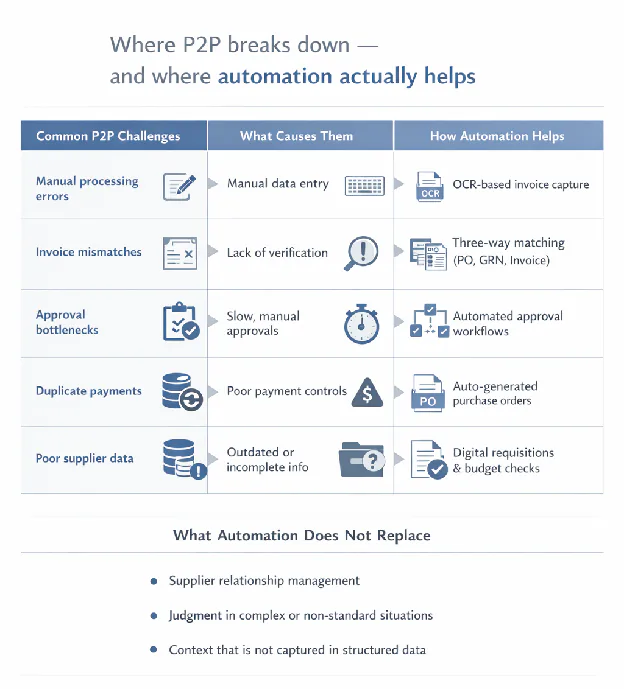
Most P2P problems trace back to a small number of root causes. Knowing them makes them easier to fix.
Manual processing errors
When purchase orders and invoices get keyed in manually, mistakes happen. Wrong quantities, wrong prices, wrong supplier codes. Each error needs time to identify and fix. In a high-volume environment, that overhead is significant.
Invoice mismatches
A supplier bills for something slightly different from what was ordered: a different quantity, a different unit price, or a different item description. Without a clear matching process, these either get paid incorrectly or sit in an exceptions pile waiting for someone to investigate. Neither outcome is good.
Approval bottlenecks
Approvals that depend on one specific person, with no backup or escalation path, bring the process to a halt the moment that person is unavailable. This comes up again and again. Everything is waiting for an email that hasn't been answered.
Duplicate payments
Without proper controls, the same invoice can get paid twice, especially when invoices arrive by email, get printed, and then get entered manually into a system. Duplicate payment rates of one to two percent are common in businesses without automated matching. That sounds small. At any meaningful invoice volume, it isn't.
Poor supplier data
Wrong bank details, outdated contact information, expired certifications. If supplier records aren't maintained, the P2P process breaks down at the payment stage or the compliance check. Unglamorous problem, disproportionate downstream impact.
How Automation Helps, and What It Doesn't Replace
Automation doesn't replace the P2P process. It makes the process faster, more accurate, and less dependent on people doing repetitive tasks correctly every single time.
Here's what it actually does at each stage:
- Purchase requisitions: digital forms with built-in budget checks and automatic routing, replace email chains.
- Approvals: Automated workflows send requests to the right approver based on value, category, or department, with reminders and escalation if no response.
- PO creation, approved requisitions generate purchase orders automatically with pre-populated supplier data.
- Invoice capture: OCR reads invoice data and enters it into the system without manual keying.
- Three-way matching: automated comparison of PO, GRN, and invoice flags discrepancies without anyone pulling three documents and checking them manually
- Payment scheduling: approved invoices get scheduled according to the agreed terms without further intervention.
What automation doesn't replace: supplier relationship management, the judgment calls on complex or non-standard situations, and anything that requires context that isn't captured in the data.
On the tools side, platforms like Procurify and Coupa handle the purchasing and AP automation layer well for mid-market businesses. SAP Ariba and Oracle NetSuite are the established options at enterprise scale.
The right fit depends on your ERP environment and how complex your approval workflows are. Our guide to P2P software covers how the main options compare in detail.
Where ChinaSource Fits Into the P2P Process
The P2P process officially starts when a purchase need gets identified. But the quality of everything that follows depends on what happened before that: the sourcing and supplier qualification work that determines who you're actually buying from.
If a supplier was never properly vetted, the problems don't always show up immediately. The PO gets raised, the goods arrive, and somewhere in the invoice or compliance stage, it becomes apparent that pricing didn't match what was discussed, or a certification was missing, or delivery terms weren't what anyone agreed to. The P2P process catches some of that. But it can't fix problems introduced before it started.
ChinaSource is built for that upstream stage. When you're identifying suppliers, gathering comparable quotes, and doing the qualification work that determines whether a supplier should enter your P2P process at all, ChinaSource's AI agents handle the outreach and information-gathering that typically takes days of back-and-forth.
The platform contacts multiple suppliers simultaneously, collects responses in a standardized format, and compiles quote comparisons, making supplier selection faster and more defensible. By the time a supplier enters your P2P cycle, they've already been assessed against your criteria, which makes the rest of the process significantly cleaner.
P2P Mistakes Worth Avoiding
Skipping the purchase requisition
It feels like unnecessary admin, especially for smaller purchases. But without a PR stage, there's no internal control layer, no budget check, and no record of who requested what and why. Spending becomes invisible until it shows up in the accounts, which is always later than you'd want.
No three-way matching
This is the single most important control at the payment stage. Businesses that skip it or apply it inconsistently regularly pay for things they didn't receive or pay the wrong amount for things they did. The error rate in manual invoice processing without matching controls is consistently high across industries.
Vague approval workflows
Get manager approval' is not a workflow. A workflow specifies who approves what value of purchase, what happens when they're unavailable, and what the escalation path is. Without that specificity, approvals become bottlenecks, and people start bypassing the process just to get things moving.
Treating P2P as a financial problem
The P2P process touches procurement, operations, and finance. When it gets owned exclusively by one department, the other two build workarounds rather than working within the process. P2P works best when all three functions have a hand in designing it.
Not updating the process as you grow
A P2P process that worked well at 50 people and 30 suppliers doesn't necessarily scale to 300 people and 200 suppliers. Growth changes the volume, complexity, and risk profile. The process needs to be revisited periodically, not just when something breaks.
Procure-to-Pay FAQ
What does P2P stand for?
Procure-to-pay. It covers the full process from identifying a purchasing need to paying the supplier and recording the transaction.
What is three-way matching, and why does it matter?
Three-way matching is checking that three documents line up before approving payment: the purchase order, the goods receipt note, and the supplier's invoice.
If quantities, prices, and items match across all three, payment goes through. If they don't, the discrepancy gets investigated first. It's the main control that prevents overpayments, duplicates, and payment for goods that were never actually received.
What's the difference between a purchase requisition and a purchase order?
A purchase requisition is internal; it's a request to buy something, which needs approval before anything happens. It doesn't go to the supplier. A purchase order is external; it goes to the supplier and is a legally binding commitment to buy at the agreed terms. The PR comes first. The PO follows once the PR is approved.
How long should the P2P cycle take?
It depends on the purchase and how automated the process is. A routine purchase in a well-automated system can move from requisition to payment in a few days. In a manual process with unclear approval paths, the same purchase can take weeks. Most businesses track invoice processing time specifically, from receipt to payment and aim to get standard transactions below ten days.
Does every business need a formal P2P process?
Not every business needs the same level of formality. A small business buying from a handful of suppliers can manage with simpler controls. But once you have multiple departments spending, multiple suppliers, and a finance team that needs to report accurately on spend, a structured P2P process stops being optional. The risk of errors, fraud, and supplier disputes grows with the size and complexity of the business.
How does P2P connect to compliance?
The P2P process is where most procurement compliance controls live, including approval limits, segregation of duties, three-way matching, audit trails, and supplier verification.
Get the P2P process right, and compliance becomes a natural output rather than a separate effort. It also makes audit preparation significantly less painful, because the documentation already exists in structured, traceable form.
To Wrap Up
The P2P process doesn't get a lot of attention in strategy conversations. It's not exciting. It's not the part of procurement that shows up in presentations about innovation or growth.
But it's where most of the money moves. And it's where most of the cost, risk, and inefficiency live in businesses that haven't taken the time to build it properly.
You don't need to redesign everything at once. Start with whatever is causing the most pain right now. Approval bottlenecks slowing everything down? Fix the workflow. Invoice mismatches eating finance team time? Build the matching process. Fix one thing, measure what changes, then move to the next.
And if the problems sit upstream, in supplier qualification, quote comparison, or the sourcing work that feeds into P2P,
ChinaSource helps at that stage. Getting the right supplier data into your P2P process from the beginning is what makes the downstream cycle run cleanly.