
LED Lighting: Why Do Identical Specs Give Different Life?

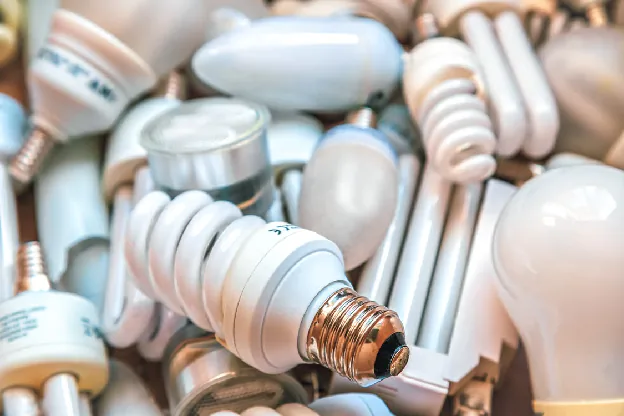
Two spec sheets. Same lumens. Same wattage. Same color temperature. One batch of fixtures lasts six years in a warehouse; the other fails at eighteen months. Sound familiar?
It happens constantly with LED lighting from China, and the spec sheet almost never tells you why. The datasheet lists outputs measured under lab conditions, not the conditions your loading dock or retail floor will actually deliver. Buyers who only compare lumens-per-watt are comparing the wrong thing entirely. This guide breaks down what actually drives lifespan, what to check before you commit to a purchase order, and which questions separate a reliable factory partner from a risky one.
LED Lighting from China: Why Identical Specs Give Different Life
Here's the thing: an LED chip's rated lifespan is a statistical projection, not a guarantee stamped on every unit. Two fixtures can share the exact same chip part number and still age at completely different rates. The chip is maybe 30% of the story. The rest comes down to thermal design, driver quality, and how consistently the factory controls its production line.
LM-80 and TM-21: The Real Lifespan Predictors
Legitimate lifespan claims trace back to LM-80 testing, the IES standard for measuring LED light source lumen depreciation over time. TM-21 then extrapolates that raw data into a projected L70 rating — the point where output drops to 70% of initial brightness. If a supplier can't produce LM-80 test reports from an accredited lab, the "50,000-hour lifespan" on their datasheet is just a number someone typed in. Ask for it. Every time.
Driver Quality: The Hidden Variable
The driver — the small component converting AC power to the DC current the LED needs — fails far more often than the diode itself. Cheap electrolytic capacitors inside low-cost drivers degrade fast in heat, especially in outdoor or high-ambient environments. A fixture rated for 50,000 hours on the chip alone can die at 15,000 hours because the driver gave up first. It's not a chip problem. It's a component-sourcing problem, and it's completely invisible on a spec sheet.
Evaluation Criteria: What to Check Before You Order
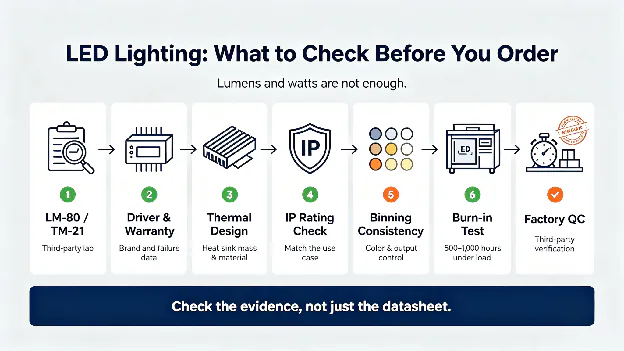
Judging LED lighting on lumens and wattage alone is like judging a car on top speed and ignoring the brakes. Evaluate these factors instead:
- LM-80/TM-21 documentation from an accredited third-party lab, not an internal factory test.
- Driver brand and warranty terms — reputable driver manufacturers (Mean Well, Inventronics, and similar) publish their own failure-rate data.
- Thermal management design, including heat sink mass and material (aluminum die-cast vs. thin stamped sheet metal makes a real difference).
- IP rating verification matched to actual use case — an IP65 rating tested in a lab means little if the housing gasket is a cheap add-on.
- Binning consistency, meaning how tightly the factory sorts LEDs by color temperature and output to avoid visible mismatch across a batch.
- Sample burn-in testing before mass production, run for at least 500-1,000 hours under load.
- Factory quality control inspection reports, ideally from a third-party inspector, not just the supplier's self-reported figures.
Working through a structured quality management and inspection process at this stage catches most of these issues before they become a container full of returns.
If you want to complete these professional evaluations efficiently and avoid unqualified manufacturers, ChinaSource provides one-stop sourcing support, including professional product assessment, qualified supplier matching, factory background verification, custom quotation inquiries, and multi-supplier comparison.
Red Flags to Avoid
Some warning signs show up before you ever place an order — if you know where to look.
Thermal Management Shortcuts
Watch for fixtures using undersized heat sinks relative to their wattage. A 100-watt LED high bay with a heat sink that looks barely bigger than a 60-watt unit is a thermal problem waiting to happen. Excess heat is the single biggest driver of premature lumen depreciation and driver failure — full stop.
Binning and Color Consistency Problems
Ask to see units from three different production runs side by side. If the color temperature visibly shifts — one fixture reading noticeably warmer or cooler than another labeled identically — that's poor binning discipline. It signals a factory prioritizing output speed over consistency, and it will show up as customer complaints down the line.
Vague or Recycled Test Reports
If every supplier quote references the same generic "50,000 hour" claim with no batch-specific documentation, be skeptical. Genuine LM-80 reports are tied to a specific LED package and drive current — not a marketing blanket statement copied across an entire catalog.
Questions to Ask Your Supplier
Before signing anything, get direct answers to these:
- Can you provide LM-80 test data for this exact LED package and drive current?
- Who manufactures your driver components, and what's their published failure rate?
- What's your in-process quality control inspection protocol, and can a third party verify it?
- How do you handle LED binning across production batches?
- What burn-in testing do you run on samples before mass production starts?
- What are your terms for defective units discovered after DDP or FOB delivery?
A supplier who answers all six without hesitation is worth pursuing. One who dodges two or three of them is worth walking away from.
Price vs. Value: Reading the Pricing
Pricing on LED lighting from China spans a wide range for a reason. A $4 high bay fixture and a $14 high bay fixture can look nearly identical in photos. They are not the same product.
What Cheap Pricing Hides
Rock-bottom quotes almost always mean corners cut somewhere — thinner heat sinks, unbranded drivers, skipped burn-in testing, or looser binning tolerances. None of that shows up until months into deployment, when failure rates climb and warranty claims pile up. By then, the "savings" are gone, eaten by replacement shipping and labor costs.
What Premium Pricing Buys
Higher pricing, when justified, buys documented LM-80/TM-21 data, name-brand drivers, tighter binning, and a factory with real quality management systems in place. It also usually buys better payment protection — many established manufacturers work comfortably with secure terms like a letter of credit, which signals financial stability on their end too.
| Factor | Budget Fixture | Verified Fixture |
|---|---|---|
| Driver source | Unbranded, unknown MTBF | Branded, published failure rate |
| Test documentation | None or generic | LM-80/TM-21, batch-specific |
| Heat sink design | Minimal, stamped metal | Sized aluminum die-cast |
| Typical L70 in real use | 15,000–25,000 hrs | 40,000–60,000+ hrs |
| Warranty support | Limited or absent | 3–5 year structured warranty |
Working through a partner that manages sourcing, sample development, and quality control inspections end-to-end tends to close this gap fast — it's the difference between guessing and verifying.
Final Checklist Before You Sign
Before any purchase order goes out, confirm:
- LM-80/TM-21 documentation is batch-specific, not generic marketing copy.
- Driver brand and warranty terms are named in writing.
- Sample units have passed burn-in testing under real load conditions.
- Third-party quality control inspection is built into the production timeline.
- Shipping terms (DDP, CPT, or FOB) and payment protections are clearly defined before funds move.
Frankly, most LED lifespan disputes trace back to skipping one of these five steps. Reading a detailed sourcing and manufacturing guide before your first order helps you spot these gaps early. Verifying suppliers through structured audits and quality programs catches the rest. And if you're ready to move forward, reaching out for a quote with clear technical requirements in hand puts you ahead of most buyers who never ask.
Identical specs on paper. Different life in the field. That gap is almost always a sourcing and verification problem — not a chip problem. Treat it that way, and LED lighting from China stops being a gamble.