
Kitchen Goods: How to Verify Food-Contact Compliance?


A spatula that melts. A mug that leaches lead. A cutting board that fails a migration test in a customer's home country. None of that is rare. It's what happens when buyers skip the verification steps for food contact materials before goods ship.
This guide walks through the process — no theory, no fluff. Just the steps a sourcing team should run before signing off on a kitchenware order bound for the U.S., EU, or any regulated market.
Before You Start
You'll need a few things in place before verification even starts.
- A clear target market list (the U.S., EU, UK, and China each have different rules for food contact materials)
- Product specs showing every material touching food — resin type, coating, printing ink, adhesive
- A supplier willing to share test reports, not just a signed letter
- Budget for third-party lab testing (rough estimate: $150–$600 per material per market, depending on lab and test scope)
- A quality control inspection plan built into your production timeline, not bolted on at the end
Skip any of these and you're guessing. Guessing gets recalls. Please refer to the process below to understand the specific operation, and ChinaSource can also assist you in completing it. If you have any questions, feel free to star with WhatsApp at any time
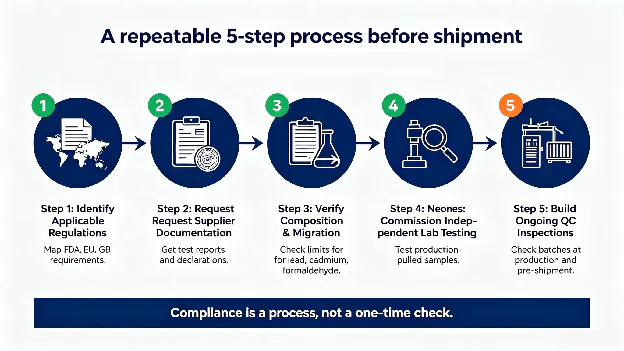
Step 1: Identify the Food Contact Materials Regulations That Apply
Every market defines "safe" differently. Start by mapping which rules govern your target country before you even look at a supplier's paperwork.
U.S. Requirements (FDA)
The FDA regulates food contact substances under Title 21 of the Code of Federal Regulations, parts 174–186. Materials need to meet specific migration thresholds tied to how they're used — a mug is treated differently than a vacuum-seal bag.
EU Requirements
The EU works under Framework Regulation (EC) No. 1935/2004, plus material-specific rules like Regulation (EU) No. 10/2011 for plastics. Overall migration limit: 10 mg per dm² of contact surface, per the EU framework.
China Requirements (GB Standards)
China uses the GB 4806 series — GB 4806.1 for general safety requirements, plus material-specific standards like GB 4806.7 for plastics. If you're sourcing from Chinese manufacturers for export back into China's domestic market, this is non-negotiable.
Here's what goes wrong: buyers assume "FDA-approved" material is automatically fine for the EU. Not even close. Migration limits, test methods, and even which chemicals get flagged differ by jurisdiction.
| Region | Governing Rule | Overall Migration Limit | Test Method |
|---|---|---|---|
| United States | 21 CFR 174-186 (FDA) | Substance-specific | FDA-recognized protocols |
| European Union | EC 1935/2004 + EU 10/2011 | 10 mg/dm² | EN 1186 series |
| China | GB 4806.1 / GB 4806.7 | 10 mg/dm² (plastics) | GB 31604 series |
Step 2: Request Documentation from the Supplier
Once you know the rule set, ask the factory for paper. Real paper — test reports, not marketing claims.
Certificates and Declarations
Ask for a material safety declaration, a certificate of conformity, and — where the destination market requires it — a full migration test report from an accredited lab. A certificate of conformity confirms the batch matches the tested sample; without it, you have no proof the shipped goods match the report on file.
What a Complete Package Looks Like
A supplier that takes food contact materials seriously will hand over, unprompted:
- A bill of materials listing every resin, pigment, and coating
- Migration test reports dated within the last 12–24 months
- A certificate of conformity tied to the specific production batch
- Supplier declarations for restricted substances (lead, cadmium, BPA)
If a supplier hesitates, stalls, or offers a "we've always passed" verbal assurance instead of documents — walk. That's the single biggest red flag in the entire process.
Step 3: Verify Material Composition and Migration Limits
Documents are a start. Verification means checking the numbers actually hold up against the standard you picked in Step 1.
Overall Migration Testing
This measures the total amount of substance that transfers from the material into a food simulant (usually a fatty, acidic, or aqueous liquid depending on intended use). A silicone baking mat tested against EU limits should show migration well under 10 mg/dm² — anything close to the ceiling is a warning sign, not a pass.
Specific Substance Limits
Beyond overall migration, some substances get individual caps — lead, cadmium, formaldehyde, melamine. Kitchen goods like ceramic mugs and bamboo-fiber tableware get flagged here often. Melamine tableware, in particular, draws frequent scrutiny for formaldehyde release under heat, so request heated-condition test data, not just room-temperature results.
Get this step wrong and you'll find out during a customs hold — or worse, after a customer complaint goes viral.
Step 4: Commission Independent Lab Testing
Supplier-provided reports are a floor, not a ceiling. Independent testing is how you confirm what you were told.
Pick an accredited lab (ISO/IEC 17025 accreditation is the baseline to look for) and send physical samples pulled directly from production — not samples the factory hand-picks. Run the test against the exact regulation for your target market: EN 1186 for the EU, the relevant GB 31604 method for China, or FDA-recognized protocols for the U.S.
Example: a stainless-steel water bottle destined for German retail gets tested for nickel and chromium migration under EN 1186-13. Results land at 0.08 mg/kg against a limit of 0.1 mg/kg — a pass, but a thin margin. That margin matters if raw material sourcing shifts even slightly between production runs.
Skip independent testing and you're relying entirely on a supplier's word. That's fine until it isn't.
Step 5: Build Verification Into Ongoing Quality Control Inspections
One clean test report doesn't guarantee the next batch is identical. Raw material suppliers change. Formulations drift. That's why food contact compliance needs to live inside your regular quality control inspection process, not just at project kickoff.
During Production Checks
A mid-production inspection should re-confirm material batch numbers against the original certificate of conformity. If the resin supplier changed without notice — and this happens more than buyers expect — the original migration test may no longer apply.
Pre-Shipment Random Sampling
Pull random units from the finished lot and cross-check labeling, batch codes, and any embossed material markings against your approved specification sheet. Confirm the food-contact surface itself matches what was originally tested — a coating or glaze swap can invalidate prior results even when the base material stays the same.
Buyers who treat compliance as a one-time checkbox instead of an ongoing inspection habit are the ones who end up issuing recalls eighteen months later.

*Photo by Sergey Meshkov on Pexels*
Troubleshooting Common Compliance Failures
Even careful buyers hit snags. Here's what tends to break, and how to fix it.
Problem: Supplier provides an outdated test report. Migration test reports older than 24 months shouldn't be trusted for active production, especially if the formulation or supplier chain changed. Fix: require a fresh report tied to the current production run, not a filed-away report from the original quote stage.
Problem: Test results pass "on paper" but fail on re-test. This usually means the sample sent to the lab wasn't representative of actual production. Fix: always pull samples directly from the production floor, ideally during a factory audit, rather than accepting factory-selected samples.
Problem: Customs holds a shipment over documentation gaps. Missing or mismatched certificates of conformity are a common cause. It's also worth checking that your product's classification lines up correctly under the Harmonized Tariff Schedule — misclassification can trigger extra scrutiny even when materials are fully compliant. Fix: confirm all paperwork — declarations, certificates, lab reports — travels with the shipment, not just the invoice.
Problem: Buyer assumes one region's approval covers all markets. Covered above, but worth repeating: an FDA-compliant mug is not automatically EU-compliant or GB-compliant. Fix: map every target market separately, every single time.
Frankly, most compliance failures trace back to skipped documentation, not bad chemistry. Fix the paperwork discipline and the material risk drops fast.
Why Kitchen Goods Face Extra Food-Contact Scrutiny
Kitchen goods sit closer to daily food and heat exposure than almost any other product category. Mugs, utensils, and storage containers touch hot liquids, oils, and acidic foods repeatedly over their lifespan. That repeated contact is exactly why food contact materials regulations exist — a single migration test at room temperature does not tell you how a mug behaves after a year of dishwasher cycles and microwave use.
When verifying food contact materials for kitchen goods specifically, treat heat and repeated-use conditions as separate risk factors from the base material itself. A resin that passes cold-contact migration limits can still fail once it's exposed to boiling water or reheating. Build that distinction into your supplier questions from the start, rather than assuming one test result covers every real-world use case.
Final Checklist Before You Ship
Before any kitchenware order leaves the factory, run this shortlist one more time:
- Confirmed applicable food contact materials regulation for the destination market
- Collected current certificate of conformity and migration test reports
- Verified specific substance limits (lead, cadmium, formaldehyde) against the right standard
- Commissioned independent lab testing on production-pulled samples
- Built compliance checks into pre-shipment quality control inspections
Get this sequence right and food contact materials compliance stops being a gamble. It becomes a repeatable process — the kind that keeps kitchenware moving through customs and off retail shelves without a single recall notice. For sourcing teams that want this handled end-to-end, ChinaSource's team can walk through documentation, testing, and inspection scheduling; reach out for a quote and get specifics for your product line. More process breakdowns like this one are also up on the ChinaSource blog.