
FOB, CIF or DDP? Which Incoterm Should You Choose?

Ask five importers to explain FOB, CIF, and DDP Incoterms, and you'll likely get five different answers. Some are flat wrong. Confusion around these three-letter codes costs real money — a bad Incoterm choice can shift thousands of dollars in freight, duty, and liability onto the wrong party without anyone noticing until the invoice arrives. This article pulls apart the most common myths about FOB, CIF, and DDP incoterms, using the actual ICC rules as the reference point, not shipping-forum folklore.
Why These Myths Stick
Incoterms rules get updated roughly every decade. The current version, Incoterms 2020, is published by the International Chamber of Commerce (see the official ICC Incoterms rules). Yet plenty of purchase orders still reference terms from the 2010 edition — or worse, no defined edition at all.
Old habits die hard. That gap between contract language and what actually happens at the port is exactly where myths grow.
Old Contracts, New Confusion
Small and mid-size buyers often copy boilerplate from a supplier's last quote. Nobody rereads the fine print. The term "FOB Shenzhen" gets pasted into contract after contract, long after the buyer's freight setup has changed.
Freight Forwarders Push Familiar Terms
Forwarders default to whatever's easiest to quote, not necessarily what's best for the buyer's risk profile. Frankly, that's not malice — it's just habit, and habits are hard to audit from a spreadsheet.
Myth 1: FOB Is Always the Cheapest Option
The claim: The supplier's FOB quote is the lowest number on the table, so FOB must be the cheapest way to buy.
The reality: FOB price excludes freight, marine insurance, customs clearance, duty, and destination handling. Under the ICC Incoterms 2020 rules, FOB shifts cost and risk to the buyer once goods are loaded onboard. Add up ocean freight, destination port fees, customs brokerage, and trucking, and the "cheap" FOB number often lands higher than a well-negotiated DDP price — especially for buyers without an existing freight forwarder relationship (a rough industry rule of thumb, not a fixed figure, since freight rates swing with fuel surcharges and container availability).
What to do instead: Compare landed cost, not the quoted unit price. Coordinating logistics through an established supply chain and logistics service usually surfaces hidden costs that a bare FOB quote hides. Or start with WhatsApp, and use ChinaSource to run the full math — freight, duty, handling, insurance — before deciding.

*Photo by K on Pexels*
Myth 2: DDP Incoterms Mean Zero Risk for the Buyer
The claim: DDP puts everything on the seller, so the buyer is fully covered — no risk, no surprises.
The reality: Not even close. Under DDP, the seller does carry maximum delivery obligation — duties, taxes, and destination delivery are on them, per the standardized Incoterms rules. But the buyer is still exposed if the seller mis-declares customs value, lacks proper tax registration in the destination country, or ships product that fails a compliance check at the border. A held shipment is still a held shipment, no matter whose name is on the paperwork.
Who Actually Carries the Risk
Risk doesn't vanish under DDP. It just moves earlier in the timeline. Buyers still need to confirm:
- The seller is registered for VAT/import tax where required
- Product labeling and certification meet destination-market rules
- Customs valuation matches the actual commercial invoice
Customs Bonds and Tax Liability
Some destination countries require an importer of record with a local tax ID — a role many overseas factories can't legally fill without a local agent. That's a detail that trips up buyers who assume "DDP" means "hands off completely."
What to do instead: Confirm the supplier's customs credentials before signing off on DDP terms. Supplier verification and factory audits catch this kind of gap long before a shipment ever leaves the dock.
Myth 3: CIF Insurance Covers Full Product Value
The claim: CIF automatically insures the cargo for its full commercial value, so nothing more needs negotiating.
The reality: Under the ICC Incoterms rules, CIF only requires the seller to buy minimum cargo cover — typically Institute Cargo Clauses (C), a narrower policy than most buyers assume. For high-value electronics, custom tooling, or fragile goods, that minimum cover can leave a serious gap if cargo is damaged or lost.
What to do instead: Negotiate Institute Cargo Clauses (A) — the broader "all risks" tier — in writing, or arrange separate cargo insurance. Don't assume the "I" in CIF means you're fully protected. Worth noting: this single clause swap can be the difference between a covered claim and an expensive write-off.
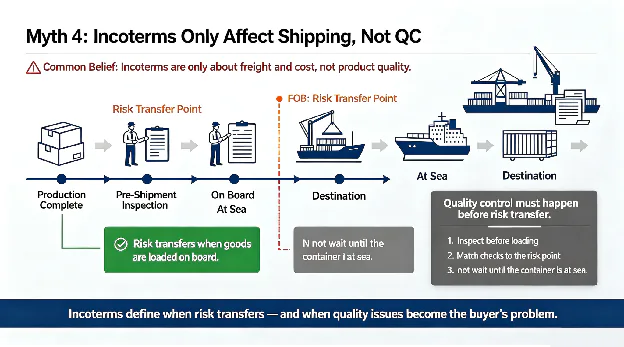
Myth 4: Incoterms Only Affect Shipping, Not Quality Control
The claim: Incoterms are a freight and cost issue, full stop — they have nothing to do with product quality.
The reality: That's backwards. The Incoterm chosen determines exactly where risk transfers, which in turn determines when a quality problem becomes the buyer's problem. Under FOB, risk transfers at loading — so a defect found after that point is technically the buyer's issue unless a pre-shipment inspection was written into the contract. Buyers who skip quality control inspections before the risk-transfer point routinely absorb costs they never should have.
What to do instead: Build inspection checkpoints into the contract, timed to match the Incoterm's risk-transfer point — not after the container's already at sea.
What the Evidence Actually Shows
Put the myths aside, and a clearer picture emerges: no single Incoterm is universally "best." Each one moves cost, risk, and paperwork burden to a different party at a different point in the shipment.
Cost and Risk Comparison Table
| Factor | FOB | CIF | DDP |
|---|---|---|---|
| Freight cost | Buyer arranges | Seller pays, buyer reimburses via price | Seller pays |
| Cargo insurance | Buyer's responsibility | Seller buys minimum cover | Seller's responsibility |
| Customs & duty | Buyer handles | Buyer handles | Seller handles |
| Risk transfer point | On loading at origin port | On loading at origin port | At buyer's destination door |
| Best fit | Buyers with own forwarder network | Buyers wanting simpler quoting, willing to add insurance | Buyers new to importing or wanting predictable landed cost |
Matching Incoterms to Your Supply Chain Strategy
Choosing between FOB, CIF, and DDP incoterms comes down to three questions:
- Does your team have an established freight forwarder and customs broker?
- Can you absorb a delayed or damaged shipment without insurance backup?
- Do you need a single, predictable landed cost for budgeting?
If the answer to the first two is "no," DDP incoterms usually reduce exposure — even if the quoted price looks higher upfront. If you've already got freight and customs handled in-house, FOB can shave real cost off the total. CIF sits in between, useful mainly when a buyer wants simplified quoting but plans to negotiate insurance terms separately.
None of this is guesswork best left to a single email thread with a supplier. Sourcing teams that pair Incoterm selection with proper OEM/ODM manufacturing management and packaging coordination tend to avoid the nastiest surprises — the kind that show up as a stuck container or a surprise duty bill three weeks after the PO was signed. For deeper breakdowns on shipment terms and sourcing decisions, the ChinaSource blog covers more scenario-specific cases. And if a shipment's already got you second-guessing the contract terms, it's worth reaching out through ChinaSource's contact page before the next PO goes out.
Bottom line: FOB, CIF, and DDP each solve a different problem. Pick based on who's best equipped to manage risk at each stage — not on which quote looks smallest on the page.