
Will Chinese New Year Break Your Delivery Schedule?


Every fall, buyers ask the same question: will the Chinese New Year factory shutdown wreck this year's shipping schedule? Short answer: it might, if you're not planning around it. Longer answer: the holiday itself is short, but the ripple effect around it is long. Factories close, workers travel home, ports jam up, and container rates spike. Buyers who don't map this cycle in advance often eat weeks of delay. Buyers who do plan around it barely notice the disruption.
The Problem: Orders Stall Right When You Need Them Most
Here's the pain point, plain and simple. A buyer places a purchase order in December, expecting a normal four-to-six-week production run. Then Chinese New Year hits in late January or February, and the factory goes quiet. Not for a week. Often for three or four.
Orders that should have shipped in February slide into March. Retail buyers miss spring resets. Electronics brands miss product launch windows tied to trade shows. Toy and gift importers miss early-buy programs that retailers lock in months ahead.
The cost isn't abstract, either. A two-to-four-week production gap, stacked on top of already-tight ocean transit times, can push a shipment's arrival back by five to eight weeks total once port congestion and carrier rebooking are factored in — a widely cited pattern among freight forwarders during the pre- and post-holiday surge. Anecdotally, sourcing teams report expedited air freight costs of $1,000 to $3,000 more per container when a missed vessel booking forces a switch from ocean to air just to hit a deadline. That's real money, and it's avoidable.
Why It Happens: Root Causes Behind the Chinese New Year Factory Shutdown
Understanding the mechanics matters more than memorizing dates. The holiday itself is officially short. China's State Council publishes the annual Spring Festival holiday calendar, and it typically runs about seven days as a national public holiday. The real disruption comes from what surrounds it.
Migrant Labor Return Season
Millions of factory workers travel home for the holiday, many for the only extended visit of the year. Some don't come back right away. Some don't come back at all, choosing new jobs closer to home instead. Factories often spend two to three weeks post-holiday just rebuilding staffing levels back to full production capacity.
Compressed Production Calendars
Smart factory managers try to front-load orders before the break. That means every buyer is competing for the same production slots in December and early January. Lines get overbooked. Quality control gets rushed. Corners get cut when everyone's racing the same clock.
Port and Carrier Congestion
Shipping volume spikes hard in the weeks before the holiday as exporters race to clear goods before the shutdown. Container availability tightens, freight rates climb, and vessel space gets booked out weeks in advance. Miss the window, and you're stuck waiting for the post-holiday backlog to clear too.
The Fix: Building a Shutdown-Proof Production Schedule
None of this is unmanageable. It just requires working backward from the holiday instead of forward from your order date.
Step 1: Map the Calendar Early
Lock in the holiday dates the moment they're published, then count backward. Any order that needs to ship before the break should be placed no later than mid-October for most product categories, giving factories room to slot you in before the December rush.
Step 2: Build in Buffer Stock
Carry an extra two to four weeks of inventory heading into the holiday window. Frankly, this is the single cheapest insurance available. Warehousing costs a fraction of what expedited air freight does.
Step 3: Lock In Logistics Windows Early
Whether you're shipping DDP, CPT, or FOB, book vessel space well ahead of the pre-holiday surge. Coordinating B2B supply chain and logistics around the shutdown window — rather than reacting to it — is exactly the kind of planning a logistics coordination partner earns its fee doing. Understanding how duties are classified under the Harmonized Tariff Schedule also helps avoid last-minute customs surprises when shipments get rerouted.
Here's a quick comparison of how each shipping term handles the pre-CNY squeeze:
| Shipping Term | Who Books Space | CNY Risk Level | Best Use Case |
|---|---|---|---|
| FOB | Buyer books ocean freight | Higher — buyer competes for space | Buyers with strong freight forwarder relationships |
| CPT | Seller books to named destination | Moderate | Mid-size buyers wanting shared control |
| DDP | Seller handles freight and duties | Lower — seller absorbs booking risk | Buyers wanting full-service, hands-off delivery |
How to Prevent a Repeat: Planning Around the Lunar Calendar
Fixing one bad season is good. Not repeating the mistake next year is better.
Diversify Your Supplier Base
Relying on a single factory means a single point of failure. Supplier verification and factory audits across two or three qualified manufacturers give you backup capacity when one line is buried in pre-holiday orders.
Schedule Quality Control Inspections Before the Rush
Pre-shipment inspections booked in early-to-mid December — before the holiday scramble — catch defects while there's still time to fix them. Waiting until January often means defects get discovered only after the factory has already gone dark for the break.
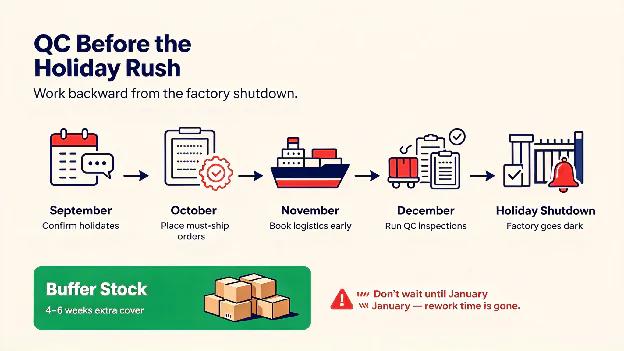
- Confirm holiday dates with every active supplier by September.
- Place must-ship orders no later than mid-October.
- Book logistics slots by early November.
- Run quality control inspections in early-to-mid December.
- Build buffer stock covering four to six extra weeks.
To execute this tight lunar-cycle planning accurately and avoid seasonal delays, you can leverage ChinaSource to customize your annual production, QC, and shipping schedule in advance.
When to Bring in Help: DIY Sourcing vs. Professional Coordination
Some buyers manage this cycle fine on their own, especially if they've got one or two steady factory relationships and low order volume. But complexity changes the math fast.
If you're managing multiple suppliers across categories — say, packaging, private labeling, and OEM manufacturing all at once — tracking every factory's specific holiday timeline gets unwieldy quick. That's when a sourcing partner earns its keep. Working with an Original Design Manufacturer (ODM) for turnkey product designs can also cut lead time risk, since ODM factories often carry existing tooling and don't need a full development cycle squeezed in before the shutdown.
It's also worth bringing in help when:
- You're launching a new product and can't afford a delayed sample cycle.
- Your current supplier hasn't been through a recent factory audit.
- You need DDP logistics coordination across multiple ports.
- Quality control inspections have been inconsistent or self-managed with no third-party check.
Browsing available services and coordination options on the products page is a reasonable starting point if you're weighing what to hand off.
Key Takeaways for Your Next Sourcing Cycle
Chinese New Year isn't a surprise. It happens every year, on a published schedule, and the disruption pattern is well understood across the sourcing industry. The buyers who get burned are usually the ones treating it as an afterthought rather than a planning input.
Build your calendar backward from the holiday. Carry buffer stock. Book logistics early. Diversify suppliers where volume justifies it. Simple as that.
For deeper guidance on seasonal sourcing calendars, the blog covers timing strategies specific to different product categories. And if the shutdown window is already creeping up on you, reaching out through our page for a quote beats scrambling in January. Bottom line: the shutdown doesn't have to break your schedule — only a lack of planning does.