
Is Your Chinese Supplier a Factory or a Trading Company?

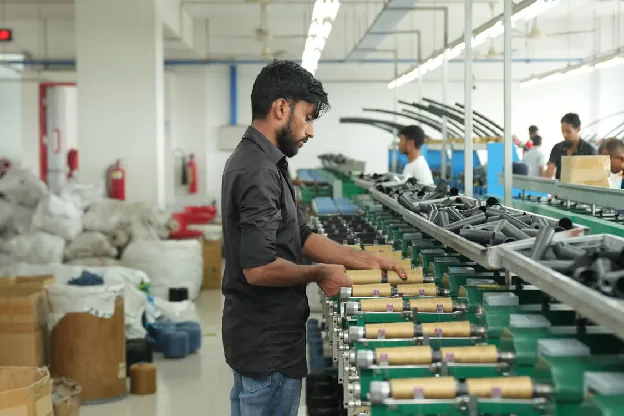
Here's a question that trips up almost every first-time importer: is the company on the other end of your email chain actually making your product, or just reselling it? The factory vs trading company distinction sounds academic until you're staring at a 30% price gap you can't explain. Get it wrong, and you'll overpay, lose quality control, and wait longer than you should. Get it right, and sourcing gets a lot less risky.
This guide breaks down what to check, what to avoid, and exactly what to ask before you commit.
Factory vs Trading Company: What the Terms Actually Mean
A factory owns the equipment, the floor space, and the labor. A trading company owns relationships — and sometimes not even that. Both can be legitimate business partners. The problem starts when one pretends to be the other.
What a Real Factory Looks Like
Real manufacturers hold a business license listing manufacturing as their registered scope, not "trading" or "import-export." They'll have a physical production address you can verify, machinery on-site, and staff who can answer detailed process questions without pausing to "check with the factory." That pause, by the way, is usually the tell.
What a Trading Company Actually Does
Trading companies source from multiple factories, consolidate orders, and handle export paperwork. Some add real value: language support, smaller minimum order quantities, and single-point contact across several product categories. Others just add a markup and forward your emails. Neither is inherently bad — but you need to know which one you're paying for.
Why the Distinction Changes Your Costs
Markups from trading intermediaries commonly run 15% to 40% above factory-direct pricing, based on typical wholesale-to-retail sourcing spreads reported across B2B trade platforms — treat that as a rough estimate, not a fixed rule. Lead times shift too. A trading company adds a layer of communication between you and the production line, which means slower answers when something goes wrong on the floor.
| Trait | Factory | Trading Company |
|---|---|---|
| Business license scope | Manufacturing | Trading / Import-Export |
| Physical production site | Yes, verifiable | Often none |
| Price transparency | Direct cost visibility | Marked-up quote |
| Technical process answers | Immediate | Delayed, relayed |
| MOQ flexibility | Often stricter | Often more flexible |
| Product range | Narrow, specialized | Broad, mixed categories |
*Photo by Artyom Malyukov on Pexels*
What to Evaluate
Before you sign anything, work through these criteria. Skip one, and you're guessing.
Documentation and Licensing
- Business license with manufacturing scope clearly stated
- Export license and customs registration number
- ISO 9001 or product-specific certifications relevant to your category (electronics, textiles, toys, etc.)
- Factory audit report from a third-party inspection body, not a self-supplied PDF
Operational Signals
- Production capacity matched to your order volume — ask for machine count and shift patterns
- Sample development turnaround time (a real factory usually quotes 7–15 days for a working prototype)
- Willingness to schedule an on-site or virtual factory audit
- Clear answers about subcontracting — many factories farm out parts of an order, and you deserve to know which parts
Suppliers who won't share licensing details or dodge audit requests aren't worth your budget. Full stop.
What to Avoid
Some warning signs show up before you even place a deposit. Watch for these.
Vague answers to specific process questions. Ask "what's your injection molding cycle time for this part" and get a marketing brochure back instead of a number — that's a red flag. A real production manager knows this cold.
Mismatched company names across documents. If the business license, the bank account, and the factory sign at the loading dock all show different entity names, you're likely dealing with a broker layering itself between you and the actual manufacturer.
Reluctance to allow third-party inspection. Legitimate factories accept quality control inspections as routine. Suppliers who stall, reschedule repeatedly, or insist on "arranging everything themselves" are protecting something — usually a subcontracted relationship they don't want you to see.
Prices that seem too good given the stated MOQ. If a quote undercuts every competitor by a wide margin, ask why. Sometimes it's a factory absorbing labor costs efficiently. Sometimes it's a trading company promising a price it can't actually deliver at scale.
Questions to Ask Your Supplier
Bring this list to your next call. Don't accept vague answers.
- Can you share your business license and confirm the registered scope of operations?
- What is your factory address, and can we schedule a supplier verification and factory audit, either on-site or via live video walkthrough?
- Do you subcontract any part of this order, and to whom?
- What Acceptable Quality Limit (AQL) standard do you inspect against, and can we set the sampling level together?
- Who manages sample development and prototyping — an in-house engineer or a third party?
- What are your logistics terms — DDP, CPT, or FOB — and who handles customs clearance on each end?
- Can you provide references from two existing B2B clients in our product category?
A supplier that answers all seven without hesitation has probably done this before, many times.
Reading the Pricing
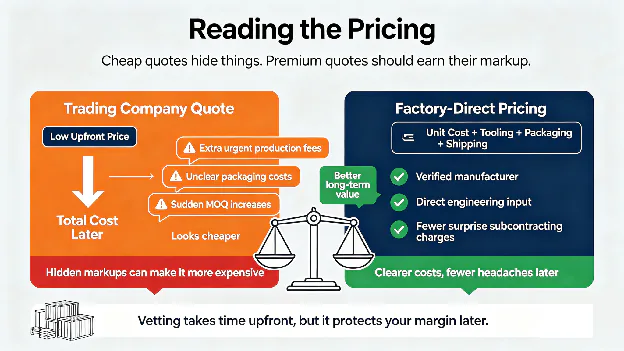
Cheap quotes hide things. Premium quotes should earn their markup with something tangible.
Why Trading Company Quotes Look Cheaper Upfront but Cost More Later
A trading company might quote fast and low to win the deal, then adjust terms once you're committed — extra fees for "urgent" production slots, unclear packaging costs, or sudden MOQ increases. Because they're not the ones absorbing production risk, they have less incentive to protect your margin over the long run.
What Factory-Direct Pricing Really Buys You
Working with a verified manufacturer, or through a partner that manages supplier verification and OEM/ODM project management on your behalf, usually means transparent per-unit costs, direct engineering input on custom manufacturing, and fewer surprise charges tied to hidden subcontracting layers. It costs more time upfront to vet. It saves money and headaches later. That trade-off is worth it more often than not.
Where Sourcing Support Actually Pays Off
Vetting a Chinese supplier from another continent, without local staff on the ground, is genuinely hard. Government resources like the International Trade Administration's market guides can help with country-level trade context, but they won't tell you whether a specific factory floor matches its brochure.
That's the gap a sourcing partner fills. ChinaSource runs supplier verification, factory audits, and quality control inspections as core services — not add-ons — so you're not relying on a supplier's own paperwork to make a six-figure decision. Browse the full range of sourcing and manufacturing management services on the ChinaSource products page, and check the ChinaSource blog for deeper guides on supplier vetting and OEM project management.
Confirming Whether a Chinese Supplier Operates as a Factory or a Trading Company
The factory vs trading company question comes down to verifiable facts, not sales talk. Start with the business license. A genuine Chinese manufacturer lists production as its registered scope. A trading company lists import-export or wholesale instead. Ask for the factory address and cross-check it against customs export records or a video call showing the production floor.
Next, look at who answers technical questions. A real Chinese factory can explain tooling, material sourcing, and defect rates without delay. A trading company usually pauses to consult someone else, because it does not control production. That pause is a reliable signal.
Finally, compare the quoted price against known material and labor costs for that product category. Trading company quotes often bundle an unstated markup for the introduction service. Factory-direct quotes tend to break down closer to actual manufacturing cost. Neither model is dishonest by default, but knowing which one you are paying protects your margins.
Final Checklist
Before you sign a purchase agreement, confirm:
- Business license scope matches what they claim to be (factory or trading company)
- A recent, independent factory audit report exists and matches the stated address
- Sample development and prototyping timelines are documented in writing
- AQL inspection standards are agreed upon before production starts
- Logistics terms (DDP, CPT, FOB) are spelled out, with responsibility assigned at each handoff point
- Pricing breakdown separates unit cost, tooling, packaging, and shipping — no bundled mystery fees
Getting the factory vs trading company question right up front saves money, time, and a lot of frustrated emails later. If you'd rather skip the guesswork, reach out to ChinaSource for a quote and let a verified network do the vetting for you.