
Solar Panels from China: Which Specs Are Overstated?


Buyers sourcing solar panels from China face a familiar problem: datasheets look identical, but real-world performance doesn't. Wattage, efficiency, and warranty numbers often get rounded up, tested under best-case lab conditions, or copied from a competitor's spec sheet. This isn't a China-specific issue — it happens with panel makers everywhere. But because so much of the global module supply now comes out of Chinese factories, buyers need a repeatable way to separate honest datasheets from marketing fluff. That's what this framework is for.
Below is a five-criterion scorecard you can apply to any quote, sample, or factory audit before you commit to a container order. Or conduct supplier background checks through ChinaSource before placing an order.
The Framework at a Glance
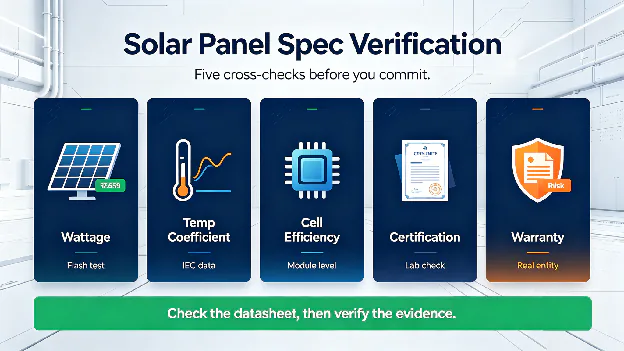
Here's the deal: no single spec tells you whether a panel will perform. You need a small set of cross-checked criteria, evaluated together, before signing a purchase order. Think of it as a decision matrix — each row forces a specific verification step instead of a gut feeling.
| Criterion | What's Often Overstated | How You Verify It |
|---|---|---|
| Wattage/Power Output | Peak rating vs. field output | Independent flash test report |
| Temperature Coefficient | Cold-lab number vs. hot-climate loss | IEC 61215 test data |
| Cell Efficiency | Cell-level % applied to whole module | Module-level efficiency, not cell-level |
| Certifications | Copied logos, expired reports | Direct check with issuing lab |
| Warranty | 25-year promise, no backing entity | Corporate guarantee documentation |
A quick five-item checklist for any incoming quote:
- Does the wattage match an independent flash test, not just the datasheet?
- Is the temperature coefficient tested per IEC 61215, or just claimed?
- Is the efficiency percentage calculated at module level, not cell level?
- Can the certification be verified directly with the testing lab?
- Is the warranty backed by a traceable manufacturer, not a trading shell?
If a supplier can't answer all five without hesitation, that's worth flagging before deposit.
Criterion 1: Wattage Claims on Solar Panels from China
Why It Matters
Wattage drives your price-per-watt math, your system design, and your customer's expectations. A 1–2% gap sounds small. Multiply it across a container of 500 panels and the shortfall becomes a real financial problem, not a rounding error.
How to Evaluate
Ask for an independent flash test report, not just the factory's internal one. Third-party labs — TÜV Rheinland, Intertek, and similar accredited testers — measure output under Standard Test Conditions defined by IEC 61215. Compare that number against the datasheet. A gap under 3% is typical tolerance. Anything wider deserves a second sample pull.
Red Flag
Watch for suppliers who refuse third-party flash testing or only offer "positive tolerance" claims with no test paperwork attached. Not even close to acceptable for a bulk order.
Criterion 2: Temperature Coefficient and Real-World Degradation
Why It Matters
Panels lose output as they heat up. The temperature coefficient (expressed as %/°C) tells you how much. In hot climates — think Arizona, the Gulf states, Southeast Asia — this number matters more than the headline wattage.
How to Evaluate
Check whether the coefficient came from IEC 61215 environmental testing or from a generic industry average pasted across the whole product line. Ask for degradation curve data too; reputable manufacturers publish linear degradation guarantees tied to actual accelerated-aging test results, not just a marketing promise.
Red Flag
A datasheet listing an identical temperature coefficient across five different panel models, regardless of cell technology, usually means nobody re-tested it. That's a copy-paste spec, not a measured one.
Criterion 3: Cell Efficiency Percentages
Cell efficiency and module efficiency are not the same number, and this is where a lot of overstatement happens. A cell might test at 22% efficiency in a lab, but once it's assembled into a full module — with frame, glass, and spacing losses — the real module efficiency drops to something lower, often 20–21% for premium monocrystalline PERC or TOPCon panels, per public efficiency benchmarking from NREL's cell efficiency research. Suppliers sometimes quote the cell number on the module spec sheet because it looks better. Ask specifically: "Is this cell-level or module-level efficiency?" If they hesitate, you already have your answer.
Criterion 4: Certification and Test Report Authenticity
Why It Matters
Certifications like IEC 61215 (design qualification), IEC 61730 (electrical safety), and UL 61730 aren't optional paperwork — they're what customs, installers, and insurers rely on. A forged or expired certificate can halt a shipment or void a project's insurance.
How to Evaluate
Contact the issuing lab directly using the certificate number, not through a link the supplier sends you. During supplier verification and factory audit work, this is one of the fastest ways to separate a compliant factory from one that's borrowing someone else's paperwork. It mirrors the logic of a formal Request for Information (RFI) process: you're asking a supplier to prove claims with documentation before you move to a binding order.
Red Flag
If a supplier sends a certificate PDF but can't produce the original test report with sample serial numbers, treat that as disqualifying. Frankly, that's the single biggest early-warning sign in this entire framework.

Criterion 5: Warranty Terms and Manufacturer Backing
A 25-year linear power warranty is standard across the industry now — most tier-1 crystalline silicon module makers publish something close to it, guaranteeing output retention into year 25 as a rule of thumb built into most current datasheets. The overstated part isn't always the number. It's the backing. A warranty is only as good as the company standing behind it in year 12 when a panel underperforms.
Check who's actually issuing the warranty: the factory, a trading company, or a shell entity that could dissolve. Ask for the legal manufacturing entity's registration details, not just a brand name printed on the glass. If the warranty document names an entity different from the factory that built the panel, dig further before you commit to volume.
Putting the Framework to Work: A Scorecard Example
Here's how the scorecard plays out on an actual quote comparison. Say two suppliers offer what looks like the same 550W monocrystalline module at nearly the same price.
| Criterion | Supplier A | Supplier B |
|---|---|---|
| Independent flash test | Provided, within 2% | Not provided |
| Temp. coefficient source | IEC 61215 tested | Generic industry figure |
| Efficiency stated | Module-level, 21.3% | Cell-level, 22.5% (misleading) |
| Certificate verification | Confirmed with lab | Certificate number invalid |
| Warranty entity | Named manufacturer | Unnamed trading company |
Supplier A passes every check. Supplier B fails four of five. On paper, B's quote might even look slightly better — cheaper, higher stated efficiency. That's exactly the trap this scorecard is built to catch.
This kind of verification work is typically bundled into factory audits and quality control inspections rather than left to a buyer reading a PDF alone. Once a module clears the scorecard, the remaining risk shifts to logistics — container loading, insurance, and Incoterms like FOB or DDP — where practices from international ocean liner shipping standards help confirm your freight terms match what's actually on the bill of lading.
Final Take: Building the Scorecard Into Your Sourcing Process
None of these five criteria are exotic. They're the same checks a competent QC team runs on any factory relationship, whether it's solar modules, kitchenware, or electronics components. What changes with solar panels from China is the stakes: a bad batch doesn't just cost you a refund, it costs a client's rooftop system years of underperformance.
Build the scorecard into your supplier onboarding process, not just your final inspection. A written framework — checked at quotation, at sample stage, and again at pre-shipment inspection — catches most overstated specs before they ever reach a container. For buyers who want this process managed end-to-end, from supplier identification through OEM/ODM production oversight, ChinaSource's sourcing and quality control services build these checks into every project stage. Teams looking for more sourcing guidance can also browse ongoing supplier verification insights on the blog, or reach out directly to discuss a specific panel order before it ships.