
Why Do Cheap Hinges Fail? What Specs to Check

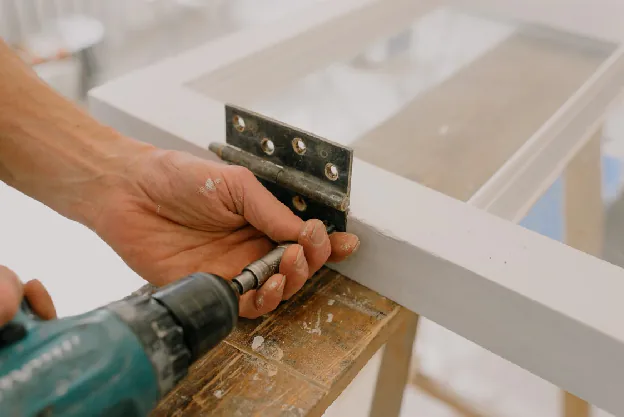
A cabinet door that sags after six months isn't bad luck. It's a spec problem. Cheap hinges fail because buyers skip the numbers that actually predict performance — cycle rating, base metal, tolerance, load capacity. Furniture hardware sits at the joint between design intent and daily abuse, and it absorbs wear that finishes and upholstery never see.
This article lays out a five-point framework — call it a scorecard, a checklist, whatever fits your procurement process — for evaluating hinges before they ship, not after a customer complains.
The Framework at a Glance
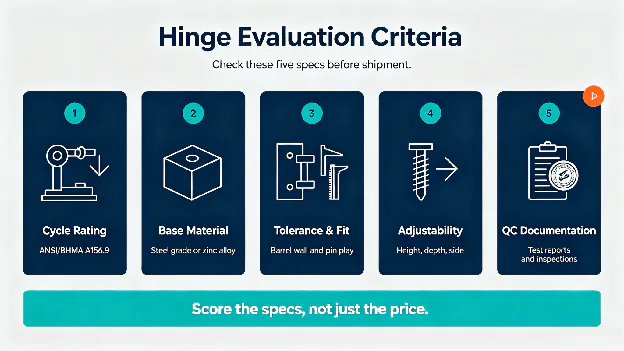
Hinge failure almost always traces back to one of five gaps: undertested cycle life, weak base material, sloppy tolerances, poor adjustability, or missing quality documentation. None of these show up in a product photo. All of them show up in a factory audit or a lab report. Here's the quick-reference version of the framework before we break down each criterion.
| Criterion | What It Predicts | Quick Check |
|---|---|---|
| Cycle rating | Long-term durability under daily use | ANSI/BHMA A156.9 test certificate |
| Base material | Corrosion and fatigue resistance | Steel grade or zinc alloy spec sheet |
| Tolerance and fit | Door sag, misalignment over time | Barrel wall thickness, pin play |
| Adjustability | Field serviceability, warranty cost | 3-way adjustment screws present |
| QC documentation | Batch-to-batch consistency | Third-party inspection report on file |
That's the whole decision matrix in one table. Now let's dig into why each row matters and how to verify it before a purchase order gets signed.
Criterion 1: Hinge Cycle Rating and Load Capacity
Why Cycle Ratings Matter
A hinge doesn't fail from one slam. It fails from the ten-thousandth slam. Cycle testing simulates repeated opening and closing to find the point where a hinge loosens, binds, or snaps. Skip this spec and you're guessing.
How to Verify Load Ratings
Ask suppliers for cycle-test documentation under ANSI/BHMA A156.9, the standard the Builders Hardware Manufacturers Association maintains for cabinet hardware performance grading. The standard sets tiered grades — Grade 1, 2, 3 — with higher grades demanding tougher cycle and load performance before a hinge is rated to pass. A legitimate factory can produce this paperwork on request. A trading company reselling unbranded stock usually can't.
Red Flag: No Cycle Test Data
If a supplier can't produce a test certificate, cycle rating, or even a grade claim, treat that silence as data. Frankly, it usually means nobody ever tested the part. Not even close to acceptable for a commercial order.
Criterion 2: Furniture Hardware Base Material and Plating Quality
The metal underneath the finish decides whether a hinge lasts five years or five months. Plating hides a lot of sins — for a while.
Cold-Rolled Steel vs. Stainless Steel vs. Zinc Alloy
Here's how the common base materials stack up in real terms.
| Material | Corrosion Resistance | Typical Use | Relative Cost |
|---|---|---|---|
| Cold-rolled steel, nickel plated | Moderate | Indoor cabinetry, dry environments | Budget |
| Zinc alloy (Zamak) | Low to moderate | Decorative and light-duty hardware | Budget to mid |
| SAE 201 stainless | Lower than 304; higher carbon, less nickel | Cost-reduced parts marketed as "stainless" | Mid, often mislabeled |
| SAE 304 stainless | High | Kitchens, bathrooms, humid or coastal climates | Premium |
Evaluating Plating and Corrosion Resistance
Request the actual alloy spec, not just the word "stainless." SAE 201 and 304 look identical on a spec sheet at a glance but behave very differently near moisture. A quick magnet test helps in the field — 304 is largely non-magnetic, 201 often shows some magnetic response due to its composition — though lab verification (per ASTM A240 for stainless sheet) is the reliable route for volume orders.
Criterion 3: Pin, Barrel, and Cup Tolerances
Tolerance Stack-Up and Door Sag
Small gaps add up. A hinge pin with 0.2mm of extra play doesn't sound like much until it's multiplied across three hinges on one door. That's how doors start drooping at the corner within a year, even when the material itself is sound.
Checking Barrel Wall Thickness
Thin barrel walls flex under load and lose their grip on the pin over time. Ask for wall thickness in millimeters, not a vague "heavy-duty" label. Calipers or a micrometer during an inbound inspection catch this in minutes. It's a cheap check with an outsized payoff.
Criterion 4: Adjustability and Soft-Close Mechanism Durability
Three-way adjustable hinges let installers correct for minor cabinet or door variance without swapping parts. Cheap versions often skip one or two adjustment axes to save cost, which means any misalignment becomes permanent. Soft-close dampers are another common failure point — the damping cartridge wears out long before the hinge body does, and low-cost versions rarely disclose a damper cycle life at all.
Buyers should ask two direct questions here: does the hinge adjust in all three planes (height, depth, side), and is the soft-close cartridge rated separately from the hinge itself? If a supplier hesitates on either, that's worth flagging before committing to a production run.
Criterion 5: Supplier Verification and Quality Control Documentation
None of the specs above matter if the supplier can't back them up consistently across batches. This is where verification work earns its keep.
Factory Audit Checklist Items
A proper factory audit should confirm:
- In-house cycle testing equipment, not just outsourced lab reports
- Material traceability records tying raw stock to finished lots
- Plating thickness measurement tools on the production floor
- Documented tolerance specs for pins, barrels, and cups
- A corrective action process for rejected batches
Third-Party Inspection Reports
Pre-shipment inspection reports should list actual measured values against the agreed spec — not just a pass/fail checkbox. Furniture hardware, unlike many nondurable consumables, is expected to perform for years; it falls squarely into what economists classify as durable goods (see the durable goods classification for the underlying distinction), which is exactly why upfront verification matters more here than on a one-time-use item.
Supplier quality management and quality control inspections exist to close this gap — catching a bad plating batch or an undersized barrel before it lands in a container, not after.
Putting the Framework to Work
Here's a simplified scorecard example for a mid-range concealed cabinet hinge order, scored on a 1–5 scale per criterion.
| Criterion | Score (1–5) | Notes |
|---|---|---|
| Cycle rating documentation | 4 | ANSI/BHMA A156.9 Grade 2 cert on file |
| Base material verification | 2 | Labeled "stainless," alloy grade unconfirmed |
| Tolerance measurement | 5 | Barrel wall checked at 1.2mm, within spec |
| Adjustability | 3 | Height and depth only, no side adjustment |
| QC documentation | 4 | Pre-shipment report with measured values |
Total: 18/25. A score like that flags one clear gap — material verification — worth resolving before a full production commitment, even if everything else checks out.
Building this checklist into your sourcing process doesn't need to slow anything down. Product sourcing and supplier identification, paired with factory audits, typically front-loads this work so it's resolved before samples ever ship. For teams evaluating OEM and ODM manufacturing partners, the same framework applies to hinges, slides, and other hardware alike — browse the current furniture hardware solutions and manufacturing services to see how sourcing and QC are bundled together in practice.
Cheap furniture hardware isn't cheap once you count the warranty claims, the re-installs, and the customer complaints. A five-point scorecard — cycle rating, material, tolerance, adjustability, documentation — catches most failures before they leave the factory. For sourcing guides and inspection tips specific to hardware categories, the ChinaSource blog covers additional case-by-case breakdowns. And if a current supplier can't answer these five questions with paperwork, it's worth reaching out for a sourcing quote before the next purchase order goes out.