
How to Calculate Landed Cost Before You Order?


Quoting a factory price and calling it done is how margins disappear. Landed cost is what a product actually costs once it clears customs and lands on your dock — freight, duties, insurance, and every fee in between. Skip the math, and a $4.00 unit can quietly become $6.50 by the time it's on a truck. This framework gives you a repeatable way to price it out before you commit to an order, not after the invoice surprises you.
The Landed Cost Framework at a Glance
Landed cost calculation isn't guesswork. It's five factors, checked in order, every time you source a new SKU or switch suppliers. Miss one and your margin math is fiction.
Here's the checklist to run before you place a purchase order:
- Confirm the base unit price and MOQ tier from the supplier
- Lock the Incoterm (FOB, CPT, or DDP) and know exactly where cost transfers
- Pull the correct HTS code and duty rate for the destination country
- Get a real freight quote — not a rough estimate — for the actual lane and volume
- Add insurance, broker fees, port handling, and last-mile delivery
| Cost Component | Who Usually Pays It | Typical Range (rule of thumb) |
|---|---|---|
| Unit price (FOB) | Buyer | Varies by category |
| Ocean/air freight | Buyer (unless DDP) | 5–20% of unit cost |
| Customs duty | Buyer | 0–25%+ depending on HTS code |
| Insurance | Buyer or supplier | 0.3–0.5% of cargo value |
| Broker/handling fees | Buyer | $150–$500 per shipment |
Criterion 1: Direct Factory Price and Volume Tiers
Why it matters: your entire landed cost stack is built on top of this number. Get the base price wrong, and every downstream calculation inherits the error.
Confirming Real Unit Pricing
Ask for a quote broken out by MOQ tier, not a single blended number. Factories routinely quote lower per-unit prices at higher volumes — sometimes 8–15% lower, per standard tiered-pricing practice in contract manufacturing. That's a rule of thumb, not a guarantee.
Sample Cost vs. Production Cost
Sample pricing almost never matches bulk pricing. Confirm production-run cost separately before you build a landed cost model off a sample quote — that's a common and expensive mistake.
Red flag: a supplier who won't itemize price by quantity, or who quotes only in verbal terms without a written proforma invoice. Walk away from that one. A clean total landed cost calculation always starts with a documented, tiered price sheet.
Criterion 2: Incoterm Selection and Risk Transfer
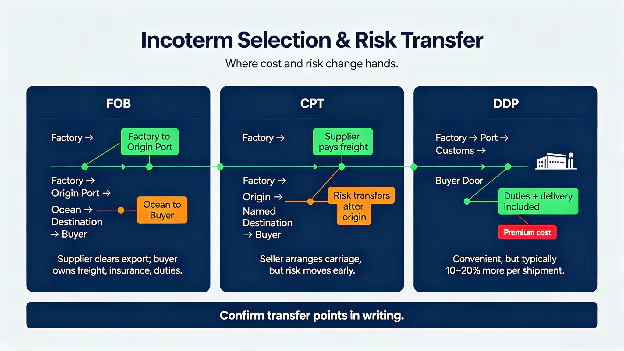
Why it matters: FOB, CPT, and DDP shift cost and risk to different points in the journey. Pick the wrong one and you'll underestimate what you actually owe.
FOB: You Own the Ocean Leg
Under FOB, the supplier's job ends once goods clear the origin port. Everything after — freight, insurance, duties — is yours to plan and pay.
CPT: Shared, But Watch the Fine Print
CPT means the seller pays freight to a named destination, but risk transfers to you once goods leave origin. That distinction matters if cargo gets damaged mid-route.
DDP: Convenience at a Premium
DDP bundles duties and delivery into the supplier's price. It's simpler, but usually 10–20% costlier per shipment than managing freight yourself — again, a rough industry estimate, not a fixed figure.
Criterion 3: Customs Duties and Trade Compliance
Why it matters: duty rates can swing 0% to 25%+ depending on the Harmonized Tariff Schedule (HTS) code assigned to your product. Misclassify it, and you're either overpaying or risking a compliance penalty.
Getting the HTS Code Right
Cross-check the code your freight forwarder assigns against official tariff schedules. Don't just accept whatever code the factory suggests — factories aren't customs brokers.
Checking for Additional Tariffs
Some categories carry extra duties layered on top of the base rate — anti-dumping measures or country-specific tariffs, for example. These stack, and they add up fast.
Red flag: a broker or forwarder who can't explain the duty rate in plain terms. If they can't justify the number, don't trust it.
Criterion 4: Freight Mode, Consolidation, and Hidden Fees
Why it matters: freight and accessorial charges are where most landed cost estimates fall apart. Port congestion, fuel surcharges, and demurrage fees rarely make it into a first-pass quote.
How to evaluate it: request an all-in freight quote that names every line item — origin handling, ocean/air freight, destination handling, chassis fees, and demurrage/detention. Ask specifically about consolidation options; combining multiple SKUs into one container often cuts per-unit freight cost meaningfully, though the exact savings depend on lane and volume.
Disqualifier: a freight quote with a single lump-sum number and no breakdown. That's a quote designed to hide surprises, not prevent them.
Criterion 5: Supplier Reliability and Quality Control Costs
Why it matters: a cheap unit price means nothing if 12% of the shipment fails inspection and gets rejected at the port. Rework, re-shipment, and chargebacks belong in your landed cost math too.
How to evaluate it: build in a per-unit QC line item — third-party inspection typically runs a modest flat fee per shipment, well worth it against the cost of a failed container. Factor in supplier verification history, on-time delivery rate, and defect rate from prior orders.
Red flag: no inspection budget at all. That's not lean sourcing — that's a gap waiting to become a loss.

*Photo by Kindel Media on Pexels*
Putting the Framework to Work
Here's how the scorecard looks applied to a real order — say, 5,000 units of a kitchenware SKU sourced FOB Ningbo.
| Criterion | Weight | Score (1–5) | Notes |
|---|---|---|---|
| Unit price/tiering | 25% | 4 | Tiered quote confirmed in writing |
| Incoterm clarity | 20% | 5 | FOB stated, freight quoted separately |
| Duty/HTS accuracy | 20% | 3 | Code unconfirmed — needs broker review |
| Freight/hidden fees | 20% | 4 | Full breakdown received, demurrage flagged |
| QC/supplier reliability | 15% | 5 | Verified factory audit on file |
A weighted score below 3.5 overall should stop the order until gaps get resolved. This isn't bureaucracy for its own sake — it's the difference between a landed cost projection and a landed cost surprise.
Working through this decision matrix on every new SKU takes maybe 20 minutes once you've built the template. That's cheap insurance against a miscalculated shipment. Teams managing OEM and ODM programs, supply chain coordination guides, or private-label consolidation runs tend to formalize this into a shared spreadsheet across sourcing and finance — worth doing before volume scales.
Bottom line: landed cost isn't one number, it's five. Price, Incoterm, duty, freight, and quality risk all have to clear the bar before an order makes sense on paper. Run the checklist, fill in the scorecard, and don't sign a PO until every line item has a real source behind it — not a guess. If you'd rather have a sourcing and quality control team run the numbers for you, request a landed cost quote before your next shipment goes out.