
How to Background-Check a Chinese Supplier?

A supplier background check isn't paperwork for paperwork's sake. It's the single step that separates a five-year manufacturing partnership from a wired deposit that vanishes. Buyers who skip it tend to find out the hard way — usually after the money's already gone. This article breaks down the numbers, the standards, and the actual process behind a real supplier background check, so you know what to ask for and why it matters.
Chinese Supplier Vetting: By the Numbers
Start with scale. China's General Administration of Customs reported roughly $3.38 trillion in exports for 2023, a figure widely cited across trade press covering GACC data. That's an enormous base of exporters — and not all of them are who they claim to be.
Registration data backs that up. China's State Administration for Market Regulation (SAMR) maintains a public credit registry, the National Enterprise Credit Information Publicity System, covering tens of millions of active companies. Cross-referencing a supplier's business license against this registry is step one of any real supplier background-check — and it's free.
Quality certification tells another story. The ISO Survey of Certifications has recorded China at the top for total ISO 9001 certificate counts for over a decade, with past published surveys showing more than 300,000 active certificates in the country — more than any other nation. That volume cuts both ways: real certification is common, but so is certificate fraud. Verification against the issuing certification body matters more than the PDF a supplier emails you.
Core Verification Metrics & Benchmarks
Not every check carries equal weight. Some are non-negotiable; others are supplementary. Here's how the major checkpoints stack up.
| Check Type | What It Confirms | Typical Data Source | Red Flag Threshold |
|---|---|---|---|
| Business license validity | Legal registration, scope of operations | SAMR national registry | License expired or scope excludes your product |
| Export license | Legal right to ship internationally | China Customs (GACC) | No export code on file |
| Factory audit score | Real production capacity, working conditions | Third-party audit report | Score below internal QC threshold |
| Financial health | Solvency, payment risk | Bank reference, credit report | Unpaid litigation, frozen accounts |
| Certification validity | ISO 9001, ISO 14001, product-specific marks | Certifying body database | Certificate not found in issuer's registry |
Five rows, five distinct failure points. Miss any one and the rest of your due diligence is decorative.
Business License & Registration Checks
Every legitimate Chinese manufacturer holds a business license issued by SAMR, listing registered capital, legal representative, and business scope. If the scope doesn't cover your product category, that's a real problem — not a technicality. It usually means you're dealing with a trading company posing as a factory.
Financial and Production Capacity Indicators
Registered capital numbers get thrown around a lot in sourcing conversations, and honestly, they're overrated on their own. Pair them with production floor size, staff headcount, and monthly output claims. If a "factory" claims 500 workers but the audit report shows a 2,000-square-meter space, do the math — that doesn't add up.
Standards & Regulatory Frameworks Behind Supplier Verification
Verification isn't guesswork. It leans on documented standards, and knowing the codes helps you ask sharper questions.
ISO Certifications to Confirm
ISO 9001:2015 covers quality management systems — the baseline most buyers request. ISO 14001 addresses environmental management, increasingly requested by apparel and packaging buyers under EU and U.S. sustainability pressure. Neither certificate means much unless it's checked against the certifying body's own database, not just the paper copy.
Customs & Trade Compliance Documentation
Import compliance runs on its own rulebook. U.S. Customs and Border Protection publishes detailed import guidelines covering entry requirements, tariff classification, and documentation — all worth reviewing before goods ever leave China. On the shipping-terms side, the ICC's Incoterms 2020 rules define FOB, CPT, and DDP obligations used in nearly every cross-border manufacturing contract. Get these definitions wrong in a purchase order and liability disputes follow.
Quality inspection also has a code. ANSI/ASQC Z1.4 defines the acceptable quality limit (AQL) sampling plans used across most third-party QC inspections — the framework behind "how many units get pulled and checked" on any given production run.
Cost & Trends Shaping Supplier Vetting in China
Money talks, and vetting costs money — but skipping it costs more.
What Verification Actually Costs
As a rough industry estimate, a single-day third-party factory audit in China commonly runs $300 to $1,200 depending on region, scope, and turnaround speed. That's a rule of thumb, not a fixed rate — remote provinces and rush requests push costs higher. Compare that to a lost deposit on a fraudulent order, and it's not close.
Where Fraud Risk Is Rising
Sourcing-industry forums and trade groups have anecdotally flagged a rise in "shell factory" listings on B2B marketplaces since 2021 — legitimate-looking storefronts backed by no real production capacity. There's no single authoritative count on this, but it's consistent enough across buyer complaints that it shouldn't be ignored. Frankly, the pattern tracks with the growth of online B2B sourcing volume itself: more listings, more noise, more impersonation attempts.
Here's a short list of the fraud patterns that show up most often in buyer complaints:
- Business license photos that don't match the registered company name
- Certificates listed under a different legal entity
- Bank accounts registered to individuals, not the company
- Refusal to allow a third-party audit before deposit
- Product photos reused across multiple unrelated storefronts
How to Run a Supplier Background Check, Step by Step
Order matters here. Skip a step and you'll pay for it later.
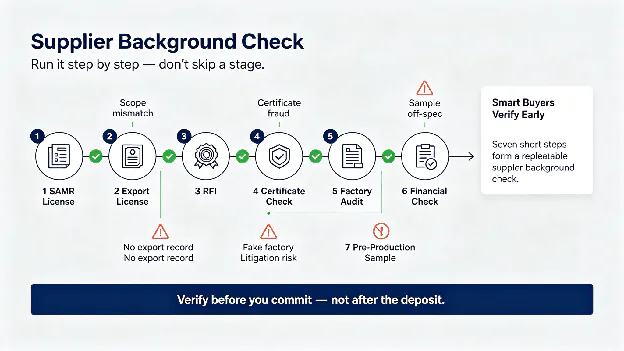
- Pull the SAMR business license and confirm registration status, scope, and legal representative.
- Request export license documentation and cross-check against China Customs records.
- Send a formal Request for Information (RFI) to gather capacity, certifications, and references before committing to samples.
- Verify every certificate — ISO 9001, ISO 14001, product-specific marks — directly with the issuing body.
- Schedule a third-party factory audit covering production lines, staff count, and working conditions.
- Run a financial check for litigation history, frozen accounts, or unresolved disputes.
- Order a pre-production sample and confirm it matches spec before locking a purchase order.
Seven steps. None of them optional if the order size matters.
Buyers managing this process directly often lean on a verified supplier network rather than starting from a cold marketplace listing — it shortens steps one through four considerably. Reviewing established supplier verification services before initiating first contact tends to catch problems earlier, when they're still cheap to walk away from.
Alternatively, you can directly hand over your requirements to ChinaSource for evaluation and verification, quickly matching you with suitable suppliers.
Background-Checking a Chinese Supplier's Documents and Site
A thorough background-check on a Chinese supplier goes beyond a paper license. Match the business license number against the SAMR registry first, then confirm the registered address exists as a real factory, not a residential unit or shared office. A short video audit or third-party on-site visit settles this quickly and cheaply. Pull export customs records where available; a factory with zero export history for your product category is a warning sign, not a formality. Check litigation and enforcement records through China Judgements Online, since unresolved disputes often surface there before a supplier discloses them. Bank reference checks, though harder to arrange, confirm operating history and financial standing beyond what a registration certificate can show. Each step is inexpensive on its own, but skipping any one of them is how buyers end up qualifying a trading company as a factory.
Key Metrics to Track After Onboarding
Verification doesn't end at contract signing. Ongoing tracking is what keeps a supplier honest over time.
- On-time delivery rate — track monthly; anything under 90% deserves a conversation.
- AQL inspection pass rate — per ANSI/ASQC Z1.4 sampling, consistent failures signal a process problem, not a one-off.
- Certificate renewal dates — ISO certifications expire; a lapsed cert with no renewal on file is a red flag.
- Payment and credit terms compliance — late invoicing or sudden term changes often precede bigger issues.
- Business license status — re-check annually; licenses do get revoked.
Bottom line: a supplier background check isn't a one-time gate — it's a recurring discipline. The buyers who track these metrics quarterly catch problems in weeks instead of after a container's already at sea. For sourcing teams building this into standard practice, it helps to read up on current verification and quality-control approaches and to line up a direct inquiry with a sourcing partner before the next production run gets scheduled.